InSight detects 5 magnitude Martian quake, the largest detected so far

The seismometer deployed by the Martian lander InSight has now detected its largest quake yet on Mars, with an estimated magnitude of 5.

NASA’s InSight Mars lander has detected the largest quake ever observed on another planet: an estimated magnitude 5 temblor that occurred on May 4, 2022, the 1,222nd Martian day, or sol, of the mission. This adds to the catalog of more than 1,313 quakes InSight has detected since landing on Mars in November 2018. The largest previously recorded quake was an estimated magnitude 4.2 detected Aug. 25, 2021.

The timing was very fortunate. Only three days later the power being generated by InSight’s dust-covered solar panels dropped too low, and the lander went into safe mode. Though its mission has been extended through the end of this year, the inability of the solar panels to produce energy because of dust has been predicted to shut down operations sooner. While it might be possible to restart science operations, this most recent safe mode situation could very well be that moment.

Meanwhile, scientists will analyze the data of this most recent large quake to attempt to pinpoint its location. They will also study it to gain a better understanding of the interior structure of Mars.

1 comment

Momentus gets final launch permits for its space tug

Capitalism in space: After a year delay due to government security concerns, Momentus has finally gotten all the launch permits required for a launch later this month on a Falcon 9 of its space tug, Vigoride, on its first orbital test flight.

In late April Momentus had gotten FCC approval. Now it has gotten clearance from the FAA. The FAA had blocked last year’s launch because of security concerns related to the foreign connections of several of the company’s founders/investors. Those individuals have now left the company, clearing the way for license approval.

The delay however caused Momentus to lose several customers while allowing another space tug competitor, Launcher, to catch up.

1 comment

South Korea’s new president wants bigger space effort closely tied to U.S.

The new president of South Korea, Yoon Suk-yeol, has made it clear that when he takes office today his policy will be to expand that nation’s space effort while tying that effort more closely with NASA and the U.S. military.

[His goals] include establishing an independent aerospace agency offering integrated management of civil and military space programs in Sacheon, South Gyeongsang Province, home to nearly 100 aerospace companies, and developing a high-power rocket for independent satellite launches in the near term and lunar and Mars exploration in the long-run.

…Yoon has also promised to facilitate the public-to-private transfer of space technologies, reform regulations and launch a space industry cluster to grow the country’s nascent domestic space industry. In line with this, the science ministry recently selected five universities that will be subsidized $4 million each over the next five years in return for running education programs designed to nurture skilled space engineers.

“Countries jockey for position in the space industry to secure a competitive edge in national security and future competitiveness,” Yoon wrote in his election manifesto, pledging to make South Korea “one of seven most advanced space powers in the world by 2035.”

However, the first space-related task of Yoon’s adminstration, which merely accelerates what the previous South Korean government had been doing, will likely be to replace the Russian rockets that South Korea presently has contracts with to launch several satellites.

1 comment

Astra signs deal to launch from SaxaVord Spaceport in Shetland

Capitalism in space: Astra today announced an agreement with the SaxaVord Spaceport in the Shetland Islands to begin launches from that United Kingdom location, beginning in 2023.

These launches will be the first by Astra outside the U.S. It is the second American company to sign on with SaxaVord, with Lockheed Martin’s ABL rocket company smallsat startup planning its own first launch there later this year. SavaVord also has a launch deal with a French company, Venture Orbital Systems, which hopes to launch later this decade.

None of these however could be the first launch from the United Kingdom since the 1960s. Virgin Orbit has a deal to launch from a runway from a Cornwall airport later this year. Furthermore, the rocket company Orbex is planning to launch its Prime rocket from a differenct spaceport in Sutherland, Scotland.

1 comment

Yawn: Rogozin tweets threats to Musk, Musk shrugs

In yesterday’s non-news Dmitry Rogozin, the head of Roscosmos which runs Russia’s entire aerospace industry, issued a threat against Elon Musk for supplying the Ukraine Starlink service in its war against the Russian invasion, and Musk responded with an almost cheerful quip.

On Sunday (May 8), Musk posted on Twitter a note that he said Rogozin, the head of Russia’s federal space agency Roscosmos, had sent out to Russian media. The note claimed that equipment for SpaceX’s Starlink satellite-internet system had been delivered to Ukrainian marines and “militants of the Nazi Azov battalion” by the U.S. military. “Elon Musk, thus, is involved in supplying the fascist forces in Ukraine with military communication equipment,” Rogozin wrote, according to an English translation that Musk posted. (He also tweeted out a Russian version.) “And for this, Elon, you will be held accountable like an adult — no matter how much you’ll play the fool.”

This sounds very much like a threat, as Musk acknowledged in a follow-up tweet on Sunday. “If I die under mysterious circumstances, it’s been nice knowin ya,” he wrote. Musk’s mom, Maye, didn’t appreciate that glib response, tweeting, “That’s not funny” along with two angry-face emojis. The billionaire entrepreneur responded, “Sorry! I will do my best to stay alive.” (It was Mother’s Day, after all.)

Musk’s light-hearted response only stands to reason, considering Rogozin’s loud-mouthed track record. Nothing he says really matters, so why should Musk care that much. Musk probably posted Rogozin’s comments out of amusement more than anything else..

8 comments

China launches Tianzhou freighter to space station

The new colonial movement: China today successfully used its Long March 7 rocket to launch a new Tianzhou unmanned cargo freighter to its Tiangong space station.

The cargo is for the station’s next crew, scheduled to launch in June for a six month mission, during which two new large modules will be added to the station.

The launch took place at China’s sea coast Wenchang spaceport, so its expendable lower stages all fell harmlessly in the ocean.

The leaders in the 2022 launch race:

18 SpaceX
15 China
6 Russia
3 Rocket Lab
2 ULA

U.S. private enterprise still leads China 26 to 15 in the national rankings, as well as the entire world combined 26 to 24.

1 comment

Pushback: Lawsuit forces Rhode Island to let oral surgeon to reopen his practice

Oral surgeon Stephen Skoly, blackballed by Rhode Island

Today’s blacklist story is an update from a story in February, where I outlined how the Rhode Island health department had irrationally shut down the practice of oral surgeon Stephen Skoly — denying 800 patients dental treatment and putting ten employees out of work — simply because Skoly had refused to get the COVID jab for valid medical reasons, including the fact that he had already gotten the Wuhan flu, had anti-bodies, and had other health issues that made getting the shot ill-advised.

Skoly had sued Rhode Island’s governor, Democrat Daniel McKee, as well as the head of the state’s health department, James McDonald. It now appears the lawsuit had some positive impact:

In March 2022, after over five months of suspension, and three days before a court hearing where medical experts were to testify to the irrationality of Rhode Island’s conduct, Rhode Island finally relented. It agreed to treat the N95 masked Dr. Skoly the same as other unvaccinated N95 masked workers. Dr. Skoly was permitted to re-assemble his ten-person dental team and return to practice.

The lawsuit, filed on behalf of Skolly by the New Civil Liberties Alliance, has not been abandoned, and instead has been expanded because of the state’s decision to deny Skoly unemployment benefits.
» Read more

5 comments

Curiosity climbing out of Gordon Notch hollow

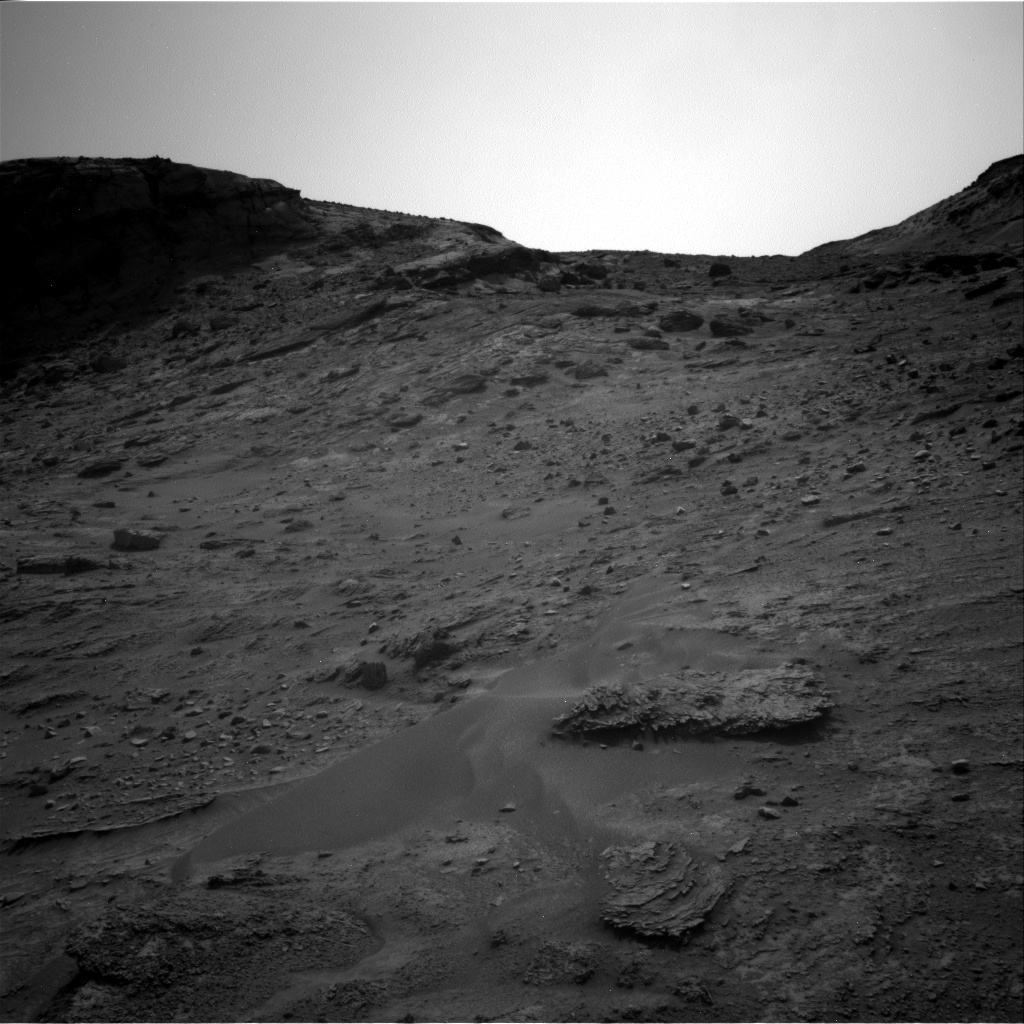
Panorama showing the upcoming steep climb
Click for full image. For original images go here, here, here, here, and here.

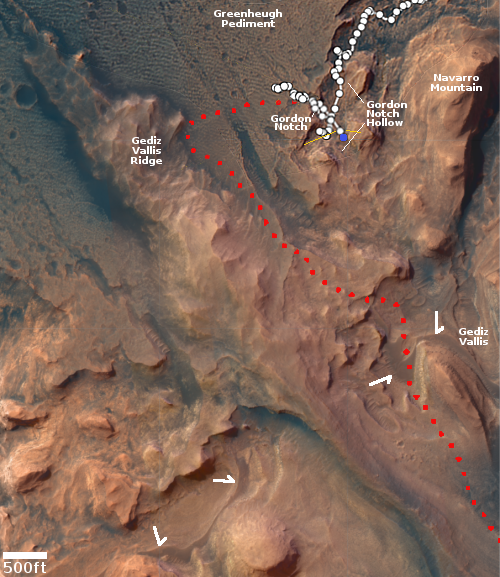
Overview map
Click for interactive map.

Cool image time! The panorama above was created from five photos taken by Curiosity’s right navigation camera on May 4, 2022 as the rover worked its way upward out of Gordon Notch Hollow, the small valley it had left when it attempted to cross the Greenheugh Pediment to the west and was forced to retreat back into when engineers found the rough terrain on the pediment too much for the rover’s wheels.

The overview map to the right provides context. The blue dot marks Curiosity’s present position on Mars, on its 3,465 Sol since landing. The yellow lines mark the area viewed in the panorama, taken two Sols earlier. The red dotted line marks the original planned route, now abandoned. The white arrows indicate one of the more interesting upcoming geological features, dubbed by scientists the “marker horizon,” a distinct layer found in many places on the flanks of Mount Sharp.

On the panorama above the red dotted line is my guess as to the planned route out of Gordon Notch Hollow.
According to the science team’s most recent update on May 4th:
» Read more

0 comments

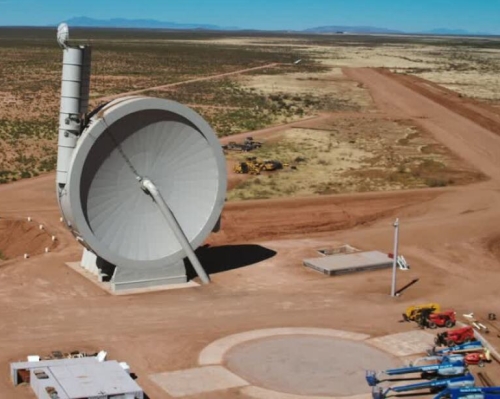
The payload’s view during a Spinlaunch test

Spinlaunch prototype suborbital launcher
Spinlaunch’s prototype launcher

Capitalism in space: Spinlaunch has released a video showing what a Spinlaunch test launch looked like from the payload’s perspective.

I have embedded that video below. This was the company’s eighth test launch, all of which appear to have only gotten to about 30,000 feet or so. The payload camera does not turn on until the payload has been released and is ascending upward. Try to ignore the dramatic music, which of course is nothing but fake PR.

Three things are revealed. One, the acceleration at launch quickly drops as the payload ascends. Second, the payload’s wild spin appears intended, to help stabilize its flight. Third, its descent is slow, suggesting the release of parachutes.
» Read more

2 comments

China releases to the public some of the datasets from the Chang’e-5 lunar mission

China announced today that it has made available to the public the data from some of the instruments that flew on its November 2020 Chang’e-5 sample return lunar mission.

The instruments involved were the mission’s landing camera, panoramic camera, lunar mineralogical spectrometer, and regolith penetrating radar.

The data is supposedly available here, but you have to be able to read Chinese to find it.

2 comments

Chinese pseudo company Linkspace to try suborbital vertical rocket test this year

The Chinese pseudo-company Linkspace announced in a press release May 5th that it will attempt to vertically launch and land a first stage booster to suborbital space before the end of the year.

The rocket will later be transported to Lenghu in the northwestern Chinese province of Qinghai, the site of LinkSpace’s earlier tests. The team aims to launch the 47.5-foot-tall (14.5 meters) RLV-T6 to an altitude of around 62 miles (100 kilometers) and land it safely using landing legs and grid fins, similar to the way that the first stage of SpaceX’s Falcon 9 rocket touches down.

The rocket to be tested is almost exactly the same height as SpaceX’s Falcon 9 first stage, so apparently this test will be a test of a full scale prototype of Linkspace’s own first stage. If successful, the company will be able to soon followup with reusable launches.

Linkspace had performed small scale vertical rocket tests three years ago, and then disappeared for unknown reasons. Its reappearance now suggests the Chinese government has approved its effort and will thus allow it to go forward.

Note: I call all the so-called private companies coming out of China “pseudo” because none function like an independent company privately owned. They might raise Chinese investment capital and work to earn profit, but anything they design or build is closely determined by the communist Chinese government. None builds anything without that supervision, and should the government change its mind the company will quickly be shut down.

0 comments
1 128 129 130 131 132 192