Today’s blacklisted American: Professor’s suspension for having an opinion now more than 100 days long, with no end in sight

Georgetown University: No free speech allowed

They’re coming for you next: The suspension by Georgetown University of Ilya Shapiro from his position as executive director for the Georgetown Center for the Constitution because he posted a tweet critical of Biden’s most recent Supreme Court nomination is now more than 100 days long, with no clear end date.

Shapiro’s tweet, now deleted, had noted the Biden administration’s decision to make race and gender more important than a judge’s legal qualifications in picking Ketanji Brown Jackson for the Supreme Court was a bad mistake. For that crime, Georgetown University put him on administrative leave while it conducted “an investigation.”

It is now more than three months later, and the university not only has not completed this faux investigation, which really has nothing to investigate as all the facts are plainly visible for all to see, it apparently has no intention of telling anyone when the investigation will end:
» Read more

35 comments

Are the COVID vaccines killing people over time? The data suggests yes.

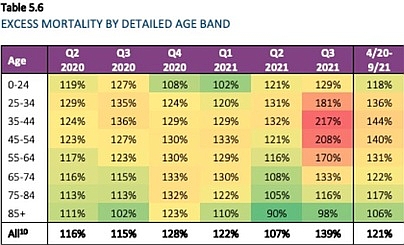
Excess mortality by age

While overall the risk of getting the COVID shots is quite small, the data is increasingly suggesting that these shots might have some very serious long term consequences. The graph to the right, taken from a January 2022 report [pdf] of the Society of Actuaries Research Institute and first spotted by Dr. Aaron Kheriaty, indicates a shocking and inexplicable increase in mortality among the nation’s young. As noted by Thomas Lifson at American Thinker:

Something is killing off large numbers of 25- to 54-year-olds in the United States, and the powers that be in government and the media are pretending it is not happening. There is no visible effort to study the alarming statistics gathered by actuaries for the life insurance industry, which keeps track of deaths because they directly impact their bottom line through claims from the insured. [emphasis in original]

These deaths are not Wuhan flu deaths. However, the sudden rise of mortality from many other causes among the young in the third quarter of 2021, only a short time after the majority of the population had been given the COVID shots, is significant and strongly suggests the shots have something to do with this.

That supposition is further strengthened by another story today:

AIDS-related Diseases & Cancers reported to VAERS increased between 1,145% and 33,715% in 2021

For clarity, these AIDS-related deaths are not related to the HIV virus. Acquired immunodeficiency (AIDS) can occur for many reasons, and when it does the victim then can die from many other diseases or cancers, because his or her body can no longer fight them off.

Below is the most pertinent graph from that story, created by The Exposé directly from publicly available CDC data.
» Read more

22 comments

NASA corrupt safety panel once again blathers on

The corrupt safety panel at NASA that spent years slowing down SpaceX’s manned Dragon capsule development with sometimes absurd demands, including delays caused simply because of paperwork, is now demanding that NASA should slow its approval of Boeing’s Starliner capsule, even if its unmanned demo mission next week succeeds completely.

This quote from the article best illustrates this safety panel’s do-nothing bureaucratic view of the world:

A further concern is that Starliner uses the United Launch Alliance (ULA) Atlas V rocket to get to orbit, but Atlas Vs are being phased out. ULA is building a new rocket, Vulcan, that could see its first launch late this year, but must go through a “human-rating” certification process that [panel member David] West said “could take years” for Starliner. [emphasis mine]

Every demand of this panel for years has demanded years of delays, with many having nothing to do with technical safety — the panel’s original purpose — but with management questions and the panel’s own overblown opinion of itself. Worse, some of its demands never made sense, such as its objection to SpaceX’s launch procedures where it fueled the rocket after the astronauts got on board. This quote from an earlier post about the panel’s recent inappropriate attempt to insert itself into NASA’s policy decisions sums things up well, and provides links to previous failures of the panel:

This panel continues to demonstrate its corrupt and power-hungry attitude about how the U.S. should explore space. For years it did whatever it could to stymie NASA’s efforts to transfer ownership to the private sector, putting up false barriers to the launch of SpaceX’s manned Dragon capsule that made no sense and were really designed to keep all control within the government bureaucracy.

It is now targeting Boeing, though amazingly it is only doing it after many of Starliner’s technical problems have been uncovered. The safety panel was a complete failure in spotting the company’s problems early on, several years ago, when it might have saved everyone a lot of time and money. Instead, it now acts like an annoying back seat driver, only kibitzing about things that went wrong long after everyone else has done the work.

I have been saying for years that it is time to shut this panel down. It is now long past time to do so. The time and money saved might actually improve safety far more than the panel ever has.

9 comments

Astra reveals vague details about its next larger rocket

Capitalism in space: In a public event in California yesterday Chris Kemp, CEO of the rocket startup Astra, revealed some vague details about the company’s new larger rocket, dubbed Rocket 4.0.

The vehicle will be able to place up to 300 kilograms into low Earth orbit and 200 kilograms into sun-synchronous orbit at a “base price” of $3.95 million. By contrast, Astra’s current Rocket 3.3 vehicle can accommodate a small fraction of that payload, having to date launched only a few cubesats at a time.

…The biggest change in the rocket is its first stage propulsion. While Rocket 3.3 uses five of Astra’s Delphin engines, generating a combined 35,000 pounds-force of thrust, Rocket 4.0 will use two larger engines that produce a combined 70,000 pounds-force of thrust.

Kemp’s presentation however did not reveal whether Astra is building it or whether the company is buying it from someone else. He did say the company does not plan to attempt ot reuse any portion of Rocket 4.0, saying that the economics did not work for Astra.

His presentation also suggested a first launch for late this year, using a mission control made up of only two people, what he called “a pilot and a co-pilot.”

2 comments

Chinese pseudo company Ispace experiences another launch failure

The Chinese pseudo company Ispace today had another launch failure of its Hyperbola rocket, the third in four launch attempts.

It appears the cause was a failure of the rocket’s second stage to ignite after stage separation.

Ispace’s first launch of Hyperbola 2019 successfully reached orbit, making it the first and still only Chinese pseudo-company to reach orbit. Since then however the rocket has failed three consecutive times, each for what appears to be different reasons.

The rocket itself has four-stages, all using solid fuel motors, which means the rocket is derived from military missile technology. This also illustrates why Ispace is a pseudo company. It might be financed by private capital, and be attempting to make profits on commercial and government contracts, but everything about it only exists because it has government permission and supervision.

Furthermore, while it is entirely possible for a startup to survive such a string of failures, the possibility is small. In most cases a purely private company would lose customers and investment capital. Ispace’s survival up to now suggests the Chinese government wants it to succeed, and in that sense is acting as its owner.

1 comment

Scientists grow plants in lunar soil brought by from Apollo missions

In their first attempt, scientists have successfully grown plants in a small lunar soil sample brought by astronauts during the Apollo missions.

Researchers at the University of Florida had spent 11 years requesting permission from Nasa to borrow some of the lunar dust brought back by astronauts on the first manned Apollo 11 and Apollo 12 missions in 1969 and the Apollo 17 mission in 1972. Armstrong and Aldrin brought back 21.6kg of material including 50 rocks, samples of dust and two cores of rock after boring 13cm down into the Moon’s surface. They contained no water and no signs of life.

…The lunar samples are deemed to be of “incalculable historical and scientific significance”, so the scientists were given only 12 grams, just a few teaspoons’ full, to work with and had to design a miniature experiment.

The researchers used thimble-sized wells in a dish usually used for growing cells as miniature plant pots and filled each with about one gram of lunar soil. They moistened the soil with water and a solution of nutrients and added a small number of seeds from the Arabidopsis thaliana plant, a common flowering weed also known as mouse-ear or thale cress. [emphasis mine]

The plants grew, but were smaller and took longer to grow then plants on even the most extreme environments on Earth. The scientists also found that plants did better in buried lunar soil then the material on the surface that had been exposed to the harsh radiation of space, suggesting that plowing the soil before planting will enhance growth.

The highlighted words in the quote above illustrate the madness of NASA’s bureaucracy. These lunar samples were brought back so that scientists could study it, not so that it could be locked away in a vault forever never to be touched. To make this very intelligence experiment wait 11 years before getting permission is absurd.

12 comments

SpaceX CEO: Starship could launch as early as June

Capitalism in space: SpaceX’s CEO and president Gwynne Shotwell revealed today that Starship could be ready for its orbital test flight from Boca Chica as early as June, though government regulatory obstacles make that launch more likely three to six months from now.

It appears that the delays in getting FAA approval for launch have not been the only issues that have delayed that first launch attempt. Though SpaceX would have likely tried a launch months ago with earlier prototypes had the approval arrived as originally promised, that launch would have likely failed based on ground tests the company has been doing during the delay.

When Musk tweeted his “hopefully May” estimate, SpaceX was nowhere close to finishing the Starship – Ship 24 – that is believed to have been assigned to the orbital launch debut. However, SpaceX finally accelerated Ship 24 assembly within the last few weeks and ultimately finished stacking the upgraded Starship on May 8th. A great deal of work remains to truly complete Ship 24, but SpaceX should be ready to send it to a test stand within a week or two. Even though the testing Ship 24 will need to complete has been done before by Ship 20, making its path forward less risky than Booster 7’s, Ship 24 will debut a number of major design changes and likely needs at least two months of testing to reach a basic level of flight readiness.

A more likely launch date is probably late July at the earliest, though of course that will also depend on the government’s approval, something that presently appears difficult to get.

5 comments

Zhurong data suggests a more watery Martian environment more recently that previously thought

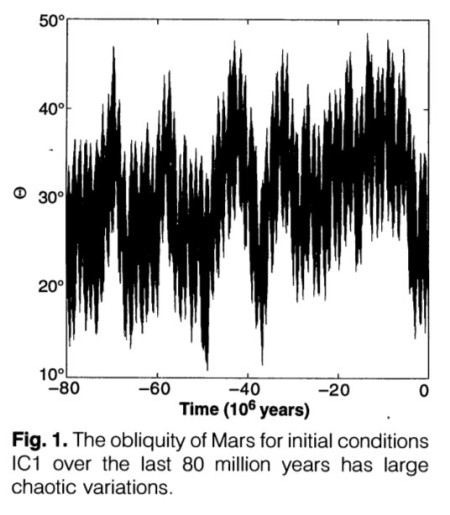
The Martian obliquity over the past 80 million years
The graph comes from this paper [pdf], and shows the shift of Mars’
rotational tilt, or obliquity, for the past 80 million years.

Scientists analyzing data obtained by China’s Zhurong rover during its first four months on Mars have concluded that the Martian atmosphere in the northern lowland plains of Utopia Planitia has been more active hydrologically much more recently than previously believed.

You can read the paper here. From its conclusions:

Unlike the weak and friable thin veneer or crusty clods at previous landing sites for Mars Exploration Rovers and InSight lander, these rocks are more akin to the fractured duricrust observed at the Viking Lander 1 site. The thin and brittle layer of duricrust has been proposed to form by salt cementation via water vapor diffusion from the atmosphere. In contrast, duricrusts at Zhurong landing site appear to be more resistant to erosion, forming cliffs perched through loose soils in the surroundings, which require a substantial amount of liquid water rather than water vapor.

…The morphology and spatial extent of platy and bright-toned rocks investigated by the Zhurong rover argue for in situ formation and degradation of these rocks in the Amazonian-aged geological unit in southern Utopia Planitia. These observations suggest that aqueous activities may have persisted much longer than previously thought. Periodical climate cycles on Mars driven by obliquity oscillations are expected to result in a latitude-dependent distribution of ground ice over geologic history. Higher obliquities (>45°) could mobilize polar ice and form glaciers and water ice sheets at midlatitudes and stabilize ground ice at Zhurong landing site for extended periods of tens of thousand years when the obliquity exceeded 29° to 33°. The hydrated minerals and widespread salt cementations imply the presence of briny liquid water in the subsurface, which may have been generated by melting the ground ice during temporary climate perturbations (e.g., volcanism and impacts).

Obliquity refers to the planet’s rotational tilt, which fluctuates from 11 to 65 degrees, and is presently tilted at 25 degrees, only slightly different than Earth’s 23 degree tilt. Since Mars’ obliquity has exceed 29 degrees numerous times in the past 80 million years, as shown by the graph above, that means it was possible that this now dry equatorial region on Mars had seen plenty of surface water or ice as recently as a few million years ago, far more recently than the three billion years previously estimated.

For liquid water to have existed on the surface is still difficult, because Mars’ atmosphere would have been too thin and cold. However, if ice sheets had existed here, there is the possibility that the ice would have become liquid at the sheet’s base, and interacted with the ground in some manner to produce the duricrust now observed.


1 comment

First radio image of event horizon of Milky Way’s central black hole

Sagittarius A*
Click for full image.

Using an array of eight radio telescopes worldwide, dubbed the Event Horizon Telescope because its purpose is to study black holes, scientists have obtained the first radio image of the event horizon of Sagittarius A* (pronounced “A-star”), the supermassive black hole at the center of the Milky Way.

The image to the right, reduced to post here, is that photo.

The image is a long-anticipated look at the massive object that sits at the very centre of our galaxy. Scientists had previously seen stars orbiting around something invisible, compact, and very massive at the centre of the Milky Way. This strongly suggested that this object — known as Sagittarius A* (Sgr A*, pronounced “sadge-ay-star”) — is a black hole, and today’s image provides the first direct visual evidence of it.

Although we cannot see the black hole itself, because it is completely dark, glowing gas around it reveals a telltale signature: a dark central region (called a “shadow”) surrounded by a bright ring-like structure. The new view captures light bent by the powerful gravity of the black hole, which is four million times more massive than our Sun.

This is the second supermassive black hole that the Event Horizon array has imaged. In 2019 it captured the central black hole of the galaxy M87, 55 million light years away. Like that first image, much of what we see here is created by computer, since the data from the eight radio telescopes needs to be massaged to create something as smooth and as complete as this.

9 comments
1 126 127 128 129 130 192