Boeing and Aerojet Rocketdyne fight over cause of Starliner valve problem

In a Reuters story today, it was revealed that Boeing and Aerojet Rocketdyne are in a fight over the cause of Starliner valve problem, where thirteen valves failed to work and caused the scrub of a launch attempt last summer, delaying almost a year to next week.

A team of Boeing and NASA engineers is in general agreement that the cause of the stuck valves involves a chemical reaction between propellant, aluminum materials and the intrusion of moisture from Starliner’s humid Florida launch site.

Aerojet engineers and lawyers see it differently, blaming a cleaning chemical that Boeing has used in ground tests, two of the sources said.

It appears that Aerojet is attempting to put the blame on Boeing because it might be liable for the cost of redesigning the valves, as well as other costs associated with the delays since last year.

The article also reveals that the valves being used in the Starliner capsule to be launched next week have only a temporary fix for the problem, and that Boeing intends to redesign them to prevent the problem in the future.

All in all, this whole fiasco does not speak well for either Boeing or Aerojet. It remains completely inexplicable for any spacecraft to be built with this kind of valve problem, now, after six decades of launches from wet and humid Florida. The problem reeks of bad design or poor quality control procedures by both companies.

The article further confirms these quality control problems by this tidbit in its last paragraph:

In 2017, Starliner had an accident during a ground test that forced the president of a different subcontractor to have his leg medically amputated. The subcontractor sued, and Boeing subsequently settled the case.

That this accident has been kept out of the news is somewhat shocking. For it to happen at all reveals a lot about the sloppy way Boeing operates these days.


9 comments

Mountains, Mesas, and Box Canyons on the floor of Valles Marineris

Mountains, Mesas, and Box Canyons
Click for full image.

Overview map

Cool image time! The photo above, cropped, reduced, and rotated to post here, was taken on March 12, 2022 by the high resolution camera on Mars Reconnaissance Orbiter (MRO). It shows a small section of the floor of the giant 2,550-mile-long and 400-mile-wide Valles Marineris canyon on Mars. In fact, this section, as indicated by the black rectangle in the overview map below, is practically in the center of the canyon, at its widest point.

The geology here hints at several Martian processes. The mesas and closed canyons in the north are typical of chaos terrain, where it erosion appears to form along fault lines to create the random intersecting canyons. In other places on Mars, in the mid-latitudes, that erosion appears mostly formed by glacial activity. Here, in Valles Marineris at only 7 degrees north latitude, little ice had been expected.

However, this spot is also in the dead center of a region where orbital data from Europe’s Trace Gas Orbiter (TGO) suggests there is a surprisingly large underground reservoir of hydrogen, which is assumed could only exist if it was locked in water molecules.

In fact, at this spot the data suggests up to 40% of the near-surface material might be composed of water (by weight). If so, that underground reservoir of ice could be causing the erosion that is creating this massive chaos terrain.

Meanwhile, the light-colored mountain in the south is the westernmost nose of a 50-mile-long ridgeline coming down from the canyon’s rim, about 30,000 feet higher. Its dendritic nature, like the hollows that form in the mountains of wet regions on Earth, suggest rainfall and water flowing downhill, wearing away these hollows over eons.

Rain however is almost certainly not the cause. Instead, we could be seeing erosion from wind, or maybe dry ice snow that fell long ago when this region was at a higher latitude when Mars’ rotational tilt was different.

Either way, the massive geology here illustrates the monumental nature of this largest canyon in the solar system, as well as the difficulties of exploring it.

1 comment

The evidence keeps pouring in showing the utter failure of all COVID mandates

Since March 2020 I have repeatedly written that the response to the Wuhan flu was an utter mindless panic that had little to do with the facts. Right off the bat, the facts, not the models, suggested the virus would resemble the flu most of all, a possible mortal threat to the sick and elderly but generally nothing more than a short sickness to the general population, with it being almost utterly harmless to the young.

Nothing that has happened since has really changed these early conclusions. I have compiled below a collection of recent studies and reports that illustrate what we have learned following the epidemic and the panic that accompanied it. Sadly, that panic did little to stop the virus, but it left us with destroyed businesses, a crushed economy, many uneducated and damaged children, and a broken Bill of Rights.

The COVID jab

The failure of the jab in the United Kingdom
Study from November 2021showing the overall uselessness of the jab
in the United Kingdom last year.

The first set of stories show some recent studies analyzing the effectiveness and safety of the COVID shots, which are not vaccines because they simply do not prevent you from getting the virus. At best — though not yet proven — they might reduce the severity of the disease should you get it. The data however now suggests that though the overall risks are not large, the jab carries enough risk that in many cases, it makes no sense to get it. To require it, as many governments and businesses have done, is downright stupid and immoral. To fire nurses and doctors for refusing the shots is beyond stupid or immoral. It is evil.

Worse, these facts were known right from the initial tests, as the last story below shows. In the company’s initial trials they found that 1,223 people died within the first 28 days after taking the Pfizer shot. Such a result in past drug trials would have made impossible the approval of that drug.
» Read more

22 comments

Pushback: Arizona parents sue over school board’s attempt to silence and intimidate them

Owned by government
What the Scottsdale school board apparently thinks of your kids.

Today’s pushback story is another follow-up of an earlier blacklist story that I posted in November 2021. At that time several parents with students in the Scottsdale Unified School District (SUSD) had discovered that the then school board president Jann-Michael Greenburg had, with the aid of his parents, compiled a secret Google drive containing personal information of 47 parents, including social security numbers, financial information, pictures of themselves and their children.

The discovery occurred because Greenburg had begun using this information to intimidate the parents — who had been protesting the school board’s mask mandates and the introduction of the racist critical race theory into the curriculum.

Three of those parents are now suing Greenburg, his parents Mark Alan and Dagmar Greenburg, and the Scottsdale school district.
» Read more

11 comments

Virgin Orbit to expand its fleet of 747s used with its LauncherOne rocket

Capitalism in space: Virgin Orbit has signed a deal with L3 Harris Technologies to buy two more 747s airplanes to airlift its LauncherOne rocket during launches.

L3Harris will modify one of the newly acquired aircrafts to serve as an additional airborne launch pad for Virgin Orbit’s small satellite launch service, with delivery expected in 2023. L3Harris will also overhaul the platform with a new cargo configuration, which is expected to allow Virgin Orbit to deliver its rockets and ground support equipment in the same aircraft that will launch from foreign spaceports.

The companies previously collaborated to produce Virgin Orbit’s flagship aircraft “Cosmic Girl,” the first customized 747-400 aircraft to carry and deploy payloads to Low Earth Orbit under Virgin Orbit’s LauncherOne program.

This deal once completed will give Virgin Orbit a fleet of three 747s for launching its rocket. The deal also suggests the company now has enough launch business to justify this expansion.

6 comments

Orbex unveils a full-scale prototype of its Prime smallsat rocket

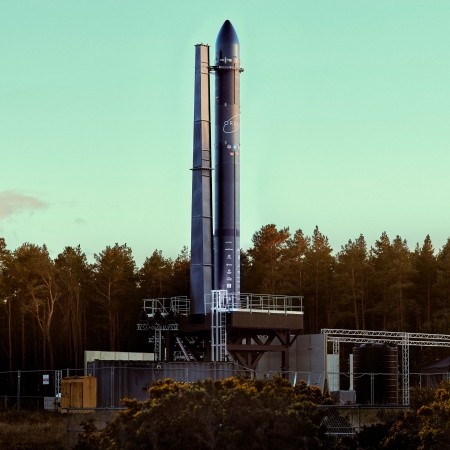
Prime rocket prototype on launchpad

Capitalism in space: Orbex today unveiled a full-scale prototype of its Prime smallsat rocket, positioned on its own launchpad at the Sutherland Space Hub spaceport in Scotland, now under construction.

The photo to the right shows that prototype, held vertical with its own strongback. From the press release:

With the first full integration of the Orbex rocket on a launch pad now complete, the company is able to enter a period of integrated testing, allowing dress rehearsals of rocket launches and the development and optimisation of launch procedures. Orbex recently revealed their first test launch platform at a new test facility in Kinloss, a few miles from the company’s headquarters at Forres in Moray, Scotland.

Note that Sutherland Space Hub is not the SaxaVord Shetland Island spaceport also being developed in Scotland. The two are competing with each other to successfully complete the first launch from the United Kingdom in history. Also competing for this honor is an airport in Cornwall, which has a deal with Virgin Orbit to do its own launch later this year. And regardless who wins this race, the three sites will likely give the UK the first European-based spaceports in history.

The United Kingdom’s decision in 2016 to shift from a single government-run spaceport to competition and capitalism appears to be now finally paying off.

6 comments

The future factions in space become clearer

Based on two stories yesterday, it appears that the future alliances between nations in space are now beginning to sort themselves out.

First there was the signing ceremony announcement of Columbia becoming the nineteenth nation to sign the Artemis Accords with the U.S. and the third Latin American country to do so.

The Artemis Accords were created by the Trump administration as an international treaty to bypass the restrictions on private property imposed by the Outer Space Treaty. By signing bilateral agreements with as many nations as possible, the U.S. thus creates a strong alliance able to protect those rights in space.

The full list of signatories so far: Australia, Bahrain, Brazil, Canada, Columbia, Israel, Italy, Japan, Luxembourg, Mexico, New Zealand, Poland, Romania, Singapore, South Korea, the United Kingdom, the United Arab Emirates, the Ukraine, and the United States.

In the second story, France and India — both of whom have so far resisted signing the Artemis Accords — announced their own bilateral agreement intended to strengthen their partnership across many fronts, from security to economic development to the Ukraine war. The agreement also included this paragraph on the subject of space:
» Read more

7 comments

Today’s blacklisted American: College in Illinois establishes black-men-only academy, no others need apply

Academia: dedicated to segregation!
Oakton Community College: dedicated to segregation!

“Segregation today, segregation tomorrow, segregation forever!” Oakton Community College, a small college in the Chicago area, has now established a special academy for black men only, dubbed the Emory Williams Academy for Black Men.

From the academy’s website:

As a member of the Academy, you will join a community designed for Black male-identifying students who are on a journey to advance their education and achieve their goals. Whether you want to earn your associate degree and transfer to a four-year school or kick-start a career with training, the Academy will meet you where you are and help you thrive.

The Academy is led by dedicated Black faculty and staff. You’ll be supported every day by a group of committed professors and student-success coaches—and your fellow scholars. [emphasis mine]

That website also describes its values like so:
» Read more

13 comments

Scientists propose new theory to explain mysterious slope streaks on Mars

Slope streaks on Mars
Click for full image.

In a paper published earlier this month, scientists have proposed a new theory to explain the the origin of slope streaks on Mars, a unique Martian geological feature that at first glance look like a stainlike avalanches which also appear to do nothing to change the surface topography. (See earlier posts here and here for a description of this strange Martian phenomenon.)

Essentially, data from the orbiters suggests that carbon dioxide frost develops just under the surface during the night. In equatorial regions this frost mixes with dust (allowing it to exist even in these warmer climates). When the morning light hits the frost it causes it to sublimate away, which in turn causes the appearance of slope streaks as the dust is released from the frost.

From the paper’s abstract:

At sunrise, sublimation-driven winds within the regolith are occasionally strong enough to displace individual dust grains, initiating and sustaining dust avalanches on steep slopes, forming ground features known as slope streaks. This model suggests that the CO2 frost cycle is an active geomorphological agent at all latitudes and not just at high or polar latitudes, and possibly a key factor maintaining mobile dust reservoirs at the surface.

The cool image above, cropped and reduced to post here, was taken on October 28, 2020 by the high resolution camera on Mars Reconnaissance Orbiter (MRO) and shows an excellent example of two very spectacular large slope streaks, one long and narrow and another short and wide. Located at 23 degrees, this is an area where no ice has yet been found near the surface.

This new theory joins two other popular theories attempting to explain slope streaks. The others postulate that the streaks are either dust avalanches of a different type or the percolation of a brine of chloride and/or perchlorate in a thin layer several inches thick close to the surface.

None have been proven. None likely fit all the known data at this point.

2 comments

CAPSTONE Moon satellite shipped to New Zealand by Terran Orbital

Capitalism in space: Terran Orbital has completed construction of the CAPSTONE Moon smallsat and has now had it shipped to New Zealand for its launch on a Rocket Lab Electron rocket no earlier than May 27th.

Tyvak Nano-Satellite Systems, a Terran Orbital Corporation, built the spacecraft for the Cislunar Autonomous Positioning System Technology Operations and Navigation Experiment, otherwise known as CAPSTONE. The 12U CubeSat includes a radio tower on top that extends its size from a traditional 12U form factor.

CAPSTONE will not go directly to the Moon but instead, follow a “ballistic lunar transfer” that will take it out as far as 1.5 million kilometers before returning into lunar orbit. That transfer, which will take about four months to complete, is designed to save propellant, making the mission feasible for such a small spacecraft. The CAPSTONE payload and its software are owned and operated by Advanced Space for NASA.

CAPSTONE will use Rocket Lab’s Proton upper stage to get it to the Moon. It will then test maneuvering as well as communicating in the lunar halo orbit that NASA wants to use with its Lunar Gateway space station. It will also be proving out the use of this kind of smallsat for future interplanetary missions.

2 comments

Blue Origin announces passengers on next suborbital New Shepard flight

Capitalism in space: Blue Origin yesterday announced the six people who will fly on its next suborbital New Shepard flight.

The company did not reveal the flight date. Nor did it say who is paying for their ticket and how much. In fact, Blue Origin has still not revealed what it is charging per ticket. It is appears however that at least one or more passengers are not paying, and were chosen instead for their PR value, including the apparent “woke” desire of Jeff Bezos to achieve as many ethnic “firsts” as possible.

It is nice that Blue Origin appears to be making money from its suborbital division. It would be much much better however if the company was be making orbital launches with its New Glenn rocket, which were originally supposed to begin in ’20 and now likely won’t start happening until ’23, at the very earliest.

1 comment
1 127 128 129 130 131 192