Pushback: Three school board members recalled in San Francisco
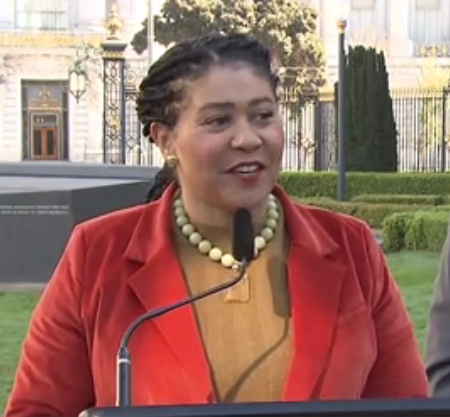
London Breed, mayor of San Francisco
San Francisco’s Democratic Party mayor London Breed,
who now takes full control of school board.

Vote the bums out! Voters in San Francisco yesterday ousted three members of the city’s seven-member school board members because of their focus on renaming schools honoring American heroes like Washington and Lincoln while refusing to reopen the city’s schools or deal with its budget issues.

School board president Gabriela López, vice president Faauuga Moliga and commissioner Alison Collins were all stripped of their positions during a special election, according to tallies by the San Francisco Department of Elections.

Furious parents launched the recall effort in January 2021 after arguing the school board was pushing progressive politics instead of acting in the best interests of children amid the pandemic.

…The recall effort was launched as the school board was trying to rename 44 school sites that it said honored public figures linked to racism, sexism and other injustices — including Abraham Lincoln, George Washington and trailblazing US Sen. Dianne Feinstein (D-Calif.).

Critics argued the push made a mockery of the country’s racial reckoning — as parents demanded to know why the board would waste time renaming schools when the priority needed to be reopening classrooms. The board eventually scrapped the plan after widespread uproar.

Opponents had called the recall a waste of time and money given the district is facing a number of challenges, including a $125 million budget deficit and the need to replace retiring Superintendent Vincent Matthews.

» Read more

7 comments

China tests lunar orbital maneuvers using last in-space component of Chang’e-5 sample return mission

China appears to be using the last in-space component of its Chang’e-5 sample return mission, left in lunar orbit after the samples came back to Earth and the sample ascent capsule was sent crashing to the lunar surface, to test a variety of lunar orbital maneuvers that could be used in future missions.

Chinese engineers have apparently moved it from a near-Moon orbit to what is called a distant retrograde orbit (DRO), shifting back and forth from the Lagrange points on each side of the Moon with respect to the Earth. Though some spacecraft in the Artemis program are planned to use this orbit, this is the first time anyone has done so.

[S]pacecraft activity tracker Jonathan McDowell, also an astrophysicist at the Harvard-Smithsonian Center, told SpaceNews that he believes China is probably using the Chang’e-5 spacecraft gaining experience with astrodynamics. “They are using it as a toy to play around with. It is clearly useful as a stable lunar orbit for future missions, I just don’t think it’s a specific precursor.”

This activity is also par for the course for China. They have previously used other leftover lunar spacecraft to test different orbital maneuvers. The activity also confirms China’s determination to continue its exploration and settlement of the Moon.

0 comments

OneWeb sued by businessman for not paying him

An American businessman with ties in Kazakhstan and who claims he used those ties to obtain permission for OneWeb to launch its satellites there has now sued OneWeb.

Giorgi Rtskhiladze, an American-Georgian businessman, claims that he was not paid for arranging space rocket-launch rights for OneWeb in Kazakhstan. The company received public funding in 2020 after filing for bankruptcy and winning the support of Dominic Cummings, then the Prime Minister’s most senior adviser.

The $30m claim, filed in New York, alleges that Mr Rtskhiladze successfully lobbied the Kazakh government to allow OneWeb to launch satellites from Kazakhstan and operate a ground station for its internet network but was not paid. Mr Rtskhiladze alleges that OneWeb defrauded him by keeping him engaged with Kazakh officials but then terminated his services only after he demanded payment. His work led to “hundreds of millions of dollars in value” for OneWeb, he claims.

OneWeb denies these claims entirely. The claims do appear suspicious because Russia was doing the launching, and it has a solid lease to do so with Kazakhstan. Moreover, it is very doubtful Kazakhstan would do anything to threaten those launches, considering Russia was making a lot of money from them and would not take kindly to such an action.

0 comments

China wants a formal hot line with U.S. and its companies to avoid space collisions

China last week proposed that a formal method of communications be established between it and the U.S. and its companies in order to avoid space collisions.

The proposal was made after Chinese officials once again claimed that several Starlink satellites had threatened its space station, something U.S. officials dispute.

At a Feb. 10 press conference, Zhao Lijian, spokesman for China’s Ministry of Foreign Affairs, reiterated claims the country made to the United Nations in December that it had to maneuver its space station twice in 2021 to avoid close approaches by SpaceX Starlink satellites. “China was fulfilling the international obligation stipulated by Article V of the Outer Space Treaty by informing the U.N. of the Starlink satellites’ dangerous approach to the Chinese space station that threatened the safety of in-orbit Chinese astronauts,” he said according to a government transcript, adding that the “in-orbit Chinese astronauts were facing real and urgent safety threats.”

China filed its notice with the U.N., he said, after failing to hear U.S. officials. “After the incidents, China’s competent authorities tried multiple times to reach the U.S. side via e-mail, but received no reply,” he said.

The U.S. government, though, tells a different story. In its own note verbale filed with the U.N., dated Jan. 28 and published by the U.N.’s Office for Outer Space Affairs Feb. 3, the U.S. says it never heard from the Chinese government about the close approaches by satellites designated Starlink-1095 and Starlink-2305.

This cat-and-mouse game is not simply about avoiding collisions in space. China this year will launch two more modules to its space station, using its Long March 5B rocket. Unless it has completely redesigned the rocket (very unlikely), the core stage for both launches will come crashing uncontrolled to the ground, causing endless bad press for China. These claims by China appear to be a propaganda effort to improve its image prior to those launches.

Nonetheless, establishing a better lines of communications with China to avoid future collisions makes sense. Right now U.S. companies are forbidden by law from communicating directly with China, which makes resolving collision threats difficult if not impossible.

5 comments

A rebranded Virgin Galactic to reopen ticket sales

Capitalism in space: Virgin Galactic today announced both a major rebranding of the company — significantly deemphasizing its links to Richard Branson — as well as a resumption of ticket sales for its suborbital flights.

Virgin Galactic opened ticket sales to the general public and rebranded itself today a week ahead of what promises to be another dismal quarterly earnings report. The company most recently reported to having 700 reservations for suborbital spaceflights, with plans to reach 1,000 later this year. Space tourism flights are currently scheduled for the fourth quarter of 2022.

Virgin Galactic’s battered stock, which opened at $8.93, soared by more than 29 percent to $10.50 on the New York Stock Exchange. The company is scheduled to report earnings (actually a loss) for the fourth quarter of 2021 on Feb. 22.

Tickets will cost $450K, with a $150K deposit required. It also appears that — in order to encourage sales — the company is capping present sales to the first 1,000 who provide the deposit. Since it has for years claimed it has 700 paying customers already, this suggests they are looking for only another 300 at this time.

Branson’s share in the company is now only about 11% — having successfully pumped and then dumped 80% of his shares — and it appears its management senses his name and the association with his Virgin Group now carries more negative than positive connotations. The new company logo for example shrinks the word “Virgin” so much that if you didn’t look close, you’d think the company was simply called “Galactic.”

6 comments

First image from IXPE

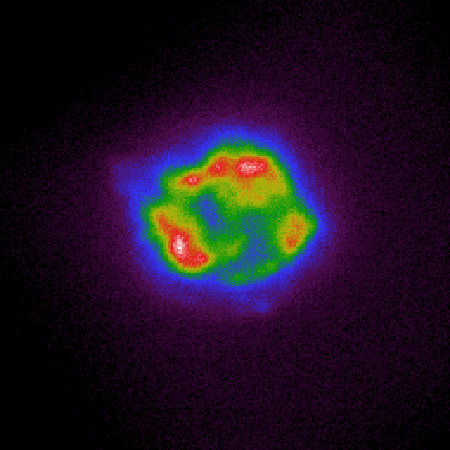
Supernova remnant Cassiopeia A as seen by IXPE

NASA today released the first image produced from its new X-ray space telescope, the Imaging X-Ray Polarimetry Explorer (IXPE).

The photo to the right is that image, showing the intensity of X-rays coming from the supernovae remnant Cassiopeia A. From the caption:

Colors ranging from cool purple and blue to red and hot white correspond with the increasing brightness of the X-rays. The image was created using X-ray data collected by IXPE between Jan. 11-18.

Though Chandra also detects objects in X-rays, IXPE will also detect their polarization, or the way the rays are oriented as they travel through space.

2 comments

Curiosity looks out across the mountains

Curiosity panorama, Sol 3387, February 15, 2022
Click for high resolution. Original images found here and here.

Overview map
Click for interactive map.

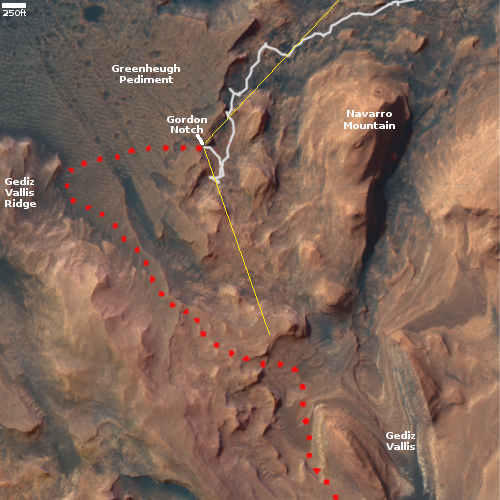
Cool image time! The mosaic above, created from two photos taken by Curiosity’s left navigation camera and downloaded from the rover today, looks to the southeast across the small rocky valley the rover has been traversing for the past two months towards Mount Sharp.

The rover had entered this valley through the nearest gap on the left, then traveled uphill from the left to the right until it had passed behind the nearest dark ridge on the right. It then retreated and turned left, starting uphill through Gordon Notch, as shown in the overview map to the right.

On the overview, the white line marks Curiosity’s past travels, with red dotted line indicating its planned future route. The yellow lines indicate the approximate view in the panorama above.

For scale, Navarro Mountain is about 450 feet tall. The actual peak of Mount Sharp is blocked by the white front range to the left. The rover is presently still 12,600 feet below that peak, which sits to the southeast about 35 miles away.

0 comments

Orbex installs launchpad at test site

Capitalism in space: Orbex has now completed the installation of the first launchpad build in Great Britain in more than a half century, and will use it for static fire tests of its Prime rocket.

Full ‘dress rehearsals’ of launch procedures for the Orbex ‘Prime’ rocket can now take place at the test site. Orbex Prime is a micro-launcher designed to transport small satellites weighing around 150kg to low Earth orbit. It will eventually launch from its ‘home’ spaceport at Sutherland in the North of Scotland.

Actual launches will occur on a different launchpad at Sutherland. Whether it will be this launchpad, moved to Sutherland, or a second new pad built at Sutherland, has not yet been decided by the company. Either way, according to earlier releases, the company is targeting that first launch before the end of the year. Since it took about two months to build this first launchpad and deliver it, the decision to build a second pad will not impact that schedule.

0 comments

SpaceX begins filling methane tanks at Starship launchsite in Texas

Capitalism in space: SpaceX has begun the slow process of filling the storage tanks at its launchpad in Boca Chica with the methane that will be used by its Starship and Superheavy rocket once launched.

To fill the two existing tanks, which may store enough methane to fuel a stacked Starship and Super Heavy about 4/5ths of the way, SpaceX will need around 40-50 more tanker deliveries. Since last November, SpaceX has completed more than 320 liquid nitrogen and 200 liquid oxygen deliveries – equivalent to about 6700 tons (~14.8M lb) of LN2 [liquid nitrogen] and 4200 tons (~9.3M lb) of LOx [liquid oxygen]. If SpaceX maintains that average and focuses entirely on LCH4 [methane], the two horizontal tanks could be filled to the brim before the end of February.

Having a substantial amount of [methane] stored at the orbital tank farm will finally allow SpaceX to attempt the first major wet dress rehearsals (WDRs) and, more importantly, the first full static fires with flightworthy Super Heavy booster prototypes. Of course, a tank farm with full supplies of LOx, LCH4, LN2, and their gaseous equivalents is also a necessity for the first orbital Starship launch attempt, which has most recently slipped from a target of mid-2021 to no earlier than (NET) Q2 2022, pending regulatory approval.

The article also notes that the way SpaceX built two vertical methane tanks at the launchpad appears in violation of Texas regulations, and might either need a waiver from the state or be rebuilt in order to be used. Subsequently the company has added two horizontal tanks that conform to regulations, and it is these tanks it is now filling. More tanks however will have to be added to give it the fuel needed for launch.

1 comment

Astronomers form lobbying group to block development on Moon’s far side

Lunar zone reserved solely for astronomers
Lunar zone reserved exclusively for radio astronomers

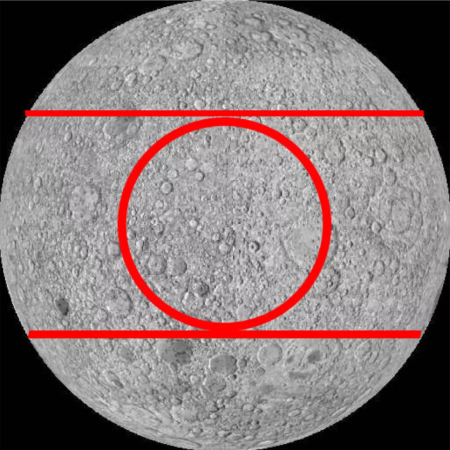
In order to allow them to someday in the future maybe consider the idea of possibly building space-based radio telescopes on the Moon, astronomers have now formed a new lobbying group to advocate the creation of a zone more than a thousand miles wide on the Moon’s far side where all future development will be forbidden.

The new committee is chaired by Claudio Maccone, an Italian SETI (search for extraterrestrial intelligence) astronomer, space scientist and mathematician. Maccone supports creation of a Protected Antipode Circle or PAC, a large circular piece of lunar landscape about 1,130 miles (1,820 kilometers) wide that would become the most shielded area of the moon’s far side.

“PAC does not overlap with other areas of interest to human activity,” he said. “PAC is the only area of the far side that will never be reached by the radiation emitted by future space bases located at the L4 and L5 Lagrangian points of the Earth-moon system.”

In view of these unique features, Maccone believes the PAC should be officially recognized by the United Nations as an international protected area, where radio contamination by humans is curbed, now and into the future.

In other words, these astronomers want to be given, for free, full ownership of the region in the center circle on the graphic above for future radio telescopes, even though at present they have no plans or projects to build such things.

Though the idea of creating a region protected from radio signals so that good radio astronomy can be conducted has merit, no one should have the slightest sympathy for this request by astronomers. Why should anyone give them this vast amount of real estate when astronomers have shown so little interest in building any telescopes in space, anywhere?

Only after the astronomical community finally proposes an actual radio telescope for installation at this site should this request be given the slightest attention. Before that, it is merely a stupid power grab by elitists who deserve nothing from nobody.

11 comments
1 168 169 170 171 172 192