Webb engineers successfully deploy the telescope’s secondary mirror

Engineers today confirmed that the secondary mirror for the James Webb Space Telescope has successfully deployed, its tripod structure unfolding and locking into place.

In addition the cover protecting the Mid-Infrared Instrument (MIRI) was successfully unlocked. The instrument’s science team did not open the cover yet because the telescope hasn’t yet cooled enough, its sun shield only in place for a day or so.

0 comments

Today’s blacklisted American: A short list of just a few of the academics fired for having opinions

Lysenko with Stalin
Trofim Lysenko, the person American academia now most admires,
preaching to Stalin as he destroyed Soviet plant research,
persecuted anyone who disagreed with him, and caused famines
that killed millions.

Today at the Daily Signal one of their writers, Douglas Blair, compiled a list of eight college professors whose lives were destroyed by the intolerant left and its effort to silence all opposition, by any means necessary. That list is as follows:

Five of those eight individuals had previously been a subject of my daily column, “Today’s Blacklisted American,” proving that the number of such cases of oppression and blacklisting by the academic left has grown so large that a daily column can’t possibly cover every story.

What struck me about this list however was the petty, ugly, and absurd reasons given for destroying or silencing these individuals. » Read more

6 comments

Ingenuity’s next flight and the plans beyond

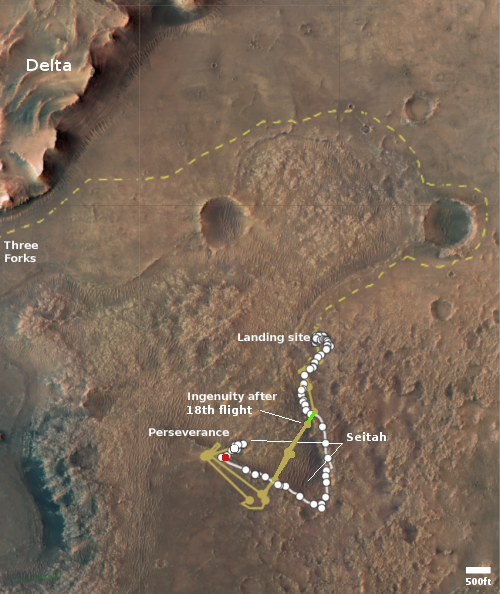
Overview map
Click for interactive map.

In an update posted today written by Ingenuity pilot Martin Cacan, he outlined the engineering team’s goal for the Mars’ helicopter’s next flight, its nineteenth.

This flight, which will take place no earlier than Friday, Jan. 7, takes the scout vehicle out of the South Séítah basin, across the dividing ridge, and up onto the main plateau. The precise landing target for Flight 19 is near the landing site of Flight 8. Images taken during Flight 9 by the rotorcraft’s high-resolution Return-To-Earth (RTE) camera were used to select a safe landing zone.

…Spanning 207 feet (63 meters), this flight will last about 100 seconds at a groundspeed of 2.2 mph (1 meter per second) and altitude of 33 feet (10 meters) while taking 9 new RTE images. The final act of the flight is to turn nearly 180 degrees to flip the RTE camera to a forward-facing orientation for future flights toward the river delta. [emphasis mine]

The green line in the map to the right indicates the exact path, going about 207 feet to the northeast. The red dot marks the location of Perseverance on December 8, 2021, the last time the Perseverance science team updated their map showing the rover’s travels.

The highlighted words are the most important. Cacan also said this in his update:

The current mission goal is to reach the Jezero river delta to aid the Perseverance rover in path planning and scientific discovery.

Assuming the helicopter continues to function correctly, their next flights will apparently be aimed towards the delta. Whether that path will follow the planned route marked by the dashed yellow line, or cut straight across, is not clear. If the latter, that implies they have revised Perseverance’s planned route so that it also cuts straight across from about the point of Ingenuity’s next landing site.

More likely Cacan was not speaking literally, and that the route Ingenuity will take to the delta will follow the planned route, around that crater to the northeast.


0 comments

Debris from Russian anti-satellite test threatens more than ISS

According to an analysis by a commercial space tracking firm, the debris from the satellite destroyed during a Russian anti-satellite test in November threatens not just ISS but many military weather and spy satellites.

Hugh Lewis, head of the Astronautics Research Group at the UK’s University of Southampton, on Monday tweeted an analysis of predicted conjunctions, or close approaches, between satellites and the Cosmos 1408 debris for the first week of January. That analysis showed 8,917 likely conjunctions where a sat and a debris fragment would pass within five kilometers of each other — scarily close in terms of collision risk.

The COMSPOC analysis also shows that Russian government claims that the debris would not harm the International Space Station are blatantly not true. In fact, the opposite appears to be the case.

At the time of ASAT test, COMSPOC listed the ISS as 20th on the list of most imperiled spacecraft. But the analysis shows that risks of a catastrophic collision with the ISS will continue to grow as the debris pieces spiral downward from the impact point into the Earth’s atmosphere, Oltrogge said.

More and more it seems this Russian anti-sat test was a deliberate act of sabotage by the Putin government, aimed at harming U.S. assets.

2 comments

China takes the global lead in fusion research

In setting new records of temperature and running time in its own tokamak fusion experiment, China now leads the U.S. in the field of developing the technology for generating practical fusion energy.

[The U.S.] ITER’s target temperature is 150 million °C (270 million °F). China’s EAST facility, which is a key contributor to the ITER project, has hit this mark already, reaching 160 million °C (288 million °F) for 20 seconds, and holding 120 million °C (216 million °F) for 101 seconds in separate experiments announced last May.

The latest experiment tested the Chinese tokamak’s capability to endure extreme temperatures over longer periods, sustaining a temperature 2.6 times hotter than the Sun’s core for some 1,056 seconds, or 17 minutes and 36 seconds. Nobody’s ever sustained a high-temperature plasma for 1,000 seconds before, so this is an important milestone.

The development of this capability continues China’s effort to lead the world in all areas of research, led I think by the many high government officials in positions of great power after cutting their teeth as managers for China’s space effort. These individuals understand how to build big technology projects at the cutting edge of science, and are likely pushing for more such research in all fields, such as the experiments in fusion energy above.

As big government projects, however, the long term future of such work is very risky. Government projects like this might start out great, which describes China’s status today, but they always end up corrupt and hidebound, as seen in the Soviet Union and at NASA in the U.S.

Nonetheless, this success highlights China’s aggressive effort to lead the world in all things. We would be foolish to ignore this.

5 comments

Starlink temporarily backs out of India due to regulatory snafu

Capitalism in space: Starlink in India has stopped taking new preorders and is refunding all previous preorders of its internet service because it had failed to get the proper regulatory permits for selling its service.

India’s Ministry of Communications issued a Nov. 26 statement instructing SpaceX to “refrain from booking/rendering” Starlink services “with immediate effect” because the company did not have a license to operate in the country.

In the days that followed, SpaceX appeared to be still accepting $99 preorder deposits via Starlink’s website for addresses in India.

But the website now tells prospective subscribers: “Starlink is not yet available in your area due to pending regulatory approval. As we receive approvals our coverage area will continue to expand, so please check back for future availability in your area.”

The head of Starlink India also announced his resignation today. It appears he not only did not get the proper permissions, he ignored that November 26 order from the government.

SpaceX apparently is now reviewing the legal situation, which is very unclear and might even block the company from selling its services in India entirely. No timeline is presently known for restarting its operations there.

0 comments

Julie Andrews – My Favorite Things

An evening pause: From the movie The Sound of Music (1965), a song about teaching children to face fear, to push past it, and live boldly and with courage. And to do it with humor. As Ray Bradbury wrote in his book, Something Wicked This Way Comes, you defeat evil and fear by laughing at it. The world needs to recapture this idea, or else we are doomed.

Hat tip Tom Wilson.

2 comments

Webb: Sun shield deployment completed

Engineers today successfully completed the full deployment of the sun shield of the James Webb Space Telescope.

The unfolding and tensioning of the sunshield involved 139 of Webb’s 178 release mechanisms, 70 hinge assemblies, eight deployment motors, roughly 400 pulleys, and 90 individual cables totaling roughly one quarter of a mile in length. The team also paused deployment operations for a day to work on optimizing Webb’s power systems and tensioning motors, to ensure Webb was in prime condition before beginning the major work of sunshield tensioning.

The process took eight days, and was by far the most complex such remote deployment ever attempted by an unmanned spacecraft. The shield is now in place to shade Webb from sunlight and heat and thus allow it to observe very faint infrared objects billions of light years away.

Next comes the deployment of Webb’s secondary mirror, followed by the unfolding of its main mirror.

12 comments

Ice canyons at the Martian north pole

Ice canyons at the Martian north pole
Click for full image.

Cool image time! The photo to the right, cropped and reduced to post here, was taken on July 24, 2021 by the high resolution camera of Mars Reconnaissance Orbiter (MRO) and shows one small portion of the edge of Mars’ north pole ice cap.

The many layers in that ice cap are clearly evident, with some darker because they were probably laid down at a time when the Martian atmosphere was more filled with volcanic ash. According to the presently accepted theory, the layers show the cyclical climate patterns of Mars, caused by the large shifts in its obliquity, or the tilt of the planet along its rotational axis, ranging from 11 to 60 degrees. Presently Mars is tilted 25 degrees, similar to Earth’s 23 degrees. The two extremes cause the planet’s water ice to shift back and forth from the mid-latitudes to the poles, causing the layers.

The height of this layered cliff face is probably about 1,500 feet, though that is a very rough estimate. Notice also that this image shows an ice canyon running from the left to the right and flowing into a much larger ice canyon to the right. The top cliff is probably about a third the height of the bottom cliff.

The overview map below shows gives the context, not only in place but also in time.
» Read more

1 comment

ArianeGroup ships the 1st Ariane-6 core and upper stages to French Guiana

Capitalism in space: ArianeGroup today announced that the first completed stages for its new Ariane-6 rocket have been shipped to French Guiana for testing.

The Ariane 6 core stage and upper stage intended for the combined tests on the launch pad in French Guiana have left the ArianeGroup sites in Les Mureaux and Bremen and begun their journey to Europe’s Spaceport. These stages will be integrated by ArianeGroup in the Launcher Assembly Building (BAL) to create the central core for the Ariane 6 combined tests model.

The press release provided no information on the schedule for the tests or the first launch. An earlier release had targeted the second quarter of ’22 for the inaugural launch, but based on today’s press release I would suspect that scheduled is very tentative.

This press release marks another major change in how Europe will launch rockets. No longer is the government-run Arianespace in charge. Instead, the commercial partnership of Airbus and Safran, dubbed ArianeGroup, is running things. In exchange for building this new rocket this partnership demanded a greater share of the profits and full control, something the European Space Agency (ESA) had denied them under Arianespace. This new arrangement was devised in the hope it would give this private partnership a direct interest in making a profit, thus cutting costs and encouraging innovation.

However, because ESA is still very very closely involved in every step, it is uncertain whether this arrangement will achieve its goals. Moreover, there are indications that ArianeGroup itself is somewhat risk adverse. For example, in designing Ariane-6 both decided to forego re-usability. Their rocket is thus more expensive than SpaceX, and has had trouble garnering launch contracts.

9 comments

Webb deployment resumes, with continuing success

After a day delay to assess the telescope’s earlier operation in space, engineers yesterday resumed the deployment of the James Webb Space Telescope’s sun shield.

First they began tensioning the shield’s first of five layers, completing that operation in about five and a half hours.

Next the engineers proceeded to tighten layers two and three, completing that task in about three hours.

Today they have begun tightening the last two layers. A live stream of this slow and relatively unexciting process (as long as nothing goes wrong) is available from NASA here.

Based on what has been done so far, it appears that the deployment of the sun shield, considered the most challenging part of Webb’s deployment, is going to complete successfully. While the unfolding and deployment of the mirror still must be done, getting the sun shield deployed eliminates one of the great concerns that has kept both astronomers and engineers awake nights for decades.

5 comments

South Korea pinpoints cause of October launch failure

The new colonial movement: South Korea’s space agency KARI has completed its investigation of the launch failure in October of its first entirely home-built Nuri rocket, revealing that the support structures for the rocket’s helium tanks were designed incorrectly, and allowed the tanks to break free during launch.

“The support structures holding helium tanks inside the third-stage oxidizer tank were not properly designed to account for a force referred to as buoyancy,” KARI said in a Dec. 29 statement. Buoyancy, the upward force exerted by a fluid that pushes an object, rises along with a rocket’s altitude, which was not accounted for, according to KARI.

The helium tanks with the faulty anchors were inside the upper stage’s oxidizer tank, which was filled with liquid oxygen needed for the rocket’s ignition. With the helium tanks coming loose, they disrupted pipelines within the oxidizer tank and led the liquid oxygen to leak, resulting in early termination of the ignition, KARI explained.

The helium is used to keep the tank pressurized as it uses up its oxygen so that oxygen will continue to flow to the engine. Thus, they sit inside the oxygen tanks, and when they came loose they damaged its internal pipes.

Though they can fix the problem, it will likely cause a delay in the second Nuri launch attempt, presently scheduled for May.

1 comment
1 189 190 191 192