Today’s blacklisted American: Boston policewoman suspended for leading opposition to COVID shot mandate

Coming to your town in America soon!
Death camps are certainly coming for the unclean unvaccinated.

They’re coming for you next: Shana Cotone, the Boston policewoman who helped form and heads Boston First Responders United, a group for Boston municipal workers that has sued to block the city’s COVID shot mandate on all workers, has been put on administrative leave by her department and is now under “an internal affairs investigation”.

Cottone said BPD officers came to her house and took her badge and gun Saturday morning. “They’re trying to come after me — to silence me,” Cottone told the Herald. “They’re not going to silence me.”

Cottone’s group is not the only one suing. » Read more

5 comments

Data from China’s Chang’e-5 lander detects very tiny amounts of water in lunar soil

The uncertainty of science: In a paper published yesterday, Chinese scientists revealed that data from an instrument on the Chang’e-5 lunar lander has detected evidence of very tiny amounts of water in lunar soil, amounts that confirm past data showing the Moon is very dry.

From China’s state-run press:

The study published on Saturday in the peer-reviewed journal Science Advances revealed that the lunar soil at the landing site contains less than 120 ppm water or 120g water per ton, and a light, vesicular rock carries 180 ppm, which are much drier than that on Earth. … The additional 60 ppm water in the rock may originate from the lunar interior, according to the researchers. [emphasis mine]

It is believed that most of this water is the result of hydrogen in the solar wind.

The paper can be found here.

Before we begin dancing in joy that the Moon is wet, reread the highlighted words. This data instead simply confirms past data that the Moon is very dry. In the paper itself, it is made very clear that this high water content, small as it is, was only detected in a single rock, with all of the surrounding terrain much much drier. From the paper:

The water contents are less than 30 ppm in most measured regolith spots except for [areas] D12 and D17, which may be due to the disturbance of the top layer of the more space-weathered/solar wind–implanted regolith by the lander exhaust and the subsequent sampling process. The unsampled areas of D12 and D17 may have been shielded by [a rock] from the lander exhaust and thus retain the top space-weathered layer that contains higher water content. We predict that higher water content may be found in surface regolith than that from the subsurface of the returned borehole samples if the original stratigraphy is preserved. The estimated water contents of the regolith in the landing area are in agreement with those measured in the Apollo regolith samples and the orbital observations.

In other words, the higher water content, still very dry, appears to only exist on the surface, which is why they suspect it is produced by the solar wind and is also very temporary.

Moreover, there are many uncertainties in this result. The detection might not even be water, but hydroxyl molecules.

What this study suggests is that the patches of suspected water that some orbiters think they have identified in low latitudes on the Moon may simply be these surface molecules left by the solar wind, and that if there is usable water on the Moon, it will only be found in those permanently shadowed craters at the poles, if there.


7 comments

Webb’s primary mirror successfully deployed

Today engineers successfully completed the unfolding of the primary mirror on the James Webb Space Telescope.

The two wings of Webb’s primary mirror had been folded to fit inside the nose cone of an Arianespace Ariane 5 rocket prior to launch. After more than a week of other critical spacecraft deployments, the Webb team began remotely unfolding the hexagonal segments of the primary mirror, the largest ever launched into space. This was a multi-day process, with the first side deployed Jan. 7 and the second Jan. 8.

Mission Operations Center ground control at the Space Telescope Science Institute in Baltimore began deploying the second side panel of the mirror at 8:53 a.m. EST. Once it extended and latched into position at 1:17 p.m. EST, the team declared all major deployments successfully completed.

Next step over the next few months will be aligning the primary mirrors 18 segments with each other as well as the secondary mirror. First science images are expected during the summer, but do not be surprised if NASA releases some test images before then, should all be well and it obtains some eye candy.

9 comments

Debris in Perseverance core sample equipment

Debris in core sample carousel on Perseverance
Click for full image.

In attempting to store its sixth core sample on Mars last week, engineers discovered that Perseverance could not do so because several small pieces of the core sample had fallen into the equipment and prevented the drilling bit with the core from inserting itself completely into the sample storage carousel.

To understand the issue precisely, the engineers commanded Perseverance to first extract the bit from the carousel so they could get pictures of it.

The extraction took place yesterday (1/6) and data was downlinked early this morning. These most recent downlinked images confirm that inside the bit carousel there are a few pieces of pebble-sized debris. The team is confident that these are fragments of the cored rock that fell out of the sample tube at the time of Coring Bit Dropoff, and that they prevented the bit from seating completely in the bit carousel.

The photo to the right shows that material at the image’s bottom.

It appears this issue was anticipated when the rover was designed giving engineers a way to remove the debris. They plan to do so, but will proceed slowly as this will be the first time it will be attempted on Mars.

1 comment

A Martian cliff

A strange Martian cliff
Click for full image.

Many features on Mars immediately make one think of the Grand Canyon and the stark dramatic geology of the American southwest. Today’s cool image on the right, cropped and reduced to post here, is a typical example. Photographed on September 7, 2021 by the high resolution camera on Mars Reconnaissance Orbiter (MRO), it shows a dramatic cliff face that I estimate is about 3,000 feet high.

A closer look, however, almost always shows that this Martian terrain is not like the American southwest at all, but alien in its own way.

At the base of this abrupt cliff the terrain suddenly changes to a series of smooth downward fan-shaped flows. The cliff evokes rough boulders, avalanches, and chaotic erosion. The fans evoke a gentle and organized erosion of small particles like dust or sand. The two processes are completely different, and yet here the former is butted right up against the latter.

The fans also appear to flow out of hollows in the rough cliff, suggesting that somehow as the cliff erodes in chunks those chunks break into sand or dust, find the lowest points, and then flow downward like liquid.

How strange. How Martian. And how truly beautiful.

5 comments

Yutu-2 approaches boulder, has now traveled more than 1,000 meters

Yutu-2's square boulder
Click for original image.

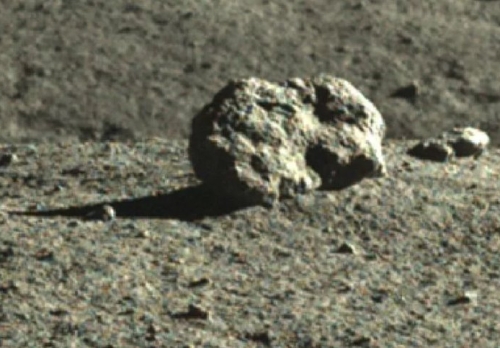
The Chinese state-run press has released some more images from its rover Yutu-2, including a new image of the square-shaped lunar rock that was first identified a month ago. This new image is to the right, cropped and reduced to post here.

In the original image, the rock appeared very square as it was on the horizon and silhouetted by the black sky. As is usual in our emotion- and movie-run society, many began to push wild theories about the rock, proposing it was anything from an alien spacecraft to the monolith from the 1968 movie 2001: A Space Odyssey.

The picture confirms what any thoughtful person would have concluded, that it was simply a rock. The available image does not provide a scale, so I cannot tell you whether this is a large boulder, or a small piece of gravel. However, a wider image taken by Yutu-2 shows that the rock is on the edge of a small crater, which suggests the boulder is probably somewhere between three to ten feet across. The rover has completed only about half of its 260-foot journey to it, and won’t reach it until its next lunar day of operations in February.

The same report also revealed that the rover has now traveled just over 1,000 meters on the far side of the Moon, or about 3,280 feet, since it began operations in early 2019.

2 comments

Pushback: Children in England are refusing to wear masks or get tests

A little child shall lead them, by James Johnson
Painting by James L. Johnson.

And little child shall lead them: According to one teacher’s union official in Great Britain, children are refusing in “huge numbers” to wear masks or get twice-weekly tests for COVID, despite government mandates requiring both.

In its latest guidance issued on Jan. 2, the UK Department for Education (DfE) recommended that secondary school pupils in England should wear face coverings inside classrooms to slow the spread of the Omicron variant of the CCP (Chinese Communist Party) virus. Before that, masks were already recommended in outdoor communal areas and corridors. Secondary school students are also advised to take a lateral flow test twice a week.

But according to the NASUWT teachers’ union, there has been strong resistance from pupils to the new policy. Damien McNulty, a national executive member of the union, told the BBC on Thursday: “Sadly, we have had reports in the last 24 hours of at least six secondary schools in the northwest of England where children, in huge numbers, are refusing to take lateral flow tests or to wear masks.”

“We’ve got one school in Lancashire where only 67 children out of 1,300 are prepared to have a lateral flow test and wear masks,” he said.

» Read more

14 comments

China tests space station robot arm

The new colonial movement: The Chinese state-run press yesterday reported that it has successfully used the robot arm on its Tiangong space station to move a Tianzhou freighter from one point to another.

After being unlocked and separated from the space station core module Tianhe, Tianzhou-2 was moved into a predetermined position by the robotic arm. The arm then reversed the maneuvers to bring the spacecraft back to its original position. Tianzhou-2 re-docked with the core module and completed locking.

The test preliminarily verified the feasibility of using the mechanical arm to conduct a space station module transfer, confirmed the effectiveness of relevant technologies, and laid a foundation for the subsequent in-orbit assembly and construction of the country’s space station, said the CMSA [Chinese Manned Space Agency].

The news report did not indicate whether this operation was run from ground control, or by the astronauts on board Tiangong. Either way, it apparently clears the way for the arrival of two more large modules, planned for launch later this year, suggesting that the arm will be used in some manner to position those modules prior to docking.

1 comment

Virgin Galactic stock crashes

Capitalism in space: For the first time since Virgin Galactic became a publicly-traded company two years ago, its stock on January 6th dropped below its initial offering price.

On Thursday, stock of the space tourism company fell to as low as $11.30 before rising back to $11.90 by the afternoon. When the company merged with a special purpose acquisition company to go public in 2019, its debut price was $11.75.

In the two years in-between, the price was pumped up to as high as $62, during which the company’s founder, Richard Branson, sold off about 80% of his stock, reducing his holdings from 51% of the company to only 11% and walking away with about $1.25 billion in cash.

Right now the company’s future is very much in question. It has delayed all of its commercial suborbital flights until late this year, if then. Meanwhile, Blue Origin is flying commercial suborbital tourist flights, and the orbital space tourism market is ramping up quite successfully. With no ability to enter that orbital market, Virgin Galactic appears to be at a dead end.

8 comments

Ariane-6 finally wins more launch contracts

Arianespace today announced a new slew of launch contracts, including two for its mostly Italian-built Vega rocket family and four for its Ariane family of rockets.

The latter launch contract is significant as those four launches, putting eight more Galileo GPS-type satellites in orbit for the European Union over the next three years, will all be launched by Arianespace’s new Ariane-6 rocket, built and owned by the commercial company ArianeGroup.

The significance is twofold. First, Ariane-6 has struggled to get launch customers because its launch cost is far higher than SpaceX’s, to a point that the low number of contracts weren’t paying for the cost of development. This new contract overcomes that difficulty by adding four more launches.

Second, the nature of all of Ariane-6’s contracts underscore the difficulties it is having. Before the arrival of SpaceX’s mostly reusable and very inexpensive Falcon 9 rocket, Arianespace held 50% of the market share for commercial launch contracts, using its Ariane-5 rocket. Those customers have mostly vanished, however, switching to SpaceX. Ariane-6 was conceived — by the government-run European Space Agency — as a newer cheaper rocket that would recapture some of that market. All of its launch contracts, both old and new, demonstrate that it is failing to do so, however. Its only customers so far are coming from European government entities, who are required to use Ariane-6 as part of their partnership in the European Union and the European Space Agency. No private concern, inside or outside Europe, seems interested in using Ariane-6. It just costs too much.

For Europe to compete in the new commercial launch market it needs to build better rockets. And to do this it needs to release its rocket industry from the control of government.

6 comments
1 187 188 189 190 191 192