Aerojet Rocketdyne wins contract from Lockheed Martin to build more Orion engines

Aerojet Rocketdyne announced yesterday that it has been awarded a new $67 million contract from Lockheed Martin to build the Orion propulsion engines for Artemis missions six though eight.

This contract option includes delivery of three additional sets of Orionโ€™s service module auxiliary engines and three additional jettison motors. The eight auxiliary engines each produce 105 pounds of thrust to help maintain Orionโ€™s in-space trajectory and position, and supplement the Orion Main Engine. The jettison motor, located on Orionโ€™s Launch Abort System (LAS), generates 40,000 pounds of thrust to separate the LAS from the crew module during both nominal operations and abort scenarios, allowing the spacecraft to continue on its journey. The jettison motor is the only motor on the LAS that fires during every mission.

These Artemis missions are not expected to occur until very late in this decade, by which time Starship will likely be making regular commercial trips to the Moon. At that time Orion will look increasingly ridiculous next to Starship, and will demonstrate starkly the difference in what government can do versus a free private sector.

6 comments

ULA delays first launch of Vulcan to June at the earliest

Peregrine landing site

An official from Astrobotics confirmed this week that an explosion during testing of the Centaur upper stage of its new Vulcan rocket will delay that rocket’s first launch for at least one to two months, from May to June or July.

On March 29, Tory Bruno, the CEO of Colorado-based spacecraft makers United Launch Alliance LLC, announced on his personal Twitter account that ULA’s Vulcan Centaur V rocket had experienced “an anomaly,” which preceded a tweet he shared on April 13 that showed a video of an explosion that occurred outside of a testing rig that housed the ULA rocket. He alluded to a hydrogen-related leak as being a possible culprit and in response the next day to other replies, Bruno said in a tweet that “June/July” will be the next earliest estimated launch timeline.

That timeline is the same one that John Thornton, CEO of North Side-based Astrobotic, shared during a speech as part of a kickoff event for the Aviation and Robotics Summit in the Strip District on Tuesday.

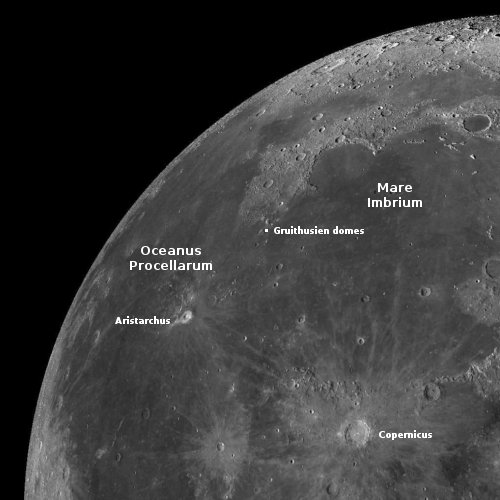
The main payload on that Vulcan inaugural launch is Astrobotic’s Peregrine lunar lander, carrying several NASA science instruments to the Gruithusien Domes region on the Moon, as indicated by the white dot on the picture above.

2 comments

Rocket Lab to reuse previously flown engine on upcoming launch

Rocket Lab engineers, having tested a previously flown Rutherford engine numerous times after recovering it from a launch in May 2022, have now approved that engine for reflight, and are inserting into their Electron rocket assembly line for launch sometime in the third quarter of this year.

The company also revealed that it has now completely abandoned the use of a helicopter in first stage recovery, and will instead pick up all first stages after they have splashed down in the ocean.

Extensive analysis of returned stages shows that Electron withstands an ocean splashdown and engineers expect future complete stages to pass qualification and acceptance testing for re-flight with minimal refurbishment. As a result, Rocket Lab is moving forward with marine operations as the primary method of recovering Electron for re-flight. This is expected to take the number of Electron missions suitable for recovery from around 50% to between 60-70% of missions due to fewer weather constraints faced by marine recovery vs mid-air capture, while also reducing costs associated with helicopter operations.

Rocket Lab will assess the opportunities for flying a complete pre-flown first stage booster following the launch of the pre-flown Rutherford engine in the third quarter this year.

Rocket Lab is presently the only operational American company besides SpaceX that is aggressively pursuing reuse of its rocket. ULA says it wishes to recover and reuse the engines of its still-unflown Vulcan rocket, but development of this concept has been very slow. Many other new companies claim their rockets will be reusable, but none has yet even launched.

0 comments

North Korea claims it is about to launch a spy satellite

According to statements by North Korea’s dictator Kim Jong-un published in its state-run press, that country is only weeks away from launching a spy satellite into orbit.

[S]ome observers said the North may attempt to launch the satellite ahead of President Yoon Suk Yeol’s upcoming state visit to the U.S. later this month. “There is a high possibility that North Korea may attempt a launch around April 23-24, on the basis that weather conditions are favorable, to show off that it has the upper hand on the Korean Peninsula issue by putting it on the table during the South Korea-U.S. summit,” Yang Mu-jin, president of the University of North Korean Studies, said.

Some observers, however, projected that it will take a few more months for the North to put the satellite into orbit given the time needed for technical preparations.

North Korea has completed two previous orbital launches, using its solid-fueled rocket missile technology. It is presently unclear if this new launch will use the same, or fly something new.

0 comments

Ohio local authorities approves land sale for future private astronaut training facility

The local city council in Brook Park, Ohio, yesterday approved by a vote of 7-0 the purchase of nearly thirteen acres by the British company Blue Abyess to allow it to quickly build its proposed private astronaut training facility.

The Brook Park location will be built around a very large, 150-foot deep, multi-level pool. It’s an area that can replicate what life would be like in outer space and allow for the necessary training, dubbed astronaut boot camp for space exploration. “They’re not swimming pools. They’re aimed at industry, whether that’s marine offshore energy, maritime defense, subsea technology, human performance in extreme environments, or how do humans cope with green space environments,” Vickers said.

Officials say this project could be a huge economic driver, potentially bringing more than 100 jobs to the area.
In addition, it will likely generate major interest from tourists.

The facility will also include a hotel for those private astronauts, whether commercial or tourist. Located next to the Glenn Research Center, the company hopes to provide its services to both the public and NASA.

2 comments

Superheavy/Starship clears tower but fails at stage separation

Starship and Superheavy, having just cleared the tower

In a spectacular first orbital launch attempt, SpaceX’s Superheavy and Starship successfully lifted off, clearing the tower and continuing through max-Q (maximum dynamic pressure). It then reached about 24 miles altitude when the rocket began to slowly spinn just prior to main engine cutoff and stage separation. At that point, because engine cutoff and separation had not occurred as planned, the engineering team used the flight termination system to destroy it so as to eliminate any risk to anyone on the ground.

As the announcers noted repeatedly, if the rocket simply cleared the tower they would consider this a magnificent success, considering that they had never fired Superheavy before in a real countdown. That Superheavy performed exactly as it should for almost its entire flight means SpaceX is that much closer to getting Starship into orbit than one would think at this stage of testing.
» Read more

70 comments

An ordinary person’s view of the Starship/Superheavy countdown

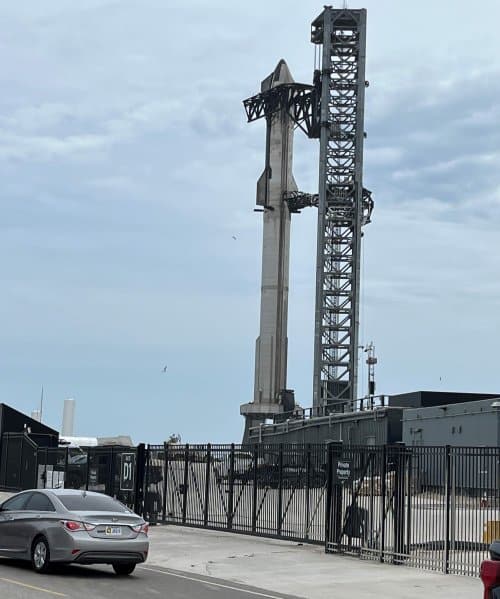
Starship and Superheavy, stacked on the launchpad for launch

One of my readers, who wishes to go by is nickname Doubting Thomas on Behind the Black, went to Boca Chica earlier this week with the hope of seeing the live first orbital launch of Superheavy with Starship stacked on top. Unfortunately, the launch on April 17, 2023 was scrubbed, and he could not remain in Boca Chica for the now rescheduled launch early tomorrow morning on April 20th.

He sent me some pictures of that experience, however, which I post here with his permission. The best of course is the one to the right, of Starship stacked on Superheavy on the launchpad. This was taken before the roads were closed, and shows how incredibly close the general public can get to that launchpad simply by driving past on a public road.

The next few pictures give us a glimpse at the options people have for viewing future Boca Chica launches.
» Read more

10 comments

April 19, 2023 Quick space links

Courtesy of BtB’s stringer Jay.


  • Blue Origin touts picture of the nozzles for its BE-7 engine
  • This is the engine the company has proposed for its Blue Moon manned lunar lander. As the first comment in the thread notes sardonically, “If you could launch something this century…”


2 comments

Today’s blacklisted Americans: NY bans whites from honoring American Indians in school nicknames

American Indian banned by New York
The American Indian, banned by New York

They’re coming for you next: The education department of New York state has now ruled that all schools outside of Indian reservations must change the names of their schools and teams if they make any reference to American Indian culture or history.

In a November 2022 memo sent by the state, all school districts were ordered to stop using Native American-themed mascots, nicknames and logos by the end of the 2022-2023 school year or risk being in violation of the Dignity Act. Districts risk the removal of school officers and the withholding of state aid if the order is not followed.

That order required schools such as Oneida (Indians), Oriskany (Redskins), Richfield Springs (Indians), Sauquoit Valley (Indians), Waterville (Indians) and West Canada Valley (Indians) with nicknames directly linked to Native Americans to change.
» Read more

7 comments

Jumbled floor of ancient Martian channel

Jumbled floor of ancient Martian channel
Click for original image.

Cool image time! The picture to the right, rotated, cropped, reduced, and sharpened to post here, was taken on February 2, 2023 by the high resolution camera on Mars Reconnaissance Orbiter (MRO).

At first glance I thought I was looking at a variety of eroding glacial flows. I was completely wrong. This terrain is located on the floor of 900-mile-long Ares Vallis, thought to have been carved eons ago by some flow, either liquid catastrophic floods or glacial ice, but is now located in the very dry equatorial regions of Mars.

Then what caused these meandering ridges? The overview map below, plus the wider view of MRO’s context camera, provides us more data but little illumination. In fact, both leave us more questions and mysteries.
» Read more

0 comments
1 137 138 139 140 141 196