NASA’s Mars Sample Return project now overbudget

According to testimony by NASA’s administrator Bill Nelson to a Senate committee, its Mars Sample Return (MSR) project now needs a lot of additional funds in order to have any chance of staying on schedule.

Nelson told the Commerce-Justice-Science (CJS) subcommittee of the Senate Appropriations Committee today that he just learned two weeks ago during a visit to the Jet Propulsion Laboratory (JPL), which is building MSR, that they need an additional $250 million this year and an additional $250 million above the request for FY2024 to stay on schedule for launch in 2028.

That FY2024 request warns that the projections for future MSR funding requirements are likely to grow and force NASA to descope the mission or reduce funding for other science projects. NASA just set up a second [independent review board] to take another look at the program.

The project is already beginning to suck money from other science missions, such as solar and astronomy and the Dragonfly mission to Saturn’s moon Titan. In addition, its method for getting the samples back to Earth remains somewhat uncertain due to ESA’s decision to not build a lander/rover for the mission, requiring JPL to propose the use of helicopters instead.

I predict Congress will fund everything, by simply printing more money as it nonchalantly continues to grow the national debt to levels unsustainable. Meanwhile, replacing the present very complex return concept — involving a lander, helicopters, an ascent rocket, and a return capsule (from Europe) — with a much cheaper and simpler option that is now on the horizon, Starship, does not seem to have occurred to any of the these government wonks.

15 comments

ILC Dover to provide spacesuits and “softgoods” for Sierra Space’s LIFE space station

Sierra Space yesterday announced that it has signed a partnership deal with ILC Dover for it to provide spacesuits and other “softgoods” for Sierra Space’s LIFE space station, including helping to build the station’s inflatable modules.

ILC Dover will be an exclusive partner with Sierra Space for softgoods used to support inflatable space habitat systems for low-Earth orbit (LEO), lunar and Mars transport and surface habitation, and use cases even farther into deep space.

The two companies have already been working together on the development and testing of Sierra Space’s first prototype inflatable modules.

0 comments

Axiom offers package space program deals for other countries

The private space station and human spaceflight company Axiom announced this week a set of package space program deals it is marketing to other countries.

In the base tier, Axiom provides countries with advice and insight, and gives those countries priority access on upcoming missions. The second tier enables research and development activities by counties. The third tier offers human spaceflight missions on a regular basis. A fourth tier offers countries the ability to co-develop parts of Axiomโ€™s station.

The first country to join the program is Azerbaijan, which will work with Axiom on satellite solutions and inspiring students to pursue space research and development activities. New Zealand and Uzbekistan are also participating, as well as Rakia Mission, an Israeli space education and research organization involved with the Ax-1 private astronaut mission to the ISS a year ago. Italy is another nation working with Axiom through a partnership that dates back to 2018. An Italian astronaut is slated to fly on Axiomโ€™s Ax-3 mission to the ISS, currently scheduled for late 2023. Two astronauts from Saudi Arabia are flying on the Ax-2 mission in May.

The company also notes that it has found its customers divide into three components, government, private citizens, and corporations. At present this is their order in terms of market share, though the company thinks that corporations will eventually become its biggest customer.

0 comments

SpaceX launches 21 second generation Starlink satellites

SpaceX this morning successfully used its Falcon 9 rocket from Cape Canaveral to launch 21 second generation Starlink satellites into orbit.

The first stage successfully completed its eighth flight, landing on a drone ship in the Atlantic.

The leaders in the 2023 launch race:

25 SpaceX
16 China
6 Russia
3 Rocket Lab

American private enterprise now leads China 28 to 16 in the national rankings, and the entire world combined 28 to 27. SpaceX now trails the entire world, including American companies, 25 to 30.

3 comments

April 18, 2023 Quick space links

Courtesy of BtB’s stringer Jay.


1 comment

Modern bigotry in Canada: Simon Fraser University declares math “racist”

One of many such workshops at Simon Fraser U
One of many such workshops at Simon Fraser University

The modern dark age: Simon Fraser University in Canada (SFU) has an Equity, Diversity and Inclusion learning group in its math office, and it appears that this office is today running a seminar, in partnership with the Simon Fraser Public Interest Group (SFPIRG), asking the important question, โ€œHow can math be racist?โ€, led by two modern “scholars” with no training in math at all.

Those set to speak at the seminar are Hannah Ghaderi, Co-Directory of Research & Education of the interest group, and Chantelle Spicer, currently the Director of Engagement [of SFU’s math Equity, Diversity and Inclusion learning group]. Neither of these individuals appear to have any professional background in math. Mathematician James Lindsay told Human Events that it is likely better that these two DEI professionals did not have a math background.

Lindsay said: โ€œThey donโ€™t need mathematics backgrounds. They have critical consciousness, which means they know how racism and transphobia are hidden in everything, even things they donโ€™t know anything about.โ€

No, actual math has nothing to do with this seminar. SFPIRG makes a big deal on its website about how it isn’t partisan, but yet its mission is “to engage students in social and environmental justice.” Or as it states in great length one paragraph later:
» Read more

17 comments

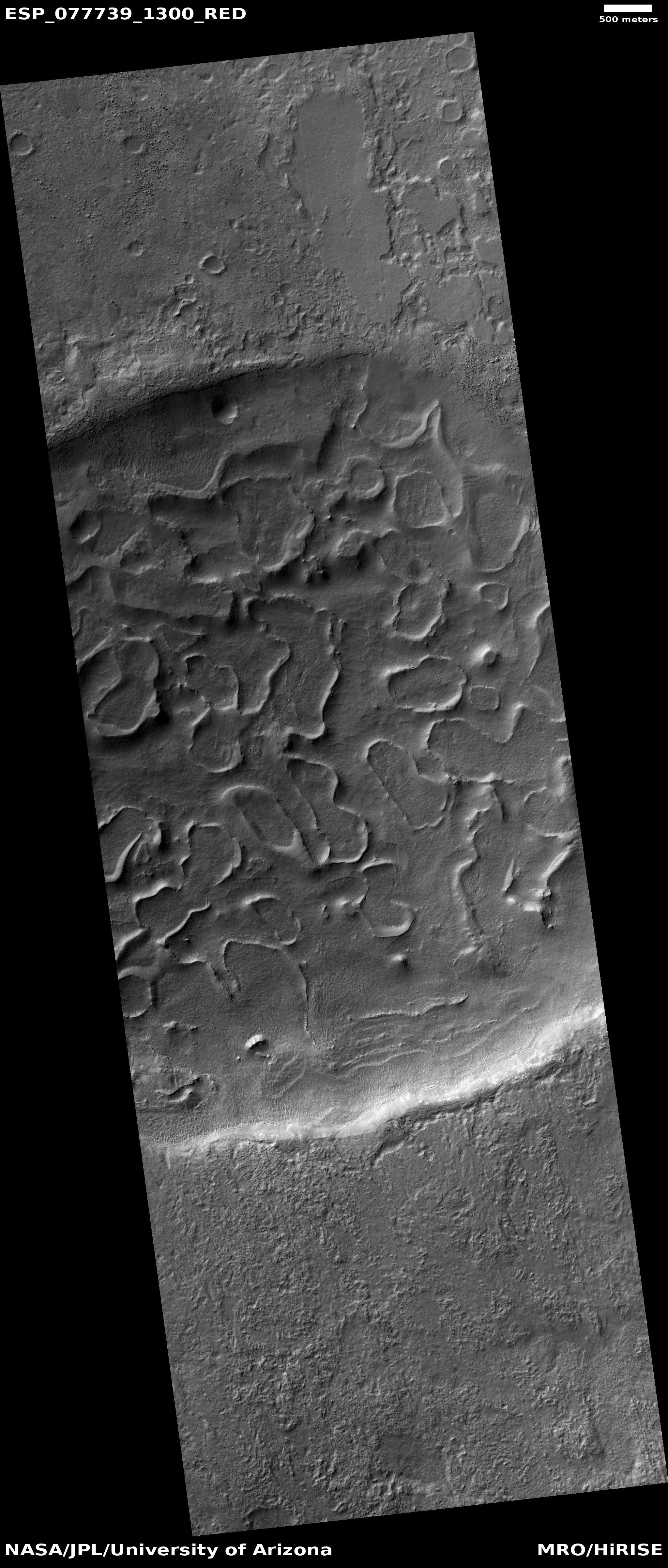
The peeling floor of a crater in the southern cratered highlands

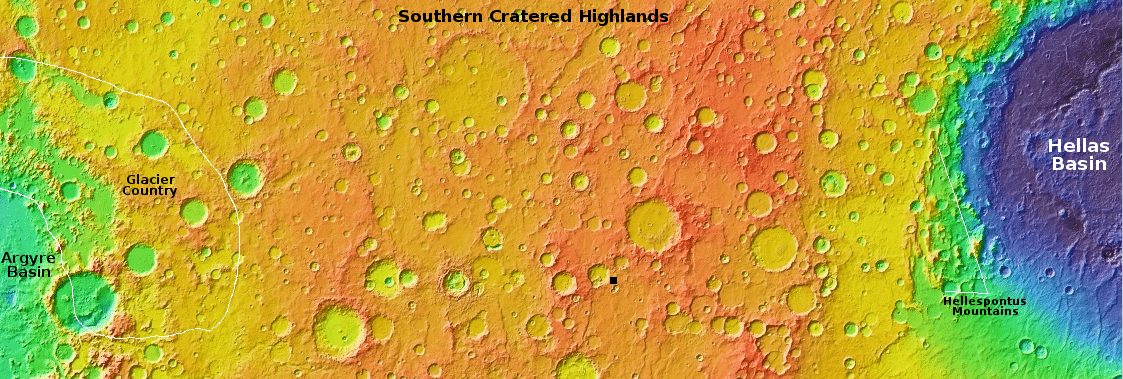
Overview map
From Argyre Basin to Hellas Basin is about 7,000 miles.

The peeling floor of a crater in the southern cratered highlands of Mars
Click for original image.

Cool image time! The picture to the right, rotated, cropped, reduced, and sharpened to post here, was taken on February 25, 2023 by the high resolution camera on Mars Reconnaissance Orbiter (MRO).

The scientists labeled this image “Crater fill”, but that hardly suffices. First, the fill appears at first glance to resemble peeling paint. At closer inspection, rather than peeling paint we have instead a collection of ridges vaguely resembling cave rimstone dams that either enclose a blob-shaped region or simply meander about until they reach the crater’s interior rim.

The crater interior itself appears largely filled with material so that its rims are subdued. The location, as indicated by that black dot near the center of the overview map above, marks the location at 49 degrees south latitude, in the middle of the cratered southern highlands of Mars where many craters have strangely eroded interiors.

What makes this crater however more puzzling is that none of the surrounding nearby craters look like this. A context camera image taken March 23, 2019 shows that while some of the nearby craters have what appears to be glacial material in their interiors, none exhibit these meandering ridges. This crater stands unique, for reasons that are utterly unknown.

Are these ridges a manifestation of the glacial material filling the crater? Or are they bedrock sticking up through that glacial debris? Your guess is as good as mine.

3 comments

Ingenuity in close-up after two years on Mars

Ingenuity in close-up after two years on Mars
Click for original image, with more information about it here.

With the Mars rover Perseverance now only about seventy-five feet away from the helicopter Ingenuity, the closest the two robots have been on Mars since Ingenuity was deployed in April 2021, the science team used Perseverance’s high resolution camera to take a new close up of the helicopter.

That picture, reduced and sharpened to post here, is to the right. From the caption:

Small diodes (visible more clearly in this image of helicopter) appear as small protrusions on the top of the helicopter’s solar panel. The panel and the two 4-foot (1.2-meter) counter-rotating rotors have accumulated a fine coating of dust. The metalized insulating film covering the exterior of the helicopter’s fuselage appears to be intact. Ingenuity’s color, 13-megapixel, horizon-facing terrain camera can be seen at the center-bottom of the fuselage.

This close-up is important to determine the overall state of the helicopter after two years on Mars. The engineering team that operates it does not know how much longer Ingenuity can last, so any data on its condition is extremely helpful.

That fine coat of dust on the panel and the rotors tells us that even flight and fast-rotating motion is not enough to keep such things clean on Mars. Thus we learn that there is likely no quick solution to the accumulation of dust on solar panels on Mars.

5 comments

Rocket Lab introduces a suborbital version of its Electron rocket for hypersonic flight testing

Rocket Lab today announced the availability of a suborbital version of its Electron rocket, dubbed HASTE, designed to do frequent hypersonic flight tests, with its first commercial flight scheduled in the first half of this year.

HASTE is evolved from Rocket Labโ€™s flagship Electron launch vehicle, which has been providing reliable access to orbit since 2018 and has successfully deployed satellites for NASA (National Aeronautics and Space Administration), the NRO (National Reconnaissance Office), DARPA (Defense Advanced Research Projects Agency) and the U.S. Space Force. HASTE employs the same innovative carbon composite structure and 3D printed Rutherford engines as Electron but has a modified Kick Stage for hypersonic payload deployment, a larger payload capacity of up to 700 kg / 1,540 lbs, and options for tailored fairings to accommodate larger payloads.

It appears that Rocket Lab is attempting to grab market share from Stratolaunch’s Roc/Talon hypersonic testbed, which is gearing up to do its own first hypersonic test flights this year.

3 comments

Lockheed Martin tests in-orbit cubesat rendezvous

Using two cubesats released separately after launch, Lockheed Martin has successfully tested maneuvering and rendezvous in space.

The two cubesats, each the size of a toaster, were deployed 300 kilometers above geostationary orbit from a ring-shaped secondary payload that carried multiple smallsats. They were released three days apart about 750 kilometers away from each other and a month later they were navigating within 400 meters of each other, Karla Brown, Linuss program manager, told reporters during a news conference at Lockheed Martinโ€™s technology center at the Catalyst Campus.

One of the cubesats performed the role of servicing vehicle and the other was the resident space object. She said she expects the satellites to come even closer, to about 200 meters as the experiment continues. The more significant goal that was accomplished was proving AI algorithms that would be needed to perform a space servicing mission, Brown said.

Maybe the most interesting aspect of this project however is how it is funded. This is old-fashioned R&D (research & development), funded not by the government but by Lockheed Martin as part of a a suite of related in-space servicing projects. Before the arrival of the military-industrial complex post World War II, such work was always paid for in house by the private sector. This commercial R&D was often given great freedom to experiment, in the hope that it would result in new products producing profits.

With the arrival of lots of government money in the 1950s and 1960s, that private R&D money dried up. Big space companies would instead only do the research and development that was funded by the government, either by NASA or the Pentagon. As a result, innovation dried up as well.

The return of private R&D likely means we shall once again see more innovation, since it will once again be done to search out new innovative ways to do things.

9 comments

Orbit Fab raises $28.5 million in private investment capital

The satellite servicing company Orbit Fab has raised $28.5 million in private investment capital, adding to the $21 million it had already obtained from contracts with the U.S. military.

Orbit Fab’s goal is very specific, to provide refueling services for satellites of all types. To encourage companies to sign on to its service, it markets its own refueling port that satellite companies can add to their satellites.

The company hopes to fly its first of three test refueling missions for the military next year.

0 comments
1 138 139 140 141 142 196