India’s PSLV rocket successfully launches two Singapore satellites

India’s PSLV rocket today successfully put two Singapore satellites into orbit, one a radar satellite and the other a large cubesat testing smallsat communication technologies.

The leaders in the 2023 launch race:

25 SpaceX
16 China
6 Russia
3 Rocket Lab
3 India

American private enterprise still leads China 28 to 16 in the national rankings, and is tied at 28 with the entire world combined.

1 comment

The view from the racecar of the Le Mans race course, as seen in 1968

An evening pause: From the youtube page:

This amazing piece of ground breaking onboard footage allows us to ride onboard one of the Gulf sponsored JWA Ford GT40s for a lap of the Le Mans circuit in 1968. This early onboard coverage was such a big deal, Stirling Moss does the narration. Its cool to see the Le Mans circuit as it was, without chicanes and with primitive safety features.

Hat tip Tom Biggar.

10 comments

April 21, 2023 Quick space links

Courtesy of BtB’s stringer Jay.


Next, a whole bunch of post-flight items relating to the Starship/Superheavy test launch:

The last story from Politico suggests first that the Biden administration and the federal bureaucracy fully intends to treat SpaceX and Starship/Superheavy differently than all other rocket startups, and second Politico is all-in on that effort.

19 comments

Starship/Superheavy did not explode!

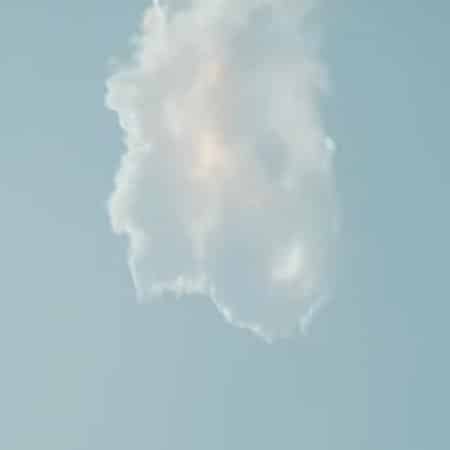
Starship/Superheavy at T+4:02, just after the self-destruct command was issued
Starship/Superheavy at T+4:02, just after the self-destruct command
was issued

In the past twenty-four hours we have another wonderful demonstration of the utter bankruptcy of the American press in the manner in which it has decided to describe yesterday’s first test launch of Starship/Superheavy. Here are just a few headline examples:

Every single one of those headlines implies that the explosion was the launch’s failure. If you read the linked articles you find that many repeat that implication in their reports.

None are correct. » Read more

37 comments

The strange terrain in the basement of Mars

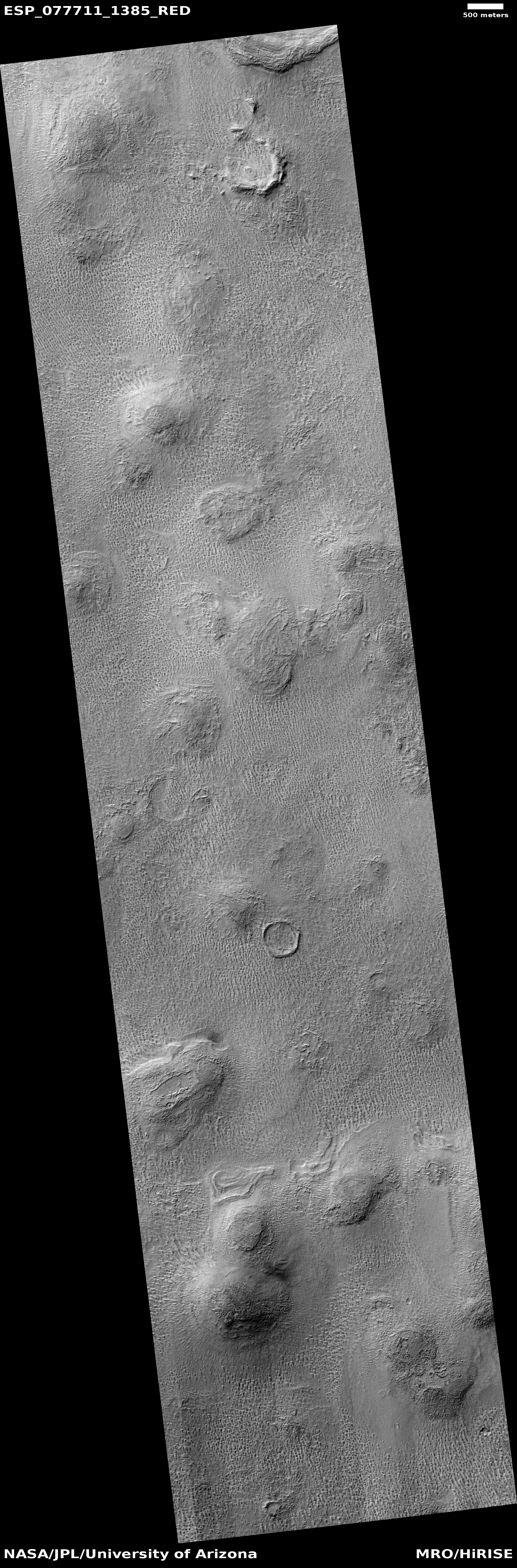
Strange terrain inside Hellas Basin
Click for original image.

I’ve posted numerous cool images about the weird and alien terrain found routinely in what is Mars’ death valley, Hellas Basin. Today is no different. The picture to the right, rotated, cropped, reduced, and sharpened to post here, was taken on February 23, 2023 to fill a gap in the schedule of the high resolution camera on Mars Reconnaissance Orbiter (MRO). Thus, it isn’t linked to any particular research, and its target was chosen by the camera science team almost at random.

What it shows is a strangely striated plain interspersed with rounded mesas and partly buried craters. The shape of the striations suggests that they were formed from wind blowing consistently from the north. This hypothesis is reinforced by the material that seems piled up at the base of the two bottom mesas, as if it was blown there.

Is ice or lava however?
» Read more

2 comments

India’s Modi government releases its new space policy

After some hints in the past month that the not-yet-released new space policy of the Modi government of India would favor commercial space over the government agencies that have run India’s space program from inception, the newly released space policy [pdf] confirms those hints.

Essentially, the policy transfers power from India’s space agency ISRO — which has always controlled all Indian launches and space development — to other government agencies, which in turn are tasked not to develop new space projects but to “ensure a level playing field for the utilization of all facilities created using public expenditure, by prioritizing their use among Government entities and [private companies].”

The policy is unlike any government document I have ever read from India. It is short, direct, clearly written, and to the point. It clearly takes control of space from ISRO and gives supervisory control to two new agencies, the Indian National Space Promotion & Authorisation Centre (IN-SPACEe) and NewSpace India Limited (NSIL), both of which are tasked to encourage the development of an independent private commercial space industry.

The policy is of course not perfect, as the power of the government bureaucracy in India is deep and wide. ISRO still has the task of developing new space technologies, such as India’s human spaceflight program. Whether it will be required to slowly become a customer of commercial resources rather then being the builder of its own we shall have to wait and see. NSIL in turn has been given ISRO’s past commercial responsibilities — such as launching rockets for profit — so that that the government bureaucracy can still compete with the private sector for market share.

All in all, however, it appears that the Modi government wishes to mimic the changes that have occurred in the U.S., transitioning from a government-run space program to a privately owned space industry from which the government buys what it needs (as outlined in my 2017 policy paper Capitalism in Space).

0 comments

Scientists predict solar maximum to arrive one year early

The scientists whose prediction of a more active upcoming solar maximum that has so far turned out more accurate than the consensus prediction have now updated their prediction, lowering it somewhat but also predicting the maximum will occur one year early, in 2024 instead of 2025.

The team’s finalized forecast for the current cycle expects it to peak in late 2024, one year earlier than NASA and NOAA had predicted. The cycle, the team thinks, will reach about 185 monthly sunspots during its maximum and thus be somewhat milder than what the team originally forecasted. This peak intensity will place this cycle at about the average compared to the historical record.

In other words, now that we are about halfway to maximum, they have concluded that while NOAA’s prediction was too low, their prediction was too high. They have now adjusted their expectations to be closer to what they now think will happen.

A short solar cycle however has historically corresponded to much higher sunspot activity. If this new prediction is correct (a short cycle with a mild maximum), it will mean that the Sun is still behaving in ways that the solar science community does not understand, or can predict.

4 comments

A spray of small impacts melting Martian ice?

A spray of small impacts melting Martian ice?

Cool image time! The picture to the right, cropped and reduced to post here, was taken on March 2, 2023 by the high resolution camera on Mars Reconnaissance Orbiter (MRO), and was taken not as part of any specific research request but by the MRO science team to fill a gap in its schedule while also maintaining the camera’s temperature. Sometimes these somewhat random times show nothing of interest. Sometimes they are fascinating, as in this case.

The photo shows what appear to be a spray of small impacts on an easily melted surface. Imagine spraying hot molten lava on a sheet of ice. Instead of creating a crater with an upraised rim, on impact each droplet would quickly melt a hole.

Did these small impacts all occur at the same time? My guess is yes, based on the overview map below.
» Read more

4 comments

New research expands lethal zone around supernovae

According to data collected from a number of orbiting space X-ray telescopes, astronomers now believe that the lethal zone for nearby habitable planets when a supernova explodes is much larger than previously thought, as great as almost 200 light years.

The calculations in this latest study are based on X-ray observations of 31 supernovae and their aftermath mostly obtained from Chandra, NASA’s Swift and NuSTAR missions, and ESA’s (European Space Agency’s) XMM-Newton. The analysis of these observations shows that there can be lethal consequences from supernovae interacting with their surroundings, for planets located as much as about 160 light-years away. “If a torrent of X-rays sweeps over a nearby planet, the radiation would severely alter the planet’s atmospheric chemistry,” said Ian Brunton of the University of Illinois at Urbana-Champaign who led the study. “For an Earth-like planet, this process could wipe out a significant portion of ozone, which ultimately protects life from the dangerous ultraviolet radiation of its host star.”

You can read the paper here [pdf], which includes a figure that suggests in certain circumstances the lethal zone can be 200 light years across. As the scientists note:

Perhaps the most interesting results are the distances at which the X-ray emission can impose lethal effects on an Earth-like biosphere. This larger range of influence has consequences for the Galactic habitable zone, such as the harmful implications for recently discovered exoplanets that would be susceptible to nearby [supernovae].

In other words, this data suggests the galaxy is far less hospitable to the development of life. It takes a lot of time for life to evolve, billions of years, and during that time a solar system traveling through the galaxy has now a much higher chance of passing too close to a supernova explosion.

9 comments
1 136 137 138 139 140 196