Cracks in Martian lava

Cracks in Martian lava
Click for original image.

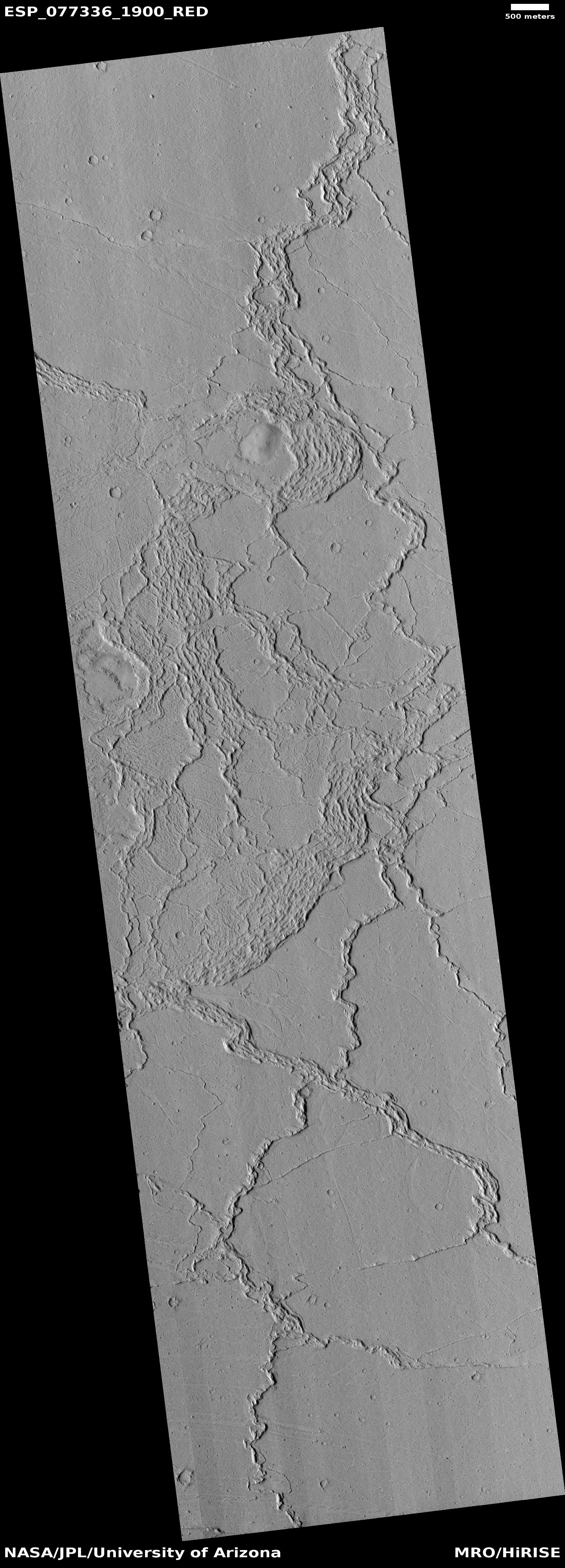
Cool image time! The picture to the right, rotated, cropped, and reduced to post here, was taken on January 25, 2023 by the high resolution camera on Mars Reconnaissance Orbiter (MRO). It was taken not as part of any specific research project, but to fill a gap in MRO’s picture-taking schedule in order to maintain the camera’s temperature. When such pictures need to be taken, the camera team tries to find something of interest in the area to be shot. Sometimes the picture is boring. Sometimes fascinating. Today’s picture I think falls into the latter category.

This is a lava flood plain, as shown in the overview map below. The meandering ridges are likely what geologists call lava dikes, places where lava was extruded out through a fissure. This suggests that the flat flood lava was an older crust, and that there was hot molten lava below it that eventually pushed its way up through cracks in that crust.

This hypothesis however is not certain, as the meandering nature of the ridges does not correspond well with what one would expect from such crustal cracks.
» Read more
0 comments

Webb finds another galaxy in early universe that should not exist

The uncertainty of science: Scientists using the Webb Space Telescope have identified another galaxy about 12 billion light years away and only about 1.7 billion years after the theorized Big Bang that is too rich in chemicals as well as too active in star formation to have had time to form.

SPT0418-SE is believed to have already hosted multiple generations of stars, despite its young age. Both of the galaxies have a mature metallicity โ€” or large amounts of elements like carbon, oxygen and nitrogen that are heavier than hydrogen and helium โ€” which is similar to the sun. However, our sun is 4.5 billion years old and inherited most of its metals from previous generations of stars that were eight billion years old, the researchers said.

In other words, this galaxy somehow obtained complex elements in only 1.7 billion years that in our galaxy took twelve billion years, something that defies all theories of galactic and stellar evolution. Either the Big Bang did not happen when it did, or all theories about the growth and development of galaxies are wrong.

One could reasonably argue that this particular observation might be mistaken, except that it is not the only one from Webb that shows similar data. Webb’s infrared data is challenging the fundamentals of all cosmology, developed by theorists over the past half century.

13 comments

ISRO successfully de-orbits defunct satellite

Last orbit of MT1

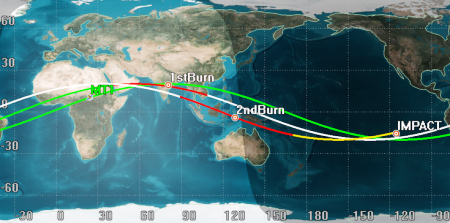
ISRO announced today that it successfully de-orbited the defunct Earth observation MT1 satellite on March 7, 2023, bringing it down over the Pacific Ocean.

The map to the right shows the timing of the last two de-orbit burns during the satellite’s last orbit.

MT1’s orbit was high enough so that it would have remained in space for about 100 more years, with a lot of fuel that might have caused an explosion and the release of many pieces of space junk. ISRO managers decided to allocate the funds to use that fuel to de-orbit it, as a test for making this a routine part of any satellite end-of-mission.

0 comments

Post-Artemis-1 report: heat shield ablated more than expected; power system issued unexpected commands; damage to launchpad

In a March 7, 2023 briefing, NASA officials provided an overall report of what happened during the first SLS launch, noting that there were some minor engineering issues but none that appeared to them significant.

The biggest issue of note was the Orion heat shield.

Howard Hu, Orion program manager at NASA, said that material on the heat shield had ablated differently than what engineers expected from ground tests and computer models. โ€œWe had more liberation of the charred material during reentry than we had expected,โ€ he said. Engineers are just beginning detailed analysis of the heat shield to determine why it behaved differently than expected.

The amount ablated was well within safety margins, but engineers still do not understand why the material behaved differently than expected.

Engineers are also trying to understand why the power system of the Orion service module issued unplanned commands, several times opening what officials called a “latching current limiter.” This action caused no problems to the capsule’s operations, but it is concerning it occurred.

The launch also did more damage to the mobile launcher tower than expected.

According to NASA officials, none of these issues will delay the planned November 2024 launch date for the Artemis-2 mission, the first intended to carry humans.

0 comments

Watching the first launch attempt of Relativity’s Terran-1 rocket

I have embedded below the live stream of the first launch attempt by the rocket startup Relativity today of its 3D-printed Terran-1 smallsat rocket, with a launch window of three hours beginning at 1 pm (Eastern). The live stream begins about an hour before launch.

The first launch of a new rocket is exceedingly challenging, and almost never succeeds. The key however is the data obtained that can be used to make the next launch attempt a success.

A lot rides on this launch. Relativity already has obtained $1.2 billion in launch contracts plus more than $1 billion in private investment capital, despite having never launched anything. Moreover, the Terran-1 rocket is really a prototype for its larger Terran-R rocket, which is intended to compete directly for the larger payloads that companies like SpaceX and ULA launch.
» Read more

0 comments

March 7, 2023 Quick space links

Courtesy of BtB’s stringer Jay.


4 comments

Flat-topped mesas in the icy northern lowland plains of Mars

Flat-topped Martian craters
Click for full image.

Cool image time! The picture to the right, cropped and rotated to post here, was taken on December 27, 2022 by the high resolution camera on Mars Reconnaissance Orbiter (MRO), and shows what the scientists have labeled “flat topped hills in Utopia Planitia.”

Utopia Planitia is the largest impact basin on Mars, approximately 2,100 miles across and located in the northern lowland plains.

Orbital evidence strongly suggests it is a region with a lot of near surface ice. The picture to the right reinforces that conclusion, as the entire flat plain surrounding these buttes appears like an ice field. Moreover, the full image shows many craters filled with glacial features, most of which also have softened features, as if with time the ice that impregnates their material has sublimated away.
» Read more

0 comments

America’s blacklist culture: Republican in Florida proposes bill to regulate speech

Jason Brodeur: Republican politician in love with restricting free speech
Jason Brodeur: Republican politician in love with
restricting free speech

They’re coming for you next: The desire of people in our culture today to control and regulate the behavior of everyone else is not a partisan thing. Though the Democrats and their leftist allies have certainly led the way in blacklisting, censoring, and destroying anyone who disagrees with them, Republican politicians are just as likely to try to use their power to squelch opposition, and should never be trusted either.

Today we have a perfect example of this non-partisan lust for power. On March 7, 2023, Florida Republican state senator Jason Brodeur introduced a bill that would amend state law to require all websites to register with the government if they made any money reporting on government actions.

You can read the bill here. The underlined portions are the sections that Brodeur wishes to add to the law. The key paragraphs state the following:
» Read more

2 comments

Fuel spill cleanup begins at Space Force telescope facility in Maui, Hawaii

The cleanup of the diesel fuel spill that occurred on January 29, 2023 at Space Force telescope facility on the top of the dormant volcano Haleakala on the island of Maui in Hawaii began last week.

Samples of the soil will be sent for testing to determine that it has been excavated to a depth that captures all the diesel fuel, the Air Force said. All the soil from those test samples, as well as the mass of earth removed, will be stored, cleaned and returned to the ground, according to the approved plan.

Hawaiians regard Haleakalaโ€™s summit as sacred and that no soil or stones should be removed from the site.

The facility is used by the U.S. military to track orbiting objects, from satellites to space junk.

1 comment

UK awards $1.9 million in development grants to universities and private companies

The space agency of the United Kingdom today announced the award of nearly $1.9 million in grants to six universities and two private companies to do a variety of space engineering research.

The stated goal of the grants is to encourage the growth of a private space sector in the UK, as stated by one official in the press release:

Todayโ€™s funding is part of the governmentโ€™s strategy to use our ยฃ5 billion investment in space science and technology to grow our ยฃ16.5 billion commercial space sector to create the businesses, jobs and opportunities of tomorrow, and the space clusters from Cornwall to Scotland.

The university research from these grants will thus hopefully produce viable products that the researchers can then use to establish private space companies.

0 comments

South Korea commits $38 million to support space startups

The South Korean government has now established a space investment fund committed to raising $38 million to support startups in its nascent private space industry.

It will be interesting to see which management companies are selected to operate the fund and how the investment process will work. This initiative can potentially create exciting new opportunities for startups, entrepreneurs, researchers, and other stakeholders in the space industry and position South Korea as a leader in this field.

…The Korean Ministry of Science and ICT plans to invest 5 billion won [$3.8 million] this year to create a fundraising fund. The goal of creating a total fund of more than 50 billion won [$38 million] by 2027 is ambitious and demonstrates the governmentโ€™s commitment to promoting private investment in the space industry.

It is very unclear what this project entails. Will the government budget the investment capital, or is it establishing a private venture capital investment firm that will in turn seek out the money from the private sector?

Either way, it appears the South Korean government wants to encourage the growth in a private commercial space industry.

0 comments
1 160 161 162 163 164 196