Curiosity’s most recent cloud campaign

A cloud on Mars
Click for original image.

On January 30, 2023 I posted the picture to the right, taken by the high resolution camera on the Mars rover Curiosity. The picture was part of their ongoing cloud survey, running from January to March ’23 and using the rover’s hi-res camera to look for clouds during twilight. Today the rover science team issued a press release describing some of the results of that campaign. For example, on February 2nd the rover captured a sunset with sun rays, sunlight illuminating the bottom of clouds after the Sun has set. The release also provided this explanation for the cloud on the right.

In addition to the image of sun rays, Curiosity captured a set of colorful clouds shaped like a feather on Jan. 27. When illuminated by sunlight, certain types of clouds can create a rainbowlike display called iridescence. “Where we see iridescence, it means a cloud’s particle sizes are identical to their neighbors in each part of the cloud,” said Mark Lemmon, an atmospheric scientist with the Space Science Institute in Boulder, Colorado. “By looking at color transitions, we’re seeing particle size changing across the cloud. That tells us about the way the cloud is evolving and how its particles are changing size over time.”

In the case of Mars, the clouds are not made of liquid water droplets like on Earth, but ice particles, sometimes water and sometimes dry ice.


0 comments

Newly discovered comet could be brightest object in sky in October ’24

Comet Tsuchinshan-ATLAS, discovered simultanuously by telescopes in China and South Africa, has the possibility of becoming brightest object in sky when it makes its closest approach to the Earth in October 2024.

As viewed from Earth, the comet may be as luminous as the brightest stars in the sky during its upcoming flyby, according to EarthSky. This is brighter than the green comet C/2022 E3 that just passed by Earth in January. That comet had a brightness of around magnitude +4.6, just visible to the naked eye. The new comet may have a brightness of magnitude 0.7, potentially peaking at magnitude -5, similar to Venus at its brightest.

The comet is presently between Jupiter and Saturn. Its 80,000 year long orbit will make its next close approach to the Sun on September 28, 2024.

Whether this will become a naked eye object of beauty of course remains totally uncertain. Its orbit, which appears stable but with rare swings past the Sun, suggests it will have lots of ice to sublimate into a bright tail. This also suggests the comet will survive this close approach without breaking up, since it has likely done this frequently in the past.

At the same time, the brightness of comets is unpredictable. We won’t really know how bright it will become until it is on it approach to the Sun, in the early fall of 2024.

6 comments

Japan’s new H3 rocket’s second stage fails during first launch

Japan’s new H3 rocket failed today on its first launch when something went wrong at second stage ignition, after separation from first stage.

Once controllers realized the rocket would not reach orbit, they initiated a self-destruct sequence, ending the mission.

This is very bad news for Japan’s space effort. Right now it does not have a viable competitive commercial rocket industry. All rocket construction is supervised and controlled by its space agency JAXA, which almost exclusively uses Mitsubishi to build what it wants. With the H3 failing (built by Mitsubishi) and the H2A and H2B (both also built by Mitsubishi) slated for retirement, JAXA does not have a rocket it can use for future missions.

1 comment

March 6, 2023 Quick space links

Courtesy of BtB’s stringer Jay.

  • Branson pumps another $5 million into Virgin Orbit
  • Branson has now invested $60 million in Virgin Orbit since November 2022 in order to keep the company above water because delays with licensing at the UK bureaucracy prevented it from doing further launches in 2022. No launches, no revenue. And we now know for sure this is his reason, because his investment deal allows him to pull that money out at any time. Expect him to do so once Virgin Orbit begins flying again and making money.


0 comments

A blacklist victory? Professor wins million dollar settlement for being blacklisted

Daniel Pollack-Pelzner, blacklisted for being Jewish
Daniel Pollack-Pelzner, blacklisted for being
white, Jewish, and willing to speak the truth.

Today’s blacklist story is a followup on one from April 2022, in which Jewish English professor at Linfield University in Oregon, Daniel Pollack-Pelzner, was fired without due process because he reported the sexual misconduct of four of the university’s ten trustees. Before they fired him however school officials, including its university president and chair of the board of trustees Miles Davis, spewed anti-Semetic comments against him, including joking about sending Jews to gas chambers.

Pollack-Pelzner has now gotten some financial satisfaction in the courts, though hardly justice.

Linfield University has agreed to settle a lawsuit filed by former Professor Daniel Pollack-Pelzner for $1,037,500 in compensation for emotional distress, lost wages, and attorney fees.

The University insists that it is not admitting guilt and only wants to avoid further loss of “time and energy from the mission of the institution.” If so, it found a weird way of doing it. They have litigated this weak case for two years and were compelled to reach a seven figure settlement.

» Read more

2 comments

IBEX leaves safe mode and returns to full science operations

Engineers have restored the orbiting astronomy probe IBEX out of safe mode, returning it to full science operations after a computer issue on February 18, 2023 that prevented the spacecraft from accepting commands.

To take the spacecraft out of a contingency mode it entered last month, the mission team performed a firecode reset (which is an external reset of the spacecraft) instead of waiting for the spacecraft to perform an autonomous reset and power cycle on March 4. The decision took advantage of a favorable communications environment around IBEX’s perigee – the point in the spacecraft’s orbit where it is closest to Earth.

After the firecode reset, command capability was restored. IBEX telemetry shows that the spacecraft is fully operational and functioning normally.

As I noted previously, IBEX was designed to study the boundary between the interstellar space and the solar system, and do it somehow from Earth orbit.

0 comments

An inactive volcanic vent on Mars

An inactive volcanic vent on Mars
Click for full image.

Cool image time! The picture to the right, rotated, cropped, and reduced to post here, was taken on October 5, 2022 by the high resolution camera on Mars Reconnaissance Orbiter (MRO). Labeled by the science team as “Vents and Lava Flows on Flank of Pavonis Mons,” the section to the right shows the picture’s largest vent. The downhill grade is to the south.

In the full photo you can see that this vent sits on top of a flat mound of hardened lava, all of which flowed from the vent in the distant past. The main flow of course went to the south, out the channel and down the flanks of Pavonis Mons, the middle volcano in the line of three just to the west of Mars’ giant Valles Marineris canyon. The caldera peak of Pavonis Mons is about 35 miles away, and sits at a height of 47,000 feet elevation, far higher than Mount Everest but still only the fourth highest Martian volcano.

In the full picture, the entire surface also generally flows south, except for a crack that goes from northeast to southwest, possibly caused when the mountain flank sagged to the south.
» Read more

2 comments

A confused spiral galaxy

An irregular spiral galaxy

Cool image time! The picture to the right, cropped and reduced to post here, was taken by the Hubble Space Telescope and released today. From the caption:

The irregular spiral galaxy NGC 5486 hangs against a background of dim, distant galaxies in this image from the NASA/ESA Hubble Space Telescope. The tenuous disc of the galaxy is threaded through with pink wisps of star formation, which stand out from the diffuse glow of the galaxy’s bright core. While this particular galaxy has indistinct, meandering spiral arms it lies close to the much larger Pinwheel Galaxy, one of the best known examples of ‘grand design’ spiral galaxies with prominent and well-defined spiral arms. In 2006 Hubble captured an image of the Pinwheel Galaxy which was — at the time — the largest and most detailed photo of a spiral galaxy ever taken with Hubble.

This galaxy is defined I think as an irregular spiral because if you look close, you can see a very faint hint of a central bar and two large arms spiraling away at its ends. It is faint however, and might simply be caused by the human mind’s natural desire to see patterns. To my eye this galaxy could just as well be a patchy elliptical galaxy, with no arms at all.

0 comments

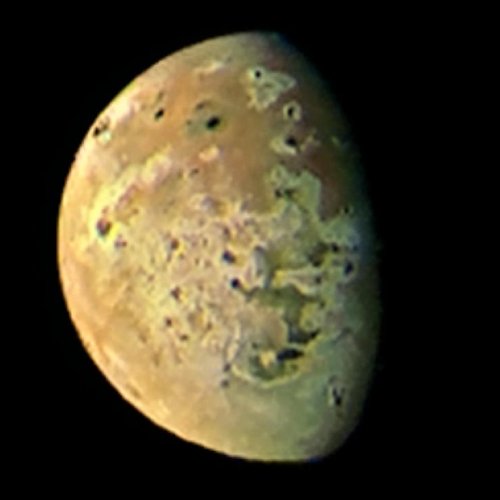
Juno captures close-up images of Jupiter’s moon Io

Io as seen by Juno

On March 1, 2023 the Jupiter orbiter Juno passed within 33,000 miles of the gas giant’s moon Io, getting its first close-up images.

Several citizen scientists have processed those images. The photo to the right, cropped and reduced to post here, was created by Andrew R Brown. This particular picture was one of five taken by Juno during the fly-by. Jason Perry processed all five here, with this caption:

Most of the dark spots seen across Io’s surface are the result of volcanic eruptions. These include East Girru, a dark spot that was not seen the last time Io was seen at this resolution during the New Horizons encounter with Jupiter in February 2007. East Girru was undergoing a major eruption at the time but hadn’t had time to produce a new lava flow before the end of the week-long encounter. This small flow field, measuring 3,200 square kilometers (1,390 square miles) in size, may have also been reactivated during an eruption in October 2021, as seen by Juno JIRAM.

Another apparent surface change is at Chors Patera, which has undergone a significant reddening since Galileo last observed it in October 2001. Reddish materials on Io are indicative of the presence of short-chain sulfur and are often associated with high-temperature, silicate volcanism. Additional dark spots near the terminator, the boundary between Io’s day and night sides, are the shadows of tall mountains. The dark spot at middle right in the upper right image may be due a mountain 5500 meters (18,000 feet) tall.

The smallest object resolved in this image is about 22 miles across.

3 comments

ISRO attempting controlled reentry of old satellite originally lacking in such plans

India’s space agency ISRO has been attempting the controlled reentry of an old India-French climate satellite that had originally been placed in a high enough orbit that de-orbit was not expected.

An uninhabited area in the Pacific Ocean between 5°S to 14°S latitude and 119°W to 100°W longitude has been identified as the targeted re-entry zone for the [Megha-Tropiques-1 (MT1)]. Since Aug 2022, 18 orbit manoeuvres have been performed to progressively lower the orbit and on March 7 the ground impact is expected to take place between 4.30 p.m. and 7.30 p.m. IST.

The satellite, once no longer able to do its primary function, still had a lot of fuel left that left it a threat. ISRO managers decided to use that fuel to lower the high orbit — where MT1 was expected to remain for at least 100 years — so that the satellite could be brought down safely now.

The real story here is ISRO’s decision to commit funds to pay for this work. Until recently, most satellites are launched without any funding to remove them once launched. SpaceX changed this with its Starlink constellation, with deorbit always included as part of each satellite’s operational plan.

0 comments
1 161 162 163 164 165 196