American camera snaps picture of shadowed floor of Shackleton crater
floor of Shackleton Crater
Click for original image.

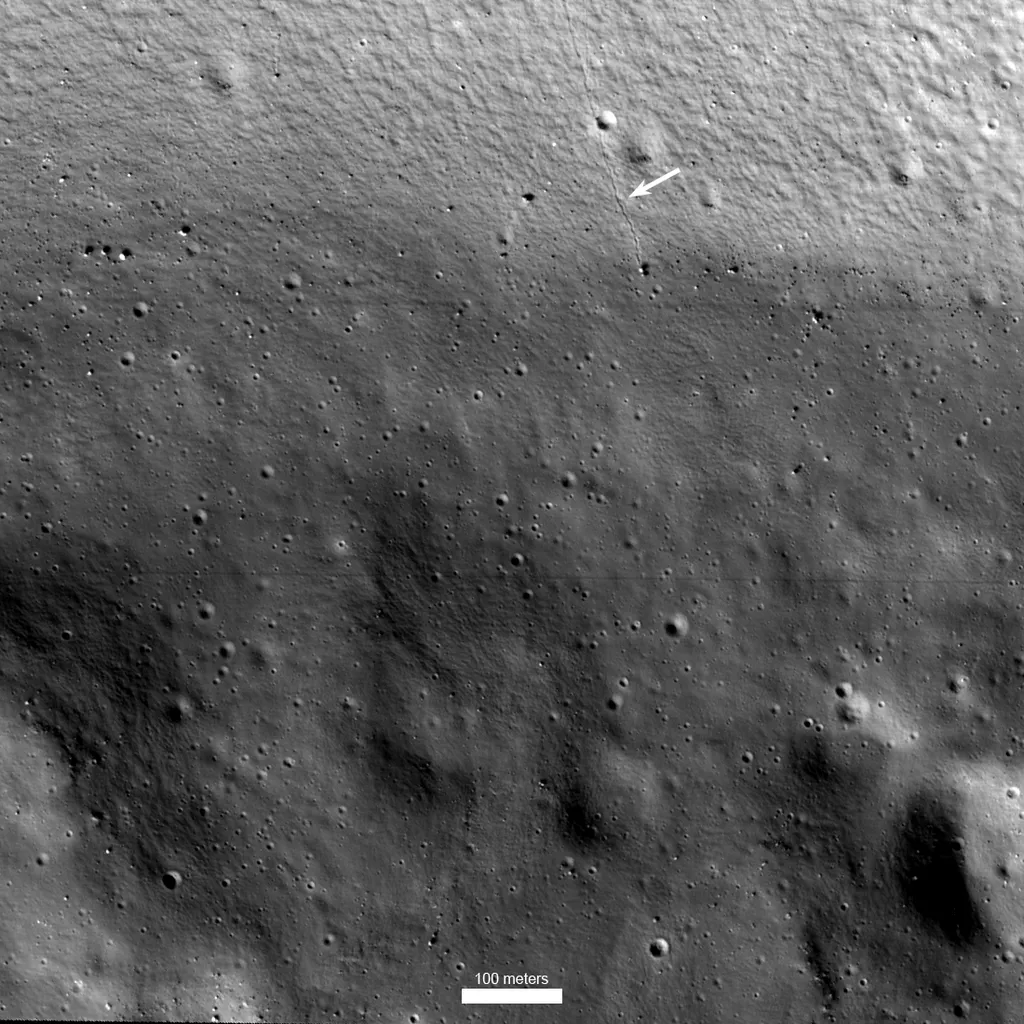
Using ShadowCam, a NASA-funded camera designed to take high resolution images of the permanently shadowed regions on the Moon, scientists have snapped the first picture of shadowed floor of Shackleton crater.

That image, reduced to post here, is to the right. I have added some labels to clarify what we are seeing. The arrow points to a boulder track caused when the boulder rolled down the crater rim slope.

The camera will be used to image the moon’s permanently shadowed regions with a resolution of better than 6.6 feet (2 meters) per pixel

ShadowCam is one of six instruments on the South Korean lunar orbiter, Danuri, which is now in lunar orbit and beginning its science phase. This was therefore only a successful test image to make sure the camera was working as planned.

Though the area photographed was in shadow (otherwise it would have saturated ShadowCam’s sensitive camera), this first image appears to show no ice at the base of the crater. This simply could be that this part of the crater floor is not permanently shadowed, but gets illuminated enough to melt off any ice. Or it could be that no ice exists in these places. We need to wait and see.
3 comments

Russia and Europe negotiating return of rockets and satellites

Russia and Europe have begun negotiations concerning the return of the various rockets and satellites that were left stranded in both countries when Russia invaded the Ukraine and all cooperative international agreements between the two entities broke off.

[I]n January 2023, an industry source told RussianSpaceWeb.com that Arianespace representatives were exploring a potential deal with Roskosmos on the exchange of Soyuz rocket components stranded in French Guiana for a group of 36 OneWeb satellites stuck in Baikonur Cosmodrome in Kazakhstan after the aborted 14th launch for the Internet constellation. The satellites were held at the Russian-controlled facility in Kazakhstan per the order by Rogozin, but the newly appointed head of the Roskosmos State Corporation Yuri Borisov was reportedly opened to negotiations on their fate.

There are many obstacles blocking this deal, the biggest being the on going war itself. It will be necessary to engineers to both places to facilitate the return, and the war right now makes that difficult if not impossible.

Ironically, Russia is likely in more need of this deal than Europe. OneWeb of course wants its satellites back, but it can replace them. Russia it appears is having trouble building complex things like rockets, and needs these rockets and components to replace components it no longer can get in the west.

1 comment

Saudi Arabia withdraws from Moon Treaty

On January 5, 2023, Saudi Arabia submitted its official withdrawal [pdf] from Moon Treaty, to be effective one year later.

The 1979 Moon Treaty is not the 1967 Outer Space Treaty, which almost all space-faring nations have signed. The Moon Treaty has been signed by almost no one because its language literally forbids private ownership.

In a sense, the Artemis Accords, which Saudi Arabia recently signed, is in direct conflict with the Moon Treaty, and no nation can really honor both. The Artemis Accords were designed by the Trump administration to get around the less stringent restrictions on private enterprise imposed by the Outer Space Treaty. That it has encouraged the Saudis to leave the Moon Treaty, however, suggests that the Artemis Accords might eventually cause a major abandonment of the Outer Space Treaty as well. To withdraw from such treaties up until now has been considered taboo. Saudi Arabia might have broken that spell.

If so, this action by the Saudis could be the best news for the future exploration and settlement of the solar system that has occurred in years, even more significant than that first vertical landing of a Falcon 9 rocket. It might finally force a major revision in the Outer Space Treaty so that each nation’s laws can be applied to its own colonies.

0 comments

Astronomers discover more than 800 new supermassive black holes

Using archival data from both the orbiting Chandra X-Ray telescope and the ground-based Sloan Digital Sky Survey telescope (SDSS), astronomers have discovered more than 800 new supermassive black holes hidden in the center of galaxies.

By systematically combing through the deep Chandra Source Catalog and comparing to SDSS optical data, the researchers identified 817 XBONG candidates, more than ten times the number known before Chandra was in operation. Chandraโ€™s sharp images, matching the quality of those from SDSS, and the large amount of data in the Chandra Source Catalog made it possible to detect this many XBONG candidates. Further study revealed that about half of these XBONGs represent a population of previously hidden black holes.

The key to this discovery is the use of telescopes observing in different wavelengths, X-rays with Chandra and optical with SDSS. Combined the data showed evidence of the hidden supermassive black holes.

2 comments

January 11, 2023 Quick space links

Courtesy of BtB’s stringer Jay.


2 comments

A collapse on Mars

A collapse on Mars
Click for full image.

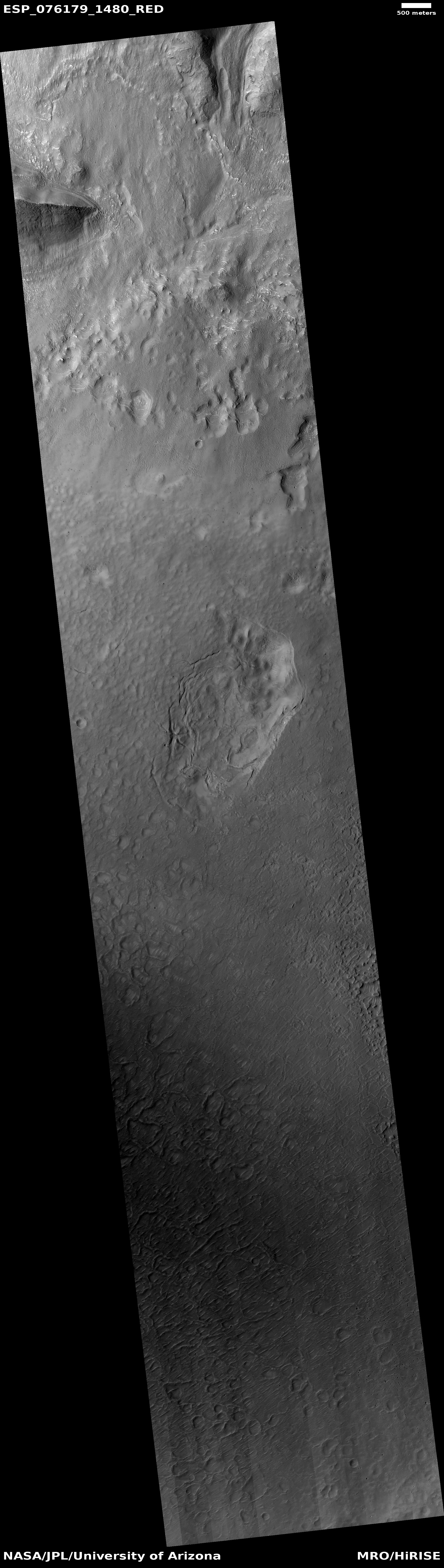
The photo to the right, cropped, reduced, and enhanced to post here, was taken on October 27, 2022 by the high resolution camera on Mars Reconnaissance Orbiter (MRO). The full photo was simply labeled as a “collapse feature”, and because it contained a few other sinks to the north beyond the top edge of this cropped picture, it is unclear if the scientists were referring to this sink in particular.

This sink is the most interesting however, because it really looks like something had sucked material out from below, causing the surface crust to fall downward, intact except for some cracks along the perimeter of the collapse.

The overview map below as always provides some context that might explain what we are seeing.
» Read more

0 comments

A new hotspot map of Io, based on Juno data

Hot spot map of Io
Click for original figure.

Scientists have compiled a new map of the many volcanic hotspots on the Jupiter moon Io, based on data obtained by Juno, including 23 spots previously undetected. From the paper’s abstract:

We mapped the hot spot distribution on Io’s surface by analyzing the images acquired by the JIRAM instrument onboard the Juno spacecraft. We identified 242 hot spots, including 23 not present in other catalogs. A large number of the new hot spots identified are in the polar regions, specifically in the northern hemisphere. The comparison between our work and the most recent and updated catalog reveals that JIRAM detected 82% of the most powerful hot spots previously identified and half of the intermediate-power hot spots, thus showing that these are still active. JIRAM detected 16 out of the 34 faint hot spots previously reported.

The map above is taken from figure 2 of the paper. The data, when compared to other earlier data, confirms that many of these hot spots are long-lived, and have been erupting now for decades.

1 comment

Ingenuity about to fly up onto the delta

Overview map
Click for interactive map.

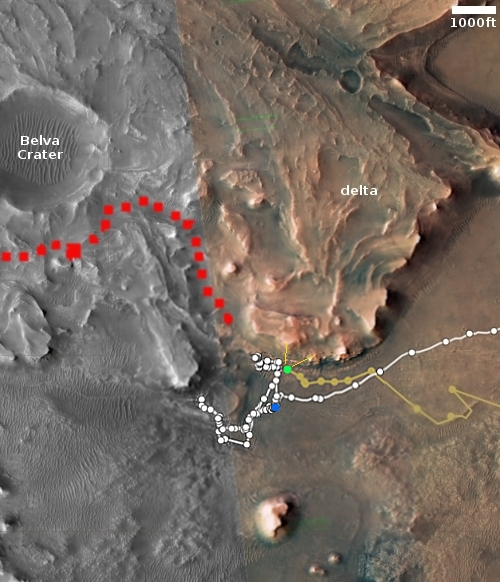
The engineering team that operates the helicopter Ingenuity on Mars announced today that the next flight, #39, will go about 456 feet and travel to the northeast.

The green dot on the map to the right shows Ingenuity’s present location. The yellow lines indicate the territory within which this flight will head. If successful it will be the first time the helicopter has left the floor of Jezero Crater, and moved uphill onto the delta that flowed into that crater sometime in the far past.

The blue dot marks Perseverance’s present location. The dotted red line indicates its eventual planned route on that delta.

The engineers state that their flight goal is to “flight test new software”. This new software is supposed to allow Ingenuity to fly over rougher terrain. On the 38th flight, it proved its worth by not only flying over an area of rippled sand dunes, it landed between two.

This next flight, scheduled for sometime today, will be even more challenging, because the helicopter will have to fly upward above higher terrain.

0 comments

World View gets new lease from Pima County

Because the original lease was ruled unconstitutional under the Arizona state constitution, Pima County yesterday approved a new lease for the high altitude balloon company World View.

The original deal had the county build the building. World View would lease it for 20 years, guarantee employment of 400 people, and then buy the facility for $10 at the end of the lease. This was ruled unconstitutional.

Lesher said [the new lease] will give the county more flexibility and a safeguard when it comes to those terms and theyโ€™ll be able to base the appraisal price on a percentage of the fair market value. Another big change โ€“ the employee benchmark has been significantly lowered. In the original contract, World View was required to hire 400 workers, now thatโ€™s down to 125.

Until more details are provided, it is unclear what has changed to make the new deal acceptable to the courts. I suspect the big change is that World View will not have an option to buy for $10.

5 comments

TESS finds a second Earthsize planet orbiting in the habitable zone of a star

TESS solar system

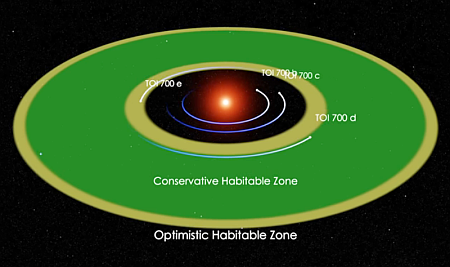
The orbiting survey telescope TESS has discovered a second Earthsize planet in a solar system of four exoplanets.

The graphic to the right, a screen capture from a short video provided by the press release, shows these four exoplanets. Planet D had previously been discovered. Planet E is the new discovery, and is thought to be 95% Earth’s mass and likely terrestrial in make-up. Both are near the inner edge of the habitable zone.

TOI 700 is a small, cool M dwarf star located around 100 light-years away in the southern constellation Dorado. In 2020, Gilbert and others announced the discovery of the Earth-size, habitable-zone planet d, which is on a 37-day orbit, along with two other worlds.

The innermost planet, TOI 700 b, is about 90% Earthโ€™s size and orbits the star every 10 days. TOI 700 c is over 2.5 times bigger than Earth and completes an orbit every 16 days. The planets are probably tidally locked, which means they spin only once per orbit such that one side always faces the star, just as one side of the Moon is always turned toward Earth.

This discovery only underlines the infinite possibilities and variables that exist for life on other worlds. These planets might be similar in mass to the Earth and get about the same heat/light energy from their sun, but the star is very different, their orbits are very different, and their environment is very different.

3 comments
1 189 190 191 192 193 196