
Leaking Soyuz to return empty; Unmanned Soyuz to be launched to replace it

The Russians announced today the plan to deal with the leaking Soyuz capsule on ISS as well as provide transportation back to Earth for its three astronauts.

First, the damaged Soyuz will return empty to Earth. Second, the next Soyuz will be launched in February unmanned so that it can bring back all three astronauts. Their mission however will likely be extended. Instead of returning in March as planned, they will stay in orbit until September, when that capsule was originally going to return to Earth. If this happens, it means their flight will end up being about a full year long. For the American in that crew, Frank Rubio, this could mean he will set a new American record for the longest spaceflight.

The Russians also added these details about the puncture in the Soyuz, which is believed to have been caused by a meteor:

According to calculations, a hole in the instrument compartment of the spacecraft, observed with a camera of the American ISS Segment, could be caused by a one-millimeter particle striking the vehicle with a speed of around 7,000 meters per second. Borisov also said that a possibility of a manufacturing defect in the radiator system of Soyuz MS-22 had also been evaluated but had not been confirmed.

4 comments

ABL’s first launch attempt fails

The first launch of ABL’s RS1 rocket failed yesterday when the first stage engines shut down right after liftoff so that the rocket fell back onto the launchpad and exploded.

The company said in subsequent updates that the nine engines in its first stage shut down simultaneously after liftoff, causing the vehicle to fall back to the pad and explode. The company did not disclose when after liftoff the shutdown took place or the altitude the rocket reached. The explosion damaged the launch facility but no personnel were injured.

This rocket startup has raised several hundred million dollars, with its chief investor Lockheed Martin, which has also signed a contract for as many as 58 RS1 launches.

1 comment

Starlink and National Science Foundation sign deal coordinating spectrum use

SpaceX and the National Science Foundation (NSF) today signed an agreement coordinating the use of radio spectrum so that Starlink satellites will not interfere with radio astronomy.

The National Science Foundation (NSF) and SpaceX have finalized a radio spectrum coordination agreement to limit interference from the company’s Starlink satellites to radio astronomy assets operating between 10.6 and 10.7 GHz. The agreement, detailed in a statement released by NSF today, ensures that Starlink satellite network plans will meet international radio astronomy protection standards, and protect NSF-funded radio astronomy facilities, including the National Radio Astronomy Observatory (NRAO) and the Green Bank Observatory (GBO).

This deal was part of a larger negotiation with the entire astronomy community to limit the problems caused to astronomy by the 3,000-plus Starlink satellites presently in orbit. These other actions include

…continuing to work to reduce the optical brightness of their satellites to 7th visual magnitude or fainter by physical design changes, attitude maneuvering, or other ideas to be developed; maintaining orbital elevations at ~700 km or lower; and providing orbital information publicly that astronomers can use for scheduling observations around satellite locations.

This agreement demonstrates again that SpaceX has tried hard to be a good citizen in this matter. It also illustrates once again that ground-based astronomical observations is becoming increasingly impractical. Astronomers have to go to space, and if Starship flies as SpaceX desires, the company will provide them a way to do it.

1 comment

January 10, 2023 Quick space links

Courtesy of BtB’s stringer Jay, who probably has more energy than me at this time.


  • Virgin Orbit’s finances are really bad
  • The article essentially outlines the loss of revenue because the company could not launch in 2022, waiting for the UK bureaucrats to say yes. To stay afloat it borrowed lots of money, with the hope that revenues would begin pouring in with launches in 2023. That is now unlikely, at least for several months.


  • China’s CAS-Space shows off models of its future rockets
  • CAS-Space is a pseudo-company, supposedly private but really owned by the Chinese Academy of Sciences. As Jay wrote, “Looks like they copied both SpaceX and Blue Origin.” I found the similarity to be shameless, especially with its manned capsule.


1 comment

China’s Mars orbiter and rover in trouble

Yesterday we reported a tweet from Scott Tilley that suggested engineers were having trouble establishing a communications link with China’s Mars orbiter Tienwen-1.

Today it appears that communications with China’s rover Zhurong have also not resumed following its winter hibernation from May until December.

The Post independently confirmed with two sources on Thursday that the rover should have resumed running by now, but no contact has been established.

Though Zhurong’s solar panels can be tilted to kick dust from them, during hibernation this is apparently not possible. Because the winter dust season this year was especially bad (killing InSight for example), it is possible that Zhurong experienced the same fate.

Zhurong had a 90 day mission, and instead lasted a year. Moreover, tt was never expected to survive a Martian winter. The achievement thus remains grand.

As for the Tienwen-1 orbiter, it would be a much bigger failure if communications cannot be re-established. China without question expected this orbiter to operate for years, even functioning as a communications link for later landers/rovers. Its loss will force a revision of later plans.

3 comments

SpaceX successfully launches 40 OneWeb satellites

Using its Falcon 9 rocket, SpaceX tonight successfully placed 40 OneWeb satellites into orbit from Cape Canaveral, Florida.

This was only the second launch of this first stage, which landed successfully at Cape Canaveral. The rocket has now deployed all 40 satellites successfully, putting more than 80% of OneWeb’s constellation in orbit.

SpaceX had also planned a Starlink launch from Vandenberg in California tonight, but an hour before launch it was delayed until tomorrow.

At the moment only SpaceX and China have launched any satellites in 2023, and are both tied at 2 launches each.

3 comments

Virgin Orbit launch a failure today from Cornwall, Great Britain

Five minutes after I posted the information below, Virgin Orbit’s announcer came on to announce that LauncherOne had suffered “an anomaly” and would not successfully place the satellites in orbit.

The failure must have occurred during a later stage after the rocket was released and was preparing for the second engine burn of its upper stage. They have ended the live stream without providing a further update, which is not surprising considering the data that needs to be analyzed.

Original post:
—————
Virgin Orbit today successfully completed the first orbital launch ever the United Kingdom, taking off from a runway in Cornwall, Great Britain, and then releasing its LaunchOne rocket from the bottom of a 747.

All in all 9 satellites were launched. This was Virgin Orbit’s fifth successful commercial launch, and hopefully will open a 2023 whereby the company will makeup for six months of bureaucratic red tape that essentially blocked about six launches last year. As of this writing the satellites have not yet deployed.

The 2023 launch race:

2 China
1 SpaceX

Two SpaceX launches coming later this evening.

5 comments

January 9, 2023 Quick space links

Courtesy of BtB’s stringer Jay.

  • An image and video as SpaceX restacks Superheavy #7 and Starship #24 for testing


0 comments

Defrosting Martian Dunes

Defrosting Martian dunes
Click for full image.

Cool image time! The photo to the right, cropped, reduced, and sharpened to post here, was a captioned image on January 6, 2023 from the science team of the high resolution camera on Mars Reconnaissance Orbiter (MRO). From the caption by Alfred McEwen of the Lunar & Planetary Laboratory in Arizona:

In the late winter when first illuminated, the carbon dioxide frost at high latitudes will begin to sublimate. Over sand dunes, the defrosting spots and mass wasting on steep slopes produce striking patterns. This scene is especially artistic given the shapes of the dunes as well as the defrosting patterns.

» Read more

5 comments

Webb finds “wide diversity of galaxies in the early universe”

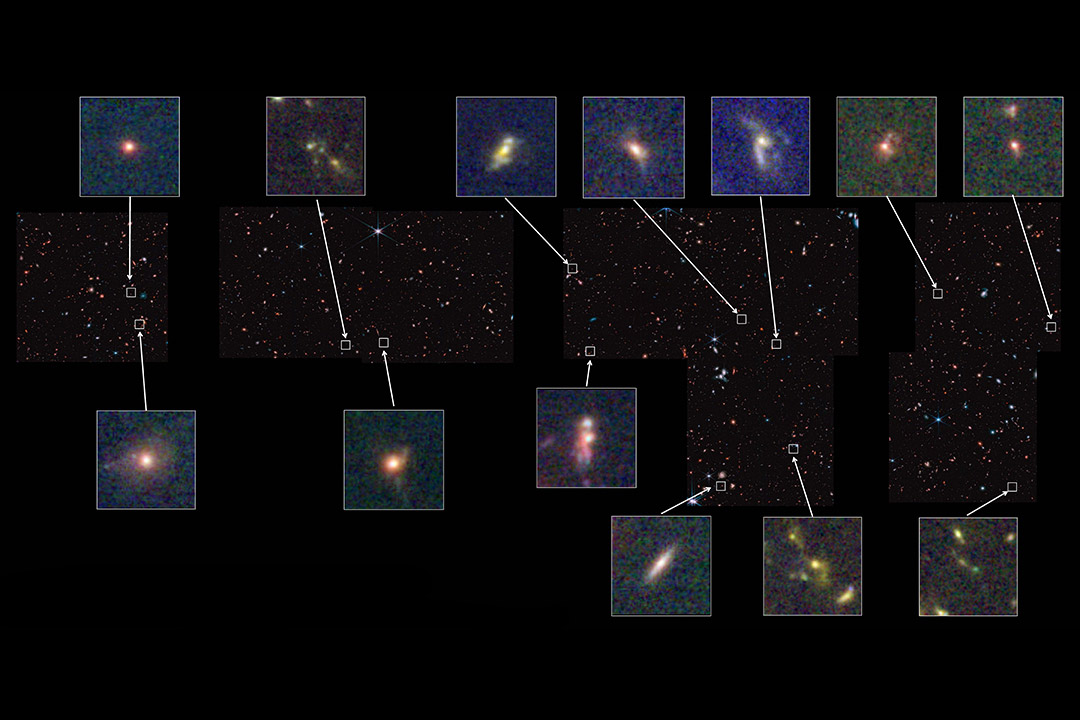
Webb galaxies in the early universe
Click for full image.

New data from the Webb Space Telescope and presented this week at an astronomy conference has found that galaxies in the early universe exhibit much of the same range of shapes and morphologies seen in the recent universe, a result that was not expected.

The image to the right comes from the press release. You can read the research paper here [pdf].

The study examined 850 galaxies at redshifts of z three through nine, or as they were roughly 11-13 billion years ago. Associate Professor Jeyhan Kartaltepe from Rochester Institute of Technology’s School of Physics and Astronomy said that JWST’s ability to see faint high redshift galaxies in sharper detail than Hubble allowed the team of researchers to resolve more features and see a wide mix of galaxies, including many with mature features such as disks and spheroidal components.

“There have been previous studies emphasizing that we see a lot of galaxies with disks at high redshift, which is true, but in this study we also see a lot of galaxies with other structures, such as spheroids and irregular shapes, as we do at lower redshifts,” said Kartaltepe, lead author on the paper and CEERS co-investigator. “This means that even at these high redshifts, galaxies were already fairly evolved and had a wide range of structures.”

The results of the study, which have been posted to ArXiv and accepted for publication in The Astrophysical Journal, demonstrate JWST’s advances in depth, resolution, and wavelength coverage compared to Hubble. Out of the 850 galaxies used in the study that were previously identified by Hubble, 488 were reclassified with different morphologies after being shown in more detail with JWST. Kartaltepe said scientists are just beginning to reap the benefits of JWST’s impressive capabilities and are excited by what forthcoming data will reveal.

“This tells us that we don’t yet know when the earliest galaxy structures formed,” said Kartaltepe. “We’re not yet seeing the very first galaxies with disks. We’ll have to examine a lot more galaxies at even higher redshifts to really quantify at what point in time features like disks were able to form.”

In other words, it appears galaxies of all shapes, as we see them today, already existed 11-13 billion years ago, shortly after the universe was born. This defies most theories about the formation of the universe, which predict that these early galaxies would be different than today’s.

The data however at this point is sparse. Webb has only begun this work, and as Kartaltepe notes, they need to look a lot more galaxies.

5 comments
1 190 191 192 193 194 196