
Steady decline for decades in the publication of “disruptive science”
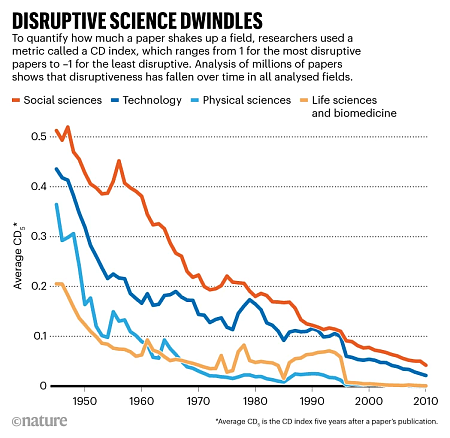
The steady decline in the publication of disruptive science

Though their definition of what makes a science paper disruptive is open to debate, a review of millions of peer-reviewed papers published since the end of World War II has shown a steady decline in such papers, as if scientists are increasingly unwilling or unable to think outside the box.

The graph to the right comes from this research.

The authors reasoned that if a study was highly disruptive, subsequent research would be less likely to cite the study’s references, and instead cite the study itself. Using the citation data from 45 million manuscripts and 3.9 million patents, the researchers calculated a measure of disruptiveness, called the ‘CD index’, in which values ranged from –1 for the least disruptive work to 1 for the most disruptive.

The average CD index declined by more than 90% between 1945 and 2010 for research manuscripts, and by more than 78% from 1980 to 2010 for patents. Disruptiveness declined in all of the analysed research fields and patent types, even when factoring in potential differences in factors such as citation practices.

The authors also analysed the most common verbs used in manuscripts and found that whereas research in the 1950s was more likely to use words evoking creation or discovery such as ‘produce’ or ‘determine’, that done in the 2010s was more likely to refer to incremental progress, using terms such as ‘improve’ or ‘enhance’.

The article that I link to above is from Nature, so of course it can’t see the elephant in the room, citing as a possible explanation “changes in the scientific enterprise” where most scientists today work as teams rather than alone.

I say, when you increasingly have big government money involved in research, following World War II, it becomes more and more difficult to buck the popular trends. Tie that to the growing blacklist culture that now destroys the career of any scientist who dares to say something even slightly different, and no one should be surprised originality is declining in scientific research. The culture will no longer tolerate it. You will tow the line, or you will be gone. Scientists are thus towing the line.

To my readers: I had intended to include this paper as part of a larger essay about the general blacklist culture that now dominates American society, but my continuing health issues make it difficult to sit at my desk for long periods. I hope to have things under control in the next few days, but until then my posting is going to continue to be limited.

12 comments

Two nearby galactic neighbors

Two nearby galactic neighbors
Click for full image.

Cool image time! The photo to the right, cropped, reduced, and sharpened to post here, was taken by the Hubble Space Telescope of two nearby galaxy neighbors to the Milky way.

This image from the NASA/ESA Hubble Space Telescope features the galaxy LEDA 48062 in the constellation Perseus. LEDA 48062 is the faint, sparse, amorphous galaxy on the right side of this image, and it is accompanied by a more sharply defined neighbour on the left, the large, disc-like lenticular galaxy UGC 8603. A smattering of more distant galaxies also litter the background, and a handful of foreground stars are also visible throughout the image.

LEDA 48062 is estimated to be approximately 30 million light years away. This image was part of a recent Hubble campaign to study every known galaxy within 33 million light years.

Assuming that UGC 8603 is about the same approximate distance, the utter dissimilarity between these two galaxies is quite mystifying. It is also possible that UGC 8603 is larger and much farther away.

2 comments

Musk: SpaceX is now targeting late February/March for 1st orbital launch of Starship

According to a tweet put out by Elon Musk on January 8, 2023, SpaceX is now targeting late February/March for 1st orbital launch of the 24th prototype of Starship and the seventh prototype of Superheavy.

The testing in 2022 has not gone as smoothly as hoped, and is the reason no launch occurred last year:

Super Heavy B7 first left SpaceX’s Starbase factory in March 2022 and has been in a continuous flux of testing, repairs, upgrades, and more testing in the nine months since. The 69-meter-tall (~225 ft), 9-meter-wide (~30 ft) steel rocket was severely damaged at least twice in April and July, requiring weeks of substantial repairs. But neither instance permanently crippled the Starship booster, and Booster 7 testing has been cautious but largely successful since the rocket’s last close call.

Following its return to the OLS [orbital launch site] in early August, Super Heavy B7 has completed six static fire tests of anywhere from one to fourteen of its 33 Raptor engines. It has almost certainly dethroned Falcon Heavy to become the most powerful SpaceX rocket ever tested. And on January 8th, 2023, SpaceX rolled the rocket back to Starbase’s orbital launch site for the seventh time. According to statements made by CEO Elon Musk and a presentation from a NASA official, the last major standalone test between Booster 7 and flight readiness is a full 33-engine static fire. Together, B7’s 33 Raptor 2 engines could produce up to 7600 tons (16.7 million lbf) of thrust at sea level, likely making Starship the most powerful rocket stage in the history of spaceflight.

I had read speculation earlier that it was impossible for SpaceX to do a full 33-engine static fire test because the OLS could not hold the rocket down. That now appears to be incorrect.

Musk’s tweet and proposed schedule should also not be taken with great seriousness. He routinely sets ambitious targets merely to keep the pace fast, even if those targets are not met.

11 comments

Decision on leaking Soyuz and its replacement to be made by Russia on January 11th

According to Russian space reporter Anthony Zak, Russia now says it will make its final decision on replacing the leaking manned Soyuz capsule on ISS January 11. Zak added this:

According to unofficial reports, the damaged spacecraft would return to Earth without crew, while the Soyuz MS-23 spacecraft would be launched in February 2023 piloted by a single cosmonaut Oleg Kononenko. His crew mates Nikolai Chub and Andrei Fedyaev would remain on the ground to free return seats for the two Russian members of the stranded Soyuz MS-22 crew. NASA astronaut Frank Rubio, who also traveled to the ISS on Soyuz MS-22, would return to Earth aboard a US Dragon vehicle, according to that scenario. On Jan. 9, 2023, Roskosmos denied that such a plan had been approved.

I have strong doubts about these “unofficial reports.” First, there would be no reason to fly the Soyuz manned, as it can do everything automatically, just like a Progress freighter. Second, there are serious safety issues about flying Rubio home as an extra passenger on Dragon. More likely someone in Russia wants to tweak some noses by suggesting Russia considers its own astronauts more valuable than the American.

Expect Russia to announce that the new Soyuz will arrive unmanned in February, and bring all three men home.

14 comments

China launches twice today to start its 2023 year

China today launched twice with two different rockets from two different spaceports.

First, a Long March 7 rocket took off from its coast Wenchang spaceport, placing three satellites into orbit. Few details were released about the satellites, other than they were being used for various tests of new technology.

Second, the Chinese pseudo-company Galactic Energy used its military-derived solid fueled Ceres-1 rocket to place five smallsats into orbit from China’s interior Jiuquan spaceport. Once again, little information was released about the satellites.

At this moment China leads SpaceX 2 to 1 in the 2023 launch race. However, there are three more U.S. launches planned for today. First Virgin Orbit hopes to finally launch from Cornwall. You can watch the broadcast here.

Then SpaceX has two launches from opposite coasts within an hour, first launching a batch of Starlink satellites from Vandenberg at 9:15 pm (Pacific), then following with a launch from Kennedy of a batch of OneWeb satellites.

1 comment

January 6, 2023 Quick space links

Courtesy of Jay, BtB’s stringer. I am still under the weather, so this might be the last post of the day.


  • Anthony Zak’s predicts major additional cuts in Russia’s space program
  • This only confirms what I have been saying for about a decade, since Putin consolidated the entire space industry into a single government-controlled corporation and thus ended all competition. His war in the Ukraine has only underlined his poor judgment. These cuts also continue the downward budget spiral for Roscosmos that has been ongoing for about a decade.


3 comments

General Atomics wins Air Force contract to build technology test lunar satellite

General Atomics yesterday announced that it has been awarded an Air Force Research Laboratory (AFRL) contract to build a satellite to test a variety of technologies in near lunar space.

The AFRL Oracle spacecraft program is intended to demonstrate advanced techniques to detect and track objects in the region near the Moon that cannot be viewed optically from the Earth or from satellites in traditional orbits such as geosynchronous earth orbit (GEO). The anticipated launch date for the Oracle spacecraft is late 2025.

While this is good business for General Atomics, the company is not selling its product to the Air Force, but building what the Air Force wants, making the spacecraft government owned. This is how the space industry functioned in the United States for almost a half century after Apollo, generally accomplishing little for great cost. Much better in the long run if the military bought this kind of product from private companies, who developed it for profit and for sale not just to the military.

5 comments

Private lunar rover to fly on private lunar lander

Yaoki deployed from Nova-C

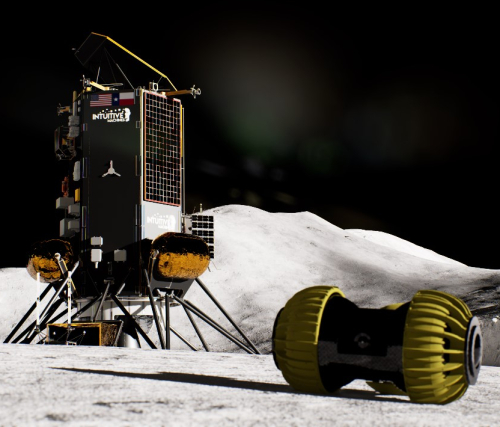
The Japanese based robot company Dymon has now purchased payload space on Intuitive Machines second lunar lander, Nova-C, in order to fly its own lunar rover, dubbed Yaoki, to the Moon.

Yaoki is expected to be flown to the lunar south pole on board Intuitive Machines’ Nova-C lunar lander in the second half of 2023. After landing, Yaoki is expected to deploy from Nova-C to demonstrate Dymon’s lunar mobility technology designed by its Founder and Chief Executive Officer, Shin-ichiro Nakajima.

The agreement with Dymon leverages Intuitive Machines’ Lunar Access Services and Lunar Data Services business segments to land the Yaoki rover on the Moon and control it via secure lunar communications.

The main passenger on this mission is NASA, but Inituitive Machines is free to make money by selling payload space to others. The graphic, from the press release, is intriguing, as it does not show how the rover will be deployed.

3 comments

Impulse’s first demo space tug scheduled for launch

Impulse Space announced on January 4, 2023 that it has now scheduled the launch of its first demo space tug, Mira, for the fourth quarter of 2023.

Impulse Space said its LEO Express-1 mission, using a transfer vehicle it is developing called Mira, is manifested for launch on SpaceX’s Transporter-9 rideshare mission currently scheduled for launch in the fourth quarter of 2023. LEO Express-1 will carry a primary payload for an undisclosed customer.

Barry Matsumori, chief operating officer of Impulse Space, said in an interview that the mission can accommodate additional payloads, like cubesats. The mission profile is still being finalized, but he said the vehicle, after making some initial deployments, may raise its orbit, then lower it to demonstrate operations in what’s known as very low Earth orbit, around 300 kilometers.

After this demonstration flight the company has plans for additional flights in 2024. This tug will then join a growing fleet of companies offering this orbital transport capability to cubesats.

3 comments

Virgin Orbit’s launch from Cornwall finally scheduled for January 9th

The first orbital launch from the United Kingdom has finally been scheduled, with Virgin Orbit’s 747 taking off from an airport in Cornwall on January 9, 2023 and carrying its LauncherOne rocket with 9 satellites.

Monday’s mission opportunity has been purchased by the US National Reconnaissance Office and is being used to advance a number of satellite technologies of security and defence interest to both the American and British governments. But there are also civil applications being taken up on the flight – and a number of firsts, such as the first satellite built in Wales and the first satellite for the Sultanate of Oman.

The UK’s Civil Aviation Authority [CAA], which regulates commercial spaceflight in the UK, said on Thursday that all nine spacecraft on the manifest had now been licensed. Virgin and Spaceport Cornwall received their launch licences before Christmas.

The launch was originally planned for sometime in the summer, but delays in obtaining the launch permits from the CAA pushed it back a half year. That unexpected and unnecessary delay now threatens the very existence of Virgin Orbit, as the company could do no other launches as it waited and thus earned nothing.

3 comments
1 191 192 193 194 195 196