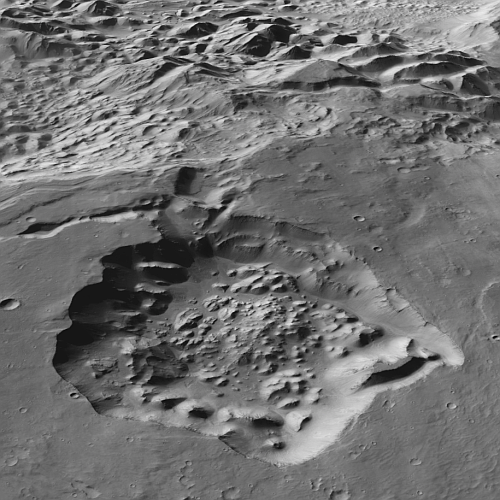
A close-up of the giant crack that almost splits Mars

A close-up of the crack that splits Mars
Click for original image.

Cool image time! The picture to the right, rotated, cropped, reduced, and sharpened to post here, was taken on June 28, 2023 by the high resolution camera on Mars Reconnaissance Orbiter (MRO). The intended science focus of the image is likely the floor of this canyon on the lower right, showing what appears to be a patch of uprised topography surrounded by what looks like glacial debris, which at this latitude of 39 degrees north is expected on Mars.

The grade at this location is downhill to the southwest, so if this is a glacier it is flowing in that direction.

The cliff is about 3,000 feet high, dropping that distance in about a mile and a half. Thus, this is only slightly less steep than the very steep cliff wall of the caldera of Olympus Mons, highlighted as a cool image two days ago.

What makes this canyon interesting — besides its spectacular scenery — is its larger context, recognized when one looks at this location from afar and thus sees how it shaped a vast portion of the global surface of Mars.
» Read more

0 comments

FAA and FCC now competing for the honor of regulating commercial space more

Two stories today illustrate again the growing appetite of federal alphabet agencies to grab more power, even if that power is not included in their statutory authority.

First, the Federal Aviation Administration (FAA) proposed new rules governing the de-orbiting of the upper stages of rockets by commercial launch companies.

The FAA is proposing a new rule requiring commercial space companies to dispose of their rocket upper stages to limit the creation of more space debris. Five disposal methods are allowed: a controlled or uncontrolled deorbit within certain time limits, putting the stage into a less congested orbit or sending it into an Earth-escape orbit, or retrieving it. A 90-day public comment period will begin once the proposed rule is published in the Federal Register.

Though this “appears to implement the updated U.S. Orbital Debris Mitigation Standard Practices issued in 2019,” it upgrades it from a “practice” that the government requests companies to follow to a “rule” they must follow. It also expands the power of the FAA to regulate commercial rocket companies, setting a new precedent of control that I guarantee with time will expand further.

Not to be outdone in this power grab, the Federal Communications Commission (FCC) added its own new satellite rules to the satellite licenses of two constellations run by the companies Iceye and Planet. The rules however have nothing to do with regulating the use of the electromagnetic spectrum, which is the FCC’s sole purpose according to the law that created it:
» Read more

4 comments

NASA requests proposals from private industry for deorbiting ISS

NASA on September 18, 2023 sent out a request for proposals from private industry for methods for deorbiting the International Space Station (ISS), with a deadline for such proposals of November 17, 2023.

You can review the request here. According to the press release at the first link, the bulk of any contract will be fixed price.

To maximize value to the government and enhance competition, the acquisition will allow offerors flexibility in proposing Firm Fixed Price or Cost Plus Incentive Fee for the Design, Development, Test and Evaluation phase. The remainder of the contract will be Firm Fixed Price.

That the development phase might be cost-plus allows a lot of room for budget growth, however, especially since the companies most likely to want such a contract are the old big companies (Boeing, Lockheed Martin, Northrop Grumman) that routinely go overbudget and behind schedule.

The full proposal is more than 600 pages long, so I have not reviewed it in its entirety. I wonder therefore if NASA would entertain proposals that include salvaging any ISS modules for use on other space stations.

7 comments

Chinese pseudo-company experiences launch failure

The Chinese pseudo-company Galactic Energy last night experienced the first launch failure of its solid-fueled Cere-1 rocket, launching from the Jiuquan spaceport in the northwest of China.

No details about the failure were released, including where in China the rocket crashed. The rocket has four stages, and is derived from Chinese missile technology. This was its tenth launch, and first failure.

Like all of China’s pseudo-companies, Galactic Energy obtains investment capital and then competes for government or commercial contracts. It is not a real company in that the government has closely supervised and controlled it (especially because of its dependence on missile designs), and can take it over at any time.

3 comments

Wedding String Quartet – Le Onde by Ludovico Einaudi

An evening pause: This video breaks one of rules for a good evening pause, in that is is shot from one static wide shot camera. I normally reject such videos, as the visuals are boring. I make an exception here because of the music and the arrangement, which is so breath-taking you don’t care about the visuals at all. Makes me want to know more about this composer and his work.

Hat tip Alton Blevins.

4 comments

September 20, 2023 Quick space links

Courtesy of BtB’s stringer Jay.


  • First satellite built in Hong Kong successfully completed
  • This satellite is the first in a proposed 360 satellite constellation for “communications and remote sensing,” with the first launch planned for November. I suspect the Chinese government’s take-over of Hong Kong, including the crushing of freedoms there, includes maintaining close control of this project as well.


No political column from me today. I needed a break.

3 comments

Visible ice layers in a crater in the lower mid-latitudes of Mars?

Visible ice layers in the low-mid-latitudes of Mars?
Click for original image. For the original color image, go here.

Cool image time! The picture to the right, cropped, reduced, and sharpened to post here, was taken on July 14, 2023 by the high resolution camera on Mars Reconnaissance Orbiter (MRO), and shows what appear to be horizontal layers in the inner wall of a small one-mile-wide and 150-foot deep unnamed crater on Mars. I have included the color version below, zoomed in to make those layers and their colors very clear.

As I have not contacted the scientists who requested this picture, I can only guess at its purpose. My guess however relates to those horizontal blue layers, reminiscent of the ice layers seen in Martian scarps at the high latitudes at about 50 to 55 degrees.

Normally it is rare to see horizontal layers like this in craters on Mars. Instead, what you usually see are downward-pointing gullies along with drainage and avalanche-type patterns, though the latter two might not be formed by either drainage or avalanches.

In this case these horizontal layers are clear and pronounced, making this crater a possibly important and somewhat unique find, based on its location.
» Read more

0 comments

Another enthusiastic review of Conscious Choice

Cover of Conscious Choice

A new review of my latest book, Conscious Choice: The origins of slavery in America and why it matters today and for our future in outer space, has just been published by American Thinker. I especially like this quote:

What makes Conscious Choice interesting is that it’s not just another social history of what happened, and who did what to whom in a horrible time of man’s inhumanity to man. It’s an effort to draw concrete knowledge from the past, for application to solving predictable problems in the not-too-distant, not altogether impossible future.

Conscious Choice reads easily, flows smoothly, is linguistically elegant, covers an extremely important topic, and asks important questions. Conscious Choice is also well referenced, with two appendices of additional data and sourcing information for the deepest dive. Conscious Choice is well worth reading simply to revel in the technical merits, which are far too rare these days. It would also pair well with a rereading of Robert A. Heinlein’s classic The Moon is a Harsh Mistress, possibly while listening to Jason Aldean’s “Rich Men North of Richmond,” and sipping a few pints of good New England beer.

As is to be expected, I don’t entirely agree with the reviewer’s interpretation of my book, but such disagreements are to be expected (and celebrated), as they enhance our knowledge. Moreover, in this case the disagreement is very minor, and provides me another piece of evidence that I was successful in conveying in a readable fashion the conclusions I drew from history.

As always, if my readers are interested in buying the book, it is available in hardback, paperback, and ebook editions. You can get it at all major book outlets, such as Amazon and Barnes & Noble, as well directly from my publisher, ebookit. You can also get an autographed hardback or paperback by buying it directly from me. Just email me at [my last name] at nasw dot org.

5 comments

Image released of permanently shadowed floor of Shackleton Crater

Shadowcam-LRO mosaic
Click for original image.

NASA today released a mosaic combining images from Lunar Reconnaissance Orbiter’s high resolution camera LROC and the Shadowcam camera on South Korea’s Danuri lunar orbiter that shows for the first time the entire permanently shadowed floor of Shackleton Crater at the Moon’s south pole.

That mosaic, cropped, reduced, and sharpened to post here, is to the right. I have added the black cross to mark the location of the south pole, just inside Shackleton, the large crater on the right. The inset shows the floor of the crater at higher resolution.

LROC can capture detailed images of the lunar surface but has limited ability to photograph shadowed parts of the Moon that never receive direct sunlight, known as permanently shadowed regions. ShadowCam is 200-times more light-sensitive than LROC and can operate successfully in these extremely low-light conditions, revealing features and terrain details that are not visible to LROC. ShadowCam relies on sunlight reflected off lunar geologic features or the Earth to capture images in the shadows.

Thus, in the mosaic to the right the interior of Shackleton was imaged by Shadowcam, and then placed on a mosaic of LROC pictures.

If you click on the full image at high resolution and look closely at the crater floor, it is difficult to determine if there is any ice there. There are several mounds that could be ice, but could also be accumulated dirt and debris. What is most significant however is the smooth interior walls of the crater. It appears it will very possible for a rover to drive down those walls and into Shackleton.

2 comments

German space plane company completes test program of prototype

The German space plane company Polaris Spaceplanes had now completed a 15-flight test program of the small prototype of its planned orbital and suborbital spaceplane.

The test-flights took place over the course of three days, between Aug. 22 and Sep. 8, and were meant to demonstrate the vehicle’s aerodynamics and flight control systems in preparation for a larger-scale spaceplane prototype the company plans to equip with a linear aerospike rocket engine.

MIRA-Light measures just 8.2 feet (2.5 meters) long, and flies using four electric fans. For 10 of MIRA-Light’s 15 flights, the mini-spaceplane was equipped with a mock aerospike engine to simulate its impact on vehicle performance. In total, the prototype accumulated about 40 total minutes of flight time, according to a report from European Spaceflight.

What makes this project interesting is its use of an aerospike engine, a rocket-engine concept that has been around for decades but never successfully implemented. If successful here, it will make the engines of Polaris’ spaceplane very efficient.

The company now plans a series of test programs using prototypes of increasing size, leading to flying its full-scale hypersonic space plane Aurora on commercial suborbital and orbital flights in ’26 or ’27.

2 comments

High School students discover new orbital changes from asteroid impacted by DART

In observing Dimorphos, the small asteroid that the probe DART impacted in September 2022, researchers as well as students at a California high school have discovered unexpected orbital changes.

Recent observations have indicated the asteroid is tumbling since the impact. However:

Dimorphos also appeared to be continuously slowing down in its orbit for at least a month after the rocket impact, contrary to NASA’s predictions. California high school teacher Jonathan Swift and his students first detected these unexpected changes while observing Dimorphos with their school’s 2.3-foot (0.7 meter) telescope last fall. Several weeks after the DART impact, NASA announced that Dimorphos had slowed in its orbit around Didymos by about 33 minutes. However, when Swift and his students studied Dimorphos one month after the impact, the asteroid seemed to have slowed by an additional minute — suggesting it had been slowing continuously since the collision. “The number we got was slightly larger, a change of 34 minutes,” Swift told New Scientist. “That was inconsistent at an uncomfortable level.”

Swift presented his class’s findings at the American Astronomical Society conference in June. The DART team has since confirmed that Dimorphos did indeed continue slowing in its orbit up to a month after the impact — however, their calculations show an additional slowdown of 15 seconds, rather than a full minute. A month after the DART collision, the slowdown plateaued.

One explanation proposed for this slowdown points at the spray of rocks and boulders that surrounded Dimorphos after DART’s impact. When some of those boulders fell back onto the asteroid, they might have caused the orbital slowdown, and as the number of new impacts dropped, the slowdown stabilized.

Now that a full year has passed since the impact, it is possible to assess the full orbital changes to the asteroid. Thus, a new report is expected shortly.

3 comments
1 53 54 55 56 57 196