Tchaikovsky – Waltz of the Flowers

An evening pause: Most people today likely associate this music with space stations and spacecraft in space (influenced by the movie 2001: a Space Odyssey), but this video shows the real reason it was written, for dancing the waltz.

Hat tip Judd Clark.

4 comments

September 18, 2023 Quick space links

Courtesy of BtB’s stringer Jay.


2 comments

The American Geophysical Union shows off its ignorance of the scientific method

Recently a climate scientist caused an uproar among scientists and peer-review journals when he admitted in an op-ed that the only way he could get his climate paper published in the journal Nature was to fake his results in order to fit them to the narrative that human-caused global warming is causing all our environmental problems.

In my paper, we didn’t bother to study the influence of these other obviously relevant factors. Did I know that including them would make for a more realistic and useful analysis? I did. But I also knew that it would detract from the clean narrative centered on the negative impact of climate change and thus decrease the odds that the paper would pass muster with Nature’s editors and reviewers.

While that op-ed brutally exposed the political biases at Nature that make it impossible to get honest research published, it only told a part of the story. Nature is only one journal, and if it was the only place this corruption of science was occurring, the problem would be manageable.

In truth it is only one example of a far more widespread problem, because it is now practically impossible for any skeptic of global warming to get his or her work published in almost any scientific journal. Worse, most of the major science organizations worldwide no longer simply favor pro-global warming climate research, they act aggressively to promote only one kind of result, to the point that the things they publish sometimes are little different than Soviet propaganda.

The American Geophysical Union, where science is no longer practiced
The American Geophysical Union, where
science is no longer practiced

As a prime example, I want to focus today on the American Geophysical Union (AGU), an scientific organization initially formed as an umbrella group to help American scientists publish and publicize their research on the study of the Earth, its interior, and its nature as a planet. To do so the AGU publishes a wide range of peer-review journals, all intended as fair-minded outlets for new research.

Sadly, in the past two decades the AG abandoned that primary function. For example, it has made its global-warming biases clear for several decades, essentially telling every climate scientist worldwide that if you submit any paper that raises any questions about global warming, it will be rejected outright.

More recently however the AGU has become even more up front and public about its close-minded approval of the as-yet unproven theory that humans are causing the climate to heat up. » Read more

6 comments

Two galaxies merging

Merging galaxies
Click for original image.

Cool image time! The picture to the right, cropped, reduced, and sharpened to post here, was taken by the Hubble Space Telescope as part of a survey project to photograph the entire Arp catalog of 338 “peculiar galaxies,” put together by astronomer Halton Arp in 1966. From the caption:

The larger galaxy (in the left of this image) is an extremely energetic galaxy type known as a Seyfert galaxy, which house active galactic nuclei at their cores. Seyfert galaxies are notable because despite the immense brightness of the active core, radiation from the entire galaxy can be observed. This is evident in this image, where the spiraling whorls of the whole galaxy are readily visible. The smaller companion is connected to the larger by a tenuous-seeming ‘bridge’, composed of dust and gas. The colliding galactic duo lie about 465 million light-years from Earth.

Note that if you ignore the blue whorls of the left galaxy, the two bright cores of these merging galaxies are about the same size. As it is unclear how long this merger has been on-going, it is possible that the galaxy on the right, in circling the left galaxy, drew out those whorls and that tenuous bridge. Other scenarios are also possible, however, such as the galaxy on the left stripping and scattering the arms of the galaxy on the right.

1 comment

Federal government continues to block the return of Varda’s commercial capsule, carrying drugs to treat HIV

Even as the FAA continues to block Varda from returning its capsule back to Earth, the Air Force has now joined in to block its landing at its Utah Test and Training Range, the same location NASA will use on September 24 to drop the return capsule from OSIRIS-REx, carrying material from an asteroid.

Varda originally planned to bring back a capsule containing crystals of ritonavir, a drug used to treat HIV, in mid-July. After announcing that had been delayed [due to the FAA’s refusal to issue a landing license in July], the company was looking at September 5 and 7, a source told TechCrunch. This information was confirmed by USAF.

The company declined to comment, but posted on X that the “spacecraft is healthy across all systems” and that they are continuing to collaborate with regulators to bring the capsule back to Earth. They added that the spacecraft can survive for up to a year on-orbit.

“Sept. 5 and 7 were their primary targets,” a spokesperson for the USAF said in an emailed statement. “The request to use the Utah Test and Training Range for the landing location was not granted at this time due to the overall safety, risk and impact analysis. In a separate process, the FAA has not granted a reentry license. All organizations continue working to explore recovery options.”

The spokesperson further said that Varda “is working on presenting alternate plans,” but would not elaborate further whether that meant seeking an alternate landing site. A spokesperson for the FAA told TechCrunch that Varda’s application was denied on September 6 because the company “did not demonstrate compliance with the regulatory requirements.”

“On September 8, Varda formally requested that the FAA reconsider its decision. The request for reconsideration is pending,” the spokesperson said.

The actions of these agencies is unconscionable and a outright abuse of power. There is no rational reason for the FAA to continue to deny Varda the right to bring its capsule back to Earth. Its claims of environmental impact are bogus, especially since capsules and spacecraft have been returning to Earth like this for more than three-quarters of a century. Nor is there any reason for the Air Force to have blocked the return now. Its claim of issues of “safety, risk, and impact” is utter garbage, especially since it is allowing a NASA capsule to land in this exact same facility in only days, and that capsule is carrying material from an asteroid.

One might question why Varda apparently flew its capsule prior to getting these landing approvals, but it did exactly the right thing, for two reasons. First, if it waited for approvals before flying, it would have no leverage on these power-hungry federal agencies and it likely would still be on the ground, going bankrupt (think of Virgin Orbit in the United Kingdom). This by the way is the same tactic used by SpaceX. You don’t wait on them, you put them under the gun by moving forward as fast as possible.

Second, this situation helps highlight the power grab by these agencies. While the FAA has some concerns relating to conflicts with airplane traffic, that should simply be a matter of coordination and involve no great delay. Similarly, landing on an Air Force base is merely scheduling. Since when did government agencies have the power to block a landing beyond those points? They don’t, not legally, morally, or practically.

Though I am sure most workers at the FAA and Air Force are likely trying to do their best to help
Varda, the structure of such regulatory agencies always encourages the power-hungry to grab power. The result has been endless mission creep, to the point where today no space activity can happen without some government agency sticking its nose in to demand control.

12 comments

India’s Aditya-L1 solar telescope initiates some science observations

According to India’s space agency ISRO, its Aditya-L1 solar telescope has begun science observations with one instrument, even as it continues its journey to its final position at L1, one million miles from the Earth.

The activation of STEPS occurred on September 10, 2023, at a distance exceeding 50,000 km from Earth. This distance equates to more than eight times the Earth’s radius, placing it significantly beyond the Earth’s radiation belt region. Following the successful completion of essential health checks for the instrument, the data collection process continued until the spacecraft had travelled beyond the 50,000 km mark from Earth.

All units of STEPS are currently operating within normal parameters. A graphical representation illustrates the measurements, showcasing fluctuations in the energetic particle environment within Earth’s magnetosphere, which were collected by one of the instrument’s units.

It is expected Aditya-L1 will reach L1 in January, where it will begin round-the-clock observations of the Sun, in parallel with NASA’s Soho telescope, which has been at L1 since the 1990s.

0 comments

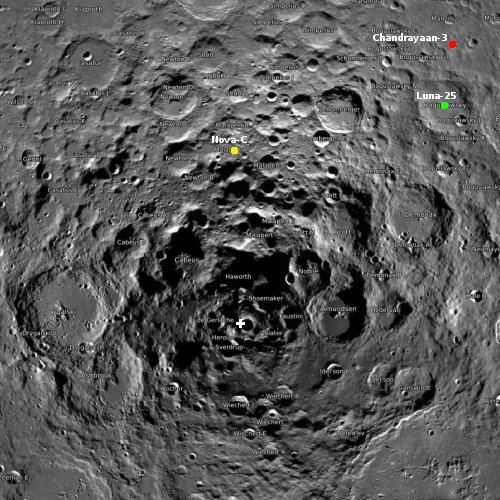
Russian investigators pin down cause of Luna-25 failure

Though the investigation is not yet complete, reports out of Russia indicate that the cause of the failure of Luna-25 during an engine burn while in orbit around the Moon has been identified.

The article at the link provides the details, which involve problems with two “BIUS-L accelerometers” during the flight, which for reasons not yet understood were switching from the primary to the secondary randomly during the journey to the Moon, apparently because of some failure.

However, ahead of the fateful lunar orbit correction on August 19, both accelerometers worked correctly, but once the maneuver started, one set failed again, while the flight control system never switched to data from the second set. As a result, onboard computers were not receiving data about critical parameters required for properly completing the orbit correction, such as orientation of the spacecraft in space, velocity and altitude.

If confirmed, this crash scenario would likely implicate deficiencies in the development or testing of the flight control system and its software rather than any mechanical problem of the propulsion system, which was implied in the initial statement about the incident. [emphasis mine]

The highlighted sentence says it all. The serious quality control problems that have hampered Russia’s space efforts remain, and in fact appear systemic throughout its entire aerospace industry. In fact, this failure of a planetary probe helps explain the many difficulties Russia has been having in its war in the Ukraine, attributable to these same issues.

15 comments

China launches military reconnaissance satellite

China today successfully launched a classified military reconnaissance satellite, using its Long March 2D rocket lifting off from its Xichang spaceport in the south of China.

No word on where the rocket’s lower stages crashed in China. All the stages use hypergolic fuels, which are extremely toxic.

The leaders in the 2023 launch race:

65 SpaceX
43 China
13 Russia
7 Rocket Lab
7 India

American private enterprise still leads China in successful launches 76 to 43, and the entire world combined 76 to 69. SpaceX by itself now trails the rest of the world combined (excluding American companies) 65 to 69.

0 comments

SpaceX launches another 22 Starlink satellites

SpaceX last night successfully launched another 22 Starlink satellites into orbit, its Falcon 9 rocket lifting off from Cape Canaveral.

The first stage completed its fifth flight, landing on a drone ship in the Atlantic.

The leaders in the 2023 launch race:

65 SpaceX
42 China
13 Russia
7 Rocket Lab
7 India

American private enterprise now leads China in successful launches 76 to 42, and the entire world combined 76 to 68. SpaceX by itself now trails the rest of the world combined (excluding American companies) 65 to 68.

2 comments

Don Rickles, Ruth Buzzi, and Arte Johnson – bloopers from Rowan & Martin’s Laugh-In

An evening pause: This sequence shows the almost vain attempt to shoot a series of quick jokes using the running gag of Buzzi playing her character “Gladys” on a park bench being “accosted” by Arte Johnson, playing his character “Tyrone”. Rickles adds another element. It shows again that humor is at its heart silliness. If you can’t be silly you can’t be funny, and these three comedians certainly understood that.

Hat tip Cotour.

0 comments

September 15, 2023 Quick space links

Courtesy of BtB’s stringer Jay.


0 comments
1 55 56 57 58 59 196