The remnant of the supernova from 1181, as seen in multiple wavelengths

Supernova remnant as seen in multiple wavelengths
Click for original image.

Using a number of different telescopes and observing in many wavelengths outside the visible spectrum, astronomers have produced a new composite image of the remnant of a supernova that was detected in the year 1181 and remained visible to the naked eye for about six months.

That composite picture is to the right, cropped and reduced to post here. From the press release:

X-ray observations by ESAโ€™s XMM-Newton (blue) show the full extent of the nebula and NASAโ€™s Chandra X-ray Observatory (cyan) pinpoints its central source. The nebula is barely visible in optical light but shines bright in infrared light, collected by NASAโ€™s Wide-field Infrared Space Explorer (red and pink). Interestingly, the radial structure in the image consists of heated sulfur that glows in visible light, observed with the ground-based Hiltner 2.4 m telescope at the MDM Observatory (green) in Arizona, USA, as do the stars in the background by Pan-STARRS (white) in Hawaii, USA.

Because the remnant is so dim in visible light, it has taken years of searching to locate it.
2 comments

SLIM survives its second lunar night, re-establishes contact

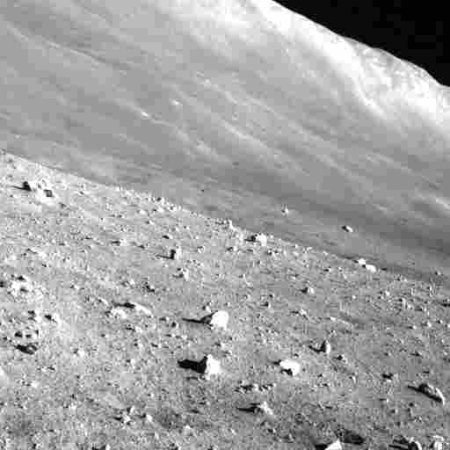
SLIM's view after surviving its 2nd night on the Moon
Click for original image.

According to Japan’s space agency JAXA, the SLIM lunar lander has successfully survived its long night on the Moon, re-establishiing contact with ground controllers yesterday.

Last night, we received a response from #SLIM, confirming that the spacecraft made it through the lunar night for the second time! Since the sun was still high and the equipment was still hot, we only took some shots of the usual scenery with the navigation camera

One of those pictures is to the right, reduced slightly to post here. It looks west across the floor of Shioli Crater, with the far rim about a thousand feet away. The picture is identical to previous images, tilted because the spacecraft landed on its side and has limited scientific capabilities, being primarily an engineering test mission.

That this engineering test has now survived two lunar nights speaks well for its design. It tells us that future Japanese lunar landers (and rovers) will have a good chance of surviving for a long time on the Moon.

5 comments

Real Space – Every Space Station Size Comparison

An evening pause: Some quick visual space station history. Note how almost all the non-U.S. stations are essentially assembled using revisions of the same early Soviet-era modules. Note too how the future private stations are all very different from each other. The contrast illustrates the difference between what you get when governments control everything, and when competition and freedom rule.

Hat tip Edward Thelen.

3 comments

March 27, 2024 Quick space links

Courtesy of BtB’s stringer Jay. This post is also an open thread. I welcome my readers to post any comments or additional links relating to any space issues, even if unrelated to the links below.


5 comments

Part 3: The expected tantrum of madness should Biden actually lose the election

The Democratic Party: hostile to freedom and fair elections

For the past two days I have tried to lay out some of the illegal and immoral strategies and tactics of the Democratic Party in its relentless effort to guarantee a win in this year’s presidential election, no matter what. (For the first two parts, go here and here.)

The bottom line is that Democratic Party politicians and their allies in the press and big tech will stop at nothing to prevent Donald Trump from regaining the White House. They will cheat, lie, encourage riots and looting, censor and blacklist their opponents, and in the end, even commit election and voter fraud on a massive scale.

But despite all this, what if Donald Trump still ends up victorious? Right now a rational look at both the polling trends and the disastrous consequences of Joe Biden’s presidency all suggest the American public is screaming for a change. The historic shift in the black and hispanic populations to Trump and away from the Democratic Party underlines these trends quite clearly. These trends are further underlined by the presence of two different moderate-left alternative presidential tickets, both drawing the bulk of their support from the Democrats.

In the end, this data tells us that it is very likely that none of the chaos and violence and fear-mongering and vote tampering by the Democrats will work, that in the end Donald Trump will emerge as the winner.

How will this now very close-minded and very vicious Democratic Party respond when that happens? The signs tell us that they can no longer tolerate defeat, or even the existence of alternative parties. (For example, consider the relentless effort by the Democrats to legally squelch these alternative parties from the ballot box.) For them, “democracy” only exists when they win.

We should therefore expect these terrible things to happen in short order after election day.
» Read more

75 comments

Scientists release detailed geological map of the landing site for Europe’s Franklin rover

Low resolution cropped section of map
Click for original image.

Scientists today released a new high resolution and very detailed geological map of the landing site for Europe’s Franklin rover, produced using orbital data from the U.S.’S Mars Reconnaissance Orbiter and Europe’s Trace Gas Orbiter.

A very low resolution version of the map is to the right.

The work was divided into 134 one-square-kilometre areas, so that the [80-person] team could fully cover the estimated landing area. Scientists used a web-based system that allowed everyone to work on the map in parallel. The software was provided by NASAโ€™s Jet Propulsion Laboratory and set up at ESA [European Space Agency]. Data came from the Colour and Stereo Surface Imaging System (CaSSIS) onboard the ExoMars Trace Gas Orbiter and several instruments on NASAโ€™s Mars Reconnaissance Orbiter (MRO), including the HiRISE camera, which returns images from Mars orbit at 25 cm per pixel.

The mapping leads then pieced together the information on all the areas to form a coherent map that shows the geology of the landing site in unprecedented detail. The map includes the main types of bedrock, and structures with distinct shapes like ridges and craters. It even features the material that rests on top, for example blown by the wind, or thrown long distances when meteorites impacted the surface.

The result is the highest resolution map of Oxia Planum yet, created at a scale of 1:25 000, by which every centimetre equals 250 metres on the martian surface. An average drive of 25 to 50 metres a day for Rosalind Franklin would be one to two milimetres on the map.

The team had the extra time to compile this map because the launch of Franklin to Mars was delayed a number of times because of engineering issues and the Ukraine War, which ended the Europe’s partnership with Russia, requiring ESA to find other means to launch and land the rover.

0 comments

Data from Perseverance suggests the delta in Jezero Crater was formed by a wide variety of different “fluvial” events

Jezero Crater delta
Jezero Crater delta

Using data from the Perseverance rover in Jezero crater, scientists now conclude that the delta that poured through a gap in the crater’s rim was formed by a wide variety of different “fluvial” events, not a steady flow as previously assumed.

From the paper’s conclusions:

The origin of this variability as well as that of the high discharge represented by the boulder conglomerate is still unknown. Realistic hypotheses include seasonal variations due to melting of snow, glacial input with possible episodic surges punctuating more regular fluvial input, or arid climate type of flows with intense storms and related flash floods.

We do not speculate further about the nature of fluvial activity in this study. However, the variability and the presence of high discharge rates have important implications on the lake evolution. Firstly, previous modeling of Jezero delta formation used steady-state discharge rates to estimate the time required to form the delta, an assumption that we can no longer justify according to our observations. Secondly, estimates of discharge rates … may be used as upper limits for some of the peak discharge rates, although the number of flood events is still difficult to determine from the sparse outcrops and the ubiquitous presence of scree.

In other words, the delta was not formed by a single event or a long stream of liquid flowing into the crater to form the lake that scientists believe once filled the crater. Instead, that flow varied, involved numerous distinct and different events over time, and likely included glacial ice transport as well.

Not that this is a surprise, but as always, the closer we get to a planet and the more detailed our data about it, the more complicated we find its nature and origins.

0 comments

Members of Texas Space Commission unveiled

The governor of Texas, Greg Abbott, yesterday revealed the names of the 18 individuals who will head the Texas Space Commission, created by the legislature to encourage the development of that state’s commercial space industry.

The Texas Space Commission will be tasked with developing a statewide strategy that promotes innovation, creates incentives (including grant funding) and develops workforce training. They initially have $350 million to work with, $150 million budgeted for grants and $200 million for a new research and training facility built by the Texas A&M University System.

The Texas Aerospace Research and Space Economy Consortium, which is part of the Texas Space Commission, will identify research and development opportunities and find ways to further integrate space into the Texas economy.

The commission appears strongly made up of representatives from many commercial companies, including the big companies SpaceX, Lockheed Martin, and Boeing as well as a number of newer smaller companies. Linked as it is so closely with the state government, this commission will be well placed to eliminate any obstacles within the state to commercial development.

2 comments

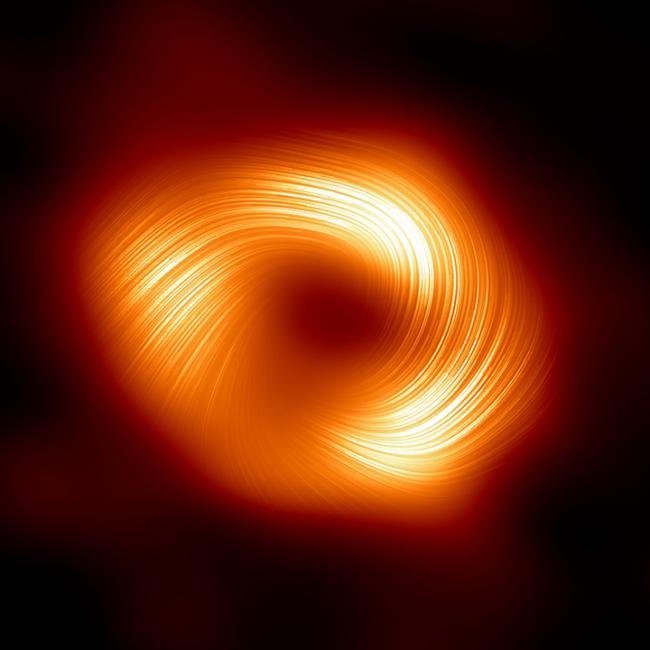
The spiraling magnetic field surrounding the Milky Way’s central supermassive black hole

The magnetic field lines surrounding Sagittarius A*
Click for original image.

Astronomers have now produced the first detailed image of polarized light surrounding the Milky Way’s central supermassive black hole, dubbed Sagittarius A* (pronounced “Sagittarius A-star”) which in turn maps out the spiraling field lines of that black hole’s magnetic field.

The image to the right, reduced to post here, shows that image. From the press release:

“What we’re seeing now is that there are strong, twisted, and organized magnetic fields near the black hole at the center of the Milky Way galaxy,” said Sara Issaoun, CfA NASA Hubble Fellowship Program Einstein Fellow, Smithsonian Astrophysical Observatory (SAO) astrophysicist, and co-lead of the project. “Along with Sgr A* having a strikingly similar polarization structure to that seen in the much larger and more powerful M87* black hole, weโ€™ve learned that strong and ordered magnetic fields are critical to how black holes interact with the gas and matter around them.”

Light is an oscillating, or moving, electromagnetic wave that allows us to see objects. Sometimes, light oscillates in a preferred orientation, and we call it “polarized.” Although polarized light surrounds us, to human eyes it is indistinguishable from “normal” light. In the plasma around these black holes, particles whirling around magnetic field lines impart a polarization pattern perpendicular to the field. This allows astronomers to see in increasingly vivid detail what’s happening in black hole regions and map their magnetic field lines.

Despite this similarlity, it still remains a mystery why the much larger M87 black hole is very active while Sagittarius A’ remains generally quiet.

0 comments

Engineers resolve issue on IXPE space telescope

Engineers have resolved the issue on the IXPE (Imaging X-ray Polarimetry Explorer) space telescope that was jumbling the data it was sending to Earth, and expect to return it to full science operations shortly.

On March 26, using procedures developed following that previous interruption, the team initiated a spacecraft avionics reset to address the issue, which put IXPE into a planned safe mode. The team has confirmed that IXPE is once again transmitting valid telemetry data and is now working to resume science operations, in as rapid and safe a manner as possible. The spacecraft is in good health.

The “previous interruption” was in 2023. In both cases it appears that simply rebooting the telescope’s software fixed the problem.

1 comment

China’s Long March 6 rocket launches remote sensing satellite

China yesterday successfully launched a classified remote sensing satellite, its Long March 6 rocket lifting off from its Taiyuan spaceport in the northeast of China.

No word on where the rocket’s four solid-fueled strap-on boosters and liquid-fueld core stage crashed inside China.

The leaders in the 2024 launch race:

30 SpaceX
13 China
4 Rocket Lab
4 Russia

American private enterprise still leads the rest of the world combined in successful launches 35 to 23, while SpaceX still leads the entire world, including American companies, 30 to 28.

0 comments
1 145 146 147 148 149 191