
Lynyrd Skynyrd – T For Texas
An evening pause: Performed live 1976.
Hat tip Judd Clark.
An evening pause: Performed live 1976.
Hat tip Judd Clark.
Courtesy of BtB’s stringer Jay. This post is also an open thread. I welcome my readers to post any comments or additional links relating to any space issues, even if unrelated to the links below.

Click for original image.
Cool image time! The picture to the right, cropped and enhanced to post here, was taken on July 17, 2024 by the high resolution camera on Mars Reconnaissance Orbiter (MRO). It shows what the scientists label as boxwork, a pattern of intersecting straight ridges criss-crossing each other in a generally random manner.
The ridges themselves are very small, only a few feet high. To make them more visible I have purposely cropped this section without reducing its resolution. I have also increased the contrast.
What caused them? According to this paper [pdf] about similar boxwork found on Mount Sharp in Gale Crater, the boxwork “formed when cements filled existing pore spaces and fractures in fractured rock, and these cements were left as topographic ridges after erosion.”
In other words, the surface hardened, then fractured. Later more resistent material, likely lava, filled the cracks. When erosion later stripped the top surface away, the lava was more resistent and so became the ridges we now see.
» Read more
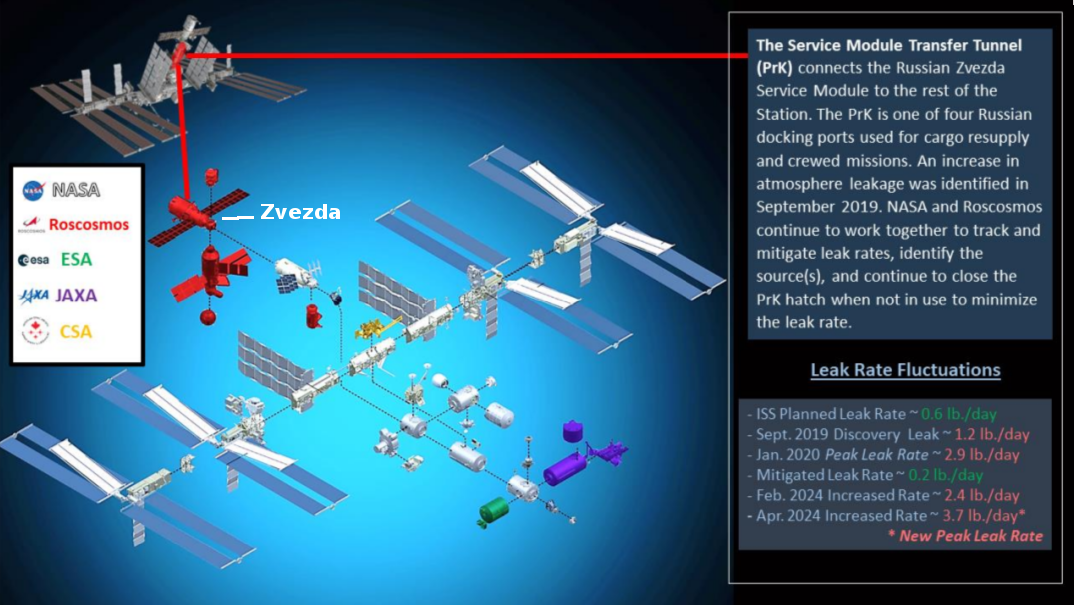
Figure 3 from September Inspector General report, annotated by me to show Zvezda location.
In a public session yesterday by a NASA commission focused on accessing the safety condition of ISS, officials revealed that the commission and Russia disagree about the root causes behind the airleak and cracks in the docking section of the Zvezda module on the Russian half of ISS, as well as the risk of a catastrophic failure. According to the commission’s head, former astronaut Bob Cabana.
The Russian position is that the most probable cause of the PrK cracks is high cyclic fatigue caused by micro vibrations. NASA believes the PrK cracks are likely multi-causal including pressure and mechanical stress, residual stress, material properties and environmental exposures.
The Russians believe that continued operations are safe, but they can’t prove that to our satisfaction. The U.S. believes that it’s not safe, but we can’t prove that to Russian satisfaction that that’s the case. So while the Russian team continues to search for and seal the leaks, it does not believe catastrophic disintegration of the PrK is realistic and NASA has expressed concerns about structural integrity of the PrK and the possibility of a catastrophic failure.
Because of this disagreement American astronauts now close the hatch between the Russian and American halves of ISS whenever a docking to Zvezda is taking place, and apparently keep that hatch closed until unloading of the docked spacecraft is complete. The Russians in turn only open the hatch to the docking section of Zvezda when they need to load or unload material into the freighter docked there, and coordinate with American astronauts whenever they do so.
Engineers from the two nations continue to discuss the issue, and hope to result their disagreement and come up with a joint plan.
Ultimately, this issue indicates the certain end of ISS in the near future, and adds ugency to the need to get some of those commercial space stations operating in orbit.
In an agreement signed yesterday, the Space and Upper Atmosphere Research Commission (Suparco) in Pakistan announced it will collaborate with China to build a small rover that will to fly on China’s Chang’e-8 lunar lander.
The lander is present scheduled to land near the Moon’s south pole in 2030, will be China’s second lander to the south pole region, and will also act to officially establish China’s International Lunar Research Station (ILRS) on the lunar surface. It will also include a “hopper” to explore the nearby surface.
Pakistan had already signed on to China’s space alliance to build the ILRS. China’s present list of partners is as follows: Azerbaijan, Belarus, Egypt, Kazakhstan, Nicaragua, Pakistan, Russia, Serbia, South Africa, Thailand, Turkey, and Venezuela. That partnership also includes about eleven academic or governmental bureaucracies.
In a signing ceremony yesterday in Copenhagen, Denmark became the 48th nation to sign the Artemis Accords.
The full list of nations now part of this American space alliance: Angola, Argentina, Armenia, Australia, Bahrain, Belgium, Brazil, Bulgaria, Canada, Chile, Colombia, Cyprus, Czech Republic, Denmark, Dominican Republic, Ecuador, Estonia, France, Germany, Greece, Iceland, India, Israel, Italy, Japan, Lithuania, Luxembourg, Mexico, the Netherlands, New Zealand, Nigeria, Peru, Poland, Romania, Rwanda, Saudi Arabia, Singapore, Slovakia, Slovenia, South Korea, Spain, Sweden, Switzerland, the United Kingdom, the United Arab Emirates, the Ukraine, the United States and Uruguay.
With this alliance established, the incoming Trump administration will have great political international leverage, increasing the chances it can finally use the accords to achieve its initial goal, to overcome the legal restrictions on private property imposed by the Outer Space Treaty.
Both China and SpaceX today successfully completed morning launches.
First China launched an environmental satellite to study “ocean salinity,” its Long March 4B rocket lifting off from its Taiyuan spaceport in northeast China.
No word on where the rocket’s lower stages crashed inside China. All use very toxic hypergolic fuels, which can literally dissolve your skin.
Next SpaceX completed another launch of 23 Starlink satellites, its Falcon 9 rocket lifting off from Cape Canaveral in Florida. The first stage completed its eighteenth flight, landing on a drone ship in the Atlantic.
The leaders in the 2024 launch race:
114 SpaceX
52 China
13 Russia
12 Rocket Lab
American private enterprise now leads the rest of the world combined in successful launches 132 to 77, while SpaceX by itself leads the entire world, including American companies, 114 to 95.
SpaceX tonight successfully launched 20 Starlink satellites, its Falcon 9 rocket lifting off from Vandenberg in California.
The satellites included 13 of the Starlink direct-to-cell satellites. The first stage successfully completed its eighth flight, landing on a drone ship in the Pacific.
The leaders in the 2024 launch race:
113 SpaceX
51 China
13 Russia
12 Rocket Lab
American private enterprise now leads the rest of the world combined in successful launches 131 to 76, while SpaceX by itself leads the entire world, including American companies, 113 to 94.
An evening pause: The tower is in Watts, Oklahoma. When the lineman looks to his right he is looking at the helicopter, which for the first few minutes, before it rises above the horizon, is difficult to see.
Hat tip Wayne DeVette.
Courtesy of BtB’s stringer Jay. This post is also an open thread. I welcome my readers to post any comments or additional links relating to any space issues, even if unrelated to the links below.
In what could be a major legal ruling [pdf], a two-judge decision this week in the DC Circuit Court ruled that the White House Council on Environmental Quality (CEQ), which has for years imposed environmental rules on other federal agencies based on the National Environmental Policy Act (NEPA), does not have the statutory authority to do so, thus invalidating every regulation so imposed.
All three members of the three-judge panel agreed that the Agencies acted arbitrarily and capriciously in [in this particular case]. However, before reaching that conclusion, the majority analyzed whether the CEQ regulations the Agencies followed in adopting the plan were valid, an argument not raised by any of the parties. The majority held, sua sponte, that because there is no statute stating or suggesting that US Congress has empowered the CEQ to issue rules binding on other agencies, the CEQ has no lawful authority to promulgate such regulations.
…Although this decision does not explicitly vacate any action taken by the CEQ, it does establish a precedent that CEQ rules lack statutory authorization, and therefore that other agency actions taken under the CEQ framework are at risk of being vacated. If this decision is not overturned by the full appellate court sitting en banc or by the US Supreme Court, it has the potential to completely change the landscape of NEPA review.
The case is complicated, partly because the Byzantine nature of the federal bureaucracy and the many agencies involved. (It is almost as if these agencies created that complexity to confuse and protect themselves.)
The heart of the decision is that CEQ was apparently first created as an “advisory” body to help other federal agencies follow the intent of NEPA in their own rule-making, but instead soon became a “regulatory” body whose rulings other agencies were required to follow. As that authority was never given it by Congress, CEQ exceeded its authority by making its rulings mandatory.
This court decision will likely leave many agencies on their own in establishing environmental regulations, based on NEPA. However, even that regulatory ability faces limitations, based on the Supreme Court’s recent Chevron decision, which said that government agencies do not have right to promulgate new regulations that are not specifically described in congressional law.
In other words, Chevron says that the bureaucracy cannot make things up, based on its own vague opinions.
The trend of all these court rulings appears aimed at limiting the power of the federal bureaucracy. It will however take some time to determine how much that power is limited, as lawsuits begin to percolate through the courts. If there are lot of lawsuits (which does appear to be happening) we should therefore expect that power to be limited significanly.


Click for original image.
Cool image time! The picture to the right, cropped, reduced, and sharpened to post here, was taken on August 10, 2024 by the high resolution camera on Mars Reconnaissance Orbiter (MRO).
My reason to posting this I admit is selfish and tourist-oriented. This narrow ridge, about a mile long and about 300 to 600 feet high, appeals directly to my hiking passions. A trail along its length would provide any hiker some really spectactular views.
The scientists took the picture because of the geology. The white dot on the overview map above marks the location, a short channel dubbed Daga Vallis that connects two major canyons in the eastern part of Valles Marineris, the largest known canyon system in the solar system. This ridge and several nearby parallel ridges were apparently made of something, possibly lava, that was resistent to the theorized ancient catastrophic floods that scientists presently believe carved out these channels and canyons.
In the inset the dotted line indicates one possible hiking trail route that travels the full length of the ridge but then heads south to continue along the rim of a 1,200-foot-high cliff face. For future Martian colonists, I offer this site as a great place to set up a bed-and-breakfast, surrounded by many potential hikes of incredible stark beauty.
Though the press release was lacking in many details, Rocket Lab yesterday announced the signing of its first launch contract for its new Neutron rocket, scheduled to make its first orbital test launch in 2025.
Under the contract, Rocket Lab will launch two dedicated missions on Neutron starting from mid-2026. The missions will launch from Rocket Lab Launch Complex 3 on Wallops Island, Virginia. The launch service agreement for these missions signifies the beginning of a productive collaboration that could see Neutron deploy the entire constellation.
The press release did not name the satellite constellation, or the company building it. Rocket Lab’s founder and CEO, Peter Beck, was quoted as follows: “Constellation companies and government satellite operators are desperate for a break in the launch monopoly.” [emphasis mine] That launch monopoly is clearly SpaceX, and Beck was positioning Rocket Lab with Neutron as the company to provide an alternative.
The announcement as well as the company’s third quarter report caused a 45% surge in its stock price.
At a symposium in DC yesterday, a panel of past managers — all of whom had been involved in previous government transitions at NASA — attempted to predict what the consequences will be for NASA with the new Trump administration.
Most of the opinions were pure guesses, some better than others. The real moment of truth came when the entire panel was asked to predict the future of SLS and Orion. The question was put forth by one of the panelists, Lori Garver, who had been NASA’s deputy administrator during the Obama administration, and seemed to have the best understanding of how much the arrival of Trump will likely shake things up significantly.
At one point in the discussion, she asked the panel if they thought the Space Launch System and Orion programs would continue in the next administration. None of the panelists raised their hands. [emphasis mine]
Several of these panelists were big supporters of SLS. Their lack of confidence in its future tells us that SLS and Orion no longer have strong political backing in Washington. Both stand on thin ice.
I predict both will be shut down within the next year, before the next Artemis flight, the first to be manned, to be replaced with a entirely different manned space exploratory program to the Moon and Mars. The decision will be a smart one, but tragically late in coming. SLS should have been dumped years ago. If it had, the U.S. effort to return to the Moon would have been better off, moving forward with a better plan years earlier. Instead, this late decision will once again delay any manned lunar missions for years more.
The change however will be good in the long run, because I expect the new program will be better designed, more efficient, cost less, and be able to do what SLS promised but could never deliver. And it will be based on what private enterprise can accomplish, not a government designed behemoth designed mostly as pork.
The rocket startup Firefly has now raised another $175 million of private investment capital, during a new round of funding, on top of another $300 million raised previously.
Firefly Aerospace has raised $175 million in a round led by a new investor to support production of launch vehicles and spacecraft with an increased focus on responsive space capabilities.
The company announced Nov. 12 it raised what it described as an oversubscribed Series D round led by RPM Ventures. Several other existing and new ventures also participated in the round, which values Firefly at more than $2 billion.
That valuation is an increase from the $1.5 billion the company reported in November 2023 when it closed the final tranche of a Series C round. The company did not disclose the size of that earlier round but said then it had raised about $300 million since February 2023.
It appears RPM likes how the company has focused on providing the military launch services, which can also be profitable for private satellite customers. This money will be used to help increase the production of Firefly’s Alpha rocket.
JPL in California announced today a layoff of 325 workers, about 5% of its workforce, the third major layoff imposed this year.
The JPL press release indicates the layoffs are because of NASA budget cutbacks, but does not provide any specificity. The cause centers mostly around NASA’s decision to pause its Mars Sample Return project, which JPL was leading. From this report:
This is the third round of layoffs at JPL this year, a reduction spurred primarily by major budgetary cuts to the Mars Sample Return mission, which is managed by JPL. NASA directed $310 million this year to the effort to bring Mars rocks back to Earth, a steep drop from the $822.3 million it spent on the program the previous year.
In January, 100 on-site contractors at JPL were let go after NASA instructed the lab to reduce spending in anticipation of a much tighter budget. In February, the lab laid off 530 employees — approximately 8% of its workforce — and another 40 contractors.
It increasingly appears that JPL’s place in the redesigned mission could be significantly reduced.
The press release also makes it sound like these cutbacks are the end of the world. As JPL has mostly functioned for decades as a private institution attached to NASA almost like a government agency, no one there ever expects to get laid off. In the real world however layoffs such as this happen all the time, especially when a company fails to deliver. JPL in recent years has had budget and management problems, epitomized by the problems now seen with that sample return mission, so it should not be surprised by these cutbacks from NASA.
For the first time a cargo Dragon capsule used its Draco attitude thrusters to test their ability to adjust or raise ISS’s orbit.
NASA and SpaceX monitored operations as the company’s Dragon spacecraft performed its first demonstration of reboost capabilities for the International Space Station at 12:50 p.m. EST on Friday. The spacecraft’s Draco thrusters adjusted the station’s orbit through a reboost of altitude by 7/100 of a mile at apogee and 7/10 of a mile at perigee, lasting approximately 12 minutes and 30 seconds.
This posting is late because of my Grand Canyon trip, but I’m posting this now to make sure it is on the webpage. The goal of the test was to prove another American method for adjusting ISS’s orbit, in order to replace the Russian Progress capsules which now do the job. This test proved Dragon’s thrusters can be used for small orbital adjustments, but whether it can do major orbital corrections remains unclear. A previous test using Cygnus had already showed it could do the job.
Courtesy of BtB’s stringer Jay. This post is also an open thread. I welcome my readers to post any comments or additional links relating to any space issues, even if unrelated to the links below.
Some of these stories would have normally gotten a full post. I post them now for completeness.
In what appears to be a first, Polaris Spaceplane on October 29, 2024 successfully completed the first ever inflight ignition of an aerospike engine, using its Mira-2 unmanned engineering prototype.
Later in the day on 29 October, MIRA II took off from Peenemünde Airport on the coast of the Baltic Sea with a takeoff mass of 229 kilograms, which represented a reduced propellant load. The vehicle flew to the ignition point over the Baltic Sea, approximately 3 kilometres away from the ground station, and once there, completed a short three-second burn of its AS-1 aerospike engine. During the short burn, MIRA II experienced an acceleration of 4 m/s².
According to the company, the engine operated at a reduced chamber pressure during the three-second burn, resulting in a fuel-rich combustion.
There have been several attempts in the past to develop the aerospike engine, none of which ever completed any test flights, as far as I am aware. The concept is that the thrust is released in a string of openings, with only one wall forming the nozzle shape and the atmosphere used to complete the nozzle on the other side. As the atmospheric density changes the nozzle shape thus changes its shape, producing the most efficient thrust throughout the engine’s entire flight.
More test flights will be required before the company will be able to begin work on its full scale Aurora spaceplane.
An evening pause: Performed live 1982.
Hat tip Judd Clark.