
Roberta Flack – First Time Ever I Saw Your Face
An evening pause: Performed live 1972.
Hat tip Tom Biggar.
An evening pause: Performed live 1972.
Hat tip Tom Biggar.

Click for original image.
Cool image time! The picture to the right, rotated, cropped, reduced, and sharpened to post here, was taken on August 31, 2023 by the high resolution camera on Mars Reconnaissance Orbiter (MRO), and shows what the science team labels as a “vent near Olympica Fossae.”
The grade within the fissure is downhill to its center. Outside the vent the grade is downhill to the north and south, with the overall grade sloping to the west as well. Note the layers on each side of the depression. Each indicates another volcanic flood event that laid down another layer of lava. At some point this vent either blew up through those layers, or it had remained opened during all those many events, the lava flowing out and acting like water to erode the layers on the north and the south.
As always, the scale of Martian geology is daunting, as shown by the overview map below.
» Read more
According to updates by the engineering team running Astrobotic’s Peregrine lunar lander, launched early today by ULA’s Vulcan rocket, the lander’s propulsion system suffered a major failure shortly after activation.
After successfully separating from United Launch Alliance’s Vulcan rocket, Astrobotic’s Peregrine lunar lander began receiving telemetry via the NASA Deep Space Network. Astrobotic-built avionics systems, including the primary command and data handling unit, as well as the thermal, propulsion, and power controllers, all powered on and performed as expected. After successful propulsion systems activation, Peregrine entered a safe operational state. Unfortunately, an anomaly then occurred, which prevented Astrobotic from achieving a stable sun-pointing orientation.
The company later released an update, stating that the failure caused “a critical loss of propellant” that will make the mission impossible as planned. They are reassessing to see if they can come up with an alternate plan, but without sufficient fuel no lunar landing will be possible under any mission profile.
Peregrine is a smaller test version of Astrobotic’s larger Griffin lunar lander, which has contracts with NASA and ESA for later missions. This failure will likely impact those missions, forcing either delays or redesigns.
This mission was always an engineering test mission designed to prove out Astrobotic’s landing design, so experiencing a failure was not a surprise. The problem is that this failure occurred so soon after launch that it prevents the company from testing that landing design, at all.

Bring a gun to a knife fight: For the first time since 2020, when state and federal governments nationwide decided the Constitution and Bill of Rights no longer applied to them and began imposing a whole range of abusive illegal regulations and lockdowns and mandates and blacklisting on Americans everywhere, we are now finally beginning to see some real push back from ordinary people, in ways that leave these tinpot dictators no choice but to back down.
Two examples in the past week. First in St. Louis the city government (controlled by radical leftist Democrats) decided it was time to institute a new panic over COVID, likely to give them the ability to once again easily manipulate voting in 2024, by instituting a new city mask mandate. Though it only recommended strongly that everyone wear masks everywhere, its director of health Matifadza Hlatshwayo Davis said that masks were required of government employees if they were indoors or in a car with another person.
Davis’s problem was that, unlike 2020, almost no one obeyed her demands.
» Read more

Click for original image.
Cool image time! The picture to the right, cropped, reduced, and sharpened to post here, was taken by the Hubble Space Telescope as part of an on-going survey of known pecular-looking galaxies. This pair is believed to be 570 million light years away. From the caption:
Galaxies are composed of stars and their solar systems, dust and gas. In galactic collisions, therefore, these constituent components may experience enormous changes in the gravitational forces acting on them. In time, this completely changes the structure of the two (or more) colliding galaxies, and sometimes ultimately results in a single, merged galaxy. That may well be what results from the collision pictured in this image. Galaxies that result from mergers are thought to have a regular or elliptical structure, as the merging process disrupts more complex structures (such as those observed in spiral galaxies). It would be fascinating to know what Arp 122 will look like once this collision is complete . . . but that will not happen for a long, long time.
From our viewpoint, the spiral galaxy at the top appears warped by the gravitational pull of the face-on spiral at the bottom, as if it is being sucked into the bottom galaxy. In truth, both galaxies are pulling on each other. If we could circle around and see them in three dimensions we would almost certainly see distortions in the bottom spiral as well.
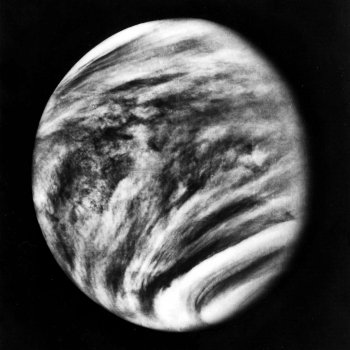
Venus as seen in ultraviolet by Mariner 10,
February 5, 1974
The uncertainty of science: Since the mid-1970s scientists have been trying to figure out the cause of the dark streaks seen in the atmosphere of Venus when photographed in ultraviolet. The image to the right was the first such UV image, taken by Mariner 10 during its fly-by on its way to Mercury. These streaks are caused by some unknown material that absorbs the UV light.
Researchers have now proposed that two different iron-bearing minerals, floating in Venus’s atmosphere, are what cause these dark UV streaks. From the absract:
Our results demonstrate that ferric iron can react with sulfuric acid to form two mineral phases: rhomboclase [(H5O2)Fe(SO4)2·3H2O] and acid ferric sulfate [(H3O)Fe(SO4)2]. A combination of these two mineral phases and dissolved Fe3+ in varying concentrations of sulfuric acid are shown to be good candidates for explaining the 200- to 300-nm and 300- to 500-nm features of the reported unknown UV absorber.
Iron has been detected in the atmosphere previously, and is theorized could come from volcanic eruptions on the planet’s million-plus volcanoes.
This new hypothesis explaining the dark UV absorber however remains unconfirmed, and joins a list of other candidates for that absorber, many of which propose either iron or sulfur in different combinations. Because so little data really exists about the atmosphere of Venus, with what is known also uncertain, it is presently impossible to solve this mystery with confidence. The problem is made even more difficult in that scientists understand almost nothing about the chemistry of materials under the conditions seen in Venus’s atmosphere, which is extremely hot (800 degrees Fahrenheit) and very thick and dense (100 times that of Earth).
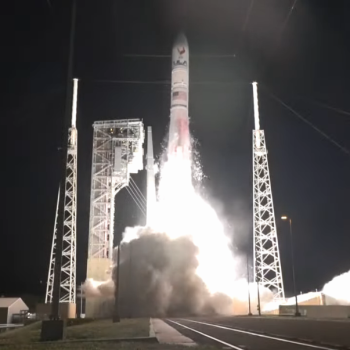
Vulcan at liftoff.
After four years of delay, mostly caused by delays at Blue Origin in delivering the two BE-4 engines used in the first stage, ULA’s Vulcan rocket finally completed its first launch early on January 8, 2024, lifting off from Cape Canaveral and successfully placing Astrobotic’s Peregrine lunar lander into orbit.
As of posting the upper stage had just deployed Peregrine, which will leave Earth orbit in about four days using its own engines. The upper stage has one more burn to send it into solar orbit, carrying the ashes of numerous people for the company Celestis.
The 2024 launch race:
3 SpaceX
1 India
1 China
1 ULA
For ULA, this launch is a very big deal. It is the first of two required in order for the Space Force to certify the rocket for future military launches. It also positions the company to begin the many launches that Amazon has awarded it to place into orbit a large percentage of that company’s Kuiper internet satellite constellation, assuming of course Blue Origin can deliver on schedule the many BE-4 engines that ULA will require.
This launch will also likely lead to the sale of ULA. » Read more
SpaceX today successfully launched another 23 Starlink satellites, its Falcon 9 rocket lifting off from Cape Canaveral.
The first stage completed its sixteenth flight, landing safely on a drone ship in the Atlantic.
The 2024 launch race:
3 SpaceX
1 India
1 China
According to a press release from NASA today, the United Arab Emirates (UAE) will build the airlock module for the Lunar Gateway space station plus have one astronaut fly a mission to the station after it is built.
Under a new implementing arrangement expanding their human spaceflight collaboration with NASA through Gateway, MBRSC will provide Gateway’s Crew and Science Airlock module, as well as a UAE astronaut to fly to the lunar space station on a future Artemis mission.
I strongly suspect that the UAE will mostly pay for this module to be built, hiring outside contractors from either the U.S. or Europe to do the work.
Embedded below the fold in two parts.
To listen to all of John Batchelor’s podcasts, go here.
» Read more
The podcast interview lasts about 75 minutes, broken up into eight segments. All are embedded below.
» Read more
An evening pause: When people are free they do great things, for their own benefit. The company, Bulldog Berries.
Hat tip Wayne DeVette.