Webb infrared data detects unexpected structure inside debris disk of Beta Pictoris

Beta Pictoris debris disk
Click for original image.

A new false color infrared image from the Webb Space Telescope has revealed an unexpected structure extending out from the two debris disks that surround the near-by star Beta Pictoris, with computer modeling suggesting might this structure have been the result of a large collision as recently as only 100 years ago.

That false-colr image is the right, with this newly discovered structure, described by the scientists as resembling “a cat’s tail”, on the right side. The infrared light of the star has been blocked in the center in order to see the details of the disk.

Webb’s mid-infrared data also revealed differences in temperature between Beta Pic’s two disks, which likely is due to differences in composition. “We didn’t expect Webb to reveal that there are two different types of material around Beta Pic, but MIRI clearly showed us that the material of the secondary disk and cat’s tail is hotter than the main disk,” said Christopher Stark, a co-author of the study at NASA’s Goddard Space Flight Center in Greenbelt, Maryland. “The dust that forms that disk and tail must be very dark, so we don’t easily see it at visible wavelengths — but in the mid-infrared, it’s glowing.”

To explain the hotter temperature, the team deduced that the dust may be highly porous “organic refractory material,” similar to the matter found on the surfaces of comets and asteroids in our solar system. For example, a preliminary analysis of material sampled from asteroid Bennu by NASA’s OSIRIS-REx mission found it to be very dark and carbon-rich, much like what MIRI detected at Beta Pic.

In an attempt to explain the cat’s tail, the scientists used computer models, which suggested it might have been caused by an event that produced a lot of dust, such as a collision between two large objects in the debris disk, and that event could have happened as recently as a hundred years ago.

This hypothesis remains unconfirmed, with much more data required before a final explanation can be accepted.
0 comments

Astronomers discover Earth-sized exoplanet roasted by a Sunlike star

Using data from the TESS space telescope, astronomers have discovered an Earth-sized exoplanet in a 4.2 day orbit around a G-type star like our Sun about 70 light years away.

The tidally locked planet is very close to Earth size (it is approximately 1.1 times the diameter of our own planet) and it’s orbiting a star that’s similar to the size of our Sun (the star is about 0.91 the size and 0.99 the mass of the Sun).

The star in this system is a G-type star, the same type as our Sun. But HD 63433 d orbits much closer to its star than we do, with a minuscule 4.2 day long “year” and extremely high temperatures on its dayside.

To read the research paper, go here. At an estimated age of only 400 million years, this exoplanet and its solar system of at least two other planets is much younger than the 4.5-billion-year-old Earth. Though the press release and paper note the possibility that it is similar in many ways to Io, a volcanic planet covered with lava, we don’t know this. All we know is that it is roasted by its star by orbiting so close to it.

1 comment

Blue Origin moves first stage of its New Glenn rocket from factory to launchpad hanger

In what might be the first step in assemblying Blue Origin’s New Glenn rocket for the first time (followed by a launch), the company yesterday transported the rocket’s first stage from its factory to its launchpad hanger.

Transported by a series of multiwheeled carriages and an arching structure, the 189-foot-tall first stage for what will be a 320-foot-tall rocket when fully assembled traveled horizontally on a 22-mile trip from the New Glenn factory in Merritt Island through Kennedy Space Center over to Cape Canaveral Space Force Station where Blue Origin has a hangar and launch pad at Launch Complex 36.

Jeff Bezos has said the company plans that first launch before the end of this year, though the company has been making this same promise now for the last three years, and is years behind schedule. What makes this promise different however is that this time we are seeing actual hardware moving towards the launchpad.

The article also gives a rough update on the company’s effort to manufacture the many BE-4 rocket engines needed for New Glenn (7) and ULA’s Vulcan rocket (2). The two engines for the next Vulcan launch in April are presently undergoing final testing at Blue Origin’s test facility in Texas, and the company says it is about to ramp up production. It thus appears that getting enough engines built is still the main obstacle to launch. We shall finally know later this year if Blue Origin has solved this problem.

1 comment

Update on Astrobotic’s Peregrine lunar lander

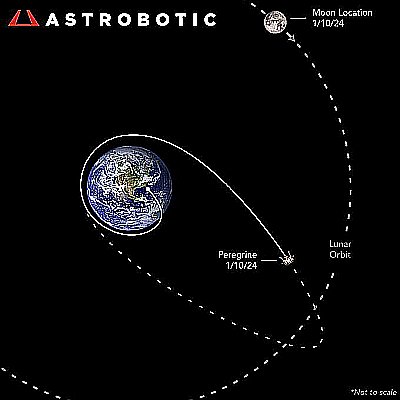
The expected flight path of Peregrine
Click for original image.

The company Astrobotic has released several more updates on the status of its Peregrine lunar lander, which will no longer attempt a lunar landing because of a major fuel leak.

The map to the right shows its expected path in the coming days. While sent in a very elongated Earth orbit by ULA’s Vulcan rocket, the spacecraft was unable to do the additional engine burns that would have put it on the correct path to reach the Moon. Instead, it will fall back towards Earth, though its fate beyond that is unclear at this time.

Meanwhile, engineers have succeeded in getting data from all payloads designed to communicate back to Earth.

We have successfully received data from all 9 payloads designed to communicate with the lander. All 10 payloads requiring power have received it, while the remaining 10 payloads aboard the spacecraft are passive. These payloads have now been able to prove operational capability in space and payload teams are analyzing the impact of this development now.

Engineers have also been able to get the spacecraft to send back a number of images. These successes help the company prove out some of the spacecraft’s systems, though it is unable to test the mission’s prime goal, landing on the Moon.

7 comments

China successfully launched twice today

China completed two different launches from two different launch locations today, with one being the first launch of a new rocket.

First, China’s solid-fueled Kuaizhou-1A lifted off from the Jiuquan spaceport in northwest China, placing what the state-run press described as a “satellite is mainly used for experiments such as space environment detection.” No other information was released. Nor was any information released about where the rocket’s lower stages crashed inside China.

Next, a Chinese pseudo-company, Orienspace, completed the first launch of its new Gravity-1 rocket, lifting off from a barge off the coast of Haiyang in the Yellow Sea carrying three satellites. The state-run press once again failed to mention this company’s name in its report, describing it instead as a “launch by China”, illustrating again the lack of independence these pseudo-companies have. They might design and build on their own, but they are controlled entirely by the communist government, and at any time can be taken over by it.

Though the rocket itself appears very similar in many ways to India’s largest version of its liquid-fueled GSLV rocket, very squat with four strap-on boosters, Gravity-1 is solid-fueled (thus derived from the missile technology controlled by China’s military). It is also the most powerful solid-fueled rocket now in operation, twice as powerful as Europe’s Vega-C.

The 2024 launch race:

4 China
3 SpaceX
1 India
1 ULA

0 comments

Engineers succeed in releasing two fasteners that blocked access to OSIRIS-REx Bennu samples

Using new specially designed tools, engineers have finally succeeded in removing the two fasteners that had prevented them from opening the sample return capsule that holds the bulk of material from the asteroid Bennu that was grabbed by OSIRIS-REx and brought back to Earth.

Curation processors paused disassembly of the TAGSAM head hardware in mid-October after they discovered that two of the 35 fasteners could not be removed with the tools approved for use inside the OSIRIS-REx glovebox.

In response, two new multi-part tools were designed and fabricated to support further disassembly of the TAGSAM head. These tools include newly custom-fabricated bits made from a specific grade of surgical, non-magnetic stainless steel; the hardest metal approved for use in the pristine curation gloveboxes.

The fasterners have been removed, but the sample capsule still needs to be dissassembled before the samples can be accessed and analyzed. It is now expected that by the spring the material will be fully catelogued and available for scientists to study.

In an ironic twist, OSIRIS-REx brought back so much extra material clinging to the outside of that sample return capsule that such research has already begun. In fact, that extra material actually exceeded in weight the minimum amount the mission wanted to capture inside the capsule. What will be found inside the capsule will only add to the mission’s success.

0 comments

Secretariat – Triple Crown Races

An evening pause: If you have never seen the Triple Crown victories by Secretariat in 1973, you need to watch this video. It will take your breath away. In the first two races jockey Ron Turcotte appears to let the pack take the lead at the start because he knows Secretariat can’t stand being behind. In the last, it is as if the horse wanted to prove to everyone that there was no horse now or ever that was faster. From the youtube webpage:

Secretariat (March 30, 1970 – October 4, 1989), also known as Big Red, was a champion American Thoroughbred racehorse who is the ninth winner of the American Triple Crown, setting and still holding the fastest time record in all three races. He is widely regarded as one of the greatest racehorses of all time. He became the first Triple Crown winner in 25 years and his record-breaking victory in the Belmont Stakes, which he won by 31 lengths, is widely regarded as one of the greatest races in history.

9 comments

Endless ash fields on Mars

Endless ash fields on Mars
Click for original image.

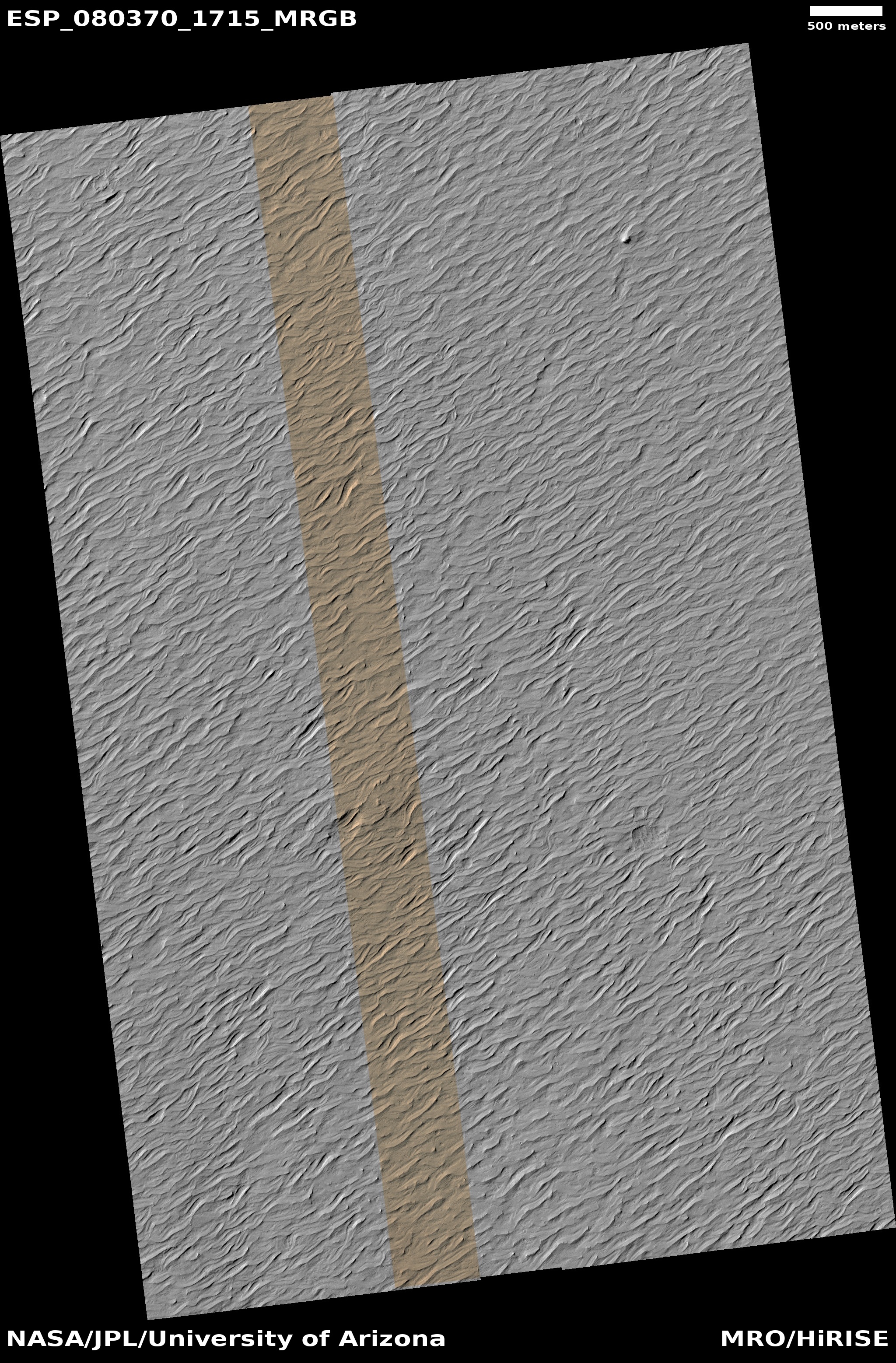
Cool image time! The picture to the right, cropped, reduced, and sharpened to post here, was taken on September 18, 2023 by the high resolution camera on Mars Reconnaissance Orbiter (MRO).

It shows the very typical surface on a high plateau in Mars’ dry tropical regions. The dunes you see here, in this very small slice, cover a region about 80 miles square, with the prevailing winds appearing to consistently blow from the northeast to the southwest and forming these endless striations.

The dunes are made of volcanic ash, and the size of this particular ash field gives us a sense of the past volcanic activity that once dominated the red planet. Once, the atmosphere was filled with ash, which covered the ground across large regions. In the subsequent eons the thin Martian atmosphere has reshaped and piled that ash into giant mounds hundreds of miles across, with the surface striated as we see here.
» Read more

4 comments

Democrats get a taste their own vicious swatting tactics

The first amendment: no longer honored
No longer honored.

For more than a decade anonymous leftists have used the ugly tactic of swatting to strike fear into the hearts of anyone who opposes them, with the hope that in some cases it might even cause the attacked person or someone in his or her family to be killed.

For those still unaware of what swatting is, let me explain. The attacker simply calls the police and reports falsely a dangerous gun-related crime in progress at the victim’s home, often suggesting there are hostages involved. The police then respond in full force, guns drawn and in large numbers. The victims, who are often asleep at the time, are suddenly faced with a military style attack by SWAT teams, at their home with their family (including children) present, with the real chance that someone will make a mistake, overreact, and begin firing.

The left has been doing this to conservatives both in and out of the political world for years (for a few specific examples going back to 2012, go here, here, and here). In some cases the perpertrators have been caught (with many being teenage boys reacting to the leftist press and thus acting out stupidly), but usually the evil-doer is not identified or punished.

Without question however this tactic has become increasingly popular on the left, which in itself has become increasingly radicalized and intolerant of any opposition.

It now appears the left is beginning to reap what it has sown. In the past few weeks a number of very prominent Democrats have been swatted themselves.
» Read more

15 comments

NASA awards more money to two private space station proposals

Because Northrop Grumman has dropped its plans to build its own private space station, joining instead the Starlab station consortium led by Voyager Space, NASA has been able to shift the funding planned for Northrop Grumman’s station to two other two private space station projects.

Voyager Space’s Starlab station development will receive an additional $57.5 million from NASA, which brings NASA’s total funding for Starlab so far to $217.5 million, the space agency said.

…The Orbital Reef space station of Blue Origin and Sierra Space is receiving an additional $42 million, bringing that project’s total NASA funding so far to $172 million.

NASA says the extra money will help both consortiums meet their schedules.

A third private station, Axiom, also under development in partnership with NASA, plans to dock its initial modules to ISS, and then undock when completed to fly free.

A fourth American private space station is also being built, but independent of NASA entirely. The company, VAST, has teamed up with SpaceX to launch its first modules on Starship/Superheavy, followed by at least two manned missions.

2 comments

Private spaceport proposed on coast of Oman

Middle East, showing Oman's proposed spaceport

A private commercial company has proposed building a new spaceport on the coast of Oman near the town of Duqm, as shown on the map to the right.

The commercial spaceport, called Etlaq, is designed to host all sizes of launch vehicles in the port town of Duqm, and would meet US Federal Aviation Administration standards to attract international launch companies.

The National Aerospace Services Company (Nascom), which is overseeing the spaceport, unveiled its plans at the Middle East Space Conference in Muscat, more than a year after initially announcing the project. Nascom chairman Azzan Al Said told The National that the Etlaq Space Launch Complex was in the planning phase and development would start by 2025, with the spaceport set to become fully operational by 2030.

Nascom is apparently Oman’s space agency, and appears tasked to remove barriers to this private project. It is trying to ease the State Department ITAR restrictions that make it impossible for American rocket companies to launch from countries such as Oman. It has also contracted with a UK company that speciallizes in building spaceports.

4 comments
1 184 185 186 187 188 191