India launches its first attempt to do an in-space docking demo

India’s space agency ISRO today successfully launched a mission, dubbed Spadex, to make its first attempt to do an in-space unmanned docking between two satellites, its PSLV rocket lifting off from its coastal Sriharikota spaceport. From the Spadex mission webpage:

The SpaDeX mission consists of two small spacecraft (about 220 kg each) to be launched by PSLV-C60, independently and simultaneously, into a 470 km circular orbit at 55° inclination, with a local time cycle of about 66 days. The demonstrated precision of the PSLV vehicle will be utilized to give a small relative velocity between the Target and Chaser spacecraft at the time of separation from the launch vehicle. This incremental velocity will allow the Target spacecraft to build a 10-20 km inter-satellite separation with respect to the Chaser within a day. At this point, the relative velocity between the Target will be compensated using the propulsion system of the Target spacecraft.

At the end of this drift arrest maneuver, the Target and Chaser will be in the same orbit with identical velocity but separated by about 20 km, known as Far Rendezvous. With a similar strategy of introducing and then compensating for a small relative velocity between the two spacecraft, the Chaser will approach the Target with progressively reduced inter-satellite distances of 5 km, 1.5 km, 500 m, 225 m, 15 m, and 3 m, ultimately leading to the docking of the two spacecraft. After successful docking and rigidization, electrical power transfer between the two satellites will be demonstrated before undocking and separation of the two satellites to start the operation of their respective payloads for the expected mission life of up to two years.

For India’s plans to build a manned space station this capability is essential. It will also be needed for its plans to send humans to the Moon.

As this was only India’s fifth launch in 2024, the leader board for the 2024 launch race remains unchanged:

136 SpaceX
65 China
17 Russia
14 Rocket Lab

American private enterprise still leads the rest of the world combined in successful launches 156 to 98, while SpaceX by itself leads the entire world, including American companies, 136 to 118.

At the moment only one more launch remains in 2024, a SpaceX Falcon 9 launch scheduled for tomorrow night. I will be publishing my year-end global launch report later this week.

4 comments

ESA approves a slightly smaller preliminary budget for 2025

The council running the European Space Agency (ESA) has now approved a preliminary budget for 2025 of $8 billion, a very slight reduction from the 2024 budget.

According to [ESA’s director general Josef] Aschbacher, the budget includes €4.8 billion in contributions from ESA member states, approximately €1.7 billion from the European Union, and €1.2 billion from “some other sources.” A more detailed breakdown of the 2025 ESA budget will be released during the DG’s annual press briefing, which is expected to occur on 9 January 2025.

It is also expected that the final budget will be higher once the legislatures of ESA’s numerous member states approve their contributions to the agency. Right now German, France, and Italy are the largest contributors. All three governments have in the past two years clearly signaled their determination to support commercial space. This should translate into support for ESA, though the two are becoming increasingly separated. Those nations could also decide there is no reason to give cash to this bureaucracy, and instead use it to directly fund their new private rocket startups.

0 comments

China replaces head of its space agency

The man who has headed China’s space agency since 2018 during its most aggressive and successful period, Zhang Kejian, has been replaced by the Chinese government. Zhang has also been removed from another important political post.

Zhang, 63, who has been head of the China National Space Administration (CNSA) since May 2018, is to be removed as Party Secretary of the State Administration for National Defense Science, Technology, and Industry (SASTIND), the agency announced Dec. 26. Shan Zhongde, 54, has been appointed as his replacement. The leader of SASTIND typically also heads CNSA and the China Atomic Energy Authority, both of which are subordinate agencies to SASTIND. CNSA has yet to announce the expected change.

China’s state run press provided no explanation for this change, though it also follows the removal of two other high ranking managers this year from another space agency, CASC, that is supervised by CNSA. Those removals are thought related to reports of corruption.

In the past two decades CNSA administrators went on to become heads of Chinese provinces, the approximate equivalent of a state governor in the U.S. and a somewhat powerful position. It appeared the Xi government was using its space agency as a training ground for its future political leaders. This in turn gave its space operations a favorable political position within the government.

Zhang’s removal in this manner and the rumors of corruption suggest this policy failed in his case. Another possibility is ven more significant if true. It might imply Zhang was involved in some power struggle that threatened Xi and his leadership. If this last possibility is so, the present favored political position of China’s space operations might be seriously threatened. Xi might have decided he did not like the power its leaders have garnered, and is now moving to squash it.

This does not mean the government will now move to reduce its space effort. It could mean however that funding will be more closely watched, and new projects questioned and rejected more easily.

1 comment

SpaceX completes two launches tonight from opposite coasts

SpaceX tonight successfully completed two launches. First it placed 20 Starlink satellites into orbit (including 13 configured for direct-to-cell capabilities), its Falcon 9 rocket lifting off from Vandenberg in California. The first stage completed its sixteenth flight, landing on a drone ship in the Pacific.

Next SpaceX successfully launched four satellites for the smallsat startup Astranis, its Falcon 9 rocket lifting off from Cape Canaveral in Florida. The first stage completed its seventh flight, landing on a drone ship in the Atlantic, while the two fairing halves completed their 12th and 22nd flights.

Astranis had previously launched one demonstration satellite, proving that its smallsat design could do the work in geosynchronous orbit traditionally done by much larger and more expensive satellites. The four satellites on this launch are its first attempt to provide commercial service. If successful it places this American company in a good position to grab the market share from the older geosynchronous companies like Intelsat, SES, and Eutelsat.

The leaders in the 2024 launch race:

136 SpaceX
65 China
17 Russia
14 Rocket Lab

American private enterprise now leads the rest of the world combined in successful launches 156 to 97, while SpaceX by itself leads the entire world, including American companies, 136 to 117.

8 comments

Roscosmos buys Earth observation data from private Russian satellite company

According to a report today by Russia’s state-run news agency TASS, Roscosmos has awarded a commercial contract to a private Russian satellite company, dubbed Sputnix, to purchase earth observation data its satellites have already collected.

“In 2024, up to 1.4 billion rubles [around $14.285 million] were allocated in budget funds to conclude forward contracts with private companies on buying out Earth’s remote sensing data obtained from their satellites and created under the federal project ‘Developing the Advanced Space Systems and Services High-Tech Sector.’ The first contract on buying out data has been concluded with the Sputnix Group of Companies,” Roscosmos said in a statement.

The Sputnix Group confirmed to TASS that the contract had been signed.

“Under the contract, the data already loaded into the database were bought out. We hope that next year we will be able to sign a forward contract as part of implementing the roadmap for the ‘Advanced Space Systems and Services’ project,” the company said, emphasizing that cooperation with Roscosmos remained a priority for Sputnix.

Sputnix was founded in 2011, and has so far launched 20 satellites into orbit, though many were short-lived cubesats. While on the surface this company appears real, it is not unlike the pseudo-companies in China. Its contracts appear to be almost all with the Russian government, all its work appears supervised by that government, and at any moment the Russian government can take it over, as it essentially did with the effort of the so-called private rocket startup S7 to launch from the Sea Launch ocean platform.

In other words, this news piece is simply the Russian government’s attempt to convince the world and its own people that there is a competitive and independent private sector in Russia, when in reality it doesn’t exist.

1 comment

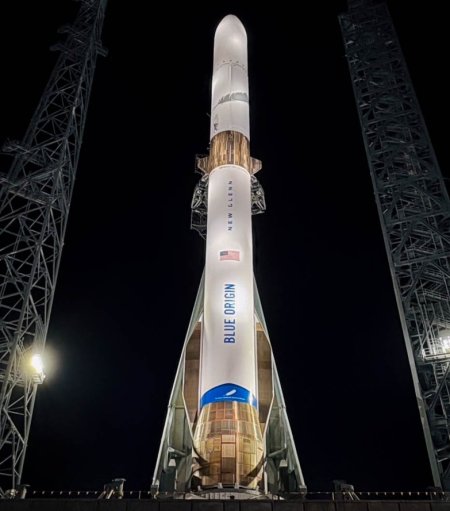
Blue Origin completes first full dress rehearsal countdown and static fire test of New Glenn

Blue Origin today successfully completed the first full dress rehearsal countdown and static fire test of its New Glenn orbital rocket at its launchpad at Cape Canaveral.

The tanking test included a full run-through of the terminal count sequence, testing the hand-off authority to and from the flight computer, and collecting fluid validation data. The first stage (GS1) tanks were filled and pressed with liquefied natural gas (LNG) and liquid oxygen (LOX), and the second stage (GS2) with liquid hydrogen and liquid oxygen–both to representative NG-1 set points.

The formal NG-1 Wet Dress Rehearsal demonstrated the final launch procedures leading into the hotfire engine run. All seven engines performed nominally, firing for 24 seconds, including at 100% thrust for 13 seconds. The test also demonstrated New Glenn’s autogenous pressurization system, which self-generates gases to pressurize GS1’s propellant tanks.

According to the company, the test achieved all its engineering goals, apparently making it ready for its targeted January 6, 2025 launch date. Beforehand however it will be rolled back into the assembly building so that its payload, Blue Origin’s Blue Ring orbital tug, can be stacked inside the fairings to fly a demo mission for the military.

7 comments

December 27, 2024 Quick space links

Courtesy of BtB’s stringer Jay. This post is also an open thread. I welcome my readers to post any comments or additional links relating to any space issues, even if unrelated to the links below.

  • Air & Space touts the navigational work done by Jim Lovell during Apollo 8 in 1968
    For most of the mission, Lovell’s work was merely a back-up to calculations provided by ground computers and plugged into the capsule computer for use with its inertial measuring unit (IMU). Only once was Lovell’s navigation necessary, when he accidentally rebooted the IMU so it thought it was on the launchpad, not on its way back to Earth. To reprogram it he had to do his sextant sightings and enter those numbers into the computer.
3 comments

Blue Origin finally gets FAA license to launch New Glenn, now targeting January 6, 2025

The first completely assembled New Glenn, on the launchpad
The first completely assembled New Glenn,
on the launchpad

The FAA, after months of apparent delays, today finally issued Blue Origin a license to launch its New Glenn rocket for a period covering the next five years.

As has now become the FAA’s custom, in issuing this license it also brags about its success in issuing the license “well in advance of the statutory deadline” for doing so.

What a crock. Blue Origin and NASA were originally targeting an October launch of New Glenn carrying two Mars orbiters, but had to cancel when the rocket couldn’t lift off during the six-day launch window. Though delays at Blue Origin certainly contributed to this cancellation, I suspect the FAA’s red tape played a major factor as well.

According to another source, Blue Origin is now targeting a launch date of January 6, 2025. The company is presently doing a static fire test on the launchpad.

Hat tip to BtB’s stringer Jay.

7 comments

Why this place in Valles Marineris is NOT a good place to establish trails and inns

Overview map

North rim and the top of the trail
Click for original image.

In my cool image yesterday I highlighted a location along the north rim of the gigantic Valles Marineris canyon on Mars that appeared a great place to establish a hiking trail. The trail would take hikers down from the rim to the floor of the canyon, a distance of more than 20 miles with an elevation loss of more than 31,000 feet, more than the height of Mount Everest. The image to the right shows the top of that trail, at the rim. The white dot on the overview map above shows its location in Valles Marineris.

Because of the trail’s length I also suggested that future colonists would likely set up inns along the way, so that hikers would have places to stay as they worked their way downhill day-by-day.

There is however one major reason not to build at this particular location, and it involves the most significant geological detail I noticed in the picture to the right. Note the arrows in both this image as well as the inset above. In the picture they mark a sudden drop paralleling the rim. In the inset they also show a series of parallel cracks further north.

The cliff and the cracks suggest that the entire cliff of this part of the north rim has subsided, and is in fact beginning to separate from the plateau, and will soon (in geological terms) collapse into a spectacular avalanche. If you look at the cliff face in the inset you can see two extended outflow piles that apparently came from smaller earlier such collapses.

Could this entire cliff face, the size of Mount Everest, actually separate and crash into the canyon? If you have doubts, then take a look at the image below.
» Read more

3 comments

Eutelsat-OneWeb stock plummets

Despite its merger with Eutelsat in 2023, the stock value of the combined Eutelsat-OneWeb satellite company has plummeted in the past year, more than halving the value of the OneWeb portion that was saved from bankruptcy by both the government of the United Kingdom and investors from India in 2020.

The collapse means the UK’s investment is worth €133m (£110m), representing a near £300m paper loss for the taxpayer. … However, while the all-share deal implied a value of €12 per share, Eutelsat’s stock has since imploded. In the past 12 months, it has halved and is trading at record lows of €2.58.

Eutelsat was facing its own collapse before the merger, as its business was geosynchronous communications satellites which are now losing their business to the low-Earth orbit constellations such as SpaceX’s Starlab and OneWeb’s. The merger was the company’s attempt to join this new market.

OneWeb however has had its own repeated problems completing that its constellation, and faced bankruptcy in 2020 because of delays from the COVID panic as well as delays in launching the Ariane-6 rocket. Then Russia’s invasion of the Ukraine in 2022 meant it lost all its remaining planned launches, forcing it to scramble to find other launch providers.

Stock market analysts don’t expect the combined company to begin earning profits for at least the next three to five years, which casts an even greater pall on its future.

2 comments

Parker probe phones home, signalling it has successfully survived its record-breaking closest approach to the Sun

Parker flight plan
The flight plan for Parker. Click for original.

NASA today reported that it has received a signal from the Parker Solar Probe, indicating all of its systems are in good health following its record-breaking closest approach to the Sun on December 24, 2024.

The mission operations team at the Johns Hopkins Applied Physics Laboratory (APL) in Laurel, Maryland received the signal just before midnight EST, on the night of Dec. 26. The team was out of contact with the spacecraft during closest approach, which occurred on Dec. 24, with Parker Solar Probe zipping just 3.8 million miles from the solar surface while moving about 430,000 miles per hour.

Not only was this the closest any human-built object has gotten to the Sun, it was the fastest any human-built object has ever traveled.

This close fly-by was Parker’s 22nd of the Sun since launch. In its nominal mission it plans to do two more close approaches as shown in the graphic to the right, both of which will be comparable to the record just set.

2 comments
1 2 3 4 191