China launches first set of satellites for planned internet megaconstellations

China today successfully launched an unknown number of satellites in the first launch of one of its planned internet megaconstellations designed to compete with Starlink, its Long March 5B rocket lifting off from its coastal Wenchang spaceport.

Not revealing the number of satellites launched is probably a violation of the Outer Space Treaty, which requires each signatory to inform others of its launches and at a minimum the number of objects placed in orbit. This constellation, dubbed Guowang, is hoping to launch as many as 13,000 satellites, and that will require some coordination to prevent it from interfering with the constellations launched by others. Not revealing the size of this satellite group makes such coordination impossible.

In a bit of good news, it appears China has solved the problem of its Long March 5B rocket, which in the past had used its core stage to place objects in orbit. After payload deployment that core stage would be in an unstable an orbit that would quickly decay, allowing the stage to crash uncontrolled, thus threatening habitable areas worldwide. The rocket’s new upper stage now takes the payloads into orbit, so the core stage can drop off sooner and fall into the ocean harmlessly.

The leaders in the 2024 launch race:

129 SpaceX
61 China
16 Russia
13 Rocket Lab

American private enterprise still leads the rest of the world combined in successful launches 148 to 93, while SpaceX by itself leads the entire world, including American companies, 129 to 112.

0 comments

FAA eliminates a stupid licensing requirement imposed when it “streamlined” its launch licensing regulations

We’re from the government and we’re here to help! The Federal Aviation Administration (FAA) announced last week that it will stop demanding rocket companies redo a flight safety analysis that have already been done by the rocket’s spaceports, a new bit of red tape that was apparently added when the agency introduced its Part 450 “streamlined” licensing regulations in 2021.

The FAA announced Dec. 13 that it will accept flight safety analyses performed by federal launch ranges in California, Florida and Virginia in applications for launch licenses under regulations known as Part 450. That decision means that companies will no longer have to perform similar analyses specifically for the FAA as part of the licensing process. Launch companies had complained of the duplication of work needed to carry out FAA analyses in addition to those required by the ranges they were launching from.

The FAA’s own bureaucracy had recognized the stupidity of this requirement (as well as many others) in July 2023 report [pdf], but the agency’s management did nothing. Apparently the political appointees who ran the agency during the Biden administration either liked this red tape — slowing American business — or were too dense to take action.

Trump’s election victory has now obviously forced some action. Not only has the agency suddenly recognized this particular problem, one week after Trump’s victory it announced the formation of an independent committee of industry and academia to review, once again, its Part 450 regulations.

It seems this committee is largely a Potemkin Village to make the Trump leadership think the agency is doing something. Instead, the FAA should do what it did last week, and adopt the many recommendations of the July 2023 report, now. The committee can then move forward cleaning up Part 450 in other areas instead of simply repeating that past work.

4 comments

Boeing to take more than a decade to refit two 747s for Air Force One

Utter incompetence: According to recent news reports, Boeing will not be able to deliver the two 747s it is refitting to be the president’s Air Force One fleet until 2029, even though it signed a $3.9 billion contract to do so in 2018.

The delay is startling given that Boeing isn’t building the planes from scratch. During Trump’s first term, Boeing started to overhaul two 747s that were built for a Russian airline that never took the jets.

This is more than absurd, it is obscene. Boeing is handed two flightworthy 747s and almost $4 billion, and it can’t refit the two planes in less than a decade? It seems one of the first things Trump should do once he returns to office next month is cancel this contract entirely, demand a refund from Boeing, and simply convert his present fleet of “Trump Force One” airplanes that he has been using since 2020 for use as president. Cheaper, faster, and certainly a wiser use of taxpayer money.

As for Boeing, this story illustrates once again how far this company has fallen. Remember, it was Boeing that conceived, designed, and built the 747. Moreover, its 747 has been used for decades for Air Force One. For its engineers now to be incapable to refitting another two 747s for this purpose seems inconceivable, and suggests those same engineers should not be trusted on any new planes they build.

22 comments

Juno spots changes on Io’s surface in just a two-month span

Before and after images by Juno of volcanic ring on Io
Click for original image.

New photos taken just two months apart by Juno of a region dubbed Nusk Patera on the Jupiter moon Io showed the appearance of a distinct ring that had hardly been there before.

The pictures, taken during two recent fly-bys of the moon, are above, and show the change. From the caption:

A red ring formed around Nusku Patera in the two months between the spacecraft’s 58th flyby on Feb. 3, 2024, and its 60th on April 9, 2024. The ring obscures some nearby features like Creidne Patera. This ring, 683 miles (1,100 kilometers) wide is likely from a Pele-type plume rich in sulfur. Similar transient red rings were observed by NASA’s Galileo mission around Grian Patera and Surt and were associated with intense but short-lived thermal “outburst” eruptions.

In other words, sulfur from eruption from the central vent/caldera was flung into the sky enough that when it eventually settled back down it landed in a ring about 340 miles away from the center.

Other data from Juno, also released this week here and here, detected fresh lava flows at another volcanic region of Io dubbed, Zal Patera.

0 comments

Thanksgiving/Christmas fund drive is over. Big thanks to everyone who donated!

Scroll down to read the newest posts.

Readers!

My annual Thanksgiving/Christmas fund drive for Behind the Black is now over. Though it sagged in the middle, the final week was an amazing barn-burner. My readers responded in an astonishing manner, so that 2024 now looks like it will turn out to be the best year for me financially since I started this webpage in 2010.

Thank you to all! I am always at a loss to express my gratitude for this support. No one is required to pay anything to read my work. And yet so many of you are still willing to do so. Thank you again!

I will leave this thank you notice up for the next few days, so that everyone can see it.

7 comments

SpaceX launches more Starlink satellites

SpaceX today successfully launched 22 Starlink satellites, 13 of which were for its direct-to-cell constellation. The Falcon 9 rocket lifted off from Vandenberg in California, its first stage completing its ninth flight by landing successfully on a drone ship in the Pacific.

According to a tweet by SpaceX at the end of October, only five more launches were necessary to complete the first version of its direct-to-cell Starlink constellation. Today’s launch meets that criteria. Since the FCC has approved the constellation’s license, this means T-Mobile can start offering the service to customers, filling in all dead spots worldwide.

What makes this launch even more unique is that for the first time in quite awhile there was a four-day-plus gap between SpaceX launches. The company has been launching so often that it has been rare for more than two days to pass this year without a launch.

The leaders in the 2024 launch race:

129 SpaceX
60 China
16 Russia
13 Rocket Lab

American private enterprise now leads the rest of the world combined in successful launches 148 to 92, while SpaceX by itself leads the entire world, including American companies, 129 to 111.

1 comment

Melinda Kathleen Reese – O Come O Come Emmanuel

An evening pause: This was first posted in February 2019. As I noted then,

The video replays her singing the same thing three times. There is a good reason, as she almost appears to have begun singing as a lark, and the acoustics of the church astonish her. The repeats help bring out this amazing quality.

I always open the Christmas-Hannukah holiday season with this truly glorious piece of music, as it speaks to both religions. And it is one magnificent song, sung here magnificently.

May all my readers have a glorious weekend.

6 comments

Perseverance reaches top of Jezero Crater rim

The view west out of Jezero Crater
Click for high resolution panorama. For original images, go here and here.

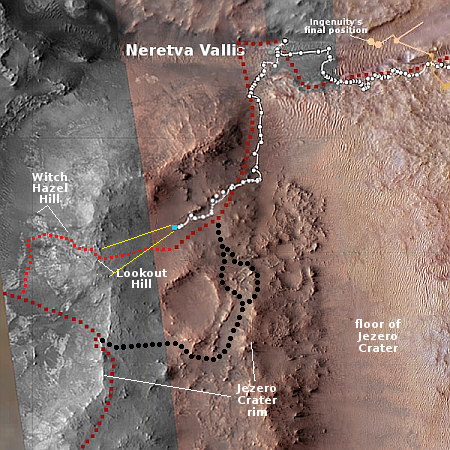
Overview map
Click for interactive map.

After spending more than three and a half years exploring the floor of Jezero Crater, the rover Perseverance has finally reached the top of the crater’s western rim, and is about to begin exploring the mountainous and potentially rich mining region to the west.

The panorama above, created from two pictures taken by Perseverance’s right navigation camera on December 11, 2024 (here and here), has been cropped, reduced, enhanced, and annotated to post here. It looks west into that mountainous region, with the yellow lines on the overview map to the right indicating the approximate view. The blue dot on that map marks Perseverance’s present position, on top of Lookout Hill, the name the rover team has given to that spot on the rim.

The low resolution of the region beyond the grey strip is unexplained. For some reason the rover team has not yet updated the interactive map showing Perseverance’s travels with the many high resolution pictures that Mars Reconnaissance Orbiter (MRO) has taken of this region, in anticipation of Perseverance’s travels there. I expect however this will change shortly.

Witch Hazel Hill is the first target beyond the rim, where there is an outcrop 330-feet-high with many layers. The rover will then head downhill and south to check out a spot that the scientists believe might show features existing from before Jezero Crater was formed. The rover will then head back up to the rim further south to look at an outcrop of blocks that might actually be ejecta from another much larger Martian impact.

These blocks may represent ancient bedrock broken up during the Isidis impact, a planet-altering event that likely excavated deep into the Martian crust as it created an impact basin some 745 miles (1,200 kilometers) wide, 3.9 billion years in the past.

Jezero sits on the northwestern rim of Isidis.

0 comments

Curiosity begins to round the corner out of Gediz Vallis

Curiosity looks ahead
Click for original image.

According to an update yesterday from the rover team, the Mars rover Curiosity has finally begun to round the corner of the northern nose of the long ridge dubbed Texoli that forms the western wall of Gediz Vallis, the slot canyon that the rover has been exploring since August 2022.

The picture to the right, reduced, sharpened, and annotated to post here, was taken on December 10, 2024 and shows the view looking west. The red dotted line indicates the planned route. As the rocky ground indicates, travel forward in the near term will be interesting. As noted in the update:

While we want to head southwest, we had to divert a bit to the north (right of the image shown) to avoid some big blocks and high tilt. The path is very constrained in order to avoid driving over some smaller pointy rocks, scraping wheels along the sides of blocks, or steering into the side of blocks that might cause the steering to fail. And we also needed to worry about our end-of-drive heading to be sure the antenna will be clear to talk to Earth for the next plan. We ended up relying on the onboard behavior to help us optimize everything by implementing a really interesting and curvy 24-meter path (about 79 feet).

» Read more

0 comments

Rocket startup Stoke Space completes static fire test of first stage engine

Stoke's Nova rocket
Stoke’s Nova rocket

The rocket startup Stoke Space revealed yesterday that it has completed a static fire test of the first stage engine it will use on its Nova rocket, shown in the graphic to the right.

The test, which was not the first for this engine, proved out several new technologies.

Stoke Space called the test significant for several reasons. It’s the first hotfire of the company’s Block 2 (flight layout) stage 1 engine, and this engine architecture — called full-flow staged combustion (FFSC) — is considered particularly challenging. Only two entities in the world — Stoke and SpaceX — have successfully developed FFSC engines. … Stoke’s stage 1 engine is a liquified natural gas/liquid oxygen engine capable of producing 100,000 pounds of thrust. The duration of the test was not revealed.

It was the first time Stoke has tested on its new vertical test stand in Moses Lake. The company’s testing philosophy is that you must “test like you fly,” and it believes vertical testing is key to engine development.

Nor is the first stage engine the only technological innovation. Nova’s second stage uses a radical design whereby the engine releases its thrust through a ring of small nozzles on the outside perimeter of the stage, rather than a single central nozzle. This design is what the company hopes will allow it to return that upper stage intact for reuse.

The four year old company has raised $100 million in investment capital, but has also faced environmental red tape from the Space Force for its launch facility at Cape Canaveral. It had previously targeted 2025 for the first test flights of Nova, but that schedule appears unlikely because of this red tape.

1 comment
1 7 8 9 10 11 191