
Daryl Hall – Can We Still Be Friends
An evening pause: With Todd Rundgren.
Hat tip Ferris Akel.
An evening pause: With Todd Rundgren.
Hat tip Ferris Akel.
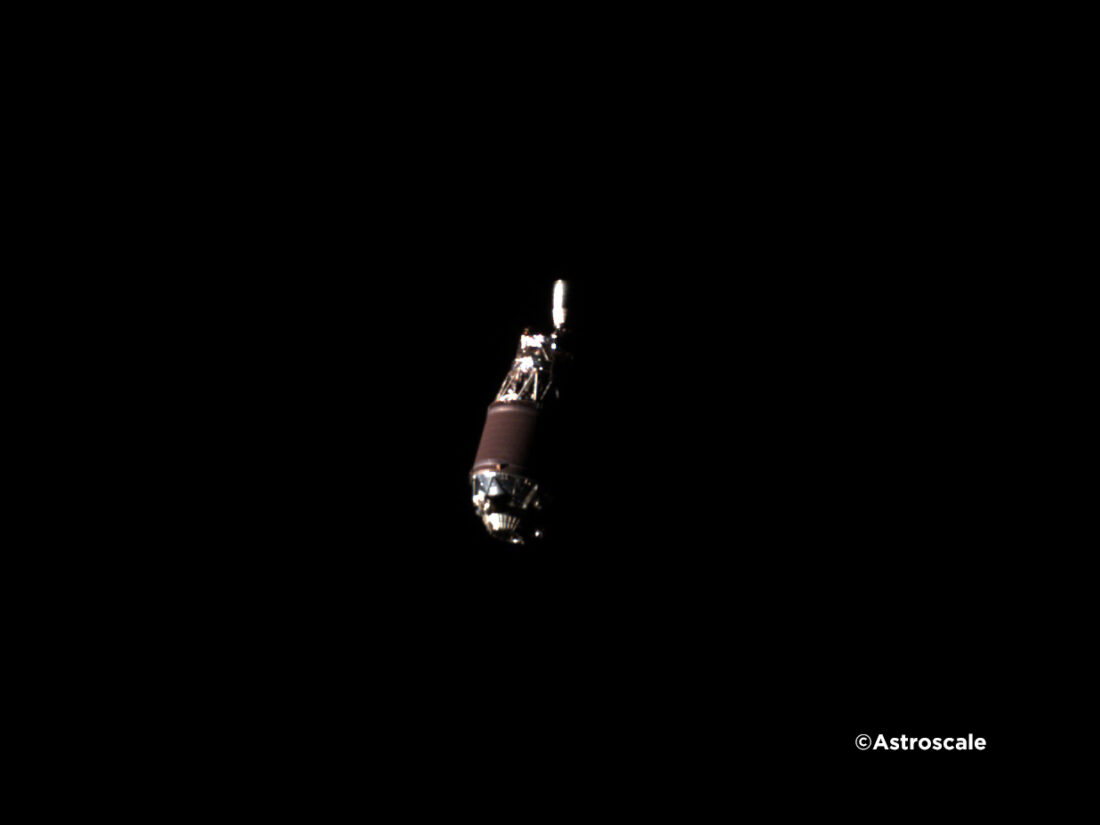
Image taken during ADRAS-J’s initial approach in April 2024.
Click for original image.
The demo maneuvering spacecraft ADRAS-J, built by the Japanese orbital tug startup Astroscale, has successfully maneuvered to within 50 feet of the abandoned rocket stage that the company hopes to grab and de-orbit on a later mission.
When ADRAS-J was 50 meters behind the upper stage the spacecraft reduced the gap in a straight-line approach then maneuvered to approximately 15 meters below the Payload Attach Fitting (PAF) — the planned capture point for the follow-on ADRAS-J2 mission — aligning the spacecraft’s relative speed, distance, and attitude. ADRAS-J successfully maintained this position until an autonomous abort was triggered by the onboard collision avoidance system due to an unexpected relative attitude anomaly with the upper stage. The spacecraft safely maneuvered away from the debris as designed before reaching the CIP. Astroscale Japan is currently investigating the cause of the abort.
Engineers will have to understand that the cause of that abort prior to launching ADRAS-J2, the mission that will grab the stage and de-orbit it.
Hat tip to BtB’s stringer Jay.
Courtesy of BtB’s stringer Jay. This post is also an open thread. I welcome my readers to post any comments or additional links relating to any space issues, even if unrelated to the links below.

Click for original image.
The uncertainty of science: A review by scientists of major ice calving events in Antarctica that have occurred in the last 47 years has detected absolutely no trend either up or down, despite decades of predictions that human caused global warming would cause huge sections of the icecap to break off and catastrophically change the Earth’s climate.
The graph to the right comes from figure 4 of the paper, and illustrates the lack of trend. Note how the actual observations, the blue dots, show no increase in large calving events. From the abstract:
We use 47 years of iceberg size from satellite observations. Our analysis reveals no upward trend in the surface area of the largest annual iceberg over this time frame. This finding suggests that extreme calving events such as the recent 2017 Larsen C iceberg, A68, are statistically unexceptional and that extreme calving events are not necessarily a consequence of climate change.
The researchers of course genuflect to human-caused global warming in their conclusion by stating that the shrinkage predicted in the Antarctic ice cap (but not yet seen in any significant amount) could instead be occurring due to an increase in small calving events.
The lack of an upward trend in annual maximum iceberg area could be attributed to an overall increase in the number of smaller calving events, which may inhibit the development of extremely large calving events. As such, small calving events pose the greatest threat to the current stability of Antarctic ice shelves.
Since there is no detailed or reliable data of the number of smaller calving events, this hypothesis is entirely made up, and carries no weight. It is simply a fantasy created to maintain the fiction of global warming. A more open-minded look at these results would say that the larger events provide an excellent guide to the overall trend, and that the icecap simply isn’t shrinking as predicted.
In part one yesterday of this two-part essay, I described the likelihood that Jared Isaacman, Trump’s appointment to be NASA’s next administrator, will push to cancel NASA’s Space Launch System (SLS) rocket and its Orion capsule, deeming them too expensive, too unsafe, and too cumbersome to use for any viable effort to colonize the solar system.
I then described how the Artemis lunar landings could still be done, more or less as planned, by replacing SLS with Starship/Superheavy, and Orion with Starship. Such a change would entail some delay, but it could be done.
This plan however I think is short-sighted. The Artemis lunar landings as proposed are really nothing more than another Apollo-like plant-the-flag-on-the-Moon stunt. As designed they do little to establish a permanent sustainable human presence on the Moon or elsewhere in the solar system.
Isaacman however has another option that can create a permanent sustainable American presence in space, and that option is staring us all in the face.
And now for something entire different
Capitalism in space: I think Isaacman should shift the gears of Artemis entirely, and put a manned Moon landing on the back burner. Let China do its one or two lunar landing stunts, comparable to Apollo but incapable of doing much else.
» Read more
According to the head of Zimbabwe’s space agency, Painos Gweme, the land-locked African country hopes to build its own spaceport and launch its own rocket sometime in the next ten years, and is in negotiations the Russians for aid.
In an interview published on Tuesday, Gweme told TASS that his country has begun negotiations with Russia’s national spaceflight corporation, Roscosmos, about the planned projects, including connecting Zimbabwe to Moscow’s cosmonaut training system. “We expect that with the assistance of our Russian colleagues, we will be able to launch our own rocket into space within the next 10 years,” he said, according to the news agency.
“We hope that our first rocket will be launched from our own cosmodrome. We have already begun working on plans, selecting a location whose natural conditions would be best suited for creating a launch complex,” Gweme added.
Any launches that take place from Zimbabwe will have to cross either South Africa or Mozambique, so expect their to be some objections from those quarters.
I also suspect that if Russia is considering this, it is doing so with the intention of building that Zimbabwe spaceport for its own uses. Zimbabwe certainly doesn’t have the capability to do this, even in ten years. Because of Russia’s invasion of the Ukraine in 2022 it was banned from its launch site in French Guiana, operated in partnership with the European Space Agency. Roscosmos might be hunting for another international site to give it more options, as well as some good international publicity.

Lucy’s route to the asteroids. Click for original image.
On December 12, 2024 the asteroid probe Lucy will do a very close fly-by of Earth, dipping to only 220 miles of the ground and thus giving it the velocity to fly through asteroid belt between Mars and Jupiter and on to the Trojan asteroids that orbit with Jupiter.
During the gravity assist, the Lucy spacecraft, from Earth’s perspective, will approach from the direction of the Sun. This means that observers on Earth will not be able to see Lucy approaching, as it will be lost in the Sun’s glare. Lucy’s trajectory will bring the spacecraft very close to the Earth, even lower in altitude than the International Space Station. To ensure the safety of the spacecraft as it passes through this region full of Earth-orbiting satellites and debris, NASA has procedures to anticipate and avoid potential collisions. If needed, the spacecraft will execute a small trajectory correction maneuver 12 hours before closest approach to alter the time of closest approach by 1 or 2 seconds — enough to avoid a potential collision.
Shortly after sunset, keen observers in the Hawaiian Islands may be able to catch a glimpse of Lucy as the spacecraft approaches Earth before it passes into Earth’s shadow at 6:14 p.m. HST. Lucy will speed over the continental U.S. in darkness, travelling over 33,000 miles per hour (14.8 kilometers per second), and emerge from Earth’s shadow 20 minutes later at 11:34 p.m. EST. At that time, Lucy may be visible to observers with a telescope in the western regions of Africa and the eastern regions of South America as sunlight reflects off the spacecraft’s large solar panels (observers in the eastern United States will be looking at the much dimmer “back” side of the solar panels, making Lucy harder to see
No imagery is planned for this flyby in order to protect the spacecraft’s science instruments.
After the fly-by, Lucy’s next target will be the main belt asteroid Donaldjohanson in April 2025. Its arrival in Jupiter orbit will follow in 2027.
Two teams of SpaceX employees have successfully recovered parts of the Starship that completed a soft vertical landing over the water in the Indian Ocean during the last test launch on November 19th.
The recovery included heat-resistant panelling and large bags of “miscellaneous metal pieces”. Images also showed large tanks being loaded off the ship, however it is unclear what they contained. Recovery of the rocket’s main section also proved too difficult, and it was left to sink to the bottom, with that part of the Indian Ocean about 6km deep. Mr Leal said allowing space material to sink after a splashdown was “pretty normal”.
It appears from this report that the Starship broke in two pieces when it fell over and hit the water. It sounds like the recovery teams focused mostly on recovering the flaps and heat shield, though getting them off the spaceship’s outer hull while it floated in the water and was sinking must have been quite an interesting experience. My guess is that salvage operations lifted out of the water for this purpose.

Click for original image.
Using all the data available, engineers at JPL have done a more detailed accident investigation into Ingenuity’s last flight on Mars on January 18, 2024, and are about to publish their report. Their conclusions however were published today by NASA, with the graphic to the right the main conclusion.
One of the navigation system’s main requirements was to provide velocity estimates that would enable the helicopter to land within a small envelope of vertical and horizontal velocities. Data sent down during Flight 72 shows that, around 20 seconds after takeoff, the navigation system couldn’t find enough surface features to track.
Photographs taken after the flight indicate the navigation errors created high horizontal velocities at touchdown. In the most likely scenario, the hard impact on the sand ripple’s slope caused Ingenuity to pitch and roll. The rapid attitude change resulted in loads on the fast-rotating rotor blades beyond their design limits, snapping all four of them off at their weakest point — about a third of the way from the tip. The damaged blades caused excessive vibration in the rotor system, ripping the remainder of one blade from its root and generating an excessive power demand that resulted in loss of communications.
The reason Ingenuity’s system couldn’t find enough features to track was because it was flying over a dune field, the ground almost all smooth sand. The only features were the soft changes of topography caused by the dunes, which were not small.
Not surprisingly, these same engineers are working on a larger drone-type helicopter for a future mission, dubbed Mars Chopper, which based on an short animation released by NASA, is the mission targeting Valles Mariner that I first described in June 2022. The investigation into Ingenuity’s failure will inform the design of Chopper.
An evening pause: Performed live 1979.
Hat tip Doug Johnson.
In an interview for the website Breaking Defense, ULA’s CEO Tory Bruno outlined his optimistic outlook in 2025 for its Vulcan rocket, despite the loss of a nozzle from a strap-on booster during its second test launch.
The important take-aways:
The last two items are significant. If this production rate is the fastest Blue Origin can do, it will limit the number of Vulcan and New Glenn launches significantly per year. For example, Vulcan uses two engines per launch. To do 20 launches in 2025 will require 40 engines. Blue Origin however wants to also launch its New Glenn a number of times in 2025, and it uses seven BE-4 engines per launch. A production rate of one per week means that Blue Origin will not be producing enough engines for the number of launches planned for both rockets. Either ULA will have to delay its Vulcan launches awaiting engines, or Blue Origin will have to do the same for its New Glenn.
Of course, it is also possible that Blue Origin will be able to up this production rate with time. It has certainly made progress in this area in the past year, since a year ago it was having trouble producing one engine per month.
Courtesy of BtB’s stringer Jay. This post is also an open thread. I welcome my readers to post any comments or additional links relating to any space issues, even if unrelated to the links below.
When George Bush Jr. first proposed in 2004 an American long term effort to return to the Moon that has since become the Artemis program, he made it clear that the goal was not to simply land in 2015 and plant the flag, but to establish an aerospace industry capable of staying on the Moon permanently while going beyond to settle the entire the solar system.
The problem was that Bush proposed doing this with a government-built system that was simply not capable of making it happen. Though this system has gone through many changes in the two decades since Bush’s proposal, in every case it has been centered on rockets and spacecrafts that NASA designed, built, and owned, and were thus not focused on profit and efficiency. The result has been endless budget overruns and delays, so that two decades later and more than $60 billion, NASA is still years away from that first Moon landing, and the SLS rocket and Orion capsule that it designed and built for this task are incapable of establishing a base on the Moon, no less explore the solar system.
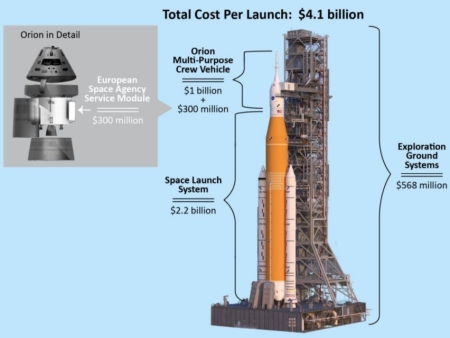
The expected real per launch cost of SLS and Orion
For one thing, SLS at its best can only launch once per year (at a cost of from $1 to $4 billion per launch, depending on who you ask). There is no way you can establish a base on the Moon nor colonize the solar system with that launch rate at that cost. For another, Orion is simply a manned ascent/descent capsule. It is too small to act as an interplanetary spacecraft carrying people for months to years to Mars or beyond.
These basic design problems of both SLS and Orion make them impractical for a program to explore and colonize the solar system. But that’s not all. Orion has other safety concerns. Its heat shield has technical problems that will only be fixed after the next planned Artemis-2 manned mission around the Moon. Its life support system has never flown in space, has issues also, and yet will also be used on the next manned flight.
Thus, it is very likely that when Jared Isaacman, Trump’s appointee for NASA administrator, takes over running the agency, he will call for the cancellation of both SLS and Orion. How can he ask others to fly on such an untested system?
When he does try to cancel both however the politics will require him to offer something instead that will satisfy all the power-brokers in DC who have skin in the game for SLS/Orion, from elected officials to big space companies to the bureaucrats at NASA. Isaacman is going to have to propose a new design for the Artemis program that these people will accept.
Artemis without SLS and Orion
Before I propose what Isaacman should do, let’s review what assets he will have available within the Artemis lunar program after cancelling these two boondoggles.
» Read more

Click for original image.
Using data from the Webb Space Telescope in an unexpected way, astronomers have discovered 138 asteroids in the main asteroid belt, most of which are the smallest so far detected.
The picture to the right shows all 138 asteroids. The researchers had originally used Webb to study the atmospheres of the exoplanets that orbit the star TRAPPIST-1. They then thought, why not see if their data also showed the existence of asteroids in our own solar system. By blinking between multiple images they might spot the movement of solar system objects moving across the field of view. From the press release:
The team applied this approach to more than 10 000 [Webb] images of the TRAPPIST-1 field, which were originally obtained to search for signs of atmospheres around the system’s inner planets. By chance TRAPPIST-1 is located right on the ecliptic, the plane of the solar system where all planets and most asteroids lie and orbit around the Sun. After processing the images, the researchers were able to spot eight known asteroids in the main belt. They then looked further and discovered 138 new asteroids, all within tens of meters in diameter — the smallest main belt asteroids detected to date. They suspect a few asteroids are on their way to becoming near-Earth objects, while one is likely a Trojan — an asteroid that trails Jupiter.
The data is insufficient for most of these objects to chart their orbits precisely. Based on this one single study, however, it suggests that pointing Webb along the ecliptic in almost any direction will detect more such objects. Do this enough and astronomers might actually be able to get a rough census of the asteroid belt’s population.
Because it presently does not have sufficient funds to build both the Giant Magellan Telescope (GMT) in Chile and the Thirty Meter Telescope (TMT) in Hawaii, the National Science Foundation (NSF) asked an independent panel to look at both projects and give recommendations on which project it should go with.
That report [pdf] has now been released, and its conclusions essentially take the advice of former Yankee catcher Yogi Berra, “When you come to a fork in the road, take it.” From the report’s executive summary:
Both GMT and TMT have strong leadership, partnership and financial commitments but require $1.6 billion in NSF funding to proceed. Without this support, significant delays or project cancellations may result. The panel emphasized the critical need for congressional support, noting that without additional appropriations, NSF may face challenges balancing these projects with other national priorities, risking U.S. competitiveness in fundamental research. [emphasis mine]
If you dig into the report however you find that TMT is a far more uncertain project. GMT is already being built, while TMT is stalled because it has been unable to get political approval to build in Hawaii on Mauna Kea, even though it initially wanted to start construction almost a decade ago.
Clearly, this report was created simply as a lobbying ploy by the NSF to Congress. NSF didn’t want the report to make a choice. It wanted it to endorse both telescopes so that — rather than bite the bullet and fund one telescope with the money it has already been given by Congress — NSF could use the report to demand more funding so that it can fund both.
Though Congress is now controlled by more fiscally-minded Republicans, don’t expect them to be anymore responsible on this issue than Democrats. These guys really don’t understand basic economics, and think they have a blank check for anything they wish to do. I anticipate Congress will give NSF the extra cash for both telescopes.
The problems for TMT remain, however, and even with that cash it remains very doubtful the telescope will be built. But gee, that won’t be a problem for NSF. Who wouldn’t like getting an extra billion or two to spend as one wishes?
In a letter [pdf] sent to the FAA on December 6, 2024, two congressmen have called for the FAA to fix what it calls its Part 450 launch licensing process, established in 2021, that has been choking off rocket development in the U.S.
The congressmen, Sam Graves (R-Missouri) and Rob Wittman (R-Virginia), specifically focused on the problems these new regulations have imposed during what the FAA calls its “pre-application review.” From the letter:
In November of 2024, the FAA indicated that 98 percent of applications are met within the statutory 180 day timeline. However, this timeframe does not include the months, and oftentimes years, of pre–application review that create extensive delays for companies seeking a launch and reentry license. [emphasis mine]
Consider the implications of this one quote. The FAA is proud of the fact that it approves license applications within six months — an ungodly long time for a startup — but doesn’t mention that the approval process is actually far longer because it requires new applications to be reviewed at length, before they can even be submitted.
In November, a week after Trump’s election victory, the FAA announced that it was forming a committee made up of people from the launch industry as well as academia to review Part 450. In their letter the congressmen approved of this new committee, but noted its work would not be completed until mid-2025, and that “the system is broken and must be fixed” immediately.
We, however, urge the FAA to act now and ensure that all actions short of rulemaking that can help mitigate the deficiencies of the part 450 regulation are taken in advance of any necessary regulatory changes to ensure that the commercial space industry does not have to wait years for relief.
I suspect we shall see some real action at the FAA come January 20, 2025, after Trump takes office.
SpaceX has successfully completed a launchpad 15-second static fire test of the 33 engines on the Superheavy booster that will be used on the next test flight (the seventh) of its Starship/Superheavy rocket.
The video at the link is remarkable in that it appears all 33 Raptor-2 engines fired for the entire test with no problems either to the rocket or launchpad, despite producing more thrust in that time than any rocket ever in the history of space exploration.
According to this report, it appears SpaceX is targeting January 11, 2025 for that seventh test flight.
SpaceX has not yet announced a launch date for Starship’s seventh test flight, but the company appears to be eyeing Jan. 11; an email sent by NASA to the U.S. Federal Aviation Administration identifies that date as the target. (According to that email, NASA plans to deploy a Gulfstream V jet to observe the upcoming flight.)
This date however has not yet been confirmed by SpaceX. Nor has the FAA indicated it will issue a license. The FAA’s approval will depend on the flight plan SpaceX chooses for the test. If similar to the previous two test flights, then that approval will be fast. If not, the red tape will likely cause several more months of delays.
AST SpaceMobile, which is building a constellation of satellites that act as orbiting cell towers and can provide service where ground-based cell towers are unavailable, has now won its second contract, signing a 10-year deal with Vodafone, a European cell company which provides service there as well as across Africa and the Middle East.
AST’s first contract is with AT&T in the U.S. It already has five satellites in orbit, and plans to begin launching its second generation and larger BlueBird satellites next year, with the goal to begin service in the U.S. first.
All it needs really is an FCC license, which it has applied for but not yet received. Its main competitor, Starlink, has received its FCC license, so expect this red tape to evaporate relatively quickly, especially with the coming change in presidents.

Australia’s spaceports
“I’m from the government and I’m here to help!” Because of its inability to get the proper permissions from a local council, the management of Equatorial Launch Australia (ELA) has abandoned its original spaceport location on the Gove peninsula in the Northwest Territory of Australia and shifted east to a new location on the York peninsula in Queensland.
On the map to the right the “X” shows the old location, with the new location near the town of Weipa on the west coast of the peninsula. The change was forced on the company when it could not get proper approvals from the Northern Land Council (NLC), which manages the Arnhem Land Aboriginal Land Trust where the original site was located.
In a statement late on Monday, ELA said its most recent attempt to finalise a lease for the expansion of the ASC in October had been unsuccessful, following three other failed attempts in the last 12 months. In each case, it said the NLC had “failed to meet its own specified deadline for the approval of the Head Lease” or “provide any official reason for the delay”, despite pleas from the NT government and the Gumatj Aboriginal Corporation.
Because ELA has a launch contract with a South Korea rocket startup Innospace that intends to launch next year, it decided the switch had to occur now to make sure it could meet its obligations under this launch contract.
NASA yesterday announced that both Panama and Austria will sign Artemis Accords tomorrow, bringing the total number of nations in the alliance to fifty.
The full list of nations now part of this American space alliance: Angola, Argentina, Armenia, Australia, Austria, Bahrain, Belgium, Brazil, Bulgaria, Canada, Chile, Colombia, Cyprus, Czech Republic, Denmark, Dominican Republic, Ecuador, Estonia, France, Germany, Greece, Iceland, India, Israel, Italy, Japan, Lithuania, Luxembourg, Mexico, the Netherlands, New Zealand, Nigeria, Panama, Peru, Poland, Romania, Rwanda, Saudi Arabia, Singapore, Slovakia, Slovenia, South Korea, Spain, Sweden, Switzerland, the United Kingdom, the United Arab Emirates, the Ukraine, the United States and Uruguay.
The accords were created by the first Trump administration with the goal to create an alliance with enough clout to overcome the Outer Space Treaty’s restrictions on private property. Under the Biden administration, the goal has been rewritten to accomplish the exact opposite, as noted by NASA yesterday:
The Artemis Accords are grounded in the Outer Space Treaty and other agreements including the Registration Convention, the Rescue and Return Agreement, as well as best practices and norms of responsible behavior that NASA and its partners have supported, including the public release of scientific data.
With Trump back in charge, expect him to bring the accords back to its original goal. Unlike his first term, the alliance is now large, and he can use it to quickly apply pressure on the international community to overcome the Outer Space Treaty’s limitations on private property.