FCC chairman blasts Amazon and its Leo satellite constellation

FCC logo

Brendan Carr, the chairman of the Federal Communications Commission, yesterday harshly criticized Amazon for filing papers opposing SpaceX’s application to place a million new satellites into orbit while failing to meet its own FCC license requirement to get 1,600 Amazon Leo satellites in orbit by July 2026.

Amazon should focus on the fact that it will fall roughly 1,000 satellites short of meeting its upcoming deployment milestone, rather than spending their time and resources filing petitions against companies that are putting thousands of satellites in orbit.

To put it mildly, Carr’s point is well taken. In legally protesting SpaceX’s proposed constellation while failing to launch on time as promised, Amazon is following what appears to be standard Jeff Bezos’ practice, epitomized by his rocket company Blue Origin. When customers begin favoring others because the Bezos company either submits a poor bid or fails to meet schedules, the Bezos companies routinely go to court in an attempt to squelch that better competition.

Carr is demanding Amazon stop this, and focus instead on getting its own job done for once. Carr is also signaling the FCC’s position on both SpaceX and Amazon. It is likely going to reject Amazon’s filing and give its okay to SpaceX’s million-satellite constellation, in one form or another.

Carr is also telling Amazon that it faces some push back for failing to launch the required number of Amazon Leo satellites on time. Though it is extremely unlikely the FCC will cancel Amazon’s Leo license, the FCC might fine it heavily. Or it could impose new limits on the constellation. Carr is also indicating the FCC will treat future Amazon license applications much more stringently.

7 comments

NASA’s Van Allen Probe A burns up over the Pacific

We didn’t all die! Van Allen Probe A, one of two NASA spacecraft launched in 2012 to study the Van Allen radiation belts that circle the Earth, yesterday burned up harmlessly over the Pacific ocean as expected.

Both Van Allen probes have been defunct since around 2019, when they ran out of fuel. Van Allen Probe B weighed about 1,300 pounds, so some pieces probably reached the ocean. Had it returned over land it did carry the small risk of doing harm.

The orbit of the other probe, Van Allen Probe B, is expected to decay sometime around 2030. Like its twin, it is heavy enough that some parts will survive re-entry. It is therefore a prime target for a demonstration mission proving the technology for removing space junk safely and under control. NASA should put out a request for bids to the many orbital tug companies that now exist to do exactly that, as it is NASA’s responsibility to make sure this spacecraft re-enters the atmosphere safely.

0 comments

Firefly launches its Alpha rocket, almost a year after previous launch failure

Firefly today successfully launched its Alpha rocket, almost a year after a launch failure in April 2025.

This launch, from Firefly’s launchpad at Vandenberg Space Force Base in California, was the last for this version of Alpha, and was designed as a test flight, both to check out the fixes to correct last year’s failure as well as to prove out some of the technology that will be used on the upgraded Alpha to be used on all future flights.

The 2026 launch race:

30 SpaceX
8 China
3 Rocket Lab
2 Russia
1 ULA
1 Europe (Arianespace)
1 Firefly

SpaceX continues to lead the entire world combined in total launches β€” as it did in both ’24 and ’25 β€” and is doing almost twice as many launches as everyone else.

3 comments

Iapetus: Saturn’s ying-yang moon

Iapetus as seen by Cassini in 2007
Click for original image.

Cool image time! The image to the right, reduced and sharpened to post here, was taken on September 10, 2007 by the Saturn orbiter Cassini as it made its first close fly-by of the moon Iapetus, from a distance of about 45,000 miles.

Iapetus, about 912 miles in diameter, is one of the strangest objects in the solar system. As it orbits Saturn, its leading hemisphere is very dark, covered with almost pitch black material, while its trailing hemisphere is very bright. This picture captures a bit of both, with the dark leading hemisphere visible along the right edge.

In many places, the dark material–thought to be composed of nitrogen-bearing organic compounds called cyanides, hydrated minerals and other carbonaceous minerals–appears to coat equator-facing slopes and crater floors. The distribution of this material and variations in the color of the bright material across the trailing hemisphere will be crucial clues to understanding the origin of Iapetus’ peculiar bright-dark dual personality.

There are several theories to explain the planet’s strange ying-yang two-tone coloration. One suggests it is material thrown off by other Saturn moons that Iapetus sweeps up. Other theories suggest the planet’s orbit itself causes the two hemispheres to have different temperatures, allowing material to sublimate off the dark side and to the bright side.

No theory is presently accepted. Nor does any explain the data fully.

Tomorrow I’ll post a most intriguing close-up of Iapetus taken by Cassini during that 2007 fly-by.

0 comments

Interstellar comet 3I/Atlas is unusually enriched with windshield wiper fluid

New Hubble image of 3I/Atlas
Comet 3I/Atlas as seen by Hubble
in November 2025. Click for original.

While interstellar comet 3I/Atlas is remarkably like most comets from our own solar system, scientists have now found new evidence that it spalled off unusual amounts of methanol (CH3OH) — material normally used as windshield washer fluid, carburetor fluid, and cooking fuel — when it made its close fly-by of the Sun in the fall of 2025.

You can read the paper here [pdf] . The research also detected large amounts of prussic acid (HCN). As the comet made its closest pass to the Sun, the numbers increased. From the paper’s abstract:

The CH3OH production rate increased sharply from August through October, including an uptick near the inner edge of the H2 O sublimation zone at r H = 2 au. Compared to comets measured to date at radio wavelengths, the derived CH3 OH/HCN ratios in 3I/ATLAS of 124+30 βˆ’34 and 79βˆ’14 +11 on September 12 and 15, respectively, are among the most enriched values measured in any comet, surpassed only by anomalous solar system comet C/2016 R2 (PanSTARRS).

Though the numbers are high, they aren’t outside the range of what has been found in comets from our own solar system. Instead, this data suggests — as has all data so far — that Comet 3I/Atlas is a normal comet, but unique in its own way, as are all comets and in fact every object in space.

4 comments

Fourteen-year-old NASA satellite about to burn up uncontrolled in the atmosphere

Chicken LIttle rules again.

Chicken Little rules again! After fourteen years, the orbit of one of NASA’s two Van Allen Probe satellites is about to decay, causing the 1,323 pound satellite to burn up uncontrolled in the atmosphere.

As of March 9, 2026, the U.S. Space Force predicted that the roughly 1,323-pound spacecraft will re-enter the atmosphere at approximately 7:45 p.m. EDT on March 10, 2026, with an uncertainty of +/- 24 hours. NASA expects most of the spacecraft to burn up as it travels through the atmosphere, but some components are expected to survive re-entry. The risk of harm coming to anyone on Earth is low β€” approximately 1 in 4,200.

As today is a very slow news day in space news, a lot of the mainstream press is highlighting this story, with the usual fear-mongering about how it could hit the Earth and cause terrible damage. And while it is certainly true that this satellite appears large enough for some pieces to reach the ground, the chances of those pieces causing any real harm is quite slim. In fact, I think NASA’s estimate of 1 in 4,200 to be far too high.

Mission engineers had initially estimated the orbit would decay in the 2030s, but that estimate was based on a prediction of a weak solar maximum. The Sun however was more active than predicted in the past decade, and that activity caused the Earth’s atmosphere to puff up, which in turn acted to accelerate the satellite’s orbital decay.

This incident once again shows us that there is money to be made in removing defunct satellites from orbit. NASA and ESA have both made it clear each would pay a company to do it. So have some private companies. Some of the orbital tug and robotic servicing companies have here an opportunity they need to grab.

8 comments

A nearby red dwarf star has a solar system of four planets, one in the habitable zone

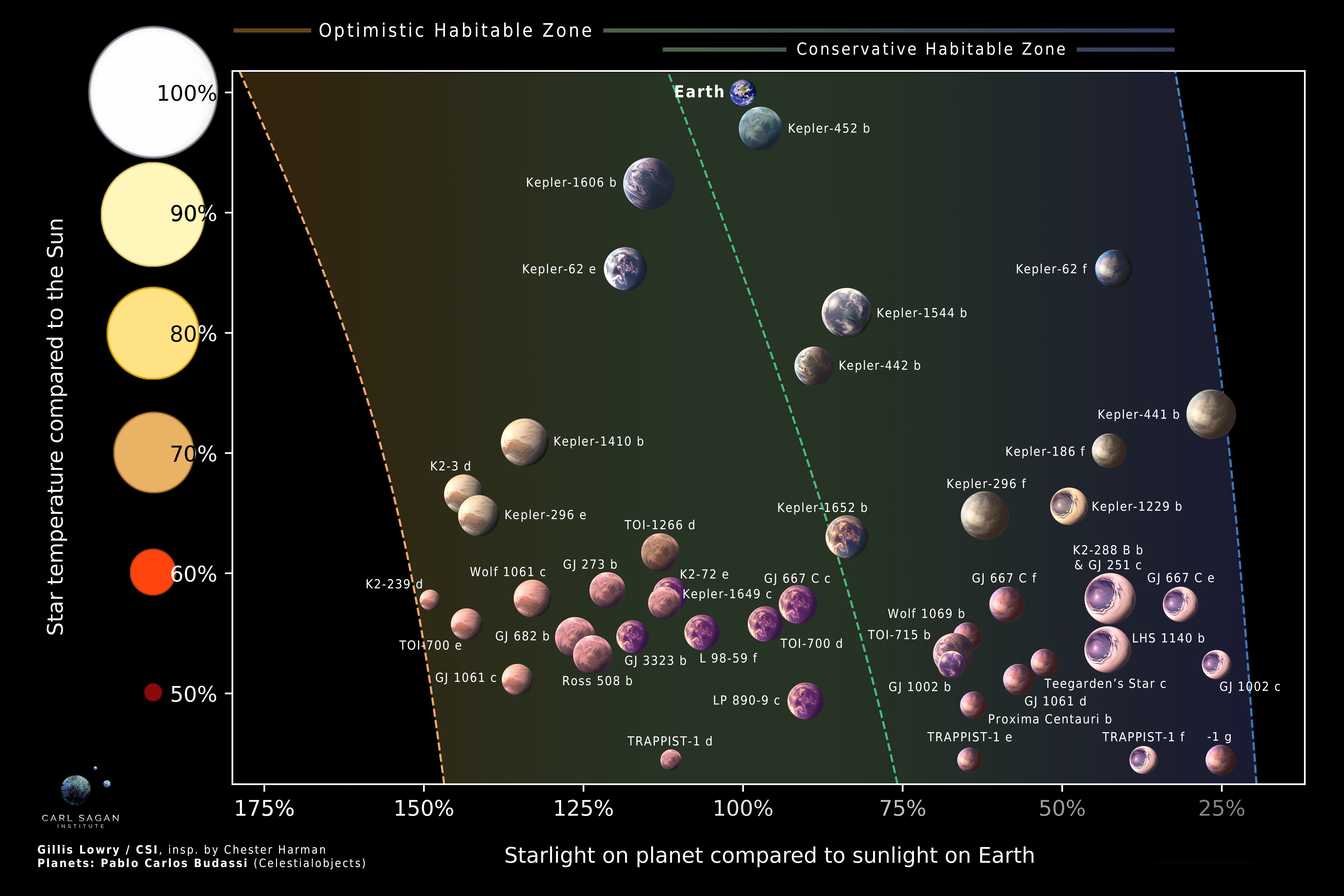
According to a new analysis of new data, astronomers now think the nearby red dwarf star GJ 887, only about 11 light years away, not only has a solar system of four planets, one of those planets is is a super-Earth orbiting the star in the habitable zone.

From the abstract:

With the Bayesian analysis, we confirmed a four-planet model, including the two previously known planets at periods of 9.2619 Β± 0.0005 d and 21.784 Β± 0.004 d, as well as two newly confirmed exoplanets: an Earth-mass planet, with a 4.42490 Β± 0.00014 d period and a sub-meter-per-second amplitude, and a super-Earth with a 50.77 Β± 0.05 d period located in the habitable zone (HZ). This super-Earth is the second closest planet in the HZ, after Proxima Cen b.

The super-Earth has a mass estimated to be anywhere from two to ten times that of Earth, so if any life could exist on it that life would have to be adapted for an extremely strong gravitational field. The star itself appears to be relatively benign for an M dwarf, having a “low level of magnetic activity”, though it does exhibit some flaring that could pose a threat to the development of life on the planet.

Unfortunately, this system is not aligned in a way to allow transits of these planets across the face of the star, so these conclusions are based on gravitational wobbles of the star analyzed by computer modeling. Lots of uncertainty. The scientists hope that direct observations of the planet by future space telescopes will reduce these uncertainties. At the moment, the proposed privately-funded Lazuli optical orbiting telescope has the best chance of doing this work, but it isn’t expected to launch before the end of the decade. It will have a 3.1 meter primary mirror, larger than Hubble’s 2.4 meter mirror.

It is a so far very slow news day in space.

5 comments

Jefferson Starship – Jane

An evening pause: Performed live 1981.

Hat tip Gene Shipp.

1 comment
1 37 38 39 40 41 74