Medical company making artificial retinas buys payload slots on Starlab

Starlab design as of December 2025

The medical company LambdaVision announced yesterday that has booked payload slots and commercial space on Starlab in order to manufacture “protein-based artificial retinas.”

LambdaVision leverages microgravity to improve the layer-by-layer production process of their artificial retina through alternating layers of the protein bacteriorhodopsin and a polymer, supported by a membrane of a synthetic fiber that has long been used by the medical community. Reduced gravity in an LEO environment improves homogeneity, stability, and performance of thin films like the protein-based artificial retina. By using proteins similar to the visual pigment rhodopsin naturally found in our eyes, LambdaVision’s protein-based artificial retina mimics the light-absorbing properties of human photoreceptors replacing the function of these damaged cells in the retinas of blind patients.

Starlab is the giant single module space station being built by a consortium led by Voyager Technologies that will be placed in orbit by a Superheavy/Starship launch.

While NASA allowed this kind of medical research on ISS, it never allowed the companies to manufacture any products on ISS for later sale on Earth. The new private space stations are decidedly opposed to that government restriction, and thus they are attracting customers like LambdaVision because they will allow it to make money on what it produces. The press release notes that while this first project is aimed at producing artificial retinas to restore vision in patients, the technology will be applicable to “sensitive biosensors, optical systems, tissue engineering, and drug delivery applications.”

In my rankings below of the five commercial American space station projects under development, the first three are basically tied, the fourth is simply late to the game, and the last, Blue Origin’s Orbital Reef, is hardly out of the starting gate.
» Read more

7 comments

February 24, 2026 Quick space links

Courtesy of BtB’s stringer Jay. This post is also an open thread. I welcome my readers to post any comments or additional links relating to any space issues, even if unrelated to the links below.

  • One of the largest known stars has changed color
    The star is located in the Large Magellanic Cloud 160,000 light years away, and has a diameter believed to be 1,500 times that of the Sun. What is happening is not really understood, but the possibilities are fascinating,
11 comments

The weird landscape of Mars’ death valley

Taffy terrain
Click for original image.

Cool image time! The picture to the right, rotated, cropped, reduced, and enhanced to post here, was taken on October 28, 2025 by the high resolution camera on Mars Reconnaissance Orbiter (MRO).

The science team labels this “bands near mesa,” an apt description. What we are looking at is a geological feature unique to Mars, but also unique to only one particular place on Mars, the planet’s death valley, the place in Hellas Basin with the lowest relative elevation of any spot on Mars.

The feature is called taffy terrain. According to a 2014 paper, the scientists posit that this material must be some sort of “a viscous fluid,” naturally flowing downward into “localized depressions.” Those localized depressions however happen to also be at the very basement of Mars.

Note how in some spots the bands appear to have been stripped off, exposing small hollows in which dust has become trapped over time to form ripple dunes.
» Read more

1 comment

The exterior of Gaudí’s church masterpiece now complete after 144 years of construction

The Basilica towering over Barcelona

The exterior of the Basílica de la Sagrada Família in Barcelona, Spain, was finally completed this week, 144 years after construction began on architect Antoni Gaudí’s greatest creation.

Last week saw the upper arm of this roughly 56-ft (17-m) tall cross fitted with the help of a giant crane. That final piece, which is nearly 15 ft (4.5 m) tall, completes the grouping of the six central towers of the church – and brings the basilica’s height to a dizzying 566 ft (172.5 m).

Interestingly, the cross was built in Germany using white enameled ceramic tiles, stone interior and glass that were made in the Spanish region of Catalonia. It was then transported in parts back to Barcelona by ferry and trucks, and finally assembled at the church.

Though more work is required in the interior of the church, for the first time in its history all outside cranes will be removed and it will be visible unobstructed.

More information about Gaudi and this church can be found here. I also posted an evening pause about this monumental work of art in 2023.

25 comments

Chinese astronauts provide their perspective on the cracked Shenzhou-20 window

Shenzhou-20 after return
Shenzhou-20 after its return to Earth. The damaged
window can be seen on the right. Click for original image.

The Chinese Shenzhou-20 crew this week gave a detailed interview describing their discovery and inspection of the cracks in the window of their Shenzhou-20 capsule.

Chen Dong, commander of the Shenzhou-20 crew, first noticed the damage to the window while conducting final checks on the return capsule. The believed culprit: space debris striking the window. …As mission commander for Shenzhou-20, Chen said he was the one who went for checking out the return craft. During that work, “I spotted something like a triangular on the viewport,” he said. “My first thought was whether a small leaf had somehow stuck to the outside of the window,” said Chen. “But then I quickly realized that couldn’t happen because we were in space. How could there possibly be a fallen leaf there?”

Chen pointed out the window anomaly to his two other colleagues also in ready mode for the return trek to Earth. Wang, who served as the flight engineer on the Shenzhou-20 mission, had previously worked as an aerospace technician involved in the construction of China’s space station before becoming an astronaut. “I wasn’t really nervous, actually. The outermost layer of the viewport is a protective layer, and inside it there are two pressure-bearing layers, and we are safe as long as the cabin pressure doesn’t change,” said Wang.

Using a 40x microscope, they determined that some of the cracks had penetrated through the window’s outermost layer.

As of today however China has yet to release images of the cracks, or if they have, no western media source has found and released them.

0 comments

Webb tracks Uranus’ atmosphere over 15 hours

Uranus and its atmosphere
Click for original image.

Using the Webb Space Telescope, astronomers on January 19, 2025 were able to observe Uranus for fifteen straight hours, tracking the atmosphere’s temperature and structure more completely than ever before.

You can read the peer-reviewed paper here. The false color image to the right, reduced to post here, is just one slice of that dataset. We are looking down at Uranus’ pole, as the rotational tilt is so severe the planet rotates on its side as it orbits the Sun. The grey circles on the outside are the planet’s faint rings. The orange blobs I think are aurora that rotate around the pole at high latitudes, as shown in this video. The orange represents the upper atmosphere.

Led by Paola Tiranti of Northumbria University in the United Kingdom, the study mapped out the temperature and density of ions in the atmosphere extending up to 5,000 kilometres above Uranus’s cloud tops, a region called the ionosphere where the atmosphere becomes ionised and interacts strongly with the planet’s magnetic field. The measurements show that temperatures peak between 3,000 and 4,000 kilometres, while ion densities reach their maximum around 1,000 kilometres, revealing clear longitudinal variations linked to the complex geometry of the magnetic field.

…Webb’s data confirm that Uranus’s upper atmosphere is still cooling, extending a trend that began in the early 1990s. The team measured an average temperature of around 426 kelvins (about 150 degrees Celsius), lower than values recorded by ground-based telescopes or previous spacecraft.

Two bright auroral bands were detected near Uranus’s magnetic poles, together with a distinct depletion in emission and ion density in part of the region between two bands (a feature likely linked to transitions in magnetic field lines). Similar darkened regions have been seen at Jupiter, where the geometry of the magnetic field there controls how charged particles travel through the upper atmosphere.

There is great uncertainty in these conclusions, mostly because the observations are for such a short time. It is like trying to understand the Earth’s climate after looking at it for only one day.

0 comments

February 23, 2026 Quick space links

Courtesy of BtB’s stringer Jay. This post is also an open thread. I welcome my readers to post any comments or additional links relating to any space issues, even if unrelated to the links below.

1 comment

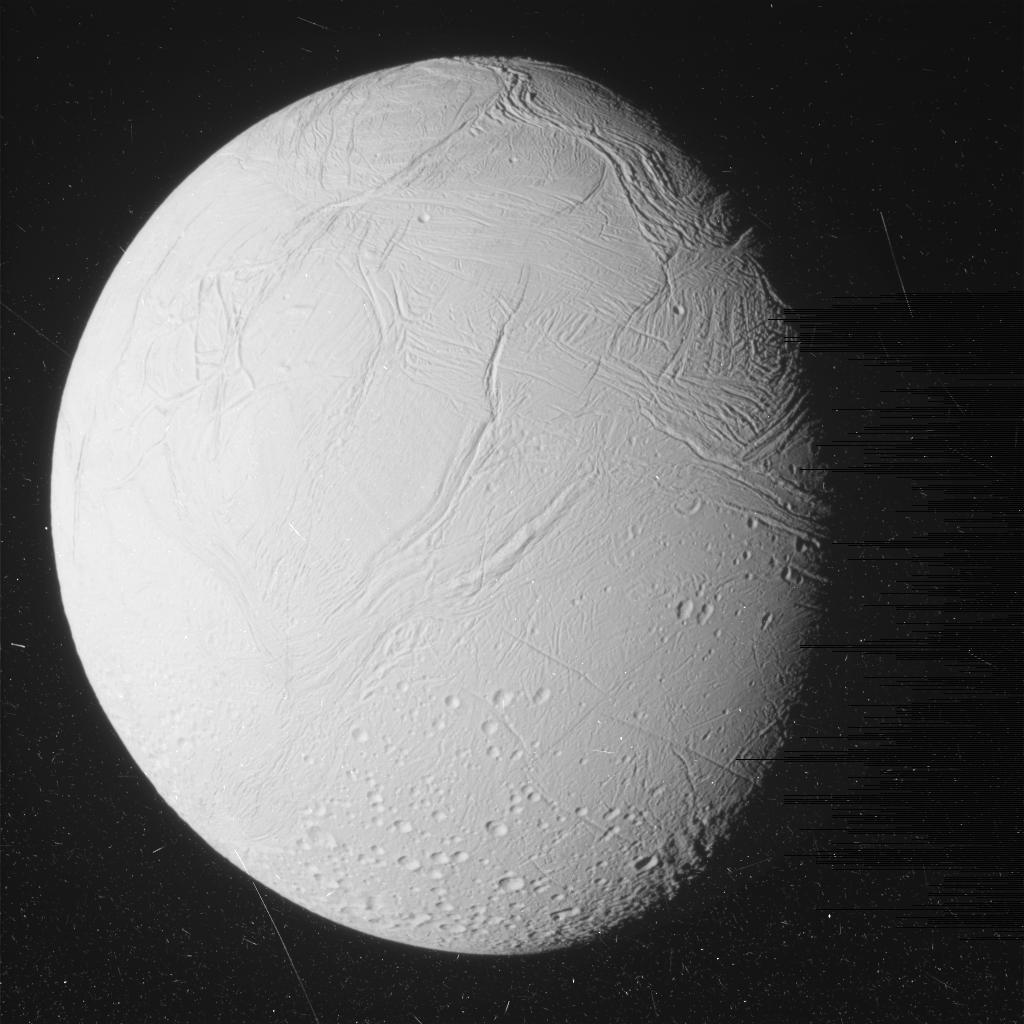
Saturn’s moon Enceladus, as seen during Cassini’s last close fly-by

Enceladus as seen during Cassini's last close fly-by
Click for original.

Cool image time! On December 19, 2015 the Saturn orbiter Cassini made its last close fly-by of the moon Enceladus, known best for the many geysers detected on its surface venting water and other carbon-based materials.

The picture to the right, reduced and enhanced to post here, shows that the entire face of this
Saturn’s moon Enceladus, as seen during that fly-by. The moon itself is only about 310 miles across.

Its icy surface is evident, as are the many fractures, some meandering almost like rivers. Interestingly, for some reason there are a lot more craters in the lower hemisphere, while the upper hemisphere is more completely covered with fractures.

The black outline indicates the approximate area captured by the two close-up images below.
» Read more

0 comments

Webb imaged a star before it went supernova

Webb detection of a supernova progenitor
Click for original image.

One of the biggest challenges facing astronomers for more than four centuries has been the detection of a star prior to its going supernova. Until very recently, no such detection had ever happened, and so astronomers could only guess at the kind of stars or binary systems that might result in these gigantic stellar explosions.

In recent years the improvement in telescopes, both in orbit and on the ground, has produced some successes, whereby the progenitor star was imaged in archival imagery and found after the explosion. The sample however has been small, and the data limited to only a few wavelengths.

Now, the Webb Space Telescope has made its first detection of a supernova progenitor, in the infrared. That image is to the right, showing the star prior to the June 2025 supernova explosion.

By carefully aligning Hubble and Webb images taken of NGC 1637, the team was able to identify the progenitor star in images taken by Webb’s MIRI (Mid-Infrared Instrument) and NIRCam (Near-Infrared Camera) in 2024. They found that the star appeared surprisingly red – an indication that it was surrounded by dust that blocked shorter, bluer wavelengths of light. “It’s the reddest, most dusty red supergiant that we’ve seen explode as a supernova,” said graduate student and co-author Aswin Suresh of Northwestern University.

This excess of dust could help explain a long-standing problem in astronomy that could be described as the case of the missing red supergiants. Astronomers expect the most massive stars that explode as supernovas to also be the brightest and most luminous. So, they should be easy to identify in pre-supernova images. However, that hasn’t been the case.

One potential explanation is that the most massive aging stars are also the dustiest. If they’re surrounded by large quantities of dust, their light could be dimmed to the point of undetectability. The Webb observations of supernova 2025pht support that hypothesis.

You can read the peer-reviewed paper here [pdf].

1 comment

First visual detection of another star’s heliosphere

A baby star's heliosphere
Click for full image.

Using both the Hubble Space Telescope and the Chandra X-ray Observatory, astronomers have made the first visual detection of another star’s heliosphere, in both X-rays and in the infrared.

The image to the right, cropped to post here.

Astronomers have nicknamed the HD 61005 star system the “Moth” because it is surrounded by large amounts of dust patterned similarly to the shape of a moth’s wings when viewed through infrared telescopes. The wings are formed from material left behind after the formation of the star, similar to the Kuiper Belt in our own solar system. Observations of these wings with NASA’s Hubble Space Telescope showed that the interstellar matter surrounding HD 61005 is about a thousand times denser than that around the Sun.

The wings are the points to the left and right. The star’s young heliosphere, which they dub an “astrosphere,” is the purple glow above and below. From the caption:

In this composite image of HD 61005 in the inset, X-rays from Chandra (purple and white) have been combined with infrared data from Hubble (blue and white). Chandra reveals a bright source of X-rays in the center of the image, which is the star itself surrounded by the star’s astrosphere. The wing-like structure sweeping away from the star in the infrared image is dusty material that remained behind after the formation of the star. These wings have been swept backwards as they fly through space.

As this star and its solar system are very young, what we have is a very dusty accretion disk interacting with a very temperamental baby star.

0 comments
1 45 46 47 48 49 74