
Canada leases Nova Scotia spaceport for $200 million
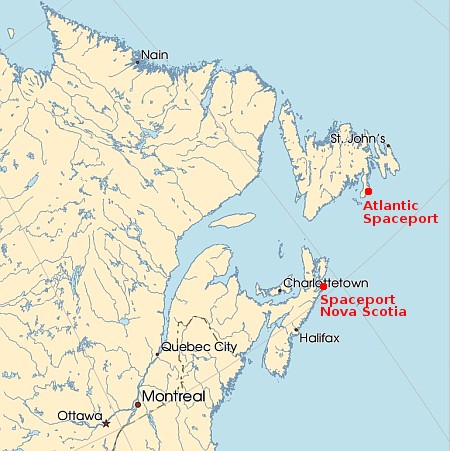
Proposed Canadian spaceports
The Canadian government yesterday announced it is committing significant funding to several space-related companies, including issuing a ten year $200 million lease to the Nova Scotia spaceport that has been unable to attract any launch customers for the past ten years.
The investment is a 10‑year, $200‑million agreement to lease a dedicated space‑launch pad that will serve as the central foundation for a multi-user spaceport near Canso, Nova Scotia. Operated by Maritime Launch Services, this spaceport will support the operational needs of the Department of National Defence (DND), the Canadian Armed Forces (CAF), and the wider Government of Canada, while also offering ad hoc access to allies and partners.
The history of Maritime and its Spaceport Nova Scotia is far from encouraging. It was first proposed in 2016, offering satellite companies both a launch site and a Ukrainian-built rocket. That plan fell through when Russia invaded the Ukraine and the rocket became unavailable. Since then Maritime has struggled to convince rocket companies to use the spaceport, all to no avail. It signed some deals, but none has gone anywhere. This Canadian government lease appears an attempt to save it, since it is very unlikely that this government will be capable of building its own rocket during those ten years.
In order to avoid accusations of favoritism, the government at the same time also announced further $8.3 million grants to three Canadian companies to help them develop their own rockets, one of which is Nordspace, which has its own proposed spaceport, the Atlantic Spaceport in Newfoundland. According to the government, these grants are part of a $105 million program to encourage a sovereign Canadian rocket industry. The other two companies are Reaction Dynamics, which wants to launch its suborbital rocket from Nova Scotia, and a new startup dubbed the Canada Rocket Company, of which little is known.
Apparently, the leftist Canadian government is following in the footsteps of the leftist government of the United Kingdom. In both cases their private spaceports have floundered for decades, unable to attract customers for a variety of reasons. To save them, both governments are now pouring cash into their pockets to prop them up.
In the case of the UK, the obstacles have almost entirely been the red tape of the government. In the case of Canada and Maritime’s Nova Scotia spaceport, it has been a series of bad management decisions that reflect poorly on the company. Private capital has thus not been interested in investing in it. Nor have any rocket companies been interested in launching from it.
So of course, the leftist Canadian government is going to use other people’s money to fund it. How typical.
Canadian may get its own launch capability from this program, but don’t bet on it. Government programs like this have routinely failed, wasting billions and decades with little to show for the effort. The program’s one saving grace however is that the government isn’t designing, building, and owning the rockets. It is instead hiring these three companies to do the work. Under that framework, there is a chance something might actually happen.

On Christmas Eve 1968 three Americans became the first humans to visit another world. What they did to celebrate was unexpected and profound, and will be remembered throughout all human history. Genesis: the Story of Apollo 8, Robert Zimmerman's classic history of humanity's first journey to another world, tells that story, and it is now available as both an ebook and an audiobook, both with a foreword by Valerie Anders and a new introduction by Robert Zimmerman.
The print edition can be purchased at Amazon or from any other book seller. If you want an autographed copy the price is $60 for the hardback and $45 for the paperback, plus $8 shipping for each. Go here for purchasing details. The ebook is available everywhere for $5.99 (before discount) at amazon, or direct from my ebook publisher, ebookit. If you buy it from ebookit you don't support the big tech companies and the author gets a bigger cut much sooner.
The audiobook is also available at all these vendors, and is also free with a 30-day trial membership to Audible.
"Not simply about one mission, [Genesis] is also the history of America's quest for the moon... Zimmerman has done a masterful job of tying disparate events together into a solid account of one of America's greatest human triumphs."--San Antonio Express-News
I did a bit of digging on this topic for a reply comment I made yesterday on Quick space links to your reader Kevin based on a link he posted to a Canadian Broadcasting Corporation (CBC) website article about the Maritime Launch Services (MLS) lease. Evidently there was even more to find as the CBC piece said nothing about money going to any entity other than MLS. The sums going to the Canada-based rocket companies seem far too modest to make a significant difference in their efforts but every little bit helps I suppose. It seems it will be some years before any of them have an orbit-capable rocket ready to fire – if ever. Sovereign space launch capability is not something that can be ginned up overnight.
As I noted in yesterday’s comment, the political future of Canada may also yet play hob with such plans. Western Canada is still restive and Quebec is perpetually so. If Western Canada leaves, in whole or in part, and Quebec follows suit at least one of those rocket companies will no longer be “Canadian” and both would be physically separated from their launch facilities by new national borders.
I hope Dynetics reaches out to them. Pyrios and the old Jarvis concept (not the New Glenn upper stage) were to use two F-1s.
Not only could Canada offer it as an SRB replacement, but the great power of Pyrios could overcome such a northerly launch location, especially if any orbital data farms require sun-synch…then it won’t matter.
The guys behind ACES might find favor in Canada since ULA is too stupid to innovate.
That it would be nationally funded means no Bob Smith morons for engineers to fight.
Dick Eagleson observed: “Sovereign space launch capability is not something that can be ginned up overnight.”
Absolutely true, if you do it in-house. There is an inevitable shake-out upcoming in the launch industry, and some companies may find a market in building for whomever has the money, as well as the soft and hard infrastructure. You buy it, you fly it.
Does anyone know of any SciFi where Canadian and Scandinavian spaceports feature? Still trying to wrap my head around a spaceport in Newfoundland. I don’t recall that anyone saw that coming. Will there be a Danish spaceport in Greenland?
Jeff Wright,
I wouldn’t get my hopes up. Dynetics, like pretty much the entirety of OldSpace – of which it is very much a part – has completely lost the knack of ginning up projects for which a large government check has not already been cut or is, at least, in reasonable prospect. And that’s a large check by US standards. I suspect the Canadians would find that a bit rich for their blood.
More to the point, Dynetics doesn’t own the intellectual property (IP) rights to the F-1 engine, L3 Harris does. L3 Harris also declines work that is not, in essence, pre-paid. To build new F-1s it would have to build tooling from scratch as all of the legacy stuff went when Aerojet Rocketdyne – as it still was then – moved from its long-time Canoga Park facility on Canoga Ave. to a new facility on De Soto St. about a mile east. Among the losses was the huge sintering furnace used to braze all of the tubing that constituted a regeneratively-cooled F-1 engine bell. It’s dead, Jim.
A lot of the original F-1’s fabrication tech was manual and artisanal. A lot of its engineering has been superseded by more modern approaches. Re-engineering the F-1 would be even more of a chore than doing the same – to the degree actually done – for the RS-25E compared to the original RS-25. Given the nine-figures-apiece price tag for new RS-25Es, one can only quail at the thought of what L3H would charge for each of a new run of F-1s.
You are, of course, the guy for whom money never counts. You are, though, pretty much singular in that regard. Money counts to Dynetics, L3Harris and the Canadian government.
You might want to redirect your fantasy life toward things at least marginally more achievable – like, say, bagging Margot Robbie or Sydney Sweeney.
Blair Ivey,
The shakeout you mention anent launch providers is already underway, though new and hopeful players seem to continue to pop up. It is hardly beyond the realm of possibility that none of the three nascent Canadian launch vehicle start-ups will survive to adulthood, so to speak.
On the question of Canadian and/or Scandinavian spaceports in sci-fi, I’m afraid I draw a blank, though I have read relatively little new sci-fi over the last couple of decades as far too much of it is the sort of woke excrement that seems about all the legacy New York publishers will touch anymore. Andy Weir is, of course, a notable exception.
Nova Scotia and Newfoundland are, admittedly, a tad off the beaten track where spaceports are concerned, but then so are Saxavord, Esrange and Andoya – also in the notably high latitudes. And at least all of those are in civilized places unlike, say, the new spaceports in the Middle East.
Will there ever be a spaceport in Greenland? Never say never. But, should it ever materialize, it isn’t likely to be Danish. The Greenlanders don’t seem enthused at the prospect of becoming a US territory, but they also have longstanding gripes with Copenhagen and some form of independence seems fairly likely before much longer.
I did contact my state’s Governor via email, pointing out the fact that, once the shuttle SRBs are used up–and with BOLE dead–Alabama might have NO rockets, what with Vulcan being so underpowered as to require them…and it is launching nothing at the moment.
She better work with L3, Dynetics, whoever, and in double -quick time.
Jarvis was a similar concept to Pyrios:
Hu Davis wanted the fly-back Star Booster system…I could see a winged Pyrios perhaps.
ULA just doesn’t innovate, and if Governor Ivey wants the keep Alabama relevant–she better move.
Dick Eagleson observed anent Greenland: ” . . . some form of independence seems fairly likely before much longer.”
I looked into the Greenland Situation when it was ‘hot’, so to speak. The island likely hasn’t generated this much interest since the 11th Century. Greenlanders may ‘want’ independence, but they are in no way positioned to ‘be’ independent. 40% of Greenland’s income comes in the form of an annual block grant from Copenhagen, and residents are entirely dependent on Denmark for medical care, education, and, in many instances, employment. Greenland currently enjoys autonomous republic status: unless they become self-supporting, anything else is not really in the cards.
Blair Ivey,
Greenland is perfectly capable of establishing a self-sustaining economy. But the Green twits in Denmark have prevented any exploitation of the huge island’s considerable mineral wealth in much the same way Ontario has serially sabotaged the provinces of Western Canada and how the Dept. of the Interior has historically treated much of the western United States.
Jeff Wright,
I’m sure your letter now occupies a place of honor in the Governor’s Crank Correspondence file. State governors are fine with economically ridiculous projects being undertaken within their borders when the feds are footing the bill, but none of them are going to put any state money into such boondoggles, especially for the notional benefit of Canadians, there being no economically rational use case for Pyrios in the US. The Gov. of AL, in any case, lacks sufficient leverage even were she interested in such a doomed project. Dynetics is an AL company, but L3Harris is HQ’d in FL.
“Greenland is perfectly capable of establishing a self-sustaining economy.”
While Greenland’s Parliamentary representation is small (2 of 179), those representatives don’t seem to have been in a big hurry to agitate for autonomous mineral wealth exploitation. My understanding, from published interviews with Greenlandic leaders, is that they want more autonomy, without giving up the Danish social welfare network. If Greenlanders really want independence, they are going to need a ‘big brother’, that can invest in, sustain, and defend them for a period of time. And if someone is going to take on that burden, they are going to want a return., plus interest.
Blair Ivey,
The Danes don’t conjure the money they need for their welfare system out of thin air, they get it by subjecting nearly everything in Denmark to very high personal and business taxes – including in Greenland. By expanding the taxable business base, the Greenlanders can pay for their own welfare state.
The US, of course, would be quite ready to provide defense services in return for suitable consideration and a reasonably free hand.