
NASA outlines the mission plan for Artemis-3
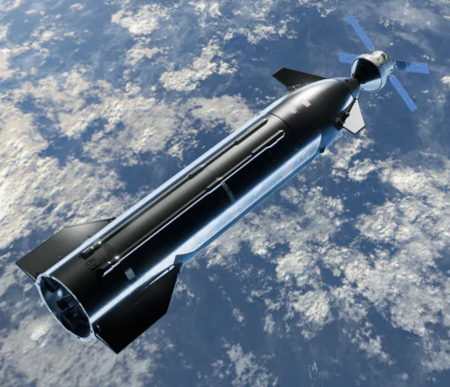
Artist’s rendering of Orion docked to Starship.
In a press release late yesterday, NASA detailed at length its present plans for the Artemis-3 mission next year, in which a crewed Orion capsule will conduct docking maneuvers first with a Blue Origin test version of its Blue Moon manned lunar lander and next with a SpaceX refitted Version-3 Starship.
For the Artemis III mission, the Blue Moon test lander will be based on Blue Origin’s current architecture for its Mark 2 crew lander, incorporating all the major avionics and flight software and control systems to ensure flight operations from this demonstration mission can directly translate to crewed lunar flights. Up to two crew members, donning orange Orion crew survival system suits, will open the hatch to enter the Blue Origin test lander. The production hardware must incorporate many of the same systems and subsystems, including an Environmental Control and Life Support System (ECLSS), a crew cabin, and avionics. The Blue Origin lander also will fly with an instrumented lunar surface spacesuit mass simulator. Like the suited “Moonikin” manikin that flew aboard Orion during the uncrewed Artemis I test flight, the low-fidelity spacesuit mass simulator will provide real-time feedback about the environment within the Blue Moon crew cabin.
SpaceX’s Starship lander test article will use a Starship Version 3, currently in production and testing, with an added docking system installed on the nose of the 171-foot spacecraft, enabling NASA and SpaceX to evaluate how the entire integrated stack of Orion and the Starship test lander interact. NASA and SpaceX are identifying controllability and communications tests for the Artemis III mission. Astronauts will not enter the Starship test lander during Artemis III.
The launch sequence will have Blue Origin use its New Glenn rocket to launch its Blue Moon test vehicle first, with a maximum orbital mission of 30 days. During that time period SLS will launch Orion, which will then conduct its rendezvous and docking with Blue Moon. Once this is completed SpaceX will then launch Starship on Superheavy. Once in orbit Orion will rendezvous and dock with it.
That’s the plan at this point, though much remains uncertain. New Glenn remains grounded after the May 28, 2026 launchpad explosion. Starship has not yet flown a full orbital mission. No version of Blue Moon, either manned or unmanned has flown at all. Whether all three will be ready for this mission, presently scheduled tentatively for late ’27, is a question we cannot answer at this moment.

On Christmas Eve 1968 three Americans became the first humans to visit another world. What they did to celebrate was unexpected and profound, and will be remembered throughout all human history. Genesis: the Story of Apollo 8, Robert Zimmerman's classic history of humanity's first journey to another world, tells that story, and it is now available as both an ebook and an audiobook, both with a foreword by Valerie Anders and a new introduction by Robert Zimmerman.
The print edition can be purchased at Amazon or from any other book seller. If you want an autographed copy the price is $60 for the hardback and $45 for the paperback, plus $8 shipping for each. Go here for purchasing details. The ebook is available everywhere for $5.99 (before discount) at amazon, or direct from my ebook publisher, ebookit. If you buy it from ebookit you don't support the big tech companies and the author gets a bigger cut much sooner.
The audiobook is also available at all these vendors, and is also free with a 30-day trial membership to Audible.
"Not simply about one mission, [Genesis] is also the history of America's quest for the moon... Zimmerman has done a masterful job of tying disparate events together into a solid account of one of America's greatest human triumphs."--San Antonio Express-News

How much does the NOT REUSABLE SLS cost? Just out of curiosity, I researched and found that a REUSABLE Falcon Heavy could launch the Orion capsule.** The individual Falcon 9s of the Falcon Heavy either return to the launch site, or land on one of the ocean platforms, to be used again, and again.
** – If, when, other rocket company(s) can compete with SpaceX (safety, reliability, reusability, & cost), then the public, private and military will have options other than SpaceX.
Unfortunately, there is no way to usefully Kerbal a mate-up between Falcon Heavy and Orion by late next year.
The biggest problem would be launching crew on a vehicle stack making its first flight. NASA – quite correctly – put the kibosh on the original plan to launch crew on the first flight of SLS Block 1B by cancelling that variant and its Exploration Upper Stage. Putting Orion on top of Falcon Heavy for Artemis 3 would be revisiting this idiocy.
Second, Falcon Heavy is not crew-rated. The modifications/additions needed to do so are not extensive, but would have to be done. Then, in any sane world, there would need to be an unmanned test flight of the newly grafted stack before crew were actually permitted to fly on it.
Third, such a lash-up would also require changes to the ground support equipment at LC-39A to support the Orion vehicle. At a minimum, some sort of power and data connection equivalent to that on the SLS launch tower would need to be rigged. If the capability to top up any necessary gases and fluids also exists, then still more changes/additions to the Falcon Heavy pad at LC-39A would be needed.
There is no question that even a fully-expended Falcon Heavy would be more than an order of magnitude cheaper than an SLS. But Falcon Heavy is not, on a percentage basis, as reusable as Falcon 9. Falcon Heavy center cores are routinely expended in addition to 2nd stages.
If all you do is fly sub-orbit, you will find the cheap fix winds up being more costly than the professionally built craft is expensive.
Now, I can make a glider for a whole lot less money than NGAD….
Here’s a better question:
If I launched SLS and circularized it such that is was in a Gene Meyers/Space Island Group type orbit, could puny Falcon/Dragon reach it to dock with.
After all, 4 billion dollars is still less than ISS’ 150 billion for the same floorspace.
Going to space is about exceptionalism. The storming of Normandy was not left to Wall Street bean counters.
People who say I focus too much on performance–in truth focus too much on “cost.”
Space is all about performance–if that isn’t foremost in your mind–then find another profession like Bob Smith was forced to.
The concentration on “performance” – narrowly defined – was what kept NASA and legacy aerospace from doing anything much to make space both more accessible and more cheaply accessible for most of a half-century. As Elon has noted repeatedly, the biggest mistake many engineers make is to optimize the wrong thing. You continue to be a cheerleader for this dead-end approach to rocketry.
Jeff Wright asked: “Here’s a better question: If I launched SLS and circularized it such that is was in a Gene Meyers/Space Island Group type orbit, could puny Falcon/Dragon reach it to dock with.”
An even better question is: Why would you or Gene Meyers ever want to launch a space station into an orbit that the customer cannot reach?
“People who say I focus too much on performance–in truth focus too much on ‘cost.’ Space is all about performance–if that isn’t foremost in your mind–then find another profession like Bob Smith was forced to.”
That’s my profession, and from day one it was all about doing the job affordably. If performance had to be sacrificed, then we sacrificed it, and there were times when we did. The requirement was to meet the requirements, not to do the job using the best performance but to do it within the budget (weight, power, money, etc.).
On a communication satellite that we were already assembling, the customer learned that there was a 110 watt TWTA (traveling-wave tube amplifier) available, but we were already installing the 100 watt version. The customer asked what it would cost to swap them out for the more powerful version (he wanted his amplifier to go to 11), and the answer led him to say, ‘never mind.’ Cost is more important than performance.
Unless you are the military.
Going to space is about exceptionalism. The storming of Normandy was not left to Wall Street bean counters. Prestige doesn’t last. History is rife with examples of that. Define ‘bean counting,’ please, because you don’t seem to use a commonly-understood definition.
I’m in a different branch of engineering than Edward, but we have to control costs carefully in order to stay in business. Ignoring them would put us all out of a job in months, because we would waste time, materials, people, and money. We have to bid on contracts and stay under what we charge to make a profit, and our margins are impacted by having competitors, so that forces fiscal discipline on us.
If you have never been responsible for wisely spending other people’s money, it can seem like foolishness to worry about costs. Until you have, you’ll struggle to understand those of us who have felt the weight of that burden.
I don’t know why I didn’t think of this for my previous comment, but cost is important in other ways. With lower launch costs has come lower launch prices, making getting to orbit more affordable. Now that the prices are lower, a far greater number of companies are launching into space and doing business there.
They can do it, because the cost to them is lower and because the availability is greater. They can do it, because they can charge their own customers a more affordable price. Low costs means more business, which begets even more business.
All increased performance gets you is an incremental increase in performance. We didn’t see much increase in business during the decades that the government-run space programs focused on performance rather than on cost.
Yes. This is the most important aspect of lowering costs that is often overlooked, that I have been touting now for almost two decades. Lower the cost, you widen the customer base, which brings in more business, more profits, and more money to innovate, more investment, and more competition, which in turn further widens the customer base.
The satellite operators of the mid 1990s had said the same thing, begging the launch companies to find a way to drop launch costs to $2,000 per pound so that many more operators and companies could launch their own satellites and increase the space economy.
Could it be that the launch companies were already making their expendable rockets about as fast as they could, so that they didn’t have much ability to increase the launch rate to accommodate a large increase in customers?
Thank goodness (and Beck, Bezos, Musk, and hopefully soon Feldman and Lapsa of Stoke Space) that reusable boosters came along and created the ability to launch at a much higher cadence. Thus, the secret to launch vehicle success is the reusable rocket, which is why we should see New Glenn do very well by the end of this decade. Soon after that Neutron and Nova should follow.
I am intrigued by the following text in the linked NASA press release:
“Meanwhile, the SpaceX test article will control the docked spacecraft for the second portion of the mission. During the docking phases, teams with NASA and the commercial partners will be able to test hardware and software interoperability, as well as dynamics of how the integrated lander-Orion spacecraft moves in space.”
This implies, but doesn’t come right out and say, that the Starship lander test article for Artemis 3 will fire at least one of its engines while on orbit to see how Orion reacts to eyes-out acceleration of the sort that will be needed given the current concept of operations already announced for Artemis 4 – Starship HLS pushing a docked Orion Moonward and braking it into a lunar orbit. Breaking NASA of its long-ingrained habits of linguistic obfuscation and fan-dancing still seems to be a work-in-progress even in the Isaacman administration.
“Whether all three will be ready for this mission, presently scheduled tentatively for late ’27, is a question we cannot answer at this moment.”
Apollo had similar drama. Its lunar lander also ran late, resulting in a slight modification of the project plan. Robert wrote a book on that modification: Genesis, the Story of Apollo 8. As with Apollo, I expect that Artemis will eventually achieve its major goal of returning man to the Moon. Whether it does so in the time suggested by the president is another matter, but Artemis as it is now is unable to achieve the sustainable lunar base part of the goal.
As it is now, the Artemis III mission forces both companies to be farther along the development path than the Apollo lunar lander was when Apollo was that close to the end of the window for achieving the goal on time.