
NASA cancels Draper/Ispace unmanned lunar lander contract
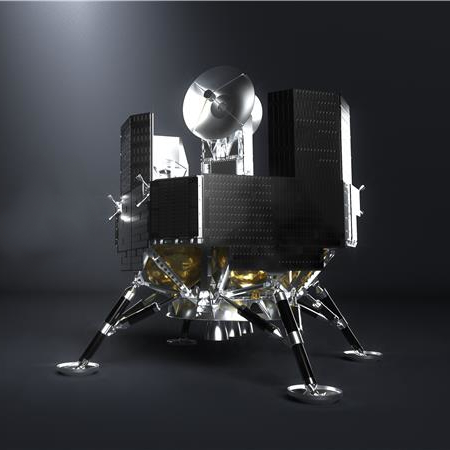
Artist rendering of Ispace’s Ultra lunar lander
According to a press release from the Japanese lunar lander startup Ispace, NASA last week canceled its contract with Draper for a lunar lander mission in 2030, a mission that Ispace was the main subcontractor.
Ispace technologies U.S., (Ispace-U.S.) an American lunar exploration company and subsidiary of Ispace, inc. (ispace), and Draper, a non-profit research, development and manufacturing company, today announced that Draper has mutually agreed with NASA to end the Commercial Lunar Payload Services (CLPS) task order CP-12.
Since July 2022, Ispace-U.S. served as a subcontractor to Draper to provide a lunar lander transportation service for NASA’s CLPS task order CP-12. Following the agreement with NASA on the primary contract, Draper and ispace-U.S. expects the mutual termination of the subcontract between the two companies.
For that 2030 mission Ispace was really the main contractor — having already built and launched two failred lunar landers — but as a Japanese company (even with a U.S. division), it needed an American company to act as lead in order to win the NASA contract. Draper fulfilled that purpose.
Draper however has little experience building lunar landers. Ispace was really doing the job. The problem was that Ispace discovered with its two failures that its original lander design was insufficient. The development of a new larger lander, dubbed Ultra, has caused significant delays.
It appears NASA and Draper decided this arrangement was not acceptable. Both were probably uncomfortable with its faux lead position. Ispace’s delays also were likely a factor.
It is certainly possible for Ispace alone to win later contracts. It has said it intends to bid. Moreover, as Japan is both a partner in the Artemis program and a signatory to the Artemis Accords, there really is little reason for NASA or Ispace to play these games. NASA can issue a contract directly to it. It simply has to make sure it issues contracts to American companies first.
Below is the present rough schedule of missions in NASA’s Artemis program, as revised under NASA administrator Jared Isaacman’s leadership, and adjusted to include this cancellation.
NASA’s Artemis mission schedule:
- Late 2026:
- 4th quarter: Moon Base 1 (likely delayed): Blue Origin’s Blue Moon Mark-1 (dubbed Endurance) unmanned lunar lander demo flight, to be launched on Blue Origin’s New Glenn rocket. Delayed due to the grounding of New Glenn following the May 28, 2026 static fire test explosion. Landing: South pole region.
- 4th quarter: Moon Base 2: The Griffin lander, built by Astrobotic (now acquired by Voyager), will be launched on SpaceX’s Falcon Heavy rocket, and targeting the south pole region, Mons Mouton.
- 4th quarter: Moon Base 3: Intuitive Machine’s Trinity (Nova-C) lunar lander, will be launched by SpaceX’s Falcon 9 rocket and targeting the Reiner Gamma region near the equator.
- 4th quarter: Firefly’s Blue Ghost mission 2, to be launched by SpaceX’s Falcon 9 rocket, and targeting the far side of the Moon.
- 2027:
- 4th quarter: Artemis 3: Manned rendezvous and docking tests of Orion in Earth orbit with the manned lunar landers being built by SpaceX and Blue Origin. It remains to be seen if either will be ready.
- 2028:
- 1st quarter: Blue Origin unmanned Blue Moon Mark-1 delivering the first of two lunar rovers to the south pole.
- 1st quarter?: Starship unmanned demo mission of human landing spacecraft, to south pole region.
- 1st quarter?: Blue Moon unmanned demo mission of human landing spacecraft to south pole region.
- 1st quarter?: Starship unmanned cargo mission to south pole region.
- 2nd quarter: Artemis-4: A manned lunar landing, with Orion launched by SLS and either SpaceX’s Starship launched by Superheavy or Blue Origin’s Blue Moon launched by New Glenn. Targeting south pole region.
- 3rd quarter: Blue Origin unmanned Blue Moon Mark-1 delivering the second of two lunar rovers to the south pole.
- 4th quarter: Artemis-5: A manned lunar landing, with Orion launched by SLS and SpaceX’s Starship launched by Superheavy or Blue Origin’s Blue Moon launched by New Glenn. Targeting south pole region.
- By end of year: MoonFall: Four JPL hoppers delivered to lunar orbit by Firefly’s Elytra lunar orbiter, targeting the south pole region.
- By end of year: Astrobotic’s Peregrine lander, targeting the Gruithuisen Domes region on near side.
- By end of year: Astrobotic’s Peregrine lander, targeting the Gruithuisen Domes region on near side.
- By end of year: Firefly’s Blue Ghost lander, landing site not yet determined.
- By end of year:: Intuitive Machines’ Nova-C lander, landing site not yet determined.
- Date and specific mission as yet undetermined: Reconfiguration of a Mars rover equipment to be a lunar rover, dubbed Promise.
- Ispace’s unmanned lander, funded by Japan’s Ministry of Economy, Trade and Industry
- 2029:
- Intuitive Machines Nova-C lander, launched on a Falcon 9 and targeting the south pole near Mons Mouton.
- Intuitive Machines first Nova-D lander, launch provider not yet determined, targeting the south pole region.
- Ispace’s unmanned Ultra lander, funded by Japan’s Space Strategy Fund
- Possible missions:
- Cargo mission(s?) using Superheavy/Starship?
- Cargo mission(s?) using New Glenn/Blue Moon?
- Multiple unmanned robot mission(s?)?
- Manned mission(s?) using Superheavy/Starship?
- Manned mission(s?) using New Glenn/Blue Moon?
- 2030 and beyond:
- Possible missions:
- Cargo mission(s?) using Superheavy/Starship?
- Cargo mission(s?) using New Glenn/Blue Moon?
- Multiple unmanned robot mission(s?)?
- Manned mission(s?) using Superheavy/Starship?
- Manned mission(s?) using New Glenn/Blue Moon?
- 1st quarter: Demo unmanned mission of Blue Origin’s Blue Moon Mark-2 manned lander: Likely delayed due to the grounding of New Glenn following the May 28, 2026 static fire test explosion. Landing: South pole region.

On Christmas Eve 1968 three Americans became the first humans to visit another world. What they did to celebrate was unexpected and profound, and will be remembered throughout all human history. Genesis: the Story of Apollo 8, Robert Zimmerman's classic history of humanity's first journey to another world, tells that story, and it is now available as both an ebook and an audiobook, both with a foreword by Valerie Anders and a new introduction by Robert Zimmerman.
The print edition can be purchased at Amazon or from any other book seller. If you want an autographed copy the price is $60 for the hardback and $45 for the paperback, plus $8 shipping for each. Go here for purchasing details. The ebook is available everywhere for $5.99 (before discount) at amazon, or direct from my ebook publisher, ebookit. If you buy it from ebookit you don't support the big tech companies and the author gets a bigger cut much sooner.
The audiobook is also available at all these vendors, and is also free with a 30-day trial membership to Audible.
"Not simply about one mission, [Genesis] is also the history of America's quest for the moon... Zimmerman has done a masterful job of tying disparate events together into a solid account of one of America's greatest human triumphs."--San Antonio Express-News