
The ubiquitous presence of ice in the Martian mid-latitudes

Click for original image.
Cool image time! The picture to the right, rotated, cropped, rotated, and sharpened to post here, was taken on November 28, 2022 by the high resolution camera on Mars Reconnaissance Orbiter (MRO). Labeled merely as a “crater with mesa”, it gives us another example of the presence of glacial ice in the mid-latitudes of Mars.
That mesa is what planetary scientists have labeled “concentric crater fill,” a glacial feature found in numerous craters throughout the mid-latitude bands from 30 to 60 degrees latitude. The ground in the terrain surrounding the crater could be also be impregnated with ice, but based on the location as shown in the overview map below, it is just as likely to be lava.
In fact, the location of this particular crater illustrates why concentric crater fill might become the best source of ice for future colonists.
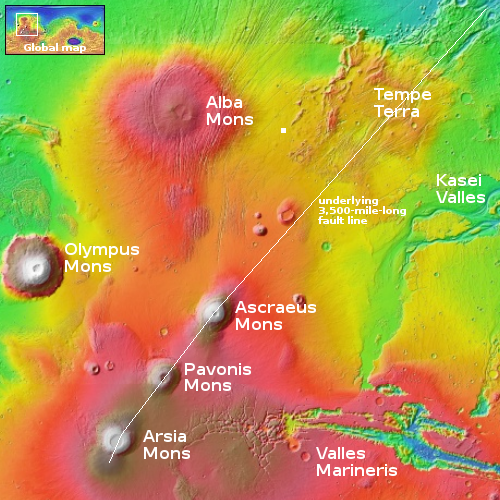
The white dot east of the giant shield volcano Alba Mons on the overview map to the right marks this crater’s location. It sits at 38 degrees north latitude, in a volcanic region where the ground is mostly lava and most glacial features are found confined within craters like this one.
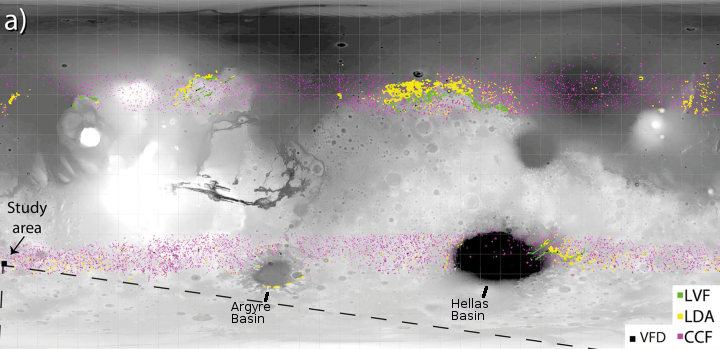
The global map below, from this 2019 paper, also shows us the value that glacial-filled craters will have for future Martians. Green and yellow indicate what scientists call lineated valley fill (LVF) and lobate debris aprons (LDA) respectively, glacial deposits that are in many ways most similar to glaciers found on Earth, flows heading downhill along natural geographic features. Magenta represents concentric crater fill (CCF), glacier features in craters and which are very evenly distributed across both the northern and southern lower mid-latitude belts.
As you can see, even in mid-latitude regions where there are relatively few glacial features, settlers will still be able to find relatively nearby craters with glaciers within them, like the one above. I can even imagine some settlers setting up a homestead at particular craters, making their living mining and selling the ice to others.

On Christmas Eve 1968 three Americans became the first humans to visit another world. What they did to celebrate was unexpected and profound, and will be remembered throughout all human history. Genesis: the Story of Apollo 8, Robert Zimmerman's classic history of humanity's first journey to another world, tells that story, and it is now available as both an ebook and an audiobook, both with a foreword by Valerie Anders and a new introduction by Robert Zimmerman.
The print edition can be purchased at Amazon or from any other book seller. If you want an autographed copy the price is $60 for the hardback and $45 for the paperback, plus $8 shipping for each. Go here for purchasing details. The ebook is available everywhere for $5.99 (before discount) at amazon, or direct from my ebook publisher, ebookit. If you buy it from ebookit you don't support the big tech companies and the author gets a bigger cut much sooner.
The audiobook is also available at all these vendors, and is also free with a 30-day trial membership to Audible.
"Not simply about one mission, [Genesis] is also the history of America's quest for the moon... Zimmerman has done a masterful job of tying disparate events together into a solid account of one of America's greatest human triumphs."--San Antonio Express-News