The elusive effort to detect gravitational waves.

After spending more than half a billion dollars and eight years of looking without a single detection, the Laser Interferometer Gravitational-Wave Observatory (LIGO) has gotten a major upgrade.

If commissioning continues to go relatively smoothly, plans call for the first Advanced LIGO observing run to start in late 2015. A second run, with a decent shot of finding a gravitational wave, would occur in the winter of 2016โ€“17. (Weiss likes to point out that a 2016 discovery would be a nice 100th-anniversary commemoration of Einstein’s paper describing gravitational waves.) By the third science run, planned for 2017โ€“18, the machine should be getting sensitive enough to almost certainly nail a detection, says Reitze.

It is hoped that the increased sensitivity, ten times better than before. will allow LIGO to finally make the first detection of a gravitational wave.
1 comment

Another update on ISEE-3

Dennis Wingo has written a detailed report on the engineering analysis of ISEE-3, including what they plan to do on Wednesday to troubleshoot the problem and possible fix it.

The bottom line is that there is still a good chance they can get the spacecraft thrusters to fire and change the spacecraft’s trajectory. We will know more tomorrow.

0 comments

What others really think of America

Travel tips for Russian, French, Chinese, and Japanese travelers to the United States.

Read them all. Not surprisingly, the French are the most bothered by American habits while the Russians struggle mightily with our general niceness. All told, however, these tips will each give you warm feelings for the wild, crazy, enthusiastic culture that is America, as seen objectively by outsiders, and best summed up by this Japanese advice:

In Japan, there is great fear of failure and mistakes in front of other people. It is better to do nothing and avoid being criticized than to taste the humiliation of failure. As a result, there are things we wanted to do, but did not, and often regret.

In America, you can make mistakes, fail, and it doesnโ€™t matter. It is a fundamental feeling that to sometimes be incorrect is natural. In addition, rather than thinking about mistakes and failures, Americanโ€™s have curiosity and say, “Letโ€™s try anyway!”

As noted so wisely in the 1982 comedy Night Shift, “Is this a great country, or what?”

9 comments

Israel repairs Gaza power line

Another Israeli war crime! Even as Hamas continued to hurl bombs at them, Israeli electric workers on Monday repaired a power line, destroyed by a Hamas rocket, that fed electricity to Gaza.

After a day without power, electricity was restored to some 70,000 Gazans when the Israeli government gave the Israel Electric Corp. the green light to repair a high-power line damaged by a rocket on Saturday. … The IEC employees dispatched to repair the damage were accompanied by Israel Defense Forces soldiers and outfitted with bulletproof vests. They wore special helmets as well to minimize the threat of shrapnel injuries.

Can you wrap you mind around this? Not only did the Israelis do the repair, ending a blackout in Gaza, the story makes it clear that this power is supplied to Gaza by Israel. And this is all taking place while Hamas tries to kill as many Israelis as possible, from Gaza.

So, just who is the hate-monger here?

2 comments

TSA don’t know nothing about geography

Does this make you feel safer? A TSA agent did not recognize a District of Columbia drivers license and did not know it is part of the United States.

When Gray handed the man his driver’s license the agent demanded to see Gray’s passport. Grays told the agent he wasn’t carrying his passport and asked why he needed it. The agent said he didn’t recognize the license. Gray said he asked the agent if he knew what the District of Columbia is, and after a brief conversation Gray realized the man did not know.

What was unfortunate for this particular agent was that the individual he questioned also happened to be a television news reporter.

5 comments

More images from Rosetta

67P

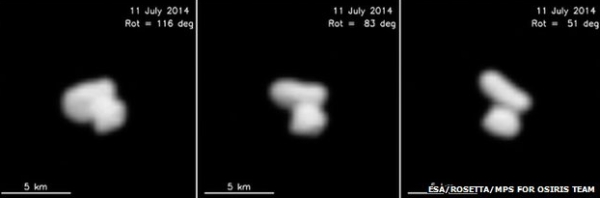
The comet that Rosetta will orbit is getting stranger and stranger, with new images suggesting that it is really two objects stuck together.

The pictures show that 67P/Churyumov-Gerasimenko appears to be not one but two objects joined together. It is what scientists call a “contact binary”. How the comet came to take this form is unknown. It is possible that 67P suffered a major fracture at some point in its past; it is also possible the two parts have totally different origins.

What is clear is that the European Space Agency (Esa) mission team now has additional and unexpected considerations as it plans how to land on the comet later this year – not least, which part of the comet should be chosen for contact?

1 comment

The House slashes IRS budget

The Republican-controlled House has slashed the IRS’s tax enforcement budget by 25%.

The cuts reflect GOP outrage over the agency’s scrutiny of tea party groups seeking tax-exempt status and frustration over the agency’s failure to produce thousands of emails by Lois Lerner, the official formerly in charge of the IRS division that processes applications for tax-exempt status.

“The use of a government agency to harass, target, intimidate and threaten lawful, honest citizens was the worst form of authoritarianism,” said Rep. Paul Gosar, R-Ariz., author of an amendment to cut the IRS tax enforcement budget by $353 million. Rep. Bill Huizenga, R-Mich., followed up with an amendment to cut $788 million more.

The Democratic floor leader on the funding bill, Rep. Jose Serrano of New York, opposed the amendments but opted against demanding a roll call vote. [emphasis mine]

This is the right way to deal with the IRS abuse of power. Cut their funds. Use the power of the purse. I also highlight the Democratic position because it illustrates several things:
» Read more

2 comments

DARPA awards contracts for XS-1 spaceplane

The competition heats up: DARPA has announced contract awards to three companies for the construction of its experimental XS-1 spaceplane, designed to take off and land like a airplane.

The contracts go to Boeing, Northrop Grumman, and Masten Space Systems, and have them each respectively partnered with Blue Origin, XCOR, and Virgin Galactic. More details on the Boeing contract can be found here.

The description of the XS program is quite exciting:
» Read more

6 comments

Sixty science papers retracted

The uncertainty of peer review: An internal investigation has caused the retraction of sixty peer-reviewed scientific papers that were published by a single journal, the Journal of Vibration and Control (JVC).

The network of JVC papers that emerged was incestuous, with the same small group of authors reviewing each otherโ€™s work and appearing together as co-authors. By the end of the year, the investigators had a list of 130 e-mail addresses associated with 60 papers, with one scientist as co-author on all of them: Chen-Yuan Chen of NPUE, who goes by โ€œPeter.โ€ When SAGE sent an e-mail to all 130 e-mail addresses requesting that the authors confirm their identity, none responded. โ€œThe authors were contacted again by SAGE in May 2014 to inform them that their papers would be retracted in the July 2014 issue,โ€ says Sherman, but again none responded. According to SAGEโ€™s official statement, Chen resigned from NPUE in February. Neither Chen nor officials at NPUE responded to e-mails from ScienceInsider

How was it possible for a scientist to become the sole reviewer on dozens of his own papers? The answer appears to be that Chen was allowed to nominate his own reviewers, who were not vetted by JVC,

Chen apparently created fake gmail accounts for both real and non-existing scientists and then chose these scientists both as his co-authors as well as his peer-reviewers.

0 comments

Great Britain’s proposed suborbital spaceport locations

The competition heats up: More information was released today describing Great Britain’s suggested spaceport locations.

These spaceports are specifically aimed at the suborbital space tourism market, for American companies like Virgin Galactic or XCOR, or for the developing British company Skylon.

It is interesting that 6 of 8 are located in Scotland, which might very well not be part of the United Kingdom after a vote on separation this fall.

1 comment

The next Proton and Angara launches

The competition heats up: Russia has set September 28 as the next launch date for its troubled Proton rocket.

The most interesting detail gleaned from this article however is this:

The Proton-M carrier rocket previously launched on May 16 from Baikonur space center collided with communications satellite Express ะะœ4R and burned up in the atmosphere above China, leaving Russia without its most powerful telecommunications satellite.

Previous reports had not been very clear about the causes of the May launch failure. All they would say is that “a failed bearing in the steering engineโ€™s turbo pump” had caused the failure about nine minutes into the flight. This report suggests that this failure occurred after separation of the payload and that it then caused the upper stage to collide with the satellite.

Russia is also about to ship its new Angara 5 rocket to the launch site for a planned December launch. This will be the first launch of the Angara configuration that is expected to replace the Proton rocket, and is expected to place a dummy payload into geosynchronous orbit.
» Read more

2 comments

An illegally destroyed hard drive blocks an investigation into a collegue of Lois Lerner

Obstruction of justice: The investigation of April Sands, a subordinate of Lois Lerner when both were at the Federal Election Commission, was stymied because the agency destroyed and recycled her computer illegally.

The FECโ€™s Office of Inspector General sought to conduct a criminal investigation into Sandsโ€™ activities but were stymied when they found that the agency had recycled her computer hard drive. โ€œTherefore the OIG was unable to show that Ms. Sandsโ€™ solicitations and political activity were done from an FEC computer,โ€ reads the letter. Because of this, the U.S. attorneyโ€™s office for the District of Columbia declined criminal prosecution. โ€œThe FECโ€™s failure to retain Ms. Sandsโ€™ hard drive prevented the FEC OIG from fully pursuing appropriate criminal sanctions for Ms. Sandsโ€™ admitted violation of federal law,โ€ wrote Issa and Jordan.

Sands was under investigation for using her position in the government for partisan purposes. In other words, though she was being paid to work for the Federal Election Commission, she was actually working illegally for the Democratic Party instead.

5 comments

John Prine and Iris DeMent – In Spite of Ourselves

An evening pause: Thanks to Keith for sending me this video. Note that I am open to any recommendations of good videos for posting as an Evening Pause, including music, engineering, comedy, anything quirky or interesting with a spark of originality.

Let me add that if you have something you want to recommend, don’t post the link in the comment. Just say in your comment that you want to recommend something and I will email you direct. I want to view and schedule these posts rather than have them appear in the comments first.

6 comments

A request in connection with Genesis

Since a new ebook edition of my first book, Genesis: the Story of Apollo 8, was released in the summer of 2013 the reviews and sales have been excellent. However, in changing distributors in late June, causing the kindle price to rise, the reviews on amazon.com have temporarily disappeared. We are trying to get them back, but I would be very grateful if any of my readers who read and enjoyed Genesis would take the time to go to amazon and post a review of the book there.

I am not asking for good reviews. I am asking for honest reviews. I am quite confident that the quality of the book will make those reviews good reviews, without my asking.

0 comments

The darkest material ever made

Scientists have developed a material so dark it is difficult to discern the shape of any object it coats.

The material absorbs all but 0.035 per cent of light, a new world record, and is so dark the human eye struggles to discern its shape and dimension, giving the appearance of a black hole. Named Vantablack, or super black, it also conducts heat seven and half times more effectively than copper, and is ten times stronger than steel. It is created by Surrey NanoSystems using carbon nanotubes, which are 10,000 thinner than human hair and so miniscule that light cannot get in but can pass into the gaps in between.

The pictures at the website are especially amazing. They coated half of a sheet of aluminum foil with the material and then crinkled the foil. You can see the crinkles in the uncoated material, but the coated material just looks black.

This will be very useful for astronomical instruments, as well as many other technical applications. For example, if you coat the body of your telescope with this material it will help eliminate stray light, which means that you will increase the efficiency of your observations.

5 comments
1 1,236 1,237 1,238 1,239 1,240 1,769