Reality always wins

Elon Musk’s talk yesterday at the National Press Club revealed several interesting things, about SpaceX’s rocket effort, about the state of the American commercial space industry, and about Elon Musk himself.

First, the company’s rocket design effort. Musk centered his talk on SpaceX’s new effort to make its Falcon 9 rocket completely reusable. Though he produced little specific details, and the moderator at the event asked no questions about it, it seems the engineering centers around these three concepts:
» Read more

22 comments

House proposes a budget increase for NIH

The Republican-controlled House has proposed a budget for National Institutes of Health (NIH) that is one billion more than last year’s budget, an increase from $30.7 to $31.7 billion.

What evil budget-cutters these Republicans are! Their mean-spirited budget increase has the nerve to reduce Obama’s budget request by about $120 million, equivalent to a whopping one third of one percent!

This is all shameful. For context, in 2008 NIH’s budget was $29.2 billion. Considering the state of the budget it seems unconscionable for the House to agree to any increase over $30.7 billion. In truth, it is perfectly reasonable to reduce NIH’S budget back to its 2008 number.

Too bad our present Congress, both Democratic and Republican, isn’t reasonable.

0 comments

NASA has identified ninety percent of the largest near-Earth asteroids

Data from the infrared telescope WISE has now identified ninety percent of the largest near-Earth asteroids.

NASA researchers also downgraded their estimate of the number of medium-sized asteroids, saying there are 44 percent fewer than previously believed. The downside is that scientists have yet to find many of these mid-sized asteroids, which could destroy a metropolitan city.

1 comment

SpaceX suspends production of its Falcon 1 rocket

SpaceX suspends production of its Falcon 1 rocket.

As much as I am a fan of Elon Musk and SpaceX, and though I realize that they have been focusing on getting Falcon 9 and Dragon off the ground — the payoff there is greater and a failure of Falcon 1 during this time could be very politically painful — this action contradicts SpaceX’s years of claims that they had a slew of signed contracts to launch Falcon 1.

I will be attending Elon Musk’s luncheon speech today at the National Press Club, and hope to ask him about this and other things.

5 comments

Exploring an abandoned mine in Nevada

An evening pause: From the youtube webpage:

This inclined shaft is located outside of Searchlight, NV. The shaft itself is about 350 feet deep with two extensive drift levels along its length. We found a winze [a vertical shaft] in the lowest drift level that went down to what appeared to be an additional level.

I must emphasize that mines are very dangerous, and should be approached with great care and caution. Unlike a cave, which has had eons to slowly establish its stable structure, a mine is cut into the rock instantly (compared to geological time), and is thus very unstable and prone to collapse.

0 comments

The coming blindness of astronomy

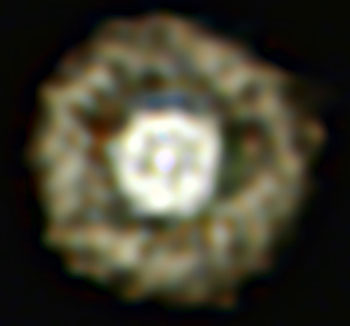
Fried Egg Nebula

The European Southern Observatory today released this infrared image today of what astronomers have named the Fried Egg Nebula. Taken by the Very Large Telescope in Chile, the picture shows the concentric dust shells surrounding a post-red supergiant star, thought to be transitioning to the next stage of stellar evolution called a yellow hypergiant. As the press release explains,

The monster star, known to astronomers as IRAS 17163-3907, has a diameter about a thousand times bigger than our Sun. At a distance of about 13 000 light-years from Earth, it is the closest yellow hypergiant found to date and new observations show it shines some 500 000 times more brightly than the Sun. . . . If the Fried Egg Nebula were placed in the centre of the Solar System the Earth would lie deep within the star itself and the planet Jupiter would be orbiting just above its surface. The much larger surrounding nebula would engulf all the planets and dwarf planets and even some of the comets that orbit far beyond the orbit of Neptune. The outer shell has a radius of 10 000 times the distance from the Earth to the Sun.

Yellow hypergiants are in an extremely active phase of their evolution, undergoing a series of explosive events β€” this star has ejected four times the mass of the Sun in just a few hundred years. The material flung out during these bursts has formed the extensive double shell of the nebula, which is made of dust rich in silicates and mixed with gas.

According to the science paper [pdf] describing this research, the stage of yellow hypergiants is a preliminary to the star evolving into a luminous blue variable, of which Eta Carinae is the most famous. In this next stage a star is thought to have a good chance of going supernova.

Though this image is truely spectacular, taken by a ground-based telescope of a star 13,000 light years away, what I find most significant about this image is its fuzziness. It reminds me of the kind of images astronomers and the public routinely accepted as the best possible, before the launch of the Hubble Space Telescope.
» Read more

1 comment
1 1,572 1,573 1,574 1,575 1,576 1,773