Schiller – Ein Schoner Tag
An evening pause: Performed live 2001.
Hat tip Judd Clark.
An evening pause: Performed live 2001.
Hat tip Judd Clark.
Courtesy of BtB’s stringer Jay. This post is also an open thread. I welcome my readers to post any comments or additional links relating to any space issues, even if unrelated to the link below.
Slow day. No other quick links.
Cool image time! The picture to the right, cropped, reduced, and sharpened to post here, was taken by the Hubble Space Telescope as part of a project to study galaxies with very active central supermassive black holes.
What sets UGC 11397 apart from a typical spiral lies at its centre, where a supermassive black hole containing 174 million times the mass of the Sun is growing. As a black hole ensnares gas, dust, and even entire stars from its vicinity, this doomed matter heats up and puts on a fantastic cosmic light show. Material trapped by the black hole emits light from gamma rays to radio waves and can brighten and fade without warning. But in some galaxies, including UGC 11397, thick clouds of dust hide much of this energetic activity from view in optical light. Despite this, UGC 11397’s actively growing black hole was revealed through its bright X-ray emission — high-energy light that can pierce the surrounding dust. This led astronomers to classify it as a Type 2 Seyfert galaxy, a category used for active galaxies whose central regions are hidden from view in visible light by a doughnut-shaped cloud of dust and gas.
To me what sets this galaxy apart is its natural beauty. It also reminds me of the universe’s vastness. Located about 250 million light years away, those hazy spiral arms represent millions of stars, many of which likely harbor planets and maybe even life.

Note that the bright areas are not ice but simply overexposed
The science team operating the Shadowcam camera on South Korea’s Danuri lunar orbiter — designed to take images in places with little light — yesterday released a new image taken of the floor of a permanently shadowed crater on the Moon, Hermes-A, located near the north pole.
That picture is to the right. The rectangle indicates the area discussed by the release, focusing entirely on describing its geological features, such as impact melt and the numerous secondary smaller impacts and ejecta within the crater floor. The inset gives the context, showing the crater’s location near the north pole. The blue areas in the inset are those areas thought to be permanently shadowed, such as the entire floor of Hermes-A.
What the release fails to mention is the most important detail lacking in this picture. Though the floor of Hermes-A crater is considered permanently shadowed, the low light image taken by Shadowcam shows no obvious ice features, at all. If there is a higher content of water here, it is locked within the soil, and would require processing to access. Even so, the picture suggests that any such moisture is of extremely low concentration, likely in the parts per billion, and hardly enough to build a lunar base.
This is the same result found by previous Shadowcam pictures. Increasingly it appears that the hope of finding large quantities of easily accessible water ice in these permanently shadowed craters is proving false.
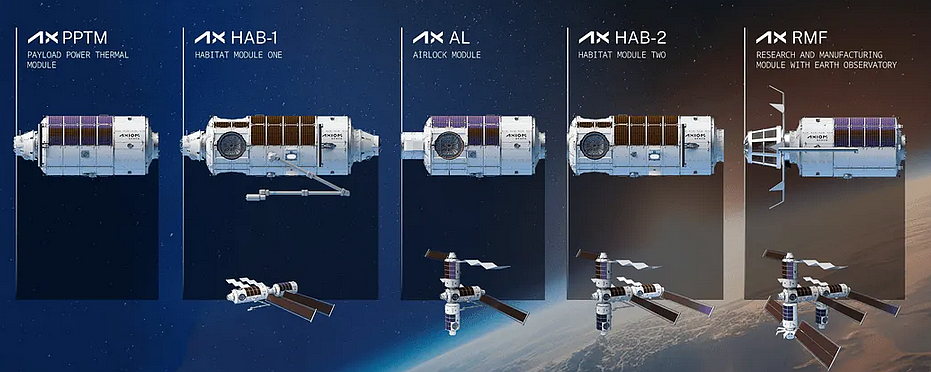
NASA today announced a new launch date of June 25, 2025 for Axiom’s Ax-4 commercial manned mission to ISS carrying a three passengers from India, Poland, and Hungary respectively and commanded by former NASA astronaut Peggy Whitson (now working for Axiom).
As with previous announcements, the information provided was sparse:
NASA, Axiom Space, and SpaceX are targeting 2:31 a.m. EDT, Wednesday, June 25, for launch of the fourth private astronaut mission to the International Space Station, Axiom Mission 4.
The mission will lift off from Launch Complex 39A at NASA’s Kennedy Space Center in Florida. The crew will travel to the orbiting laboratory on a new SpaceX Dragon spacecraft after launching on the company’s Falcon 9 rocket. The targeted docking time is approximately 7 a.m. Thursday, June 26. NASA will provide more details and its coverage information shortly.
The launch had previously been delayed several times because NASA and Russia wanted to first assess the repair work on the leaks in the Russian Zvezda module before allowing another docking at the station. No information however has been released so far detailing that assessment. Though there have been indications that the loss of air in ISS was stopped by the repair, neither NASA nor Roscosmos have provided any specific data.
According to an update today from the French cargo capsule startup The Exploration Company, its Mission Possible capsule prototype launched yesterday on SpaceX’s Falcon 9 had a “partial success (partial failure)” during its return to Earth.
The capsule was launched successfully, powered the payloads nominally in-orbit, stabilized itself after separation with the launcher, re-entered and re-established communication after black out. But it encountered an issue afterwards, based on our current best knowledge, and we lost communication a few minutes before splash down. We are still investigating the root causes and will share more information soon.
This was the second prototype test flown by the company, the first launched on the inaugural flight of the Ariane-6 rocket. That test was unable to complete its mission because of a problem with the rocket’s upper stage, which prevented it from completing its de-orbit burn, which would have then permitted the prototype to be released and return to Earth for flight testing. Instead, no test was done.
The company had initially only planned two test flights of these smaller prototypes before moving on to test flights of its full scale Nyx cargo capsule, designed to garner commercial cargo business to and from the space stations presently under development. The update today suggests it might now do another test flight with a smaller prototype.
In a press conference today, officials of the Japanese startup Ispace explained that the failure of its second lunar lander, Resilience, to land softly on the Moon on June 5, 2025 was due to a hardware issue in its laser range finder that prevented it from providing correct altitude data.
At the same time, they have not yet been able to pin down precisely what caused the failure. It could have been because of unexpected degradation during flight, or possibly a technical fault with the range finder in gathering data at the speeds and altitudes experienced.
The company is forming a task force in partnership with Japan’s space agency JAXA as well as NASA to try to figure out the issue. It is also going to add lidar instrumentation to future missions to provide a backup to the laser range finder. These actions will add about $11 million in additional costs, an amount Ispace says it can absorb.
Ispace is building two more lunar landers, one for NASA in partnership with the American company Draper, and the second for JAXA. It appears both missions are still moving forward.
An evening pause: Music by Disturbed.
Hat tip to Wamphyr, who adds, “It’s fun to watch a grandmother rock out like this.”
SpaceX today successfully placed 70 payloads, including 66 separate deployments, into orbit as part of its Transporter program for smallsats, its Falcon 9 rocket lifting off from Vandenberg in California.
The first stage completed its 26th flight, landing on a drone ship in the Pacific Ocean. It also completed this flight only 22 days after its last flight. As of posting the deployment of these payloads and satellites was on going.
The leaders in the 2025 launch race:
78 SpaceX
35 China
8 Rocket Lab
7 Russia
SpaceX now leads the rest of the world in successful launches, 78 to 58.
Courtesy of BtB’s stringer Jay. This post is also an open thread. I welcome my readers to post any comments or additional links relating to any space issues, even if unrelated to the links below.
The Parker Solar Probe has successfully completed its 24th close fly-by of the Sun, the last of its initial primary mission, matching the distance and speed record set during two previous fly-bys.
Parker Solar Probe checked in with mission operators at the Johns Hopkins Applied Physics Laboratory (APL) in Maryland — where it was also designed and built — on Sunday, June 22, reporting that all systems are healthy and operating normally. The spacecraft was out of contact with Earth and operating autonomously during the close approach.
During this flyby, the spacecraft also equaled its record-setting speed of 430,000 miles per hour (687,000 km per hour) — a mark that, like the distance, was set and subsequently matched during close approaches on Dec. 24, 2024, and March 22, 2025.
The data obtained during this fly-by will be beamed back to Earth in the coming months, as Parker moves to the outer part of its orbit, farther from the Sun.
Though this completes the planned orbits of the mission’s primary mission, the proposed Trump budget continues to fund the spacecraft’s operation for the next five years, allowing it to monitor changes in the Sun as it ramps down from solar maximum to solar minimum.
France’s space agency CNES this week awarded ArianeGroup, the rocket partnership between Airbus and Safran that builds the Ariane-6 rocket a contract to develop a more powerful methane-fueled rocket engine.
Aiming to reach between 200 and 300 tons of thrust, the new engine will be twice as powerful as the current Vulcain 2.1 main stage engine that propels Ariane 6.
No details about cost or time schedule were released.
The significance of this deal isn’t the engine, but that it was issued directly to ArianeGroup by France’s space agency, instead of through the European Space Agency’s (ESA) Arianespace commercial arm, as has been routine for the past three decades. The deal illustrates how the ESA is essentially beginning to break up. Rather than go through it, its individual nations are now going it alone, each providing support and funding to their own commercial private space startups. Germany began this process, encouraging the development of three new rocket companies (Rocket Factory Augsburg, Isar, and Hyimpulse). Spain and Italy soon followed with their own new rocket companies, (PLD and Avio respectively). France, which until recently lobbied to keep the old government model alive in ESA, has in the past year shifted strongly to the capitalism model.
This contract only underscores this shift.