Iapetus: Saturn’s ying-yang moon

Iapetus as seen by Cassini in 2007
Click for original image.

Cool image time! The image to the right, reduced and sharpened to post here, was taken on September 10, 2007 by the Saturn orbiter Cassini as it made its first close fly-by of the moon Iapetus, from a distance of about 45,000 miles.

Iapetus, about 912 miles in diameter, is one of the strangest objects in the solar system. As it orbits Saturn, its leading hemisphere is very dark, covered with almost pitch black material, while its trailing hemisphere is very bright. This picture captures a bit of both, with the dark leading hemisphere visible along the right edge.

In many places, the dark material–thought to be composed of nitrogen-bearing organic compounds called cyanides, hydrated minerals and other carbonaceous minerals–appears to coat equator-facing slopes and crater floors. The distribution of this material and variations in the color of the bright material across the trailing hemisphere will be crucial clues to understanding the origin of Iapetus’ peculiar bright-dark dual personality.

There are several theories to explain the planet’s strange ying-yang two-tone coloration. One suggests it is material thrown off by other Saturn moons that Iapetus sweeps up. Other theories suggest the planet’s orbit itself causes the two hemispheres to have different temperatures, allowing material to sublimate off the dark side and to the bright side.

No theory is presently accepted. Nor does any explain the data fully.

Tomorrow I’ll post a most intriguing close-up of Iapetus taken by Cassini during that 2007 fly-by.

0 comments

Interstellar comet 3I/Atlas is unusually enriched with windshield wiper fluid

New Hubble image of 3I/Atlas
Comet 3I/Atlas as seen by Hubble
in November 2025. Click for original.

While interstellar comet 3I/Atlas is remarkably like most comets from our own solar system, scientists have now found new evidence that it spalled off unusual amounts of methanol (CH3OH) — material normally used as windshield washer fluid, carburetor fluid, and cooking fuel — when it made its close fly-by of the Sun in the fall of 2025.

You can read the paper here [pdf] . The research also detected large amounts of prussic acid (HCN). As the comet made its closest pass to the Sun, the numbers increased. From the paper’s abstract:

The CH3OH production rate increased sharply from August through October, including an uptick near the inner edge of the H2 O sublimation zone at r H = 2 au. Compared to comets measured to date at radio wavelengths, the derived CH3 OH/HCN ratios in 3I/ATLAS of 124+30 βˆ’34 and 79βˆ’14 +11 on September 12 and 15, respectively, are among the most enriched values measured in any comet, surpassed only by anomalous solar system comet C/2016 R2 (PanSTARRS).

Though the numbers are high, they aren’t outside the range of what has been found in comets from our own solar system. Instead, this data suggests — as has all data so far — that Comet 3I/Atlas is a normal comet, but unique in its own way, as are all comets and in fact every object in space.

4 comments

Fourteen-year-old NASA satellite about to burn up uncontrolled in the atmosphere

Chicken LIttle rules again.

Chicken Little rules again! After fourteen years, the orbit of one of NASA’s two Van Allen Probe satellites is about to decay, causing the 1,323 pound satellite to burn up uncontrolled in the atmosphere.

As of March 9, 2026, the U.S. Space Force predicted that the roughly 1,323-pound spacecraft will re-enter the atmosphere at approximately 7:45 p.m. EDT on March 10, 2026, with an uncertainty of +/- 24 hours. NASA expects most of the spacecraft to burn up as it travels through the atmosphere, but some components are expected to survive re-entry. The risk of harm coming to anyone on Earth is low β€” approximately 1 in 4,200.

As today is a very slow news day in space news, a lot of the mainstream press is highlighting this story, with the usual fear-mongering about how it could hit the Earth and cause terrible damage. And while it is certainly true that this satellite appears large enough for some pieces to reach the ground, the chances of those pieces causing any real harm is quite slim. In fact, I think NASA’s estimate of 1 in 4,200 to be far too high.

Mission engineers had initially estimated the orbit would decay in the 2030s, but that estimate was based on a prediction of a weak solar maximum. The Sun however was more active than predicted in the past decade, and that activity caused the Earth’s atmosphere to puff up, which in turn acted to accelerate the satellite’s orbital decay.

This incident once again shows us that there is money to be made in removing defunct satellites from orbit. NASA and ESA have both made it clear each would pay a company to do it. So have some private companies. Some of the orbital tug and robotic servicing companies have here an opportunity they need to grab.

8 comments

A nearby red dwarf star has a solar system of four planets, one in the habitable zone

According to a new analysis of new data, astronomers now think the nearby red dwarf star GJ 887, only about 11 light years away, not only has a solar system of four planets, one of those planets is is a super-Earth orbiting the star in the habitable zone.

From the abstract:

With the Bayesian analysis, we confirmed a four-planet model, including the two previously known planets at periods of 9.2619 Β± 0.0005 d and 21.784 Β± 0.004 d, as well as two newly confirmed exoplanets: an Earth-mass planet, with a 4.42490 Β± 0.00014 d period and a sub-meter-per-second amplitude, and a super-Earth with a 50.77 Β± 0.05 d period located in the habitable zone (HZ). This super-Earth is the second closest planet in the HZ, after Proxima Cen b.

The super-Earth has a mass estimated to be anywhere from two to ten times that of Earth, so if any life could exist on it that life would have to be adapted for an extremely strong gravitational field. The star itself appears to be relatively benign for an M dwarf, having a “low level of magnetic activity”, though it does exhibit some flaring that could pose a threat to the development of life on the planet.

Unfortunately, this system is not aligned in a way to allow transits of these planets across the face of the star, so these conclusions are based on gravitational wobbles of the star analyzed by computer modeling. Lots of uncertainty. The scientists hope that direct observations of the planet by future space telescopes will reduce these uncertainties. At the moment, the proposed privately-funded Lazuli optical orbiting telescope has the best chance of doing this work, but it isn’t expected to launch before the end of the decade. It will have a 3.1 meter primary mirror, larger than Hubble’s 2.4 meter mirror.

It is a so far very slow news day in space.

5 comments

Jefferson Starship – Jane

An evening pause: Performed live 1981.

Hat tip Gene Shipp.

1 comment

March 10, 2026 Quick space links

As BtB’s stringer Jay is on vacation, here are a few links I spotted that don’t deserve full posts. This post is also an open thread. I welcome my readers to post any comments or additional links relating to any space issues, even if unrelated to the links below.

  • The Paso Robles city council approves plan to make its airport a spaceport
    Don’t bet on any orbital launches from this California city, for years if ever. There are no horizontal rockets presently operational, few are in development, and launching from California’s burdensome regulatory and anti-business government will discourage any that eventually start flying to come here. There are too many far better choices.
  • NASA inspector general generally approves its commercial manned lunar lander program
    You can read the report here [pdf]. While it identifies a number of relatively minor management issues, it admits that relying on private companies to build the lunar lander has controlled cost, kept it low, and is proceeding at reasonable speed. It whines about whether either SpaceX or Blue Origin will be ready for a 2028 manned landing, but recognizes that both are proceeding with all due speed. Note too that this report is out-of-date, as it does not include the recent reshaping of the entire Artemis program.
13 comments

Who fired “the shot heard round the world”?

Paul Revere's Ride

In just a few months we will be celebrating the 250th anniversary of the signing of the Declaration of Independence. That signing occurred because a little over a year previously a troop of British soldiers went into the heart of Massachusetts to seize weapons and ammunition that the British government did not want Americans to possess, and ended up getting involved in a firefight with the local militia in the town of Lexington, what became known as “the shot heard round the world. That shot started the American Revolution, and eventually forced the members of the Continental Congress to declare their independence from that British government.

As with all history, though that firefight sparked vast changes in politics, history, and culture across the globe and across centuries, the event itself was the act of just one or a few individuals, in a specific moment and place, under very specific circumstances created by those greater movements of politics, history, and culture.

One man fired the gun. A few others fired back. And then a war started.

But who was that man?

In one of the best histories I have ever read, historian David Hackett Fischer attempts to answer this question. His 1994 book, Paul Revere’s Ride, centers the story on Paul Revere and that man’s actions to warn the citizens throughout Concord and Lexington of the British invasion, so that they could be prepared to fight, if necessary.
» Read more

10 comments

Pluto’s cratered glacial terrain

Panorama of Pluto's eastern limb
Click for full resolution. For original images go here, here, here, and here.

Pluto in true color
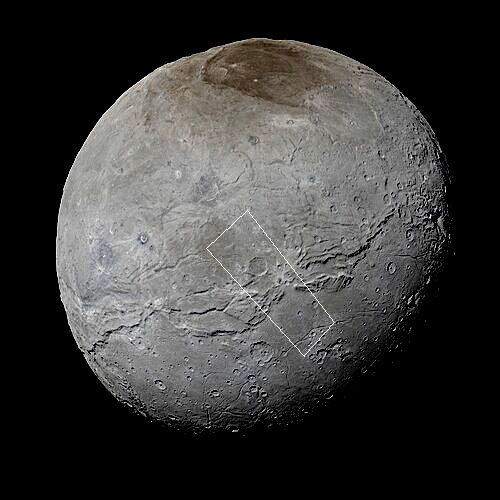
Click for original image.

Cool image time! The panorama above, created from four New Horizons’ images that were cropped and enhanced to post here, was taken by New Horizons on July 14, 2015 (here, here, here, and here), about 30 minutes before its closest approach of 7,800 miles above Pluto.

I have searched the New Horizons’ press release archive, and as far as I can tell, this sequence of images and the terrain it shows was never highlighted publicly by the science team. For that reason, I am not sure exactly where to place it on the global true-color image of Pluto to the right, released by the science team shortly after that fly-by. I suspect the panorama covers a strip on the eastern limb of the globe, in the darker crater region to the east of Pluto’s giant frozen nitrogen sea. It is also possible this is actually covering the north pole regions, with the raw images as released oriented with north to the right.

Other than these guesses I cannot tell. If anyone has better information please provide it in the comments.

What the panorama does show us is cracked and pitted terrain, thought to be mostly made up of frozen ice mixed with dust and debris with some nitrogen and other materials thrown in. Though in many ways it resembles the Moon, that similarity is only very superficial. For example, the polygon shapes near the picture’s center suggest ice floes or glaciers, though there is no underground liquid ocean on which they could float.

This is a very alien world. And it is likely even more alien than the few pictures obtained during that New Horizons’ fly-by have suggested. After all, we only saw in high resolution one hemisphere. Who knows what’s really on the planet’s other side?

2 comments

SpaceX now targeting early April for next Starship/Superheavy test flight

Based on a tweet posted by Elon Musk on March 7, 2026, SpaceX now targeting early April for next and 12th Starship/Superheavy test orbital flight.

According to this update at nasaspaceflight.com, the Superheavy booster, the 19th prototype and the first version 3 booster, is now on the launchpad for final checks.

On March 8, Booster 19 left Mega Bay 1 and rolled down Highway 4 towards the launch site and Pad 2. This is the start of pad commissioning and booster engine testing for Block 3.

Booster 19 is mounted on Pad 2 to conduct multiple tests over the coming days. This will likely include ambient pressure testing, tanking tests with Liquid Oxygen (LOX) and Liquid Methane (LCH4), spin primes, and eventually a static fire, maybe even a couple of static fires. These tests are not only to help test the booster but also to test all of the pad systems.

While crews have run operations with the Pad 2 tank farm many times, they have never loaded an actual booster with propellant. With a booster finally on the pad, this will help in the final commissioning process.

For these initial pad and booster check-outs, #19 does not have all 33 engines installed. It appears the company wants to test the launchpad fueling system first, with the minimum number of engines needed.

Meanwhile, the Starship prototype that will fly, #39 in the series, is in the assembly building after completing its own series of tanking and launchpad tests.

I want to highlight two numbers — 19 and 39 — in order to illustrate how SpaceX does things versus NASA. Not only has SpaceX already completed eleven test flights of Starship/Superheavy, it has tested or flown 19 and 39 prototypes of each, in one manner or another. The company has a very rich history of hardware and testing as it ramps up towards operational flights. This practically guarantees that those operational flights will not only occur relatively soon, they will be relatively safe and robust.

This was all done in less than a decade, though most of the testing of those prototypes has occurred in the last six years.

NASA meanwhile began work on SLS about fifteen years ago, and has built two rockets total, and so far flown only one. Though the agency did a lot of tests of pieces of the rocket, it flew only one test launch, in 2022. SLS’s design is so cumbersome and expensive, the agency could not afford to fly it multiple times. Thus, much of its testing was done on computer screens, in simulations.

Which rocket would you want to fly on when both are operational?

9 comments

Chinese scientists pinpoint a prime landing site for its manned lunar mission

Potential landing site for China's manned lunar landing

Though no final decision has apparently been made, a just published research paper suggests that China is considering a location almost dead center on the Moon’s near side, on the edge of a mare region dubbed Sinus Aestruum, for its first manned lunar landing, presently targeting a 2030 launch date. From the abstract:

We propose four prospective landing sites in the traversable areas, which provide a range of diverse geological samples, including volcanic debris, mare basalts, Copernicus crater ejecta and high-Th materials. Such a collection may provide insights into the geological evolution of the region and enhance our understanding of the lunar mantle composition and volcanic processes.

The red star on global lunar map to the right, taken from figure 1 of the paper, shows the location of this region. The lower map zooms into the region, with the four stars indicating the four prospective landing sites. The region has several rilles, long meandering channels thought to have formed from lava flow, that could be reached during an EVA.

Though it appears the scientists of this paper are lobbying for this landing region and no final decision has been reached, its location and wide variety of geology strongly suggests this will be the final choice. If so, of the four landing sites outlined two are in the smoother mare regions, and two are off the edge, in rougher terrain. For safety considerations, it is likely the final landing site will be in one of the former.

4 comments

SpaceX launches EchoStar communications satellite

SpaceX early this morning successfully launched an EchoStar communications satellite, its Falcon 9 rocket lifting off from Cape Canaveral in Florida.

The first stage completed its 14th flight, landing on a drone ship in the Atlantic. The rocket’s two fairings completed their 8th and 27th flights respectively.

The 2026 launch race:

30 SpaceX
8 China
3 Rocket Lab
2 Russia
1 ULA
1 Europe (Arianespace)

Not only is SpaceX this year leading the entire world combined in total launches β€” as it did in both ’24 and ’25 β€” at the moment its pace is twice that as the rest of the globe.

0 comments
1 38 39 40 41 42 2,928