How It’s Made – Candy Canes
An evening pause: Seems appropriate for the season.
Hat tip Dan Morris.
An evening pause: Seems appropriate for the season.
Hat tip Dan Morris.
Russia, as part of the continuing barter deal with NASA for seats on the capsules of both countries, has selected rookie astronaut Anna Kikina to be the first Russian to fly on a Dragon capsule.
Kikina is the only woman currently active in the Russian cosmonaut corps. She was selected in 2012 but has yet to fly in space, although Rogozin and other Russian officials had previously said she would fly in the fall of 2022. She would likely be on the Crew-5 Crew Dragon mission, to which NASA astronauts Nicole Mann and Josh Cassada and JAXA astronaut Koichi Wakata are currently assigned.
While according to the Russians the barter deal is finalized, according to NASA negotiations are still ongoing. This announcement by the Russians might actually be a negotiating tactic, since the tensions between the U.S. and Russia over Russian threats to the Ukraine could threaten the partnership at ISS. By making this announcement the Russians might be trying to make the barter deal an accomplished fact.
China today launched two satellites thought to be for military reconnaissance, using its Long March 4B rocket.
The leaders in the 2021 launch race:
47 China
27 SpaceX
21 Russia
6 Europe (Arianespace)
5 ULA
5 Rocket Lab
China now leads the U.S. 47 to 45 in the national rankings. There have now been 122 successful launches in 2021, making it the seventh most active year in the history of space exploratoin.
An evening pause: Most claimed flash mob performances are not really what they claim, often well staged with lots of cameras and hardly a surprise to the surrounding innocent crowd. This one, performed during the Christmas season in 2010, appears quite genuine, building out of nowhere at an ordinary mall food court. Even the camera work appears to be mostly from phones, many of which I think the producers obtained from the onlookers after the fact.
And of course, the music of Handel using the words of the Bible cannot be beat.
Hat tip Chris McLaughlin.

The Civil Rights Act of 1964: repealed at
Washington and Lee University in Virginia
“Segregation today, segregation tomorrow, segregation forever!” A program to teach business practices to college students at Washington & Lee University in Virginia makes it very clear that whites and Asians are not welcome to apply, and will be shadow-banned should they do so.
The program is offered by the Williams Investment Society, or WIS, “a student organization that manages a portion of Washington and Lee University’s endowment in equity securities,” its website states.
“To promote equality of opportunity, the WIS has developed a successful diverse shadow program and we encourage you to apply if you self-identify with any of the following communities: Women, Black, Lantinx, Latin, Native American, LGBTQ+, Veterans, and Students with Disabilities,” the society states in advertising the program.

Click for full resolution. Original images here and here.
Curiosity has now moved up and into Maria Gordon Notch, a gap in the mountains of Gale Crater that is about forty feet wide, with a 40-foot-high cliff on its western side and a 30 to 60 foot cliff on its eastern side.
The mosaic above, created from two navigation camera images, looks up at the top half of that western cliff. Note the many many layers, each one of which records some climate or volcanic event in Mars’ geological history. The Mars we see today took a long time and many events to become what it is. Such layers however have not been seen everywhere by Curiosity. Compare for example this layered cliff with the massive outcrop dubbed Siccar Point and looked at closely by the rover in October. In that outcrop the layers were either non-existent, or merged together during some subsequent geological process.
Note also the pond of sand/dust at the center-bottom, nestled in a hollow but sitting almost vertical. That the dust can maintain itself at such an angle illustrates Mars’ lighter gravity, about 39% of Earth’s, which in turn allows for a much steeper angle of repose. That lighter gravity also allows for some sections of rock to stick out more precariously than possible on Earth.
As Curiosity moves through the notch in the next few days, more such cool pictures will become available, and I shall post them.
According to press statements by India’s Minister for Science & Technology, Jitendra Singh, the schedule for that country’s next unmanned lunar lander/rover and its first manned missions have now been firmed up.
First, Singh announced that the lunar lander/rover, Chandrayaan-3, is now aiming for a launch to the Moon in the second quarter of ’22. The mission is essentially a rebuild of Chandrayaan-2, which got within a few hundred feet of the lunar surface before losing control and crashing in 2019. Chandrayaan-3 had initially been scheduled for launch in late 2020, but the COVID panic essentially shut down India’s entire space industry in both ’20 and ’21.
Second, Singh announced that India’s manned orbital Gaganyaan mission is now scheduled for launch in ’23.
Jitendra Singh said that the major missions like Test vehicle flight for the validation of Crew Escape System performance and the 1st uncrewed mission of Gaganyaan (G1) are scheduled during the beginning of the second half of 2022. This will be followed by a second uncrewed mission at the end of 2022 carrying “Vyommitra” a spacefaring human robot developed by ISRO and finally the first crewed Gaganyaan mission in 2023.
Like Chandrayaan-3, Gaganyaan was delayed significantly by the panic in India over COVID. It was originally scheduled for launch in December ’21, but the panic caused all work to stop for most of ’20 and ’21. During that time period India’s planned annual launch pace of 6 or more launches per year shrank to a mere three launches over two years, with little sign yet that ISRO is ready to resume launches.
Hopefully, these announcements are a signal that India will fully return to flight in ’22. Stay tuned.
Capitalism in space: Orbex announced today that it has awarded a contract to a Scottish company to begin the construction of the launch platform it will use with its smallsat Prime rocket.
Orbex has commissioned Motive Offshore Group, a leading Scottish company specialising in the design and manufacture of marine and lifting equipment, to fabricate and install the Launch Platform at a dedicated test site near Kinloss, close to the Orbex headquarters in Forres, Scotland.
The Launch Platform, known as Orbex LP1, is expected to be fully operational by early 2022. … The new Launch Platform will support the testing of Orbex´s Prime rocket, a micro-launcher designed to transport small satellites weighing around 150kg to low Earth orbit. Although actual launches of the Orbex Prime rocket will not take place at the Kinloss site, the Launch Platform will be fully capable of launching an orbital rocket, allowing for full ‘dress rehearsals’ of launch procedures.
This platform is likely similar to the very transportable launch platform used by Astra. The present plan is to do launches from Orbex’s launch facilities at the Sutherland spaceport in Scotland, presently under construction and the first such launch facility being built in the United Kingdom in more than a half century. If designed to be portable, however, Orbex will also be able to ship the Prime rocket to other launch locations, depending on the orbital requirements of each launch.
Capitalism in space: Stratolaunch announced today [pdf] that it has won research contract with the Missile Defense Agency to provide a testing capability to that agency’s program to develop hypersonic flight technology.
The Stratolaunch team is eagerly preparing to complete its next set of Roc carrier aircraft test flights. The team also continues to make tremendous strides in building its first two Talon-A test vehicles: TA-0 and TA-1. TA-1 will start its power-on testing by the end of year, keeping the company on track to begin hypersonic flight testing in 2022 and to deliver services to government and commercial customers in 2023. Launched from Stratolaunch’s Roc carrier aircraft, the Talon-A vehicles are rocket-powered, autonomous, reusable testbeds carrying customized payloads at speeds above Mach 5.
From this release it appears that the company is planning more flight tests of its giant Roc airplane while it begins the first ground tests of the test vehicles that Roc will take into the air, followed in ’22 with flight tests, followed next with operational test flights in ’23.
The company’s shift from using Roc as a first stage for orbital satellites to using it instead as a hypersonic test bed seems to be paying off. For years the company was unable to find any design for second stage rocket that made both technical or economic sense. Using Roc instead as a vehicle for launching a hypersonic test bed — the Talon — seems more practical, while also providing the military a relatively cheap capability for hypersonic testing that it had previously lacked.
NASA today released a very vague update describing the work of the Lucy engineering team in trying to work out a fix to the incomplete deployment of one of Lucy’s solar panels.
A project team completed an assessment Dec. 1 of the ongoing solar array issue, which did not appear to fully deploy as planned after launch in late October. Initial ground tests determined additional motor operations are required to increase the probability of the latching Lucy’s array in place as intended, and the team has recommended additional testing.
Spacecraft operations included discharging and charging the battery while pointed at Earth, moving the spacecraft to point to the Sun, operating the solar array motor with the launch day parameters, moving back to pointing at Earth, and then another battery discharge and recharge. The solar arrays charge the batteries, then the batteries are deliberately discharged, and the solar array circuits are used to recharge the batteries; performing these charging and discharging processes gives the team more information about the solar array circuits.
The team gathered information on two of the 10 gores – the individual solar array panel segments that make up the full array — that previously had no data. NASA now has data on all 10 gores confirming they are open, producing power as expected, and not stuck together. [emphasis mine]
Apparently they have been doing a variety of testing of the array to assess its precise condition. The highlighted words are the most important, as this data suggests that all ten fan sections, as shown in the graphic above, are partly open, and that an attempt to fully deploy the solar panel should work.
The Lucy team has apparently decided to approach this work very slowly and cautiously, that they have time to do so as Lucy continues its slow journey to Jupiter’s Trojan asteroids.
Capitalism in space: SpaceX early this morning successfully launched NASA’s Imaging X-ray Polarimetry Explorer (IXPE), a small X-ray telescope designed to black holes and neutron stars.
The first stage, making its fifth flight, successfully landed on a drone ship in the Atlantic.
This launch, SpaceX’s 28th for 2021, extends once again the company’s all time record for the most launches in a year by a private company.
The leaders in the 2021 launch race:
46 China
28 SpaceX
21 Russia
6 Europe (Arianespace)
5 ULA
5 Rocket Lab
China’s lead over the U.S, in the national rankings has now shrunk to 46 to 45. The launch was the 121st in 2021, making this year tied as the seventh most active year in the history of space, a ranking that is sure to go up before the end of the year.
Embedded below the fold in two parts.
To listen to all of John Batchelor’s podcasts, well worth your time, go here.
» Read more
You can now listen to the podcast of my appearance last night, December 7, 2021, on the Space Show at this link.
As always it was a fun show. Thank you to my readers here at Behind the Black for your email questions. I just wish we had had more callers, as the conversation is usually more vibrant than simply answering questions from email.
An evening pause: Hat tip Dan Morris.
Capitalism in space: Rocket Lab today successfully launched from its launchpad in New Zealand two more satellite for the Earth observation company BlackSky, completing the launch only 21 days after their previous launch, tying the company’s fastest turnaround.
This was Rocket Lab’s fifth launch in 2021, which the company states will be its last this year. At the start of the year it had predicted it would complete this number, so the company has at least matched its expectations for 2021, despite governmental hold-ups in both New Zealand and Wallops Island that slowed the launch pace.
The leaders in the 2021 launch:
46 China
27 SpaceX
21 Russia
6 Europe (Arianespace)
5 ULA
5 Rocket Lab
China’s lead over the U.S. in the national rankings is now 46 to 44. SpaceX has a scheduled launch later tonight, so the race between the two countries should continue to tighten.
This was also the 120th successful launch in 2021, the most in a single year since 1984, and making it the ninth most active year in the history of space exploration.

Click for full resolution image.
Cool image time! The photo to the right, rotated, cropped, and reduced to post here, was taken on November 1, 2021 by the high resolution camera on Mars Reconnaissance Orbiter (MRO). It shows a series of strange glacial-like flows coming off the western slopes of the central peak of a 40-mile-wide unnamed crater, located smack dab in what I call Mars’ glacier country, that 2,000 long mid-latitude strip where almost every image shows evidence of glaciers.
The cropped section to the right doesn’t really do these strange flows justice. Make sure you click on the image to see the full resolution version. There are numerous separate flows coming off that central peak. Each appears to show that as time passed, each flow traveled a shorter distance down the mountain, leaving a moraine behind at higher and higher points.
The overview map below provides the context.
» Read more

The American Indian, banned by Democrats
Blacklists are back and the Democrats have got ’em: After the Democrats controlling the state government in Colorado passed a bill banning the use of any mascot or imagery that makes any reference to any American Indian tribe or cultural icon, a Native American group immediately filed suit, claiming that the policy essentially discriminates against American Indians, banning them from the public sector in all ways.
Colorado Gov. Jared Polis [a Democrat], who is listed as a defendant in the lawsuit, in June signed Senate Bill 21-116 into law, which prohibits public schools from using “a name, symbol, or image that depicts or refers to an American Indian tribe, individual, custom, or tradition that is used as a mascot, nickname, logo, letter, or team name.” Schools with American Indian-themed mascots have until June 1, 2022 to cease use or face $25,000 fines each month for noncompliance, according to the law, which doesn’t apply if a school has an existing agreement with a federally recognized tribe.
The lawsuit, which was filed [in early November] in U.S. District Court by the Mountain States Legal Foundation, a conservative public-interest law firm, is brought by current and former Yuma High School students and the Native American Guardian’s Association (NAGA), a nonprofit that advocates for the recognition of Native American heritage.
» Read more
NASA has installed a major upgrade to the software it uses for monitoring, tracking, and predicting the future orbits of potentially dangerous asteroids.
Sentry [the original software used for the past 20 years] was very effective at calculating orbital paths based on how an asteroid is affected by the gravitational pull of the Sun and planets, but there were a few factors that it couldn’t account for. In the long run, these uncertainties can snowball into many possible orbits that may or may not impact Earth.
The Yarkovsky effect, for instance, is where the Sun unevenly heats the surface of an asteroid as it spins, creating thermal forces between the “day” and “night” sides of the rock that can produce thrust. Other times, asteroids that swing past Earth very closely could be nudged into different orbits by the planet’s gravity, changing the paths of their eventual return.
The first Sentry system couldn’t incorporate either of these two factors, meaning that for special case asteroids like Bennu or Apophis, astronomers would have to manually analyze their orbits, which is a complex and time-consuming process.
But Sentry-II is designed to account for things like these. This latest version uses a different algorithm that models thousands of random points within the uncertainty space of an asteroid’s orbit, then figures out which ones have a chance of striking Earth in future. This, the team says, could help find scenarios that have very low probability of impact.
What this upgrade means is that as new asteroids are discovered the software will be able to very quickly calculate with better accuracy any potential impacts in the coming centuries. The results won’t be perfect, but less manual work will be necessary, meaning fewer dangerous asteroids will fall through the cracks.
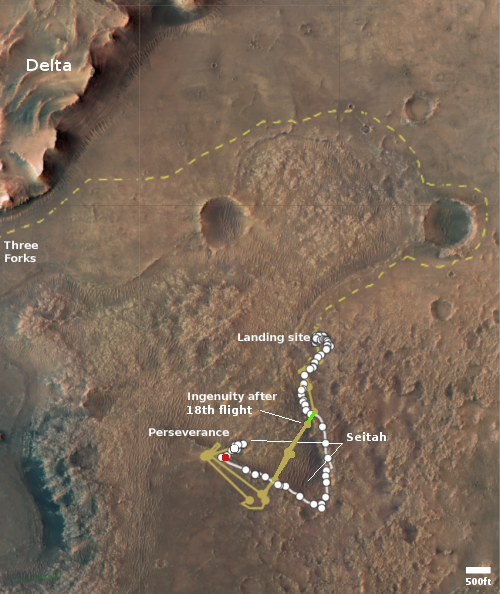
The map to the right, annotated to post here, shows the present location of the rover Perseverance (the red dot) in relation to the 17th flight of the helicopter Ingenuity (indicated by the green line and dot) that successfully occurred on December 5, 2021.
Perseverance has been very very very very slowly retreating south, following the same route it took to move into the rough sand dune region the scientists have dubbed Seitah. Based on their long term plans, the rover will retrace its path (the white dotted line) to its landing site, and then continue along the yellow dashed line to eventually reach the base of the delta, dubbed Three Forks, that in the distant past poured through a gap in the rim of Jezero Crater.
The helicopter meanwhile is also retracing its flights, heading north to the spot where Perseverance first placed it on the ground. Because of the seasonally thinner atmosphere, the helicopter’s flights during that return journey must be shorter, which is why the 17th flight only traveled halfway across Seitah. In crossing it the first time it had done so in one flight. Now it will take two.
During that 17th flight it appears that the topography between the rover and the helicopter’s landing site caused a loss of communications as the helicopter was landing.
The Ingenuity team believes the 13-foot (4-meter) height difference between the Perseverance rover and the top of Bras [an outcrop] contributed to the loss of communications when the helicopter descended toward the surface at the end of its flight.
That loss of communications apparently caused no problems, but it will likely mean that Ingenuity will do no more flights until Perseverance can get closer and better positioned.
Capitalism in space: Using its Soyuz-2 rocket and Soyuz capsule, Russia today successfully launched two tourists to ISS.
Onboard the Soyuz is Yusaku Maezawa, a Japanese billionaire known for starting online businesses Start Today and Zozo. In addition to his Soyuz mission, he has a circumlunar flight aboard SpaceX’s Starship—called “dearMoon”—booked for no earlier than 2023. Maezawa purchased both available seats on this flight of Soyuz. He [is] joined by Yozo Hirano—a media producer from Zozo—who will document the MS-20 mission. This flight will mark the first time two Japanese astronauts fly together, as well as the first flight of any Japanese space tourist.
The mission is commanded by experienced Russian cosmonaut Alexander Misurkin, on what is his third spaceflight. During the mission, he will stand ready to pilot the Soyuz in case the automated guidance software fails.
The Russians claim that this is their first tourist flight to ISS since 2009, but that makes believe the two filmmakers launched to ISS in October were not paying passengers. They might have been working on ISS, and not merely tourists, but they were not professional astronauts but paying customers.
This flight however is the first organized with Russia by the American company Space Adventures since 2009, ending that long gap caused almost entirely because all Soyuz seats since then had been bought by NASA to replace the shuttle. With manned Dragon flights available, the Russians and Space Adventures can sell tickets again.
The leaders in the 2021 launch race:
46 China
27 SpaceX
21 Russia
6 Europe (Arianespace)
5 ULA
China still leads the U.S. 46 to 43 in the national rankings. With SpaceX and Rocket Lab launches set for later tonight, these numbers should rise again.