Astronomers discover a “surprisingly mature” cluster of galaxies in early universe

Proto galaxy cluster
Click for original image.

The uncertainty of science strikes again! Astronomers using both the Webb Space Telescope and the Chandra X-ray Observatory now think they have discovered a just-forming protocluster of galaxies only one billion years after the Big Bang, when such galaxy clusters should not yet exist.

You can read their paper here [pdf]. The image to the right, cropped and reduced to post here, shows the Webb infrared data as the background of stars and galaxies, with the galaxies thought to be part of this protocluster circled. The blue cloud is Chandra’s X-ray data. From the press release:

The Chandra and Webb data reveal that JADES-ID1 contains the two properties that confirm the presence of a protocluster: a large number of galaxies held together by gravity (Webb sees at least 66 potential members) that are also sitting in a huge cloud of hot gas (detected by Chandra). As a galaxy cluster forms, gas falls inward and is heated by shock waves, reaching temperatures of millions of degrees and glowing in X-rays.

What makes JADES-ID1 exceptional is the remarkably early time when it appears in cosmic history. Most models of the universe predict that there likely would not be enough time and a large enough density of galaxies for a protocluster of this size to form only a billion years after the big bang. The previous record holder for a protocluster with X-ray emission is seen much later, about three billion years after the big bang.

It increasingly appears that there are aspects of the universe we simply do not yet understand, which in turn make our theories of its birth and formation either incomplete or invalid. Those theories might be right in principle, but the data suggests they are wrong in detail.

6 comments

New ground-based space antenna startup raises $100 million and wins $50 million Space Force contract

In a clear sign that the space industry in space now requires increased support on the ground, the ground-based space antenna startup, Northwood Space, this week announced it has raised $100 million in private investment capital even as it simultaneously won a $50 million Space Force contract.

The funding round, announced January 27, was led by Washington Harbour Partners and co-led by Andreessen Horowitz. The financing came on the heels of a $49.8 million contract that was signed with the United States Space Force to help improve the “satellite control network,” which “handles a huge variety of consequential space missions for our government,” said Bridgit Mendler, founder and CEO.

Northwood is an end-to-end ground infrastructure provider for space missions. In other words, it manufactures and deploys antennae systems, which are smaller than older models, that allow Earth to communicate with satellites in space.

Northwood was only formed three years ago, so its success is an clear indication that there is a real need for more and better ground-based facilities.

1 comment

German government hires German startup Polaris Spaceplanes to build reusable two-stage hypersonic plane

Mira-II prototype following first flight using aerospike engine
Mira-II prototype following first flight using
aerospike engine in October 2024.

The German government yesterday awarded a contract to the German startup Polaris Spaceplanes to build and fly a reusable two-stage hypersonic plane by 2027.

On 27 January, POLARIS Spaceplanes announced that it had been awarded a contract by the Federal Office of Bundeswehr Equipment, Information Technology and In-Service Support (BAAINBw) to build a fully reusable, horizontal take-off, two-stage hypersonic vehicle. The primary application of the Hypersonic Test and Experimentation Vehicle (HYTEV) will be as a hypersonic testbed for scientific and defence-related research. A variant of the vehicle with an expendable upper stage will also be capable of deploying small satellites into low Earth orbit.

According to the company, the HYTEV will be roughly the size and take-off mass of a fighter jet. The main stage will be powered by two turbofans and one of the company’s in-house developed aerospike rocket engines. The turbofans will be used for take-off and landing, and the rocket engine will accelerate the vehicle before upper-stage deployment. The upper stage will be entirely rocket-powered, with imagery accompanying the announcement appearing to show a more conventional rocket engine configuration compared with the aerospike engine equipped to the main stage. After completing its mission, it will likely be recovered under controlled glide conditions or potentially by a parachute or parafoil.

This deal appears to be an upgrade to a February 2025 German government deal with Polaris. It also follows Polaris’s successful use of an aerospike engine on a prototype test flight in 2024. While the company has shown some success, doing more than a dozen test flights with small scale prototypes (as shown in the image to the right), this program and schedule still seems quite ambitious.

3 comments

Ariane-6 gets a new government launch contract

The European Space Agency, one agency among many
The European Space Agency, one European
agency among many

The government rocket of the European Space Agency (ESA), the Ariane-6, yesterday won a new launch contract to place a pair of Galileo GPS-type satellites into orbit for the European Union (EU).

Arianespace announced today at the European Space Conference in Brussels the signature of the launch contract with the European Union Agency for the Space Programme (EUSPA), under the delegation of the European Commission, to orbit the second pair of second-generation satellites of the Galileo constellation (Galileo L18) on board an Ariane 6 launcher. With this signature, the European Commission and the EUSPA are formalizing the launch contract of Galileo L18, following the initial mission allocation to Arianespace made in April 2024.

All told this will be Ariane-6’s fifth launch of GPS-type satellites for the EU, which appears committed to Ariane-6, even though this expendable rocket costs much more than SpaceX’s Falcon 9, in order to promote European sovereignty. Eventually Europe will develop more cost effective private rockets (in about a decade), but until then its access to space will be limited by cost.

And the extra cost is not simply the expendable nature of Ariane-6. Note also the many layers of bureaucracy listed in the quote above. For the European Union there the European Union Agency for Space Programme, working under the supervision of the EU’s European Commission. It signed a deal with Arianespace, which represents the European Space Agency as its commercial rocket division.

That’s four different bureaucracies, two within the European Union and two more related to Europe’s space effort. Each adds cost to the launch, as well as the need for complex negotiations that delay any deal.

Not

6 comments

Webb finds another unexpected galaxy in the very early universe

Unexpected galaxy
Click for original image.

The uncertainty of science: Using the Webb Space Telescope, astronomers have discovered another galaxy in the very early universe that appears too bright and developed for it to even exist so soon after the Big Bang.

MoM-z14 is one of a growing group of surprisingly bright galaxies in the early universe – 100 times more than theoretical studies predicted before the launch of Webb, according to the research team. “There is a growing chasm between theory and observation related to the early universe, which presents compelling questions to be explored going forward,” said Jacob Shen, a postdoctoral researcher at MIT and a member of the research team.

…With galaxy MoM-z14 existing only 280 million years after the big bang, there was not enough time for generations of stars to produce such high amounts of nitrogen in the way that astronomers would expect. One theory the researchers note is that the dense environment of the early universe resulted in supermassive stars capable of producing more nitrogen than any stars observed in the local universe.

All theories about the Big Bang and the early universe did not predict the existence of this galaxy, or a bunch of others that Webb has now detected.

The false color infrared Webb image is to the right, cropped and reduced to post here. The full image covered a much larger area, so this tiny galaxy was not easy to find. Scientists identified it by the very high red shift of its light, due to the expansion of the universe and it being so far away. That expansion away from us causes the wavelengths of its light to stretch into the infrared so that only Webb can see it.

0 comments

SpaceX launches GPS satellite

SpaceX last night successfully launched a GPS satellite for the Space Force, its Falcon 9 rocket lifting off from Cape Canaveral in Florida.

The Space Force had originally hired ULA to launch this satellite, but two weeks ago it switched launch provider to SpaceX. Apparently the military wanted this satellite launched now, and for some reason ULA could not do it, even though the Vulcan rocket was supposedly ready for launch.

The first stage completed its fifth flight, landing on a drone ship in the Atlantic. The two fairing halves each completed their second flight.

The 2026 launch race:

11 SpaceX
5 China
1 Rocket Lab

7 comments

Scientists produce new estimate of the thickness of Europa’s icy crust

Europa in true color
Europa in true color, taken by Juno during that
September 2022 fly-by
. Click for full image.

Using data produced by Juno during a 2022 close-fly of Jupiter’s moon Europa, scientists have made a new estimate of the thickness of Europa’s icy crust, approximately 18 miles thick with a 6-mile margin of error.

In other words, their estimate could be as small as 12 miles thick, or as large as 24 miles thick.

You can read their paper here. From their abstract:

For the idealized case of pure water ice, the data are consistent with the existence of a thermally conductive ice shell with a thickness of 29 ± 10 km [18 ± 6 miles] and with the presence of cracks, pores or other scatterers extending to depths of hundreds of metres below the surface with a characteristic size smaller than a few centimetres in radius. An ice-shell salinity of 15 mg kg−1, as indicated by models based on terrestrial marine ice, would reduce our estimate of the thickness of the ice shell by about 5 km, substantially less than our 10 km uncertainty. The low volume fraction, small size and shallow depth of the scatterers indicate that the fracture interfaces observed at Europa’s surface are alone unlikely to be capable of carrying nutrients between the surface and the ocean. [emphasi mine]

The highlighted sentence is the important one. If this new estimate is right, than the unidentified reddish material that appears to leak out of the long ridgelike cracks on Europa’s surface, clearly visible in the picture to the right, are not coming from any underground ocean. The distances are too large.

Other estimates have suggested that ice crust could be as thin as 2 miles, but like this research the uncertainties are very large.

Meanwhile, the Juno mission is still alive, though essentially winding down operations. The mission was expected to officially end at the end of September 2025, when its budget ran out, but the just passed budget included enough money to keep it going, albeit at a relatively low level. According to the orbiter’s webpage, it will continue to orbit Jupiter, its orbit degrading naturally until it falls into Jupiter to burn up. As it does so data will continue to be collected, though at a much lower rate.

7 comments

January 27, 2026 Quick space links

Courtesy of BtB’s stringer Jay. This post is also an open thread. I welcome my readers to post any comments or additional links relating to any space issues, even if unrelated to the links below.

3 comments

Windswept Martian volcanic ash?

Volcanic ash on Mars?
Click for original image.

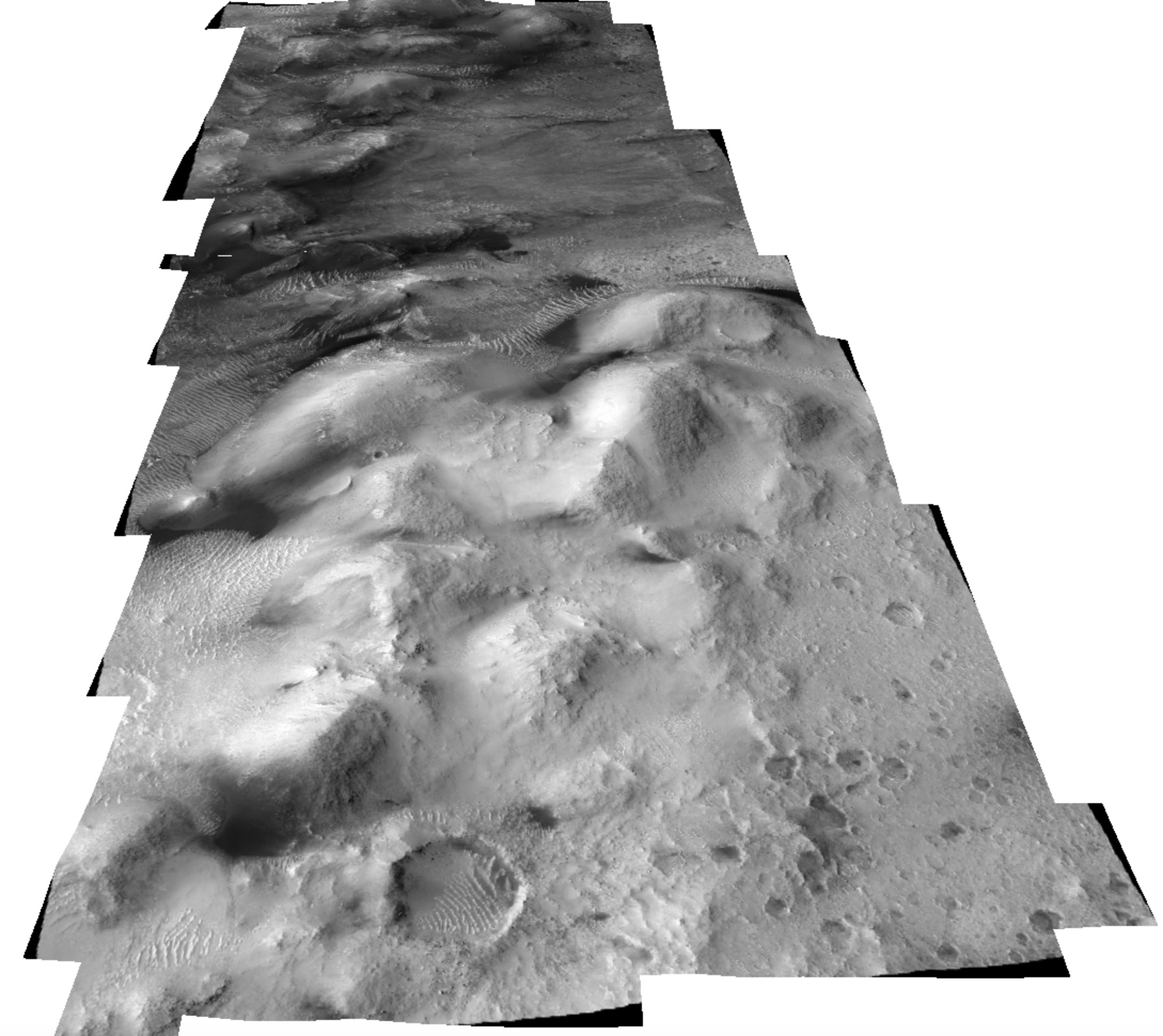
Cool image time! The picture to the right, rotated, cropped, reduced, and sharpened to post here, was taken on November 30, 2025 by the high resolution camera on Mars Reconnaissance Orbiter (MRO).

The science team labels this simply as “Features,” the vagueness of which I can understand after digging in to get a better idea of the location and geography.

The location, as shown by the white dot on the overview map below, is inside the Medusa Fossae Formation, the largest volcanic ash field on Mars that is thought to be the source of much of the red planet’s dust. That ash field is large and very deep, and was put down more than a billion years ago when the giant volcanoes of Mars were active and erupting. Thus it is well layered, and many images of that ash field show that layering exposed by the eons of Martian wind scouring its surface.

In this case, that scouring appears to have produced this feathery surface, though the origin of those ridges might have instead come from volcanic flows that are now hardened. Or we could be looking at ancient channels produced by ice or water, though that would have to have been a very long time ago, as this image is located in the Martian dry tropics, where no near surface ice presently exists.
» Read more

0 comments

Astronomers use AI to discover hundreds of weird galaxies in Hubble archive

Weird galaxies in the Hubble archive, found with AI
Click for original image.

In what is a perfect example of the proper use of artificial computer intelligence (AI), astronomers have now used this programming to analyze almost 100 million images taken by the Hubble Space Telescope over the decades to find any galaxies hidden there that have “anomalies” or unusual shapes.

The team analyzed nearly 100 million image cutouts from the Hubble Legacy Archive, each measuring just a few dozen pixels (7 to 8 arcseconds) on a side. They identified more than 1,300 objects with an odd appearance in just two and a half days — more than 800 of which had never been documented in scientific literature.

The six galaxies to the right are just a small sample. All six were previously unidentified, and include “three lenses with arcs distorted by gravity, one galactic merger, one ring galaxy, and one galaxy that defied classification” (the galaxy at the top left). From the European Space Agency’s (ESA) press release:

The strange, bi-polar galaxy seen here is certainly anomalous, with its compact, swirling core and two open lobes at the sides. Exactly what kind of galaxy it is is unclear, and it was not previously known to astronomers.

As noted in the first link, the volume of data that astronomers are now collecting from ground-based and orbiting telescopes — many of which are survey telescopes that photograph the entire sky repeatedly — has actually become a problem. They have great data, but don’t have the time or human resources to study it sufficiently. Even employing large numbers of ordinary citizens, working at home with their own computers, can’t get the job done.

This is the kind of grunt work that AI is ideally made for. It can quickly review the data and identify objects that don’t fit normal expectations. Humans then can do the real work, finding the most interesting of these strange objects, such as the top left galaxy, and devote human creativity to studying it.

2 comments

Musk: Next Starship/Superheavy test launch in mid-March

According to a recent tweet by Elon Musk , the next Starship/Superheavy test launch will occur “in 6 weeks,” placing that launch sometime in mid-March.

Musk provided no other information, but this announcement suggests the company’s engineers now understand and have corrected the issues that caused two Superheavy ruptures during two different tank tests in recent weeks. It also suggests that the launchpad repairs and upgrades will soon be completed, and that a new version 3 Superheavy prototype is ready to go, replacing one that was damaged during those tank tests.

The mission specifics however remain unclear. SpaceX could repeat the flight path of the last few tests, in an orbit low enough so that the atmosphere will bring Starship down over the Indian Ocean. In such a flight the company would test refueling within Starship, restarts of its Raptor engines, and deployment of dummy or even real Starlink satellites.

It is possible however that this next test flight will go into a full orbit, and circle the Earth once or several times. SpaceX has said that in 2026 it intends to do a Starship refueling test using two Starships, launched several weeks apart. To do this more ambitious mission however it first needs to do at least one full orbital flight of Starship. Since the company has already tested on previous orbital test flights the restart of Starship’s Raptor engines — proving its capability to do a controlled re-entry — there really is no reason it can’t go for a full orbit on the next flight. There is even the possibility that Starship will come back to Boca Chica and be caught the company’s tower chopsticks, though this remains unconfirmed.

5 comments
1 60 61 62 63 64 2,929