
A call to my readers: Find the location of NASA’s lunar base!
Click for interactive LRO map.
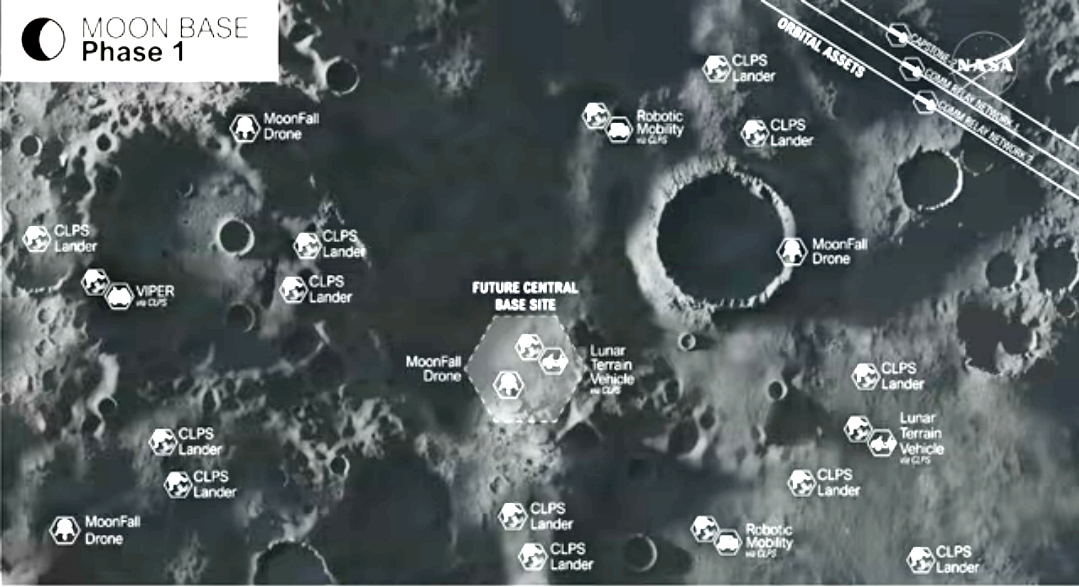
During yesterday’s NASA press conference outlining the first unmanned missions to the agency’s planned moon base near the Moon’s south pole, Carlos García-Galán, Moon Base program executive, included the graphic above of that base in his presentation.
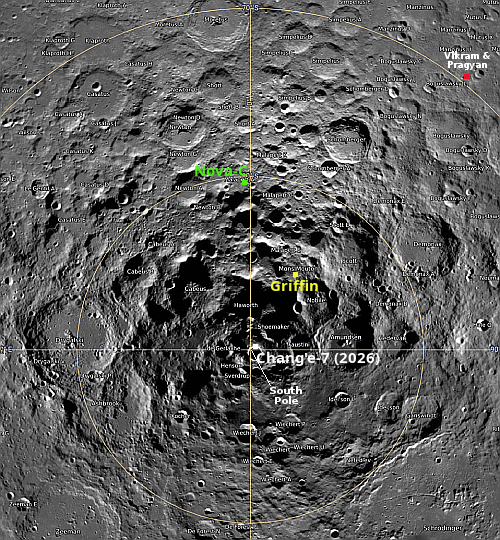
Though García-Galán said this lunar base map is in the south pole region, the map provided no crater names nor any longitude or latitude information. Nor did it provide a scale to determine the size of these craters. Because of this lack of information, I was unable to identify the map’s precise location near the Moon’s south pole, even after searching extensively at the QuickMap site for Lunar Reconnaissance Rover (LRO) images, now managed by Intuitive Machines images and found here. The map to the right was created from that QuickMap site, annotated by me later with the planned landing locations for Chang’e-7 and Griffin, plus the sites where Nova-C and Vikram landed previously.
I am now asking you, my readers, to do some detective work. See if you can pinpoint the location of the map above with the LRO south pole imagery at the link. The crater patterns should provide the first clue. Remember also that the orientation of the map might require significant rotation to match the LRO data. Remember too that the scale of the map above could require you to zoom in a great deal.
If you think you have a match, post it in the comments below.

On Christmas Eve 1968 three Americans became the first humans to visit another world. What they did to celebrate was unexpected and profound, and will be remembered throughout all human history. Genesis: the Story of Apollo 8, Robert Zimmerman's classic history of humanity's first journey to another world, tells that story, and it is now available as both an ebook and an audiobook, both with a foreword by Valerie Anders and a new introduction by Robert Zimmerman.
The print edition can be purchased at Amazon or from any other book seller. If you want an autographed copy the price is $60 for the hardback and $45 for the paperback, plus $8 shipping for each. Go here for purchasing details. The ebook is available everywhere for $5.99 (before discount) at amazon, or direct from my ebook publisher, ebookit. If you buy it from ebookit you don't support the big tech companies and the author gets a bigger cut much sooner.
The audiobook is also available at all these vendors, and is also free with a 30-day trial membership to Audible.
"Not simply about one mission, [Genesis] is also the history of America's quest for the moon... Zimmerman has done a masterful job of tying disparate events together into a solid account of one of America's greatest human triumphs."--San Antonio Express-News
With a slight bit of sarcasm; “it’s in their mind.”
It’s synthetic. Pretend. Fake. Representative, but not reality. PowerPoint engineering.
If you want actual data, here’s what NASA was thinking in 2022: https://www.nasa.gov/news-release/nasa-identifies-candidate-regions-for-landing-next-americans-on-moon/
and updated in 2024: https://www.nasa.gov/news-release/nasa-provides-update-on-artemis-iii-moon-landing-regions/
Compare those two graphics with the excellent maps available here: https://www.lpi.usra.edu/lunar/lunar-south-pole-atlas/
In particular have a look at “Topographic Map of the Moon’s South Pole (85°S to Pole)” https://www.lpi.usra.edu/lunar/lunar-south-pole-atlas/maps/SPole_85S_LOLA_v20190515.pdf where you can see, in green, the Shackleton Connecting Ridge between Shackleton and de Gerlache craters.
According to the latest NASA press release https://www.nasa.gov/news-release/nasa-provides-update-on-moon-base-rovers-landers-missions/ Moon Base I, the Blue Moon Mark 1 lander, will land on the Shackleton Connecting Ridge.
Steve Golson: Yeah, if you read the comments in my original post yesterday, I have realized this. I also link to my posts on NASA’s candidate sites.
My problem is that — despite seven decades of learning about government fakery — I still too often assume honesty from these people. This map should have been labeled for what it was, very clearly. Instead, NASA hid its fake nature.
I expected better from Isaacman.
Having given many presentations over my career I have found that graphics are important to keep the audience interested.
Any graphic.
That graphic might very well be just something the staffer pulled off the internet because he needed something, anything to fill the graphic requirement.
Jerry Greenwood: This was still a government press conference. Doing anything even slightly fishy is not acceptable. They should have labeled that map for what it was.
Bob: I don’t think Isaacman et al. are being deliberately obtuse. Rather, at this point nobody really knows exactly where everything will go!
I believe the purpose of the graphic was to convey quantity, not location. “Wow, look at all those landers!” is the reaction they wanted.
There should have been some indication on the graphic. “Representative map, not to scale” or some such.
Steve Golson: At a minimum not labeling that map honestly was very sloppy, and indicates there is still a lot of dry rot at NASA that Isaacman hasn’t yet removed, doesn’t realize is there, or is willing to tolerate.
https://www.leonarddavid.com/wp-content/uploads/2026/05/moon-base-nasa-1.jpg
They called it a graphic and not to scale and notional.
J Fincannon: I saw that bottom line also, but it was still not clear to me that this graphic was fake, unreal.
Sorry, I cheated. Some pertinent info from Grok, it went into detail and included 3 maps it found with the craters identified. The maps were from wokipedia, svs.gsfc.nasa.gov, and uaf.edu. Note I’m not saying it’s correct, and I’ve no working knowledge of south pole lunar geography.
“The large, prominent circular crater visible to the right/upper-right of the central hexagonal base site in your graphic is almost certainly Shackleton Crater (roughly 21 km / 13 miles wide and 4 km deep), with the central site on the adjacent illuminated ridges and plateau terrain.”
“The graphic is conceptual (the hexagonal site and scattered landers/drones represent planned distributed assets), but it is grounded in the real topography of this high-priority South Pole zone. NASA’s CLPS missions and MoonFall drones in Phase 1 are actively scouting and preparing this exact area for later crewed habitation.”
Key Crater Names in the South Polar RegionHere are the major named craters and features in/around the base area (visible on standard NASA/LRO topographic and brightness maps of the South Pole):
Shackleton Crater — The primary landmark; rim peaks get near-constant sunlight, interior is permanently shadowed and ice-rich.
Nobile Crater — Specific CLPS landing target (Griffin mission); nearby to the west/southwest.
de Gerlache Crater — Connected to Shackleton via strategic sunlit ridges (prime candidate zones for base infrastructure).
Haworth Crater, Shoemaker Crater, Faustini Crater — Immediately adjacent; part of the interconnected polar ridge system.
Sverdrup Crater, Cabeus Crater (a bit farther) — Additional ice-bearing shadowed craters in the vicinity.
Other notable nearby features:
Malapert Massif/Mountain, Mons Mouton, Leibnitz Beta Plateau (elevated, sunlit areas).
These are standard labels from Lunar Reconnaissance Orbiter (LRO) maps, slope/topographic charts, and Artemis candidate site studies.
John: Grok can make up what it wants, but I looked directly at Shackleton Crater as imaged by LRO (see the link I provide), and it does NOT correspond to “the large, prominent circular crater visible to the right/upper-right of the central hexagonal base site.” The small craters around it do not match.
If it is Shacketon however, with fake details added to disguise it, then the central base location is a plateau to the left and down from the crater, linked to its rim, but offset somewhat.
I repeat however that Grok is assuming a lot (which is why I generally do not trust AI). The craters around this central crater have no correspondence to the crater pattern seen in the real LRO images.
I tossed the pic to Google AI (Gemini) and it came back with:
“This image shows NASA’s planned Moon Base layout, situated near the lunar South Pole.Specifically, this map highlights the region inside and around Apollo crater, a large impact crater on the far side of the Moon where several features are officially named to memorialize the crew of the Space Shuttle Challenger.
Key Site Features:Future Central Base Site: Located in a relatively flat, open area on the floor of the Apollo basin.Crater Landmarks: The large, prominent crater visible on the right side of the map is Scobee crater (named after Challenger commander Dick Scobee), with other surrounding features honoring the remaining astronauts (such as Jarvis, McNair, Onizuka, Resnik, Smith, and McAuliffe).Mission Elements: The map lays out NASA’s Phase 1 roadmap, detailing the planned deployment of multiple Commercial Lunar Payload Services (CLPS) landers, Lunar Terrain Vehicles (LTV), and newly introduced MoonFall drones slated to scout the terrain.”
Of course if the image was altered by NASA it would have to be a guess by Google. Did it guess right?
Mitch S: Another demonstration of the unreliability of AI. Apollo Crater is really nowhere near the Moon’s south pole. It is on the far side, at 36 degrees south latitude. Google is not only wrong to imply this layout shows the south pole layout for the initial missions to the NASA Moon Base, it is very wrong.
Note that Apollo Crater is where China’s Chang’e-6 sample return mission landed and brought back samples.
I haven’t a shado of a doubt that the gov’t would want to keep the location of Moonbase a secret.
Of course you wouldn’t want speculators driving up the land prices, but far more important, you don’t want the aliens knowing where Moonbase is!
a) This is a perfect example of something I see _all the time_ when using AI – the “Gell-Mann Amnesia Effect”, named by Michael Crichton. Ask any AI about anything you actually _know_ something about and you can immediately spot that it contains major errors. Not just trivial errors: Many errors. The next step (not demonstrated in this post) is to turn around and ask it about something you don’t know much about and accept the answer as gospel.
b) So I wanted to provide a link to something on the Gell-Mann Amnesia Effect. I did a search for “Gell-Mann Effect” _not_ including the word “Amnesia” (because I forgot that was part of its name). One of the links returned by Duck Duck Go was to https://grokipedia.com/page/the_gm_effect – which, as you know, is the wikipedia alternative provided by Grok. And – go there and look at the page and tell me what you think. I don’t want to ruin the surprise. n.b.: Prominent at the top of the page: “Fact-check by Grok 3 months ago.” No doubt. (I commented on this page with their feedback mechanism but surely if you look within the next day or two it won’t have been updated yet in response to my jeering remarks.)
I see this as just another bait and switch. This administration is hostile to spaceflight and Jared is a patsy not to be trusted.
NASA/government hate is what led up to this fiction
Libertarian kills a radar gap
Tornado shoots the gap and kills..unwarned
Libertarian “see that’s what you can’t trust”
–cost cutters.
Yeah, NASA should have used real imagery. This looks like a modern attempt to replicate the paintings from when Apollo was still a concept. It just has that feel.
But unlike in the sixties, we have images of the potential sites. We should be using the real deal now. This isn’t rocket science.
Jeff Wright,
Should NASA follow through on Isaacman’s vision, will you have the decency to admit you’ve overreacted? I think Jared is a breath of fresh air that the agency desperately needed, he’s willing to make unpopular decisions while seeking to significantly speed up NASA’s operations.
This is all very childish, Jeff. It’s not even relevant here. NASA is talking about dozens of landings through the rest of the decade, and they’re buying from the private sector (and spending a bit more than the first round of CLPS, which is a good idea) to get it done. You clearly loathe the idea of cutting costs, but we will never have a fantastic future in space, with hundreds, thousands, and then millions of people living and working beyond Earth, unless we cut costs even more aggressively. The only hate here is from you.
Someone said “AI is very good at making completely false statements with an air of absolute certainty”.
(much the same as the NY Times)
AI is a savant that can comb through the vast archives of information online but doesn’t really have the sensibility to understand what it finds. Surprised Grok didn’t talk about General Motors.
AI can be a useful tool but it requires supervision. Best thing I’ve seen it do lately are funny videos of Chuck Norris knocking down famous strongmen and creatures (and it needed human guidance to do those).
Mitch S. wrote: “Someone said ‘AI is very good at making completely false statements with an air of absolute certainty’.”
This reminds me of a friend who used to often say, “I may be wrong, but I’m not uncertain.”
Edward: The last thing I expected from my misunderstanding of that fake map put up by NASA during yesterday’s press conference would be that it would demonstrate the unreliability of AI. But it did a great job of doing so.
Nate, if this were a legit base, then we’d know the location.
Until then, the Moonbase is no less fiction than the Space:1999 Eagle and the even less plausible Lunar Starship.
A legitimate concept demands real images and real maps. I stand by my assertion that this is a feel good distraction coming from these who want to wreck NASA infrastructure and keep America Earthbound
Artemis II came about no thanks to Jared, or Handmer, or you. Good. I am glad America got a win despite cost cutter traitors
Edward,
I’ve joked a few times while doing trivia with friends that I’m very good at sounding certain. Maybe I should play poker instead…
Jeff Wright,
There are multiple potential reasons why the image doesn’t align with lunar maps. You seized on the one that lets you hate Isaacman the most without stopping to consider its likelihood.
Then you would be wrong, because America’s presence in space and on the Moon only a few years from now will be substantially greater than it is today. Most of it will be private, of course, and I think that’s what you can’t stand.
Entitlement is a terrible look and makes the SLS and its supporters even less appealing. If your goal is to increase opposition to MSFC and its pet projects, you’re doing a bang-up job.
Maybe we just don’t want to telegraph our hand to China?
Referencing A.I. :
Who here actually uses a paid A.I. product in the normal course of their work? And how much weight do you or your boss actually give it?
These large language models for the most part, are trained on LOW quality data from the internet. They are not trained on textbooks or proprietary databases.
You often get wikipedia-esque answers, because the model you are using was trained on wikipedia data.
And, as David notes above— Just try getting correct A.I. answers in a field you are well acquainted with and you quickly realize the answers are bunk, they just sound “good.”
Anet AI: I was writing about gritting teeth in the past tense. Is it “grit” or “gritted”? Perfect question for AI: What is the past imperfect of “to grit”?
No problem. Turns out both are fine; “gritted” is correct, “grit” is common. I chose “He grit his teeth and forged ahead.”
Just don’t ask anything complicated or not using the jargon of the field (I didn’t care about past perfect or future perfect tenses). For example: What is a tall font with spikey serifs? returned absolute garbage. What is a condensed font with wide ascenders and sharp serifs? worked better but still poorly; I’m still learning font jargon.
I had the same problem with What is a turnbuckle for pipes? Unless you know the phrase “union coupler”, which is what I was trying to find, you’re just out of luck.
It’s dumb as a rock – because it is a rock.
Union Coupler sounds like a matchmaker for a UTU/Teamster shotgun marriage.
Not really my role to defend Grok or AI, because I agree it is often wrong, but…. In this case I told it the map was from the proposed NASA base on the south polar region and asked it for crater names. Given that info it started at nasa.gov for the source document, it was steered to some of the mission targets: An arstechnica article about blue moon mark 1, nasa.gov about Astrobiotic’s Rriffen lander, and Firefilyspace.com for moonfall drones. It outputted crater maps of the south pole that were legit, and what I asked for.
It didn’t land on the correct answer the humans wanted that the photo was doctored. But IMO NASA was actually trying to show Shackleton crater and the connecting Shackleton-de Gerlache ridge for the base. It did call the original image an ‘artist’s concept’.
I think part of the issue is the permanent shadow nature of the region make visible images difficult. Something took an IR image which is what I think the NASA infographic may be based on, but the resolution was lowest at the pole area. From looking at way too many moon maps because of this post, thank you very much for that; including topographic- I agree the craters don’t line up. I guess NASA artist took an image and made it more “moony” for aesthetics and PR.