
Bright spokes in Saturn’s rings
Click for original image.
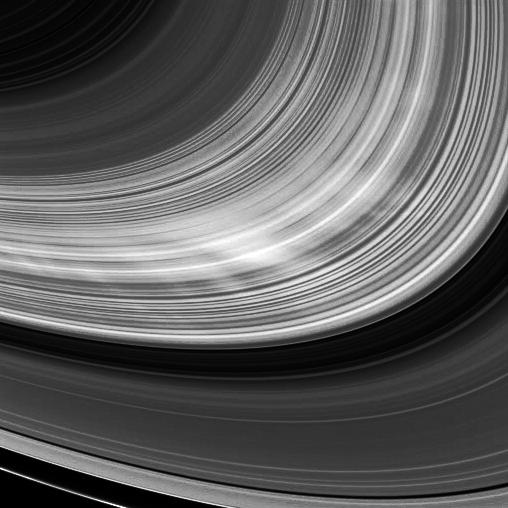
Cool image time! The picture to the right, cropped slightly to post here, was taken on December 26, 2008 from a distance of 350,000 miles by the Cassini spacecraft as it orbited Saturn. The resolution is about 37 miles per pixel.
I think sunlight is coming from the upper left, its light bouncing off the rings and thus making the those spokes bright and visible.
In the viewing geometry in which Cassini is looking approximately in the direction of the sun (called high phase), the spokes appear white against the rings because the very small particles comprising the spokes preferentially scatter light forward (in this case, toward Cassini).
At least that’s one theory for explaining the spokes that appear randomly and for only short periods within Saturn’s rings, sometimes bright, sometimes dark, depending on the angle of the Sun. According to a Hubble press release from 2023, the spokes are formed due to an interaction between Saturn’s magnetic field, the solar wind, and the tiny particles in the rings.
“The leading theory is that spokes are tied to Saturn’s powerful magnetic field, with some sort of solar interaction with the magnetic field that gives you the spokes,” said Simon. When it’s near the equinox on Saturn, the planet and its rings are less tilted away from the Sun. In this configuration, the solar wind may more strongly batter Saturn’s immense magnetic field, enhancing spoke formation.
Planetary scientists think that electrostatic forces generated from this interaction levitate dust or ice above the ring to form the spokes, though after several decades no theory perfectly predicts the spokes. [emphasis mine]
Just another strange alien phenomenon in space that remains unsolved. All we really know is that the spokes appear, remain visible for at most a rotation or two of the rings, and then disappear.

On Christmas Eve 1968 three Americans became the first humans to visit another world. What they did to celebrate was unexpected and profound, and will be remembered throughout all human history. Genesis: the Story of Apollo 8, Robert Zimmerman's classic history of humanity's first journey to another world, tells that story, and it is now available as both an ebook and an audiobook, both with a foreword by Valerie Anders and a new introduction by Robert Zimmerman.
The print edition can be purchased at Amazon or from any other book seller. If you want an autographed copy the price is $60 for the hardback and $45 for the paperback, plus $8 shipping for each. Go here for purchasing details. The ebook is available everywhere for $5.99 (before discount) at amazon, or direct from my ebook publisher, ebookit. If you buy it from ebookit you don't support the big tech companies and the author gets a bigger cut much sooner.
The audiobook is also available at all these vendors, and is also free with a 30-day trial membership to Audible.
"Not simply about one mission, [Genesis] is also the history of America's quest for the moon... Zimmerman has done a masterful job of tying disparate events together into a solid account of one of America's greatest human triumphs."--San Antonio Express-News