
Final results from Lucy’s 2025 fly-by of asteroid Donaldjohanson: A tumbling peanut!
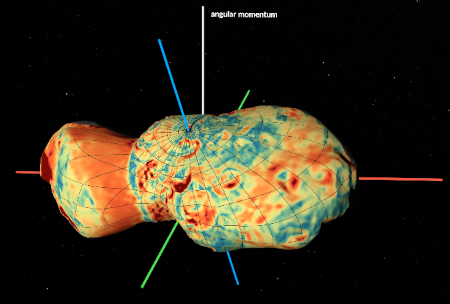
Click for movie.
The science team for the asteroid probe Lucy yesterday published their final results from the spacecraft’s fly-by of the main belt asteroid Donaldjohanson in April 2025, outlining their present hypothesis based on the data as to the asteroid’s origins and evolution that has left it today a tumbling peanut.
The image to the right comes from a short animation showing the asteroid’s computed tumbling. The colors indicate the strength of its gravitational field, depending on slope. “Higher values (warmer colors) indicate steeper terrain relative to the local gravitational pull.” From the conclusion of their published paper:
We propose the following scenario for the formation and evolution of DJ [Donaldjohanson]. The parent body of the Erigone family was ≈80 km in diameter and was destroyed by a ≈20-km impactor at ≈155 [million years ago]. DJ’s bilobed shape probably arose from the accretion of fragments from this break-up event. This left DJ with an initial spin period of ≪10 hours.
The YORP effect [the pressure of sunlight] then slowed DJ’s rotation and shifted its spin axis toward low obliquity. After 20 to 60 [million years], DJ’s spin period reached ≈10 hours, causing slopes in the neck region to fail. The resulting widespread mass movement toward both lobes produced the ridge and smoothed the neck region.
Sometime later (<40 [million years ago), craters smaller than 0.4 km were globally erased, possibly owing to seismic shaking by an impact. Localized mass wasting on the neck continued, degrading the morphology of many craters without altering the small crater SFD. From 80 to 120 [million years] after formation, DJ’s rotation entered its current NPA [non–principal axis] state, with a spin period of 100 to 200 hours.
A more prosaic way of describing “non–principal axis state” is to say the asteroid is tumbling.
Lucy is presently on its way to the Trojan asteroids that orbit with Jupiter 60 degrees fore and aft of the gas giant. It will fly past ten Trojans during its mission, with the first the asteroid Eurybates on Aug. 12, 2027.

On Christmas Eve 1968 three Americans became the first humans to visit another world. What they did to celebrate was unexpected and profound, and will be remembered throughout all human history. Genesis: the Story of Apollo 8, Robert Zimmerman's classic history of humanity's first journey to another world, tells that story, and it is now available as both an ebook and an audiobook, both with a foreword by Valerie Anders and a new introduction by Robert Zimmerman.
The print edition can be purchased at Amazon or from any other book seller. If you want an autographed copy the price is $60 for the hardback and $45 for the paperback, plus $8 shipping for each. Go here for purchasing details. The ebook is available everywhere for $5.99 (before discount) at amazon, or direct from my ebook publisher, ebookit. If you buy it from ebookit you don't support the big tech companies and the author gets a bigger cut much sooner.
The audiobook is also available at all these vendors, and is also free with a 30-day trial membership to Audible.
"Not simply about one mission, [Genesis] is also the history of America's quest for the moon... Zimmerman has done a masterful job of tying disparate events together into a solid account of one of America's greatest human triumphs."--San Antonio Express-News
When I first saw that picture, I was reminded of the Kuiper Belt object that New Horizons passed by after its time at Pluto and its moons (Arrokoth, also known as Ultima Thule).
Back then, I recall that scientists believed that such composite bodies existed, but none had been found. This particular asteroid indicates that they might not be as rare as first thought.
I believe a couple of others of this general configuration have been found as well. Slow reconvergence of fragments produced by energetic collision events seems to have been a fairly common occurrence during a part of the Solar System’s early history. These bi-lobal rocks will probably turn out to be fairly common.
I wonder if this asteroid exhibit the Dzhanibekov* effect, where the multiple axes periodically exchange turns being the principle axis of rotation? It seems like it should, given that other do.
* AKA the “tennis-racquet” effect.
Wow, Robert. That proposal is a whole lot of history, based upon a flyby.
I suppose that these kinds of — guesses? — come from the experience gained by prolonged visits to other asteroids and comets.
Did you read the paper? Though of course there are a lot of assumptions in their scenario, it is based on solid other work. For example, they assign the asteroid to the Erigone family based on its spectroscopy, which matches well with all asteroids in that family.
I would consider this proposed history as a good first stab. I guarantee it will evolve as more data is compiled directly from more asteroids. This is a field that is at its infancy.