
First unmanned test of India’s manned Gaganyaan capsule possibly delayed until late ’27
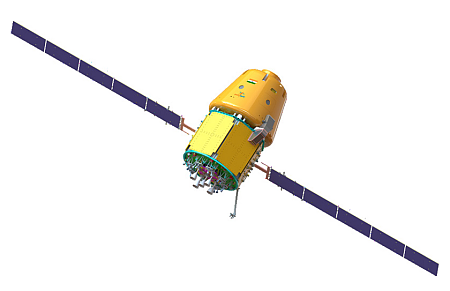
Artist rendering of India’s Gaganyaan capsule
In a presentation yesterday, the head of India’s space agency ISRO V Narayanan indicated that the first unmanned test flight of its manned Gaganyaan capsule might be delayed until the third quarter of 2027.
That test flight was originally targeting a March 2026 launch — part of a series of three unmanned test flights before the manned flight in early 2027 — but March came and went and nothing happened, nor did ISRO explain the lack of any action.
In indicating the possible delay, Narayanan also noted that the agency was looking at a launch before the end of this year. A delay until late ’27 — more than a year — however would suggest a significant issue. It would also mean the manned flight could not occur until 2028, at the earliest.
When Gaganyaan was first proposed in 2018, the goal was to have the first orbital flight in 2022. Since then the program has experienced endless delays and postponements. This new announcement, with no explanation, fits ISRO’s recent pattern of secrecy. No specific reasons for this year’s delays have ever been offered. Meanwhile, the agency has refused to outline for more than two years the specific causes of the two PSLV rocket failures of its third stage, both of which occurred at almost the exact same time in launch.
The secrecy suggests a cultural problem at ISRO, even more serious than a technical one. It implies an unwillingness to deal with error, thus resulting in repeated failures.

On Christmas Eve 1968 three Americans became the first humans to visit another world. What they did to celebrate was unexpected and profound, and will be remembered throughout all human history. Genesis: the Story of Apollo 8, Robert Zimmerman's classic history of humanity's first journey to another world, tells that story, and it is now available as both an ebook and an audiobook, both with a foreword by Valerie Anders and a new introduction by Robert Zimmerman.
The print edition can be purchased at Amazon or from any other book seller. If you want an autographed copy the price is $60 for the hardback and $45 for the paperback, plus $8 shipping for each. Go here for purchasing details. The ebook is available everywhere for $5.99 (before discount) at amazon, or direct from my ebook publisher, ebookit. If you buy it from ebookit you don't support the big tech companies and the author gets a bigger cut much sooner.
The audiobook is also available at all these vendors, and is also free with a 30-day trial membership to Audible.
"Not simply about one mission, [Genesis] is also the history of America's quest for the moon... Zimmerman has done a masterful job of tying disparate events together into a solid account of one of America's greatest human triumphs."--San Antonio Express-News
They are developing a new capability from scratch. Manned spaceflight is still an incredibly specialized field. Expertise in it is still rare relative to other space industries. They are also not starting with a Mercury or Vostok type craft. They want to do most of the work up front to make it a real fully maneuverable spacecraft capable of docking , etc. They want modern risk tolerances. That is all pretty hard.
What are the US, Chinese and Russian interests in this? Are they helping in any meaningful way. At least some stuff is public, like the docking adapter specs. However, not everything can be communicated by a publications. There’s surely a lot of “tribal knowledge”.
Cloudy: I agree that this is difficult, and delays are to be expected, especially because they are starting almost from scratch and haven’t done it before.
My complaint is with this new policy of secrecy. It is not the right way to go, as it makes it harder to fix problems.
I don’t recall ISRO being nearly so tight-lipped under its previous boss. I suspect the current stonewalling is pretty much entirely the doing of this Narayanan character. As the contrast between, say, Trump and Biden makes clear, there’s no substitute for having the right guy in the Big Chair. I’m thinking the current occupant of said chair at ISRO is probably not the ideal man for that particular job.
I wish the Indians well, but I think they are being poorly served by the current head dude at ISRO.
The head of ISRO traditionally has a two-to-three year term. The first PSLV failure occurred under the previous head. When Narayanan took over in 2025 he immediately demanded more testing and better quality control. For example, he restructured the Gaganyaan program, demanding more launch abort and drop tests, and insisted on three unmanned missions prior to the manned mission.
These demands seemed right at the time, because the previous head appeared to have been too nice a guy, at least to me as an outsider looking in. Now, it appears Narayanan is pulling the pendulum too far in the other direction, demanding so much review that nothing is getting launched, and hiding the results out of fear of public reaction.
His term reaches two years in January. It might last longer, but I suspect there will be a change, sooner rather than later.