
Ice sheets on Mars below 30 degrees latitude?
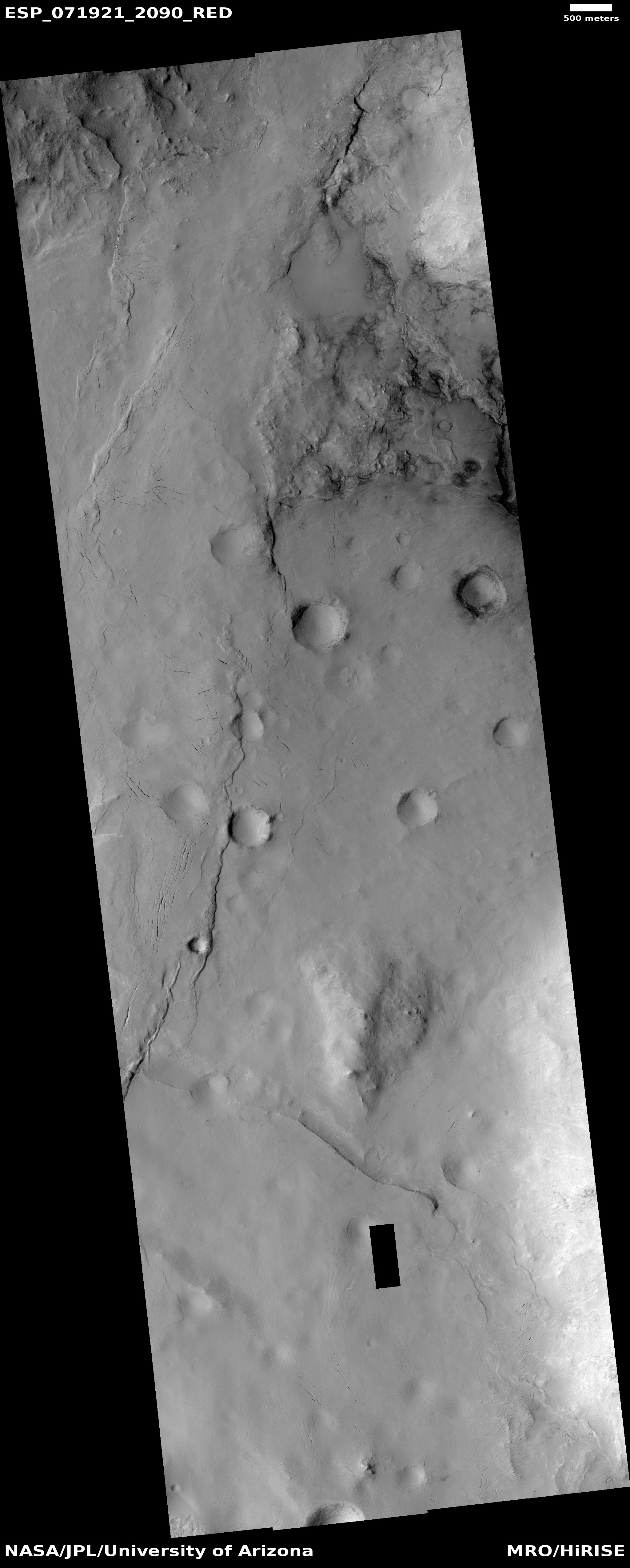
Click for full image.
Cool image time! The photo to the right, cropped and reduced to post here, was taken on November 29, 2021 by the high resolution camera on Mars Reconnaissance Orbiter (MRO). It shows a collection of scattered thin surface fractures, grouped in clusters of parallel lines with the orientation of the clusters all somewhat random to other clusters.
The fractures, as well as the material inside the craters, appears to resemble glacial features, suggesting that these fractures are the result of either the past motion of the glacial sheet, or the sublimation of the buried ice, which causes it to crack and shrink as it slowly dissipates away.
The problem with that hypothesis is the location, as shown by the overview map below.
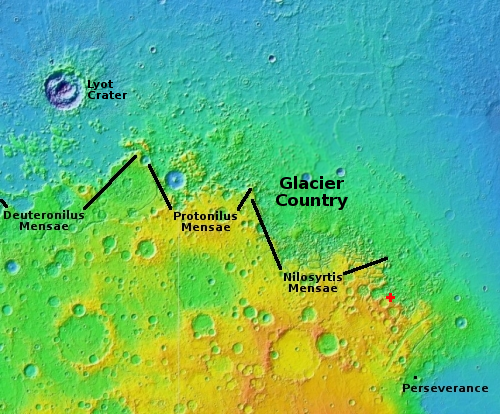
The red cross marks the location of the photo, south of Mars’ glacier country, at 27 degrees north latitude. As far as I am aware, the near surface glacial ice on Mars tends to disappear at about 30 degrees latitude. For there to be near surface ice at this latitude would be a significant discovery. Other images in other locations have suggested ice at even lower latitudes (See this February 2021 post). While such lower latitude ice has not been found easily, there are hints it does exist.
There is another explanation. We might be looking at the surface debris that once protected the ice, which cracked when the ice below sublimated away long ago. Similarly, the craters might be filled with dust and debris that now reflects the glaciers that once were below and are now gone.
Or not. The photo doesn’t really provide enough information to come to a determination. It only tantalizes.

On Christmas Eve 1968 three Americans became the first humans to visit another world. What they did to celebrate was unexpected and profound, and will be remembered throughout all human history. Genesis: the Story of Apollo 8, Robert Zimmerman's classic history of humanity's first journey to another world, tells that story, and it is now available as both an ebook and an audiobook, both with a foreword by Valerie Anders and a new introduction by Robert Zimmerman.
The print edition can be purchased at Amazon or from any other book seller. If you want an autographed copy the price is $60 for the hardback and $45 for the paperback, plus $8 shipping for each. Go here for purchasing details. The ebook is available everywhere for $5.99 (before discount) at amazon, or direct from my ebook publisher, ebookit. If you buy it from ebookit you don't support the big tech companies and the author gets a bigger cut much sooner.
The audiobook is also available at all these vendors, and is also free with a 30-day trial membership to Audible.
"Not simply about one mission, [Genesis] is also the history of America's quest for the moon... Zimmerman has done a masterful job of tying disparate events together into a solid account of one of America's greatest human triumphs."--San Antonio Express-News