
NASA requests space stations bids from industry
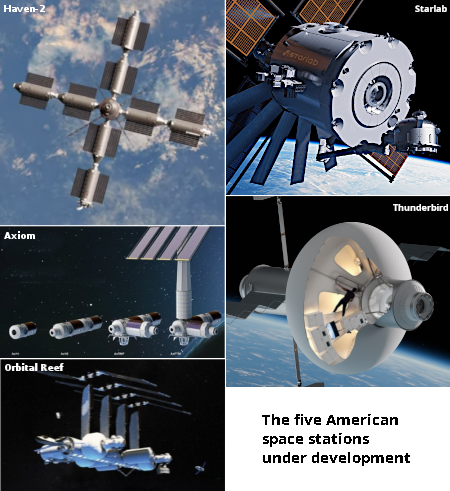
Having abandoned its short-lived NASA-built core module concept due to industry opposition, NASA is now requesting new proposals from the private sector for its space station program to replace ISS.
Based on industry’s input, NASA will proceed with its original plan to procure commercial services through FAR-based contract(s) awarded via full and open competition. Industry has indicated there is significant capital investment behind this approach and expressed high confidence in their ability to attract additional capital investment and expand future market opportunities after NASA makes an award.
NASA intends to award firm-fixed-price, multi-award, indefinite-delivery/indefinite-quantity contracts supporting development, certification, and services. This approach would allow NASA to select two or more contractors through early development, followed by a competitive task order for final design, test, evaluation, as well as certification and services from one or more contractors. [emphasis mine]
The deadline for submission is July 27, 2026. From these proposals NASA will proceed with its original plan to award construction contracts to build at least one new space station. The highlighted words above however suggest a significant change in the program. Under the original plan, NASA said it could only afford to finance one private station, something NASA administrator Jared Isaacman found unsatisfactory. NASA officials also did not believe there was sufficient private investment capital to make up the difference if NASA spread the money around to more than one station.
It looks like the industry has changed his mind. It now appears NASA will entertain multiple station proposals, and could conceivably award as many as three contracts. Of the five stations being built (see my list below), three are very robust at this point — Vast, Starlab, and Axiom — with a lot of private investment, a slew of customers, and some construction completed. Choosing one or two of these would be difficult, and possibly counter-productive, as all three have viable plans.
While I am speculating wildly, it looks to me that this NASA request for proposals is laying the groundwork for awarding at least three space station contracts, with these three stations in the lead. The amount of money in NASA’s space station budget might not be sufficient to finance all three, but it appears it might be enough once supplemented with the private capital all three stations have on hand.
Stay tuned. Some very exciting developments might very well be in the offing.
My updated ranking of the five American space stations presently under development:
- Haven-1 and Haven-2, being built by Vast, with no NASA funds. The company plans to launch its single module Haven-1 demo station in 2027 for a three-year period during which it will be occupied by at least four 2-week-long manned missions, one of which will include a French astronaut. It planned manned mission to ISS in ’28 will also include both a French and Czech astronaut. It has also made preliminary deals with Lithuania, Colombia, Uzbekistan, Japan, the Czech Republic, and the Maldives for possible astronaut flights to Haven-1, as well as four biomedical companies. It has raised more than a billion in cash for this work, and has already tested an unmanned small demo module in orbit.
- Starlab, being built by a consortium led by Voyager Space, Airbus, and Northrop Grumman, with extensive partnership agreements with the European Space Agency, Mitsubishi, and others. Though no construction has yet begun on its NASA-approved design, it has raised $383 million in a public stock offering, the $217.5 million provided by NASA, and an unstated amount from private capital. It has also begun signing up station customers, as well as a number of companies to build the station’s hardware. It also plans a mission to ISS in ’28.
- Axiom, being built by Axiom, has launched four tourist flights to ISS. A fifth mission is now planned for ’27. The company has now raised $625 million in private investment capital. Thales Alenia in Europe has been building its first two modules, with the first scheduled to launch in 2028. The company has also now established a subsidiary in Europe as well as signed Redwire to build that module’s solar panels.
- Thunderbird, proposed by the startup Max Space. It is building a smaller demo test station to launch in ’27 on a Falcon 9 rocket, and has begun work on its manufacturing facility at Kennedy in Florida. Its management includes one former NASA astronaut and one former member of the Bigelow space station team that built the first private orbiting inflatable modules, Genesis-1, Genesis-2, and BEAM (still operating on ISS).
- Orbital Reef, being built by a consortium led by Blue Origin and Sierra Space. This station looks increasingly dead in the water. Blue Origin has built almost nothing, as seems normal for this company. And while Sierra Space has successfully tested its inflatable modules, including a full scale version, its reputation is soured by its failure in getting its Dream Chaser cargo mini-shuttle launched to ISS.

On Christmas Eve 1968 three Americans became the first humans to visit another world. What they did to celebrate was unexpected and profound, and will be remembered throughout all human history. Genesis: the Story of Apollo 8, Robert Zimmerman's classic history of humanity's first journey to another world, tells that story, and it is now available as both an ebook and an audiobook, both with a foreword by Valerie Anders and a new introduction by Robert Zimmerman.
The print edition can be purchased at Amazon or from any other book seller. If you want an autographed copy the price is $60 for the hardback and $45 for the paperback, plus $8 shipping for each. Go here for purchasing details. The ebook is available everywhere for $5.99 (before discount) at amazon, or direct from my ebook publisher, ebookit. If you buy it from ebookit you don't support the big tech companies and the author gets a bigger cut much sooner.
The audiobook is also available at all these vendors, and is also free with a 30-day trial membership to Audible.
"Not simply about one mission, [Genesis] is also the history of America's quest for the moon... Zimmerman has done a masterful job of tying disparate events together into a solid account of one of America's greatest human triumphs."--San Antonio Express-News
Ideally, NASA *would* provide awards (I mean, of the size that has been discussed, and on which each provider has based their business cases) to all three of the obvious “leaders.”
I really do wonder, however, if Congress will provide the funding for that. My gut says that they won’t, and Jared will end up giving out awards to only two.
I think we are agreed that would be unfortunate. Multiple reasons for that, but one that particularly occurs to me is that if it’s only two, Vast may well be the odd man out. I think there will be a lot of sentiment in favor of Axiom, because so much funding and planning has already been invested in it, to say nothing of all the ex-NASA veterans who have populated it; Starlab likewise has already gotten some major CLD money, and its European connections will give it a political leg-up. All Vast can really claim is that they’ve actually taken the lead in getting hardware ready to send into orbit.
I hope I am wrong, however. At the least, I am happy that the RFP has finally been issued. It did not come a day too soon. They really need to get these awards nailed down as soon as possible.
If one of the three must be the odd man out, my vote would be for Starlab. Remember, Vast is closely linked to SpaceX in terms of management and style, and Isaacman is definitely a fan of SpaceX. He will also I think prefer the companies who have built things (Vast and Axiom), rather than the one who hasn’t. In this sense Starlab could be compared with Boeing, which followed the old big space policy of never spending any real money for construction until awarded the big contract. And we all know how THAT turned out.