
Sunspot update: The ramp down to solar minimum continued to stall in June
As I have tried to do every month since I started Behind the Black sixteen years ago, it is time for another sunspot update tracking the Sun’s sunspot activity as it evolves across its eleven year cycle. As always, I use as my basis the monthly update by NOAA of its graph showing the sunspot activity on the Earth-facing hemisphere but annotated by me with extra information to illustrate the larger scientific context.
As you can see by that graph below, June activity (the green dot) was only slightly less that in May, indicating a continuing stall in the ramp down to solar minimum, a ramp down that NOAA’s panel of solar scientists had predicted had begun in April 2025.
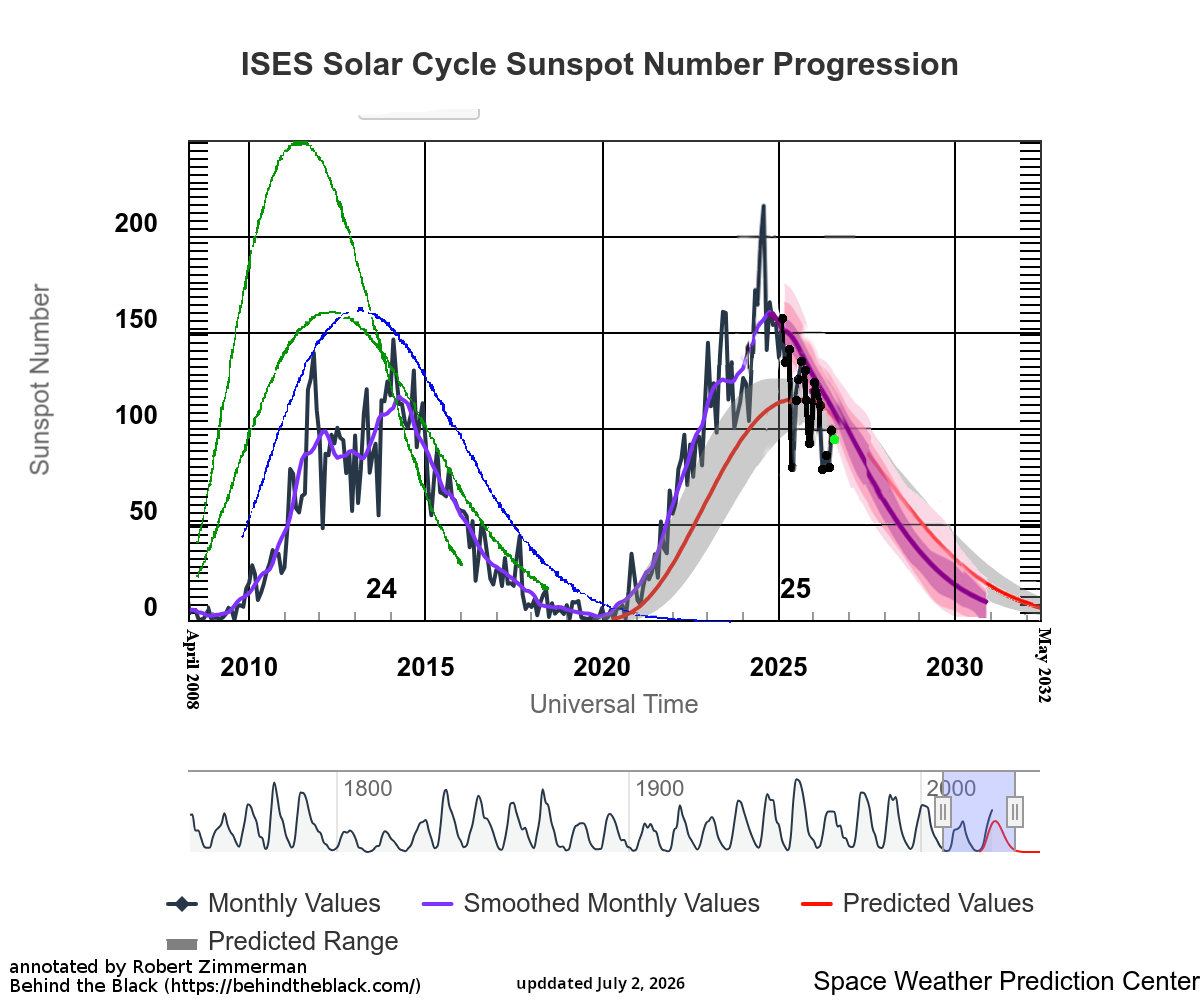
The graph above has been modified to show the predictions of the solar science community for both the previous solar maximum as well as the ongoing maximum. The green curves show the community’s two original predictions from April 2007 for the previous maximum, with half the scientists predicting a very strong maximum and half predicting a weak one. The blue curve is their revised May 2009 prediction. The red curve is the new prediction, first posted by NOAA in April 2020. At the beginning of April 2025 NOAA’s panel of solar scientists added the purple/magenta curve line, predicting that solar maximum was over, and that the ramp down to minimum had begun.
Rather than repeat again what I have written almost monthly for the past sixteen years, let me quote what I wrote last month: “The Sun’s behavior throughout the past two solar cycles has never matched the predictions.” You can see this by simply looking at the graph and the prediction curves.
I also added this blunt assessment last month:
Solar science continues to be a somewhat superficial science, based mostly on observations of phenomenon whose fundamental processes are simply not well understood.
I said this because that solar science community has for two decades worked hard hide this lack of understanding. For example, it consistently removes its prediction curves as the cycle unfolds so that the failure of its predictions will not be obvious. I of course immediately put the curves back in, so that everyone can see that failure, and thus get a better sense of the state of the science.
Or to put it even more bluntly, no matter how much lipstick the solar scientist community has tried to put on this pig, it remains a pig. Or to put it third way, it is another and very excellent example of the uncertainty of science.

On Christmas Eve 1968 three Americans became the first humans to visit another world. What they did to celebrate was unexpected and profound, and will be remembered throughout all human history. Genesis: the Story of Apollo 8, Robert Zimmerman's classic history of humanity's first journey to another world, tells that story, and it is now available as both an ebook and an audiobook, both with a foreword by Valerie Anders and a new introduction by Robert Zimmerman.
The print edition can be purchased at Amazon or from any other book seller. If you want an autographed copy the price is $60 for the hardback and $45 for the paperback, plus $8 shipping for each. Go here for purchasing details. The ebook is available everywhere for $5.99 (before discount) at amazon, or direct from my ebook publisher, ebookit. If you buy it from ebookit you don't support the big tech companies and the author gets a bigger cut much sooner.
The audiobook is also available at all these vendors, and is also free with a 30-day trial membership to Audible.
"Not simply about one mission, [Genesis] is also the history of America's quest for the moon... Zimmerman has done a masterful job of tying disparate events together into a solid account of one of America's greatest human triumphs."--San Antonio Express-News
Here is hoping to see the next ramp-down to solar minimum!