How leftwing journalists lie

Oink! The Washington editor for Bloomberg today demonstrated to all the dishonest way liberal journalists like to cover the budget debates in Congress.

In an opinion piece for Bloomberg, editor Albert Hunt says that the Republican cuts to the budget threaten the American lead in science. According to him, “House Republicans want to cut NIH funding for the current year by more than $1 billion, to $29.5 billion.” Because of this cut would “future advances in areas like brain science are especially threatened.”
» Read more

2 comments

Holdren of the Obama administration:
Deniers no, Ignorant yes!

The following story is why the advocates of global warming are losing the debate: At House hearings yesterday, Obama’s science advisor John Holdren admitted that using the term “deniers” to describe scientists who had doubts about global warming is inappropriate. “It was not my intent to compare them to Holocaust deniers, and I regret it,” he replied. “In the future I will find other terms to use.”

Sounds good, doesn’t it? Shortly thereafter, however, during the same hearing, Holdren then said this about a list of 100 climate scientists [word file] who remain skeptical about global warming:

“I haven’t seen the list,” Holdren began. “But in the past, most of the names on such petitions have turned out not to be climate scientists, and one could assume that they had not spent much time reviewing the literature.”

Without any knowledge, he slams these scientists, accusing them of being ignorant of the science.
» Read more

1 comment

The future ups and downs of government spending in space

A new report says that government spending on space will flatten worldwide over the next five years. Some key quotes from the news story however suggest all is not going downhill:

A total of 692 satellites will be launched by governments in the coming decade, up 43% from the previous decade. This is a direct reflection of the increasing number of new space-capable countries across the globe. Civil agencies will launch roughly 75% of these satellites, a significant increase compared to the last decade during which they accounted for 67% of all government satellites launched.

Also, while certain areas will show a decline (the U.S. manned program) others appear robust.

Access to space (launch capability) investments reached $4.6 billion in 2010, and should be sustained in the coming years as more governments see independent access to space as a top priority of their space programs.

In both of the above examples, the areas where space activity will increase is because of the arrival of new space-faring nations (India, Japan, China to name only the most obvious), what I have been calling the new colonial movement. I also believe that as these new countries begin to show their stuff in space, their success will further fuel the competition, and the older space-faring nations will come back to life in order to stay in the game.

1 comment

A potential landing site for next Mars rover

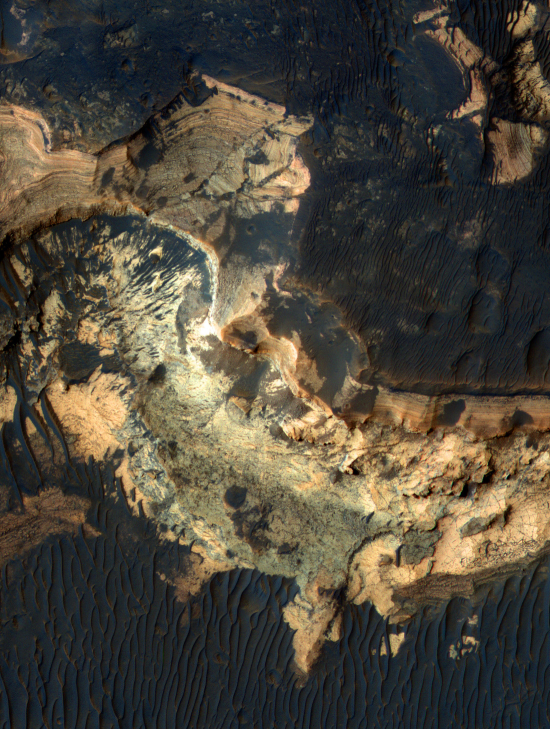
This week’s release of cool images from Mars Reconnaissance Orbiter included the color image below of a region on the floor of Holden Crater, one of the four possible landing sites for Curiosity, the Mars Science Laboratory planned for launch later this year. (If you want to see the entire image at higher resolution, you can download it here.)

Two things that immediately stand out about this image (other than this looks like an incredibly spectacular place to visit):

Holden Crater canyons

» Read more

1 comment

A retraction

Concerning Obama’s proposals for NASA’s 2012 budget, a closer look by me since yesterday has caused me to reconsider my earlier post. I think I spoke too soon, before I had time to review the Obama budget proposal entirely.

Though the Obama administration has pulled back somewhat from its initial 2011 budget proposals for commercial space, it does appear that they are not abandoning that effort as I had thought at first. Their 2012 proposal ($850 million per year) is still significantly higher than what Congress had authorized ($500 million), which suggests a willingness to fight for this program.

As for the program-formerly-called-Constellation, however, it does appear that this pork program is going forward. Instead of trying to cancel it like last year, the administration now appears to have become resigned to its existence, and this year includes significant funds for its construction.

Regardless, considering the insane state of the federal deficit, it seems to me both unrealistic and foolish to fund either of these programs at this time. Pork politics unfortunately will probably help keep alive the funding for the program-formerly-called-Constellation, while the lack of a powerful constituency for commercial space leaves these subsidizes very vulnerable to Congressional trimming.

0 comments

A clarification of the Obama NASA manned space budget

To avoid confusion, I want to clarify why I consider Obama’s commercial space budget proposal today to be a decrease, not an increase, from past budget proposals. The history of this budget goes like this:

  • In February 2010 Obama proposed to spend $1 billion per year on new commercial space.
  • Congress responded by reducing that budget to $312 million for 2011 and $500 million per year thereafter.
  • The new Obama budget for 2012 proposes to spend $850 million per year for commercial space, more than presently authorized by Congress but less than proposed by Obama only last year.

It is almost certain that Congress will trim these numbers. Meanwhile, the amount of money to the program-formerly-called-Constellation goes up.

1 comment

A victory for aerospace pork

Update: See my partial retraction here.

The NASA budget announced today by the White House proves how right I was when I stated back on July 8, 2010 that I had no faith in Obama’s new-found commitment to private commercial space. The new budget reduces the funds for private commercial space while putting the bulk of its support behind the unbuildable program-formerly-called Constellation. First read what I wrote in July:

The problem is that I simply do not believe the Obama administration. Everything I have learned about the current President, including the specifics (or lack thereof) of his proposal, tells me that none of his promises are going to be fulfilled. » Read more

0 comments

The Sun’s continuing wimpiness

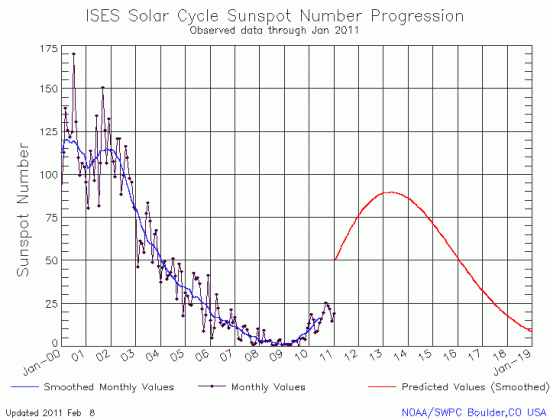
Get those winter coats out of storage! Yesterday NOAA’s Space Weather Prediction Center published its monthly update of the Sun’s sunspot cycle. I’ve posted the newest graph below, showing the continuing slow rise in sunspots (blue/black lines) in comparison with the consensis prediction made by the solar science community in May 2009 (red line).

Though the sunspot count made a slight recovery in January, it was not enough to make up for the plunge in December. Essentially, the Sun continues to act like a sleepy kitten that really doesn’t want to wake up. This suggests that even the newest and wimpiest prediction for the next solar maximum, from solar scientists at the Marshall Space Flight Center, is still overstating the Sun’s upcoming sunspot activity.

In the past a wimpy Sun has been linked to cold weather, for reasons that scientists as yet don’t quiet understand. And this next solar maximum continues to look like the wimpiest in more than 200 years (see the graph on this page)!

January sunspot graph

0 comments

The underground Moon

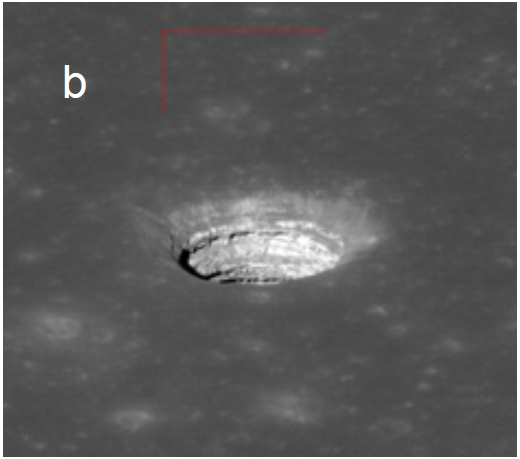
More images of lunar cave pits have been posted by the scientists of Lunar Reconnaissance Orbiter (LRO). They have also published their first paper [pdf] about these cave pits for the 2011 Lunar and Planetary Science Conference taking place in March. The paper summarizes, with images, what is know about the three pits on the Moon that have each been imaged a number of times at different angles and lighting situations.

Mare Tranquilitatus
» Read more

2 comments

Sand dunes and dry ice on Mars

Time for some more sightseeing on Mars. A recent news release from Mars Reconnaissance Orbiter noted the discovery of seasonal avalanches on Mars. This new image of the northern martian sand dunes illustrate again how the surface of Mars changes seasonally. The white patches on the ridges of the sand dunes is frozen carbon dioxide, dry ice that condenses on the crowns of the dunes every winter. When spring comes, the dry ice evaporates, and as it does so it disturbs the underlying sand, which then tumbles down the sides of the dunes, producing the dark streaks.

Ice-capped sand dunes

The process is less dramatic, however, than the avalanches seen in the previous news release, as suggested by this image below, showing the same dunes in summer without the dry ice. The dark streaks in the second image are not significantly different from the first, indicating that the process that forms them is slow and subtle.

Sand dunes with ice-cap

0 comments
1 121 122 123 124 125 139