Remembering Boris Yeltsin

A monument to Boris Yeltsin was unveiled today in his hometown on the 80th anniversary of his birth.

In this week of memorials to American space tragedies, this event in Russia brings to mind the far more important and significant events, affecting millions of people worldwide, that unfolded in the Soviet Union during the late 1980s and mid-1990s. The communist superpower was collapsing, and there was the real possibility that that collapse could lead to worldwide war and violence.

Yeltsin, far more than any other man, helped shepherd the former Soviet Union out of that chaos, and he did it as a civilized man, with relatively little bloodshed. As he shouted defiantly as he stood on a tank in front of the Russian parliament building on the day of the August coup, “Terror and dictatorship . . . must not be allowed to bring eternal night!”

Unlike many former communist leaders, Yeltsin had the openness of mind to recognize that the state-run centralized command society that he had grown up in and had helped run for years simply did not work. “We have oppressed the human spirit,” he noted sadly during a press conference shortly after the coup. More importantly, he also had the courage to take action on this realization, and force the painful changes that were necessary to save his country.

Yeltsin was no saint, and the Russian transition from dictatorship to freedom was far from perfect. No one even knows if that transition is going to hold, today, twenty years later. Nonetheless, the world should remember Yeltsin for his success, and honor that memory.

1 comment

Planned Parenthood caught on tape covering up underage sex trafficking

A video sting operation has caught a Planned Parenthood official as she gladly helps a pimp illegally cover up his underage sex ring. Key quote:

In the video, the pair visit Planned Parenthood Central New Jersey’s abortion center in Perth Amboy and clinic manager Amy Woodruff, an LPN, warns the pimp and his prostitute to have their trafficked underage girls lie about their age to avoid mandatory reporting laws.

“Even if they lie, just say, ‘Oh he’s the same age as me, 15,’…it’s just that mainly 14 and under we have to, doesn’t matter if their partner’s the same age, younger, whatever, 14 and under we have to report,” Woodruff says. “Like on the paperwork there’s going to be a point that asks, uh, like are you sexually active, stuff like that … if they’re under a certain age… – you know, me and my other counselor, like for the most part we want as little information as possible – cause we don’t want to be involved…”

Watch the whole video. Your jaw will drop in horror, especially consider how much government money Planned Parenthood gets (more than $300 million per year).

0 comments

Challenger, 25 years later

Today is the 25th anniversary of the Challenger accident. There are innumerable links from many sources talking about the event, too many for me to list here. You can find most at this link on Jeff Foust’s website, spacetoday.net.

Though I think it is very important for us to remember and honor these events, I have become somewhat disenchanted with the modern American obsession with memorials and anniversaries. Rather than build a memorial, I’d much rather we focused entirely on building new spaceships, new space stations, and new lunar bases, while flying multi-year missions on ISS, all in preparation for exploring and colonizing the solar system.

If we actually made the solar system a place for humans to live in and explore, we would build a far better memorial to those who have sacrificed their lives for the sake of exploration. And I think these heroes would be far more pleased by that memorial than by a stone statue or emotional op-ed that describes their courage.

2 comments

I’m back

As you can see, I am finally back at the computer.

I want to thank everyone who made encouraging comments or sent me private emails. The situation was a simple one: For a variety of reasons, we needed to move my 93-year-old mother to a new residence. I therefore spent the last five days packing and unpacking boxes, and guiding the movers as they transported her stuff either to her new home or storage.

Moving for anyone is always a pain in the neck. Doing it for someone else can be harder, as you have to make decisions about someone else’s possessions, about what can go and what must be discarded. Fortunately, everything worked out far better than I could have expected and she is now safely settled in a far better place.

So, back we go to space, history, science, and politics!

0 comments

Journalistic spin for the sake of disaster

The headline from this National Geographic story reads “Yellowstone Has Bulged as Magma Pocket Swells,” while the first sentence is designed to send chills up your spine:

Yellowstone National Park’s supervolcano just took a deep “breath,” causing miles of ground to rise dramatically, scientists report.

From here, the next few paragraphs go on to talk about the wild rise of the giant caldara under Yellowstone National Park in recent years, and how past eruptions there were were among the most powerful volcanic explosions ever to occur. Obviously, from this introduction, the thing is about to blow and we better run for cover!

This story is unfortunately typical for much of today’s modern media: find a story with a hint of disaster in it and play up that disaster as much as possible, regardless of the facts. For example, the opening of this article completely misreports the substance of the Yellowstone geology research. Back on December 4, I read the paper and headlined its results as follows: “Yellowstone caldara rise has slowed.” What the scientists had actually found was that after a period of significant growth beginning in 2004, the rise of Yellowstone’s giant volcanic caldara had slowed significantly since 2006, and since 2008 had actually subsided somewhat.

While the significant rise from 2004 to 2006 was then news, suggesting the worrisome possibility that an eruption was imminent, the story now, revealed by this scientific research, was how that rise has stopped, and why.

Now, if you spend the time to read the rest of the National Geographic article above, you will find that the reporter does dig a bit deeper, and notes these facts in better detail. The trouble is that a quick scan of the headline and opening paragraphs will instead leave you with an entirely incorrect impression of the facts.

That this kind of fear-mongering by modern reporters is not unusual, especially when it comes to climate research and extreme weather events, illustrates the vital importance of maintaining as skeptical an eye to what we read as possible. Don’t assume what you read is true. Read it as carefully as possible. Try to check its sources. And compare every article’s conclusions with other reports to see if you can get a feel for the truth, hidden behind the different reports.

And that, by the way, applies as much to what you read here at behindtheblack as anywhere else!

1 comment

The solar maximum keep shrinking

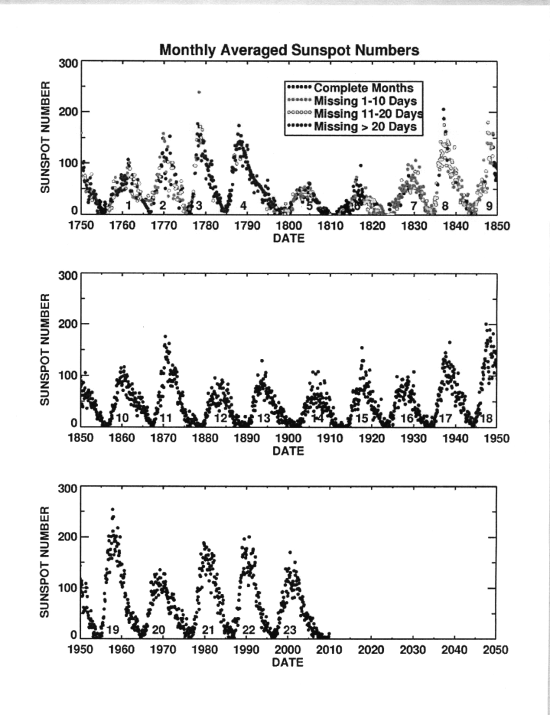
Solar scientists at the Marshall Space Flight Center have once again revised downward their prediction for the intensity of the next solar maximum. Key quote:

Current prediction for the next sunspot cycle maximum gives a smoothed sunspot number maximum of about 59 in June/July of 2013. We are currently two years into Cycle 24 and the predicted size continues to fall.

If this prediction holds, the upcoming solar maximum could be the lowest since the cycle came back to life in around 1715 following the Maunder Minimum.

the solar cycle

0 comments

The future Nemesis from space

From the American Astronomical Society meeting this week:

A team of astronomers, using the data from the Sloan Digital Sky Survey, calculated the galactic orbits of nearly 40,000 low mass stars. These stars are generally M dwarfs, cool, not very bright, and thus generally somewhat close to the Sun since if they are too far away we would not see them. You can read the abstract here, and download their full poster here [pdf].

For the astronomers, the data told them a great deal about the orbital properties of these stars. Though a majority are in circular orbits between 20 to 30 thousand light years from the galactic center, a small minority are in extremely eccentric orbits that travel far out into the galactic halo, as much 260,000 light years. A few others dive inward, getting within 6000 light years of the galactic center.

What made this poster stand out to me, however, was this quote from the abstract:

In addition, we have identified a number of stars that will pass very close to the Sun within the next [billion years]. These stars form the “Nemesis” family of orbits. Potential encounters with these stars could have a significant impact on orbits of Oort Cloud and Kuiper Belt members as well as the planets. We comment on the probability of a catastrophic encounter within the next [billion years].

All told, they found that 18 low-mass cool M dwarf stars that will eventually pass close to the Sun. One star, SDSS J112612.07+152517.6, an M3 star that is about 2,300 light years away, is in an orbit that has it moving right towards us at about 90,000 miles per hour. Its mass is less than half that of the Sun, about 0.4 solar masses. This figure from the poster roughly illustrates the star’s position relative to our solar system over the next billion years:

Nemesis star

The star itself is shown in the inset. The red curve shows its calculated distance from the Sun over time, with the black area above and below showing the uncertainties of the calculation. As you can see, every hundred million years or so the distance between this star and the Sun shrinks, with the very very very rare possibility that the distance will sometimes shrink to zero!

With 18 stars each doing this every few 100 million years or so, the average time between close approaches is about 5 million years. These results suggest that another star passes close enough to our solar system frequently enough to not only disturb the comets in the Oort cloud, but also possibly affect the orbits of the planets in the outer solar system and Kuiper belt. One wonders, for example, if such an event had some influence on Pluto’s strange orbit.

0 comments

Bad news for NASA, good news for private space

Earlier this week NASA submitted a report to Congress reviewing the design and construction status of the heavy-lift rocket and manned capsule that Congress has required them to build and launch by 2016. NASA’s conclusion: the space agency doesn’t think it can do the job in the schedule or budget that Congress has provided.

NASA does not believe this goal is achievable based on a combination of the current funding profile estimate, traditional approaches to acquisitions and currently considered vehicle architectures. . . . We will not commit to a date that has a low probability of being achieved.

NASA’s conclusions here are not surprising. The agency had been having trouble building Constellation on the much bigger budget and longer schedule given to them by past Congresses. For them to build the-program-formerly-called-Constellation for less money and in less time is probably impossible.

Nonetheless, this was the response of the Senate Commerce committee:

The production of a heavy-lift rocket and capsule is not optional. It’s the law.

This is why I have been saying that the money for this program is nothing more than pork. Congress knows that nothing can be built on this budget, but wants the money spent nonetheless, to keep people employed in their districts.

Meanwhile, in sharp contrast, Space Adventures yesterday announced a new deal with Russia, whereby the Russians have agreed to build and launch one extra Soyuz capsule per year, beginning in 2013, to fly 3 tourists to ISS. In addition, there is this report today about how SpaceX is successfully meeting all its milestones in building its cargo ferry for ISS. An earlier report last week also noted how Orbital Sciences is also moving forward with its cargo ferry, with a planned first test launch by the end of 2011.

All in all, this news is not good news for NASA. The space agency’s manned spaceflight program appears to have two futures, neither of which will involve it continuing to build rockets or fly humans into space. In one option, the new Congress, when it finally sits down to write a budget, will decide that pork and happy constituents are more important than a balanced budget, and will appropriate the money for the-program-formerly-called-Constellation. NASA will struggle hard to build it, but will not succeed. Thus, no government-built manned space program.

In the second option, Congress will agree with me and decide that it just doesn’t have money for pork, especially considering the terrible state of the federal budget. Moreover, seeing the success of the private efforts of SpaceX, Orbital Sciences, and Space Adventures, Congress will wonder why it needs to pour more billions into a vain effort by NASA to build something it can’t, when there are other private companies that can do it, and do it for less. In this circumstance, it will be very easy for them to cut the-program-formerly-called-Constellation. Once again, no NASA manned program.

Neither scenario is actually a bad thing. What we are actually seeing play out here is the free competition of different companies attempting to provide a service to a customer, and the customer eventually picking the best company from which to buy the product. NASA, as a government agency, simply can’t compete, and unless Congress decides to provide them welfare, will lose this competition hands down.

The U.S. will still have the capability of getting into space, but for far less money. And having multiple private companies competing to provide this service will also encourage innovation, something the rocket industry has sorely needed these past five decades.

5 comments

Giant black holes

From the AAS meeting, the black hole press conference!

  • Scientists, using the Gemini telescope at Mauna Kea in Hawaii, have measured the mass of the supermassive black hole in the center of the galaxy M87, and found its mass equals 6.6 billion suns, far larger than expected. They also estimate that the event horizon of this gigantic black hole is so large our entire solar system would fit inside it.
  • Other scientists have found that the total mass of M87 is more than 5 trillion suns, about 60 percent higher than earlier investigations estimated. This makes M87 one of the most massive galaxies known. In addition, more than 80 percent of that mass is contained with the galaxy’s dark matter halo.
  • In other research, astronomers have located 16 close binary pairs of supermassive black holes hidden in the nuclei of the galaxies. Scientists have long believed that the merger of smaller orbiting supermassive black holes helps form bigger supermassive black holes we see, but until this discovery, almost no close binary pairs had been located. Of these 16 binaries, all show signs that they are spiraling into towards each other, and will crash together in several millions of years.
0 comments

The uncertainty of astronomical science

From today’s first press conference at the AAS meeting, astronomers have found that two of the fundamental objects they use as units of measure might not be as reliable a unit of measure as they thought.

  • Astronomers have discovered that the Cepheid variable stars that they use to estimate the distances to the nearest galaxies are not necessarily the stars they thought. At least two Cepheids, which are variable stars, do not pulse reliably (one actually stopped pulsing entirely). Another is surrounded by a previously unknown nebula cloud, which affects its apparent brightness, an essential data-point when using these stars as a measuring tool. Here’s one press release.
  • The Crab Nebula threw out some gigantic gamma ray bursts last fall. In addition, astronomers have found that the nebula actually flickers wildly, and is also changing in gamma ray energy output over the long term, declining by seven percent in the last two years. No one yet knows what exactly causes these different variations. Like Cepheids, the Crab has been used as a standard for measuring the energy of astronomical gamma ray objects. This is no longer reliable. Here’s one press release, plus images.
0 comments

It’s time the left toned down its rhetoric

Look, I agree that we’ve got to tone down the rhetoric. And I also agree that conservatives bear as much responsibility to do this as anyone. Free debate in a civilized society requires reasoned discussion of the issues, and a willingness to tolerate disagreement. It should not include ad hominen attacks, or the wishful desire to murder your opponents.

However, it is not the tone of rightwing discourse that worries me much these days. You would be hard pressed to find any examples of any Republicans or Tea Party activists suggesting it would a good thing to kill Democrats. Such suggestions are not only considered unacceptable, everyone on the right knows that to say such a thing would probably destroy your career in the public arena. Thus, it just doesn’t happen.

Instead, it is the left, the press, and the Democratic Party’s efforts to whip up anger at the right that scares me. Nor did this ugly behavior begin on Saturday after the Tucson murders. In the past decade there have been the numerous examples (which I have been documenting these past few days) of leftwing activists, Hollywood movies, talk radio hosts, and Democratic officials advocating violence against the right. (For a talk radio host example, see this new list of liberals calling for the murder of conservatives.) Worse, such behavior has almost become routine in recent years. It seems that every random violent act has become a vehicle for the left and the press to attack and slander conservatives, despite the fact that there is no evidence that any of these accusations are true.

This behavior must stop. Violent and angry rhetoric can and will cause violence. And it probably has, considering the fact that a large number of the random violent acts in recent years have actually been committed by deranged individuals with liberal, not conservative, leanings. This is not to say that I blame the left for this violence, but that the left has as much of a responsibility as the right to think carefully about what it says, before it says it. Otherwise, they might find that they have made their less rational followers more angry than they ever imagined, or can control.

Or as Michael York says to his NAZI friend at the end of this scene from the 1972 movie, Cabaret. “You still think you can control them?”

3 comments
1 122 123 124 125 126 139