
Category: Essays And Commentaries
Long essays or op-ed length commentaries on the issues of the day or on topics of special interest.
New results from the Sloan Digital Sky Survey
From the second press conference at the AAS meeting today, results from the Sloan Digital Sky Survey, which has been surveying the sky in incredible detail over the past eleven years:
- The largest digital color image of the heavens, covering one third of the sky, imaging a half a billion stars and galaxies. Despite looking the sky in wide-field view, the data also has incredible close-up detail. This has and will continue to provide astronomers a precise baseline reference for future research.
- A 3D reconstruction of the local galactic neighborhood, showing the three dimensional position of the visible galaxies within a billion light years. They plan to use the new Sloan color image above to further extend this 3D reconstruction out to seven billion light years.
- The largest map of the Milky Way’s outer regions, showing the streams of stars captured from other galaxies, absorbed in the past galactic mergers that formed the Milky Way.
All this data will be available for anyone to dig around in.
New discoveries by Planck
From the first press conference at the AAS meeting today, focused on recent discoveries from the European space telescope Planck:
- has identified 10,000 cold spots in Milky Way, all believed to be places where stars will soon begin to form. They range widely in size, and are from 30 to 10,000 light years from us.
- Planck’s all sky survey has found 189 giant galaxy clusters, 20 of which are newly discovered. “The largest gravitationally bound objects in the universe.” Very hot, filled with hot gas.
Kepler’s most recent discovery: A rocky Earthlike planet!
Bumped. Scroll down for updates!
From the abstract of Geoffrey Marcy’s talk today at 6:30 pm (Eastern) at this week’s meeting in Seattle of the American Astronomical Society:
The NASA Kepler Mission has discovered over 700 candidate planets, with most having diameters less than 5 times that of Earth and some as small as that of Earth. One planet has a radius, mass, and density in a new domain having no counterpart in our Solar System, opening a new chapter in planetary science. [emphasis mine]
A press conference is scheduled for 11 am (Eastern). Stay tuned!
Update I. A NASA press release just made public says that Kepler has discovered a rocky planet only 1.4 times the size of the Earth.
Kepler 10b [is] a rocky planet with a mass 4.6 times that of Earth and with an average density of 8.8 grams per cubic centimeter — similar to that of an iron dumbbell.
The press conference is ongoing, but the Kepler results are still to come.
Update II. The star the planet orbits, Kepler 10, is similar to our Sun in mass and size, but older, about 8 billion years old, and is 560 light years away. Kepler 10 is also a relatively bright star in the Kepler field of view, about 11 magnitude.
The planet’s orbit itself is only 8.4 days long. Its density, 8.8 grams per cubic centimeter, is 8.8 times greater than Earth’s. This data, based on all planet models, also suggests that the planet should be a rocky planet like the Earth, though heavier and larger with a surface gravity twice that of Earth.
Since the planet orbits so close to its sun, it is a scorched world, very hot. The scientists expect that it has no atmosphere. It is also probably tidally locked, with one side always facing its Sun.
Update III: Geoffrey Marcy, one of the world’s premier exoplanet scientists, is now commenting on these Kepler results, saying he considers this discovery “among the most profound discoveries in human history.”
Update IV: In answer to a press question, the scientists speculated that the planet might have formed as a gas giant farther from the star, then migrated inward and had its gas atmosphere stripped away. No one knows yet if this is true however.
Studies of further transits might learn more about the planet, such as the temperatures between its two hemispheres. As the planet orbits the star and its illuminated side comes into view, they can see the change in temperature and thus track it. Right now they think the sunlight side could be as hot as 2500 degrees Fahrenheit.
If you want to watch the press conference for yourself, they will be posting the video here.
The Tucson shootings
Here are two links that I think are worth reading in connection with the aftermath of yesterday’s tragic shootings in Tucson:
Two sicknesses on display in Arizona.
Disgusting partisanship on display after shooting.
Above all, these murders are horrible and a terrible tragedy. For anyone from either party to try to make political gain from them is beyond despicable.
I should also note that, unlike most Islamic terrorists attacks where either no one in the Muslim community protests while many Muslim leaders express joy or agreement with the violence, I can find no one who is happy about yesterday’s murders. The general response from across the American political spectrum is horror and agony. Such things are wrong and should not happen. It is this distinction that separates Western culture from modern Islam. Until the Islamic community finally stands up to its medieval bullies, I will continue to consider it a threat to civilization and freedom.
Imaging the ground under the Greenland ice sheet
In a paper published today in Geophysical Research Letters of the American Geophysical Union, scientists describe how they have been able to produce remarkably detailed images of the ground buried almost a mile under the ice sheet of Greenland. These radar techniques are the same used in the past by spacecraft to image the hidden surface of Venus, only far more sophisticated.
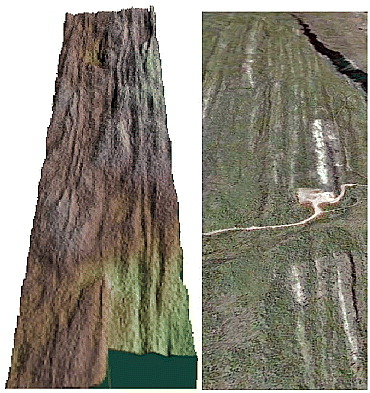
This image from the paper compares the radar image of the Greenland surface (on the left) to an photograph of a known surface feature in the Northwest Territories of Canada, produced thousands of years ago by the giant icesheets of the last Ice Age. Both are at the same scale, about a third of a mile across, and are looking at the surface at an oblique angle of about 45 degrees. With the radar-produced image on the left, sunlight is simulated as coming from the right, with the elevation increasing as the colors go from green (lowest) to yellow to brown to purple (highest).
The long grooves, generally 30 to 100 feet deep and extending sometimes several miles, are produced as the icesheet slides across the ground. In the radar image, however, these grooves are slowly being ground out now.
It is the resolution of this technique that is so exciting. That they can look through ice almost a mile thick and resolve objects that are only tens of feet across tells me that someday it will be possible for spacecraft to map the smallest features on the surface of Venus or Titan. More exciting, this suggests that the technology will one day exist to even map the unknown surface of gas giants like Jupiter or Saturn, and do it in breathtaking detail.
Yowza!
Peer-reviewed journal article a “Fraud”
Back in 1998 a peer-reviewed paper in the medical journal, Lancet, claimed that the childhood vaccinations for measles, mumps and rubella vaccine could be linked to autism and other health problems. The consequence was that thousands of parents withheld vaccinations from their children, resulting in an outburst of measles that almost certainly did actual harm to many children.
This paper has now been shown to be an outright fraud.
This story raises two thoughts. First, it demonstrates clearly that just because a research paper is published in a “peer-reviewed” science journal is no guarantee that the paper will be honest, reliable, or factually accurate. As good scientists like to say, “Extraordinary results require extraordinary evidence.” Both the press and public need to be constantly skeptical about all research, regardless of where it is published.
Secondly, the reaction of the journal, Lancet, to this whole affair suggests strongly that this particular journal is even more unreliable than most. To quote:
The Lancet withdrew the article in January of last year after concluding that “several elements” of the paper were incorrect. But the journal didn’t describe any of the discrepancies as fraud.
The journal’s reaction is similar to what we saw with the climategate emails, an effort to whitewash the situation while refusing to face the problem bluntly and fix it. If the article was as fraudulent as the Wall Street Journal article above suggests, it raises serious questions about the editorial policies at Lancet. That the editors there seem uninterested in addressing these concerns acts to discredit their publication entirely. And until they deal with this issue properly, I would look very skeptically on anything they publish.
(Note that this is not the first time Lancet has published research of questionable reliability. See this story for another example.)
Charles Bolden has come out of hiding
Today NASA administrator Charles Bolden spoke at the AIAA meeting in Orlando. According to Florida Today, he said two things of interest:
- He is proud of the achievements of the shuttle program and is sad the program is ending.
- He believes flying three more shuttle missions would be safe.
Considering that his administration has done nothing to save the program, and in fact has almost seemed eager to shut it down at times, his sadness seems incredibly insincere and self-serving.
As for his second comment about the shuttle’s safety, I wonder how he knows this, especially since his own engineers are currently struggling to pin down the root cause of the external tank cracks that have delayed the last flight of Discovery, and appear to be a chronic problem that needs to be fixed before any shuttle can once again fly.
Opportunity at Santa Maria Crater, as seen from space
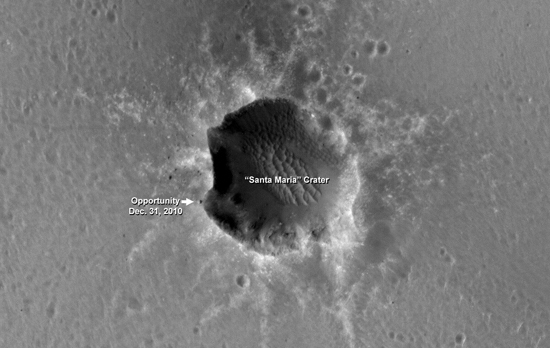
The image below was taken by Mars Reconnaissance Orbiter on New Year’s Eve. It shows the rover Opportunity on the rim of stadium-sized Santa Maria Crater, where scientists plan to spend the next two months exploring the crater.
Opportunity has truly been an astonishing success for NASA’s planetary science program. The rover has operated on the Martian surface since 2004, almost seven years beyond its original mission length. It is presently about halfway on its long journey to the much larger Endeavour Crater (14 miles in diameter), still several miles away.
A plunge in solar activity in December
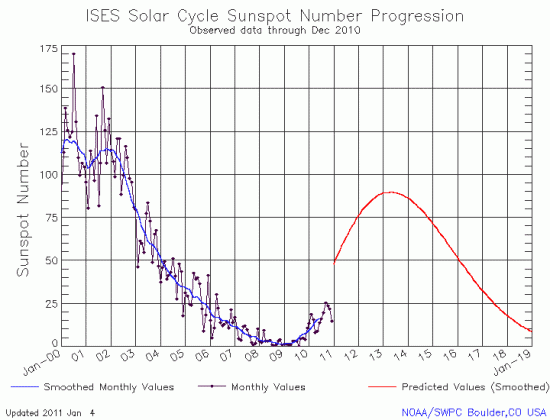
The monthly update of the Sun’s developing sunspot cycle was published tonight by NOAA’s Space Weather Prediction Center. You can see the newest graph below, which shows the slow rise in sunspots (blue/black lines) in comparison with the consensis prediction made by the solar science community in May 2009 (red line).
Not only does the Sun’s generally quiet trend continue, its activity took an additional plunge in December, dropping significantly from the previous month. This drop is probably due to the seven days of no sunspots that took place in mid-December.
All in all, we continue to head for the weakest maximum in two hundred years (see the graph on this page), which in the past meant very cold weather. Though scientists do not yet understand why the Sun does this or how these changes in solar activity influence the climate as much as they do, that this in now happening at a time when we have the technology to truly study it is an opportunity that must not be missed.
Naked bodies and a new Messiah
If anyone had any doubt that the global warming movement is undergoing a serious collapse, this so-called news article from Spiegal Online, entitled “Naked bodies and a new Messiah: Green groups are trying to sex up climate change,” probably lays that doubt to rest. Key quote:
Environmentalists and scientists are concerned about the massive drop in public interest in the topic over the last year. Now they are looking for new strategies to turn the tide. They’re searching for so-called “mind bombs” — highly emotional images that reduce a complex problem down to one core message.
Sadly, the article never asks the fundamental question: What do “mind bombs” have to do with facts, data, and proving your theories are correct in the real world?
The answer of course is obvious: Nothing.
» Read more
The Space Show
For those who would are curious to hear me talk about the past year and what’s to come as well as celebrate the 42nd anniversary of the Christmas Eve reading of Genesis by the astronauts of Apollo 8, I will be appearing on David Livingston’s long running radio show/podcast, The Space Show, today at 9:30 am Pacific time (12:30 pm Eastern time). The interview is scheduled to last 90 minutes, but David and I usually end up going far longer.
Dr. Livingston has produced more than 1000 shows, interviewing almost every single important figure in the aerospace industry. As he noted recently:
The Space Show/One Giant Leap Foundation is a non-profit 501C3 and your contributions are deductible from your U.S. tax liability. But more important, your help is needed in getting the space message out there to as many as possible, including the movers and shakers in society and the space industry. Not only do we provide a platform for many of you and your own material, we play an increasingly larger and more important role in getting space development to go viral. However, we can’t do it without your help so if you are able to make a contribution to The Space Show/OGLF this year, not only will it be appreciated, it will be most beneficial in helping to achieve Space Show goals and objectives.
To this I heartily say, amen! If you want to find out what’s going on in the aerospace community, The Space Show is undeniably one of the best places to go. The show deserves our support, and for that reason I want to give it a enthusiastic plug. You can make contributions by Pay Pal on The Space Show website here or on the One Giant Leap Foundation website. Checks made payable to One Giant Leap Foundation, Inc. can be mailed to P.O. 95, Tiburon, CA 94920.