
Worldwide military spending
The chart below, found here, shows current worldwide military spending as a percentage of GDP. The redder (or darker) the color, the higher the spending.

What does this tell us about Islam and the Islamic world?
Long essays or op-ed length commentaries on the issues of the day or on topics of special interest.
The chart below, found here, shows current worldwide military spending as a percentage of GDP. The redder (or darker) the color, the higher the spending.
What does this tell us about Islam and the Islamic world?
The Lunar Reconnaissance Orbiter has released another lunar cave image, this time showing a double pit entrance with a natural bridge between them. [Thanks to reader James Fincannon for the tip.]
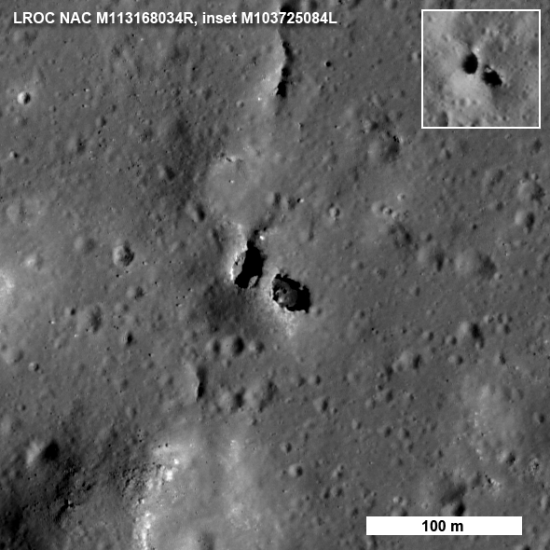
From the caption: “The bridge is approximately 7 meters wide on top and perhaps 9 meters on the bottom side, and is a 20 meter walk for an astronaut to cross from one side to the other.”
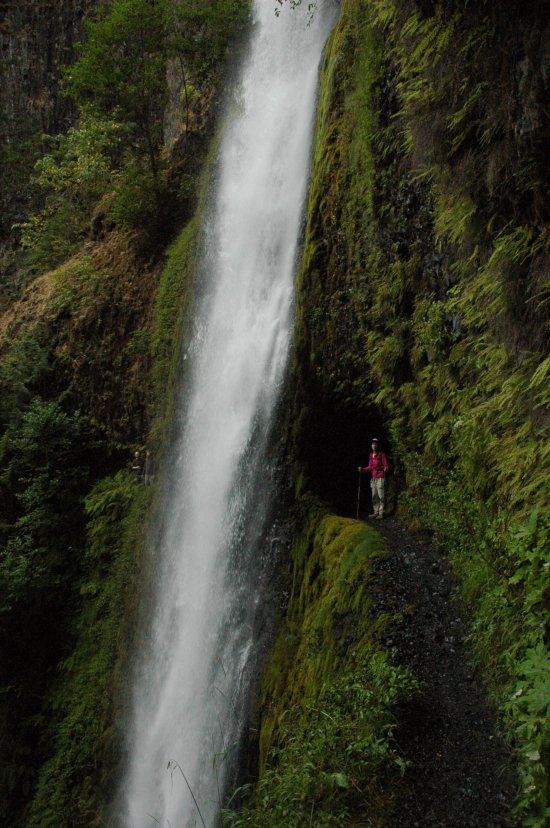
Because yesterday’s hike up Eagle Creek to Tunnel Falls (see picture below) was particularly long, 12.5 miles, I took a break from posting when I got home. Today (Monday), however, was a more easy-going day, as we did more ordinary tourist stuff, driving from place to place with only short strolls at each stop.
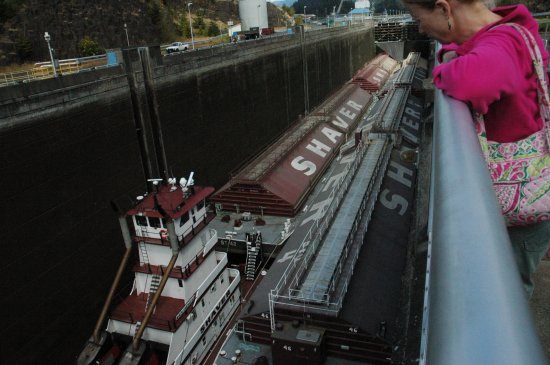
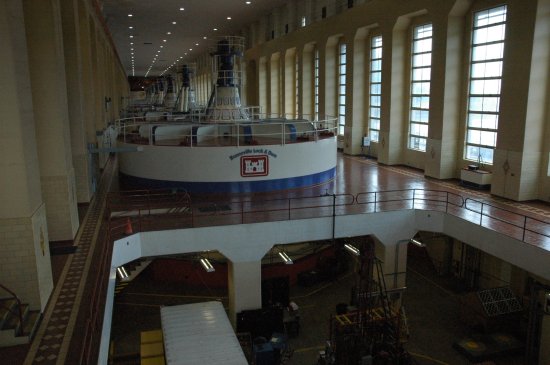
The most fascinating tourist stop of the day was by far Bonneville Dam. Just as the security guard at the gate let the car in front of us through, her phone rang. When she was finished and came up to our car, she explained that we would have to wait about a half hour before going to the visitor center, as they needed to open the swing bridge so that a barge could go through the locks. At first I thought this was very unfortunate timing. In the end, it turned out to be fortuitous indeed. We parked at the viewing area above the locks and watched five barges, tied tightly together as a unit and pushed upstream by a tug, slide gently into the lock with barely inches on either side. Neither Diane or I could believe how little spare room the tugboat captain had to pilot this massive object. The gigantic downstream doors then closed (while I quipped that music from Star Wars should be playing) and the lock was quickly filled with water, raising the barges/tugboat up almost a hundred feet. The upstream doors than opened and the barge headed out. All told, the whole operation took less than 45 minutes.
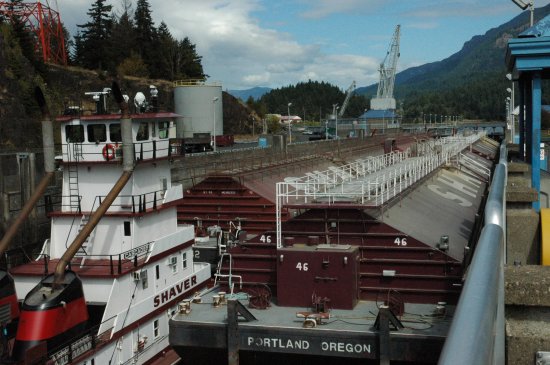
We then took a tour of the dam’s first power station, with its ten turbines all in a row. Unfortunately, none were operating at the moment. Nonetheless, whenever I see places like this (such as when I visited Hoover Dam back in 2005), I can’t help but be reminded of the scene from the science fiction movie Forbidden Planet, when Walter Pigeon gives us a tour of the Krell underground machine. Unlike the Krell, however, it didn’t take millions of years for us to learn how to build such breath-taking big dams and power stations. We did it less than 150 years after the discovery of electricity!
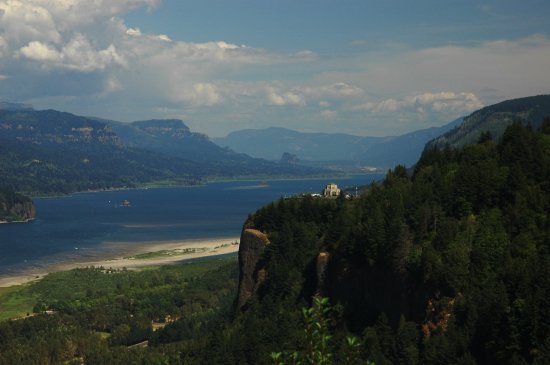
We’ve moved on from Mt. St. Helens to the Columbia River Gorge. Below is a shot of Vista House at Crown Point, looking east into the gorge. In the distance you can see Beacon Rock.
Today’s hike was short, a six mile loop starting at Multnomah Falls (620 feet total).
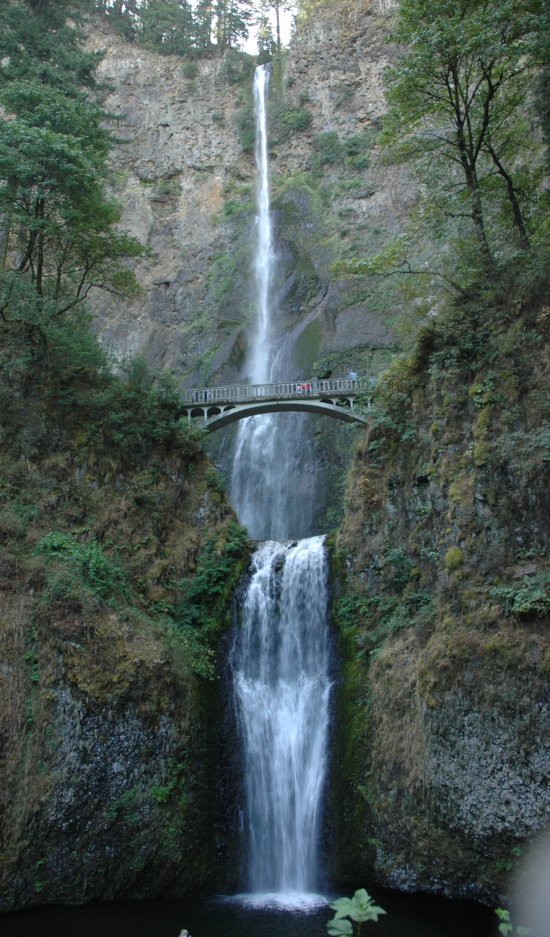
The falls and hike are probably among the most popular tourist attractions close to Portland. And since today was Saturday, there were a lot of people around. Nonetheless, the numbers quickly dropped as we worked our way up the trail, dropping to only a handful of people once we climbed past the top of the falls. The hike itself included a lot of waterfalls and babbling streams, but it also weaved its way through some impressive evergreen forests.
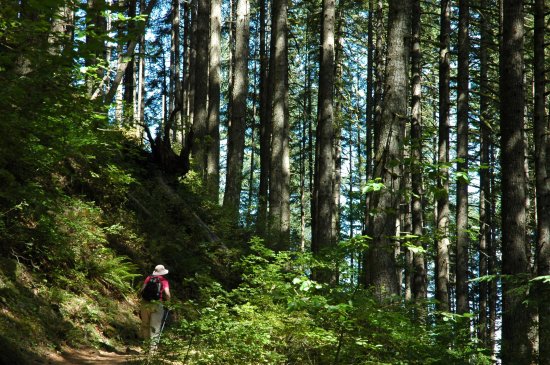
I find it sad how few people are willing to do the little extra work necessary to reach these beautiful places. At one point on our way down, we passed a family that was clearly discussing whether to continue. They had already climbed about 80 percent of the way up, but the father and mother were tired and seemed willing to stop. When the son (about 12) asked me how much farther it was to the top and I said it was only about 20 to 30 minutes, he was off like a shot, with the parents forced to follow, albeit reluctantly. My immediate thought was, “Go, kid, go!”
Though this article outlines succinctly the physical and mental difficulties faced by the 33 trapped Chilean miners, it also tends to overemphasize the worst case scenerios, none of which are likely to happen. I can state from personal experience — having spent numerous weekends underground during cave exploration trips — that though their situation is very unpleasant, I have no doubt these miners will survive. Because they have contact with the surface, and therefore a regular supply of food and information, they will simply demonstrate the limitless range of human endurance, and hold on until rescue arrives.
Freedom of speech alert! A Tennessee middle school football coach has been fired because he, on his own time, wrote and posted a song on Youtube critical of Barack Obama. Watch the song and tell me if there is anything here that is either untrue or unreasonable.
Exoplanet news! Scientists today announced the discovery of a host of planets, all orbiting a single star similar to the Sun. Though five are Neptune-sized, a sixth (not yet confirmed) might be the size of Earth. What makes this even more exciting is that the astronomers made the discovery using a ground-based telescope.
But wait, there’s more! Thursday NASA will hold a press conference about a new discovery by Kepler!
On May 18, 1980, Mt. St. Helens erupted, the blast throwing the north slope of the mountain out and downward in a terribly hot wave of ash, rock, and magma. All life in its path was destroyed. Forests were ripped to the ground, then buried. The force of the wave tore into Spirit Lake, pushing the water sideways so that it sent its own wave 500 feet up the side of the opposite mountain. The mountain then dumped so much material into the lake that it actually doubled in size, its shores raised 200 feet.
It is now thirty years later. After years of slowly oozing out two large lava domes into its shattered crater, Mt. St. Helens had finally quieted down enough for the National Park Service to permit hikers to once again return. Not only do trails now criss-cross the blast zone below the crater, if you make arrangements in advance you can actually hike up the mountain’s south face and look down into the crater.
Our hike yesterday at Mt. St. Helens consisted of two parts. The first took us down onto the Loowit Trail, the closest the National Park Service permits hikers to get to the volcano’s lava domes. The second part was a short hike down to the shoreline of Spirit Lake.
Two things stood out in both these hikes. First, I was astonished how much of the surrounding landscape remains devastated, barren, and desert-like, decades after the eruption. I come from the East, where you expect a barren field to quickly become overgrown with life. Yet, even in the rainy climate of the northwest the destruction left by the volcano is so profound it is going to take many more decades for the forest to reclaim its former glory.
Thus, the land between the mountain and Spirit Lake more resembles the deserts of the American southwest than the lush, wet forests of the Cascade mountains. At one point I even noted to Diane how the Loowit trail reminded me of the Tonto Plateau trail in the Grand Canyon — a wide shadeless terrain crossing periodic dry gullys.
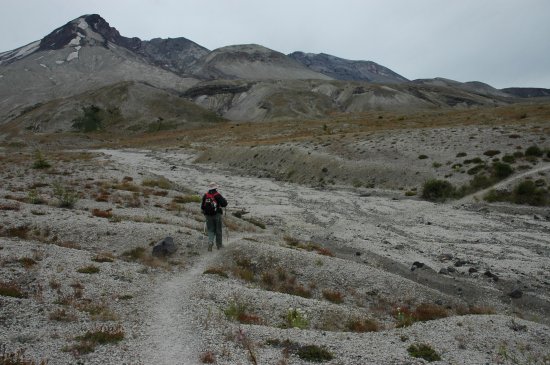
Still, in what had been a dead zone thirty years ago, small life has reappeared, from chipmunks to a variety of scrubs and grasses. There are even a scattering a small young evergreens, signaling the eventual return of the forest.
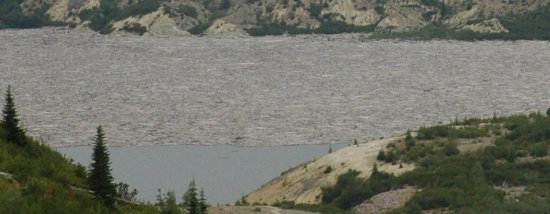
At Spirit Lake, farther from the volcano, the landscape showed even more life. Yet, the lake was still half covered with a mat of dead logs, left over from the blast. And the hillsides were littered with the blown-down logs. Though many have rotted away in the ensuing decades, many remain, scattered about like giant toothpicks.
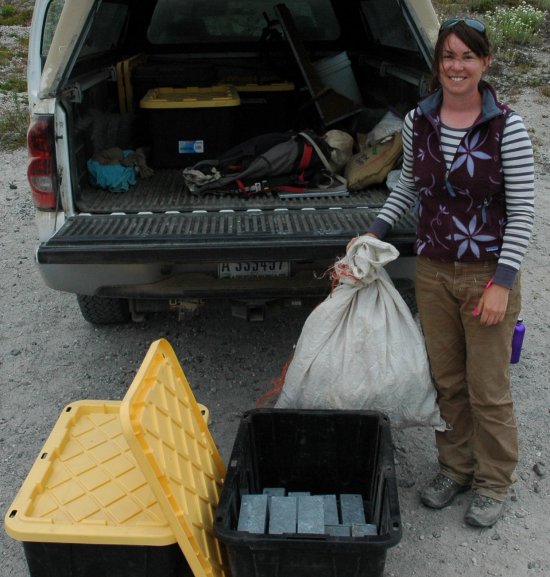
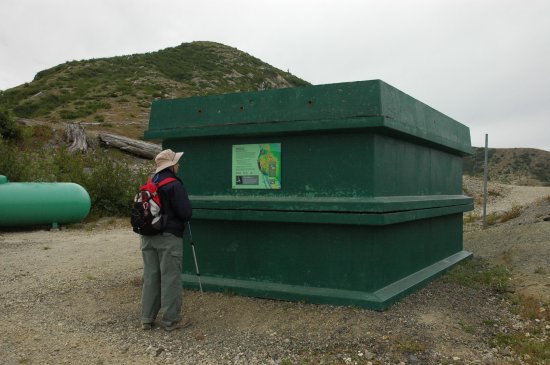
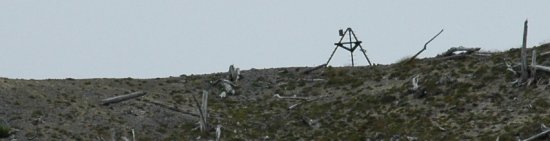
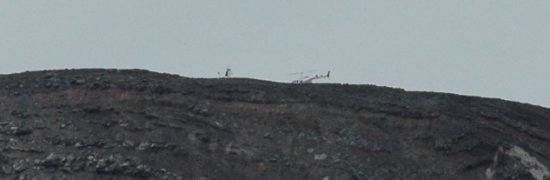
The second thing notable was how much the barren landscape of Mt. St. Helens was dominated by the research work of scientists. Wherever we looked we saw evidence of it. Instruments and sensors could be spotted everywhere. Helicopters transporting scientists flew over repeatedly. We even met a young researcher gathering animal traps, part of the continuing census of life in the blast zone. As she explained to me, they are tracking the changing species as life re-enters and repopulates the dead zone.
From a human perspective, this research is profound. Though natural disasters such as the Mt. St. Helens eruption are not unusual things in the history of our planet, humans have never had an opportunity to study the aftermath of one in such detail. The knowledge gained will be priceless beyond measure. And that we as a society are willing to dedicate the funds to do this work will speak very well of us to future generations.
According to this AP report, the massacre at Fort Hood last November 9, where 13 people were killed by Major Nidal Hasan in the name of Islam, has been designated by the Pentagon as a case of “workplace violence.” If this is true, it is another sad example of the incredible disconnect between fantasy and reality among our society’s leadership.
Another scientific scandal, this time in the field of animal and human cognitive research: Harvard scientist Marc Hauser has admitted to eight instances of misconduct. Three key quotes:
The university said in a statement last week that Dr. Hauser or a co-author had been directed to correct three published papers for which the original data could not be found. [emphasis mine]
Harvard itself had faced growing criticism for not releasing more details of the inquiry since The Boston Globe reported on Aug. 10 that the university had found evidence of scientific misconduct in Dr. Hauser’s lab. On Friday, Michael D. Smith, dean of the Harvard faculty of arts and sciences, issued a letter to the faculty confirming the inquiry and saying the eight instances of scientific misconduct involved problems of “data acquisition, data analysis, data retention, and the reporting of research methodologies and results.” No further details were given.
Harvard’s findings against him, if sustained, may cast a shadow over the broad field of scientific research that depended on the particular research technique often used in his experiments.
Gee, this sure sounds a lot like the Phil Jones/East Anglia University climategate scandal, where both the researcher and his university provided cover for each other, thereby leaving a cloud over a vast amount of climate research that depends on Jones’s data.
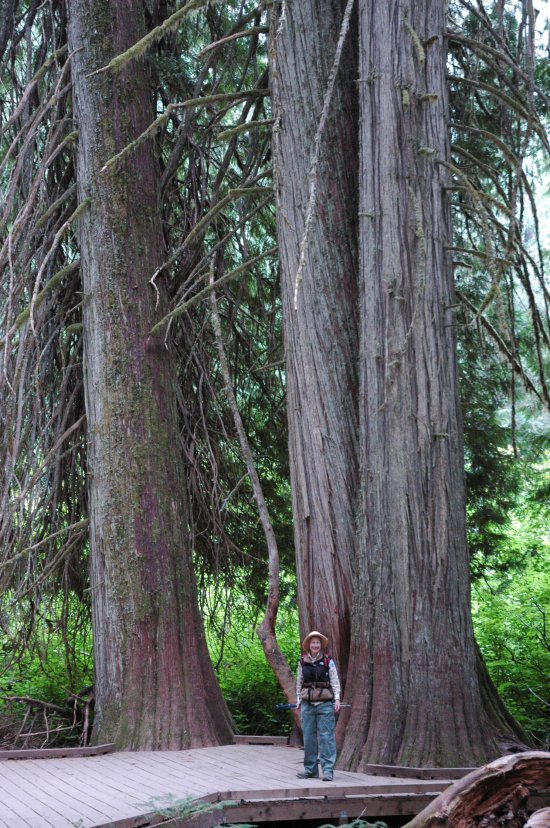
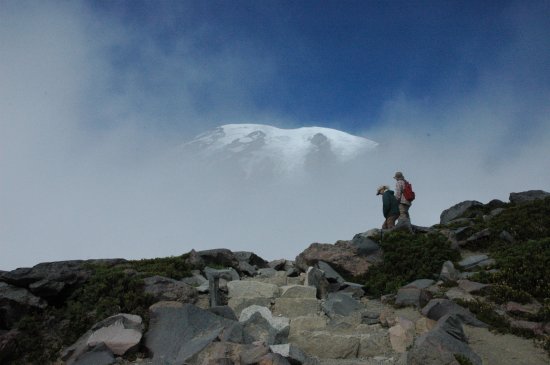
We were back at Mt. Rainier today, this time doing one short hike and one long one, totaling 8.6 miles. The short hike took us to the Grove of the Patriarchs, a small grove of thousand year old trees. The long hike took us up to 7200 feet elevation on the flanks of Mt. Rainier. Unfortunately, the mountain was shy today, keeping itself hidden behind clouds for most of the day. Near the top of the climb the clouds parted for about 30 seconds, and I was able to get a signal snapshot of it. Otherwise, we spent most of the hike in the mist, which was beautiful in its own way.
The charade in Los Angeles on Monday when President Obama arrived for a fundraiser and shut down traffic during rush hour — causing a storm of angry protest — is another very obvious illustration of the great disconnect between today’s ruling class and the general public.
It’s not just that Obama seemed oblivious to the traffic chaos he created. It is that he, as well as most politicians today (from both parties), truly expect large areas of a city to be closed down for their convenience, and don’t seem to give a damn that by doing so they make life miserable for everyone else.
To paraphrase what Glenn Reynolds likes to say, traffic jams are for “the little people.”
Obama’s actions here are far from new and have actually been deeply institutionalized since the 1960s, following Kennedy’s assassination. Originally designed to protect a president from attack, the shutting down of highways quickly became a tool to make the president’s life as easy as possible while demonstrating to all his lordly superiority.
For example, I personally experienced this kingly arrogance back in 1979. I needed to get from my house in Astoria, Queens, to LaGuardia Airport, normally a very short 10 minute drive. But as I pulled into the ramp for the Brooklyn-Queens Expressway I found myself being waved to a stop by a policeman. The expressway was being closed so that President Jimmy Carter could use it. I, along with hundreds of others, was forced to sit there for thirty minutes, waiting for his entourage of approximately thirty limousines finally go by. To say that this infuriated me is to put it mildly.
Nor do I think this behavior is reserved to Democrats. I am sure that my readers could easily cite similar events during past Republican administrations.
Nor is it limited to American political leaders. The ruling class of the defunct Soviet Union made it offical policy. There, those in power built many urban roadways with special lanes reserved exclusively for communist party officials. Moreover, when they used those lanes the street lights could be commandeered, turning them all green so that anyone on a cross street had to wait.
In the U.S. we have not yet come that far. Yet, that presidents feel it their right to shut down entire transportation systems for their mere convenience suggests that sadly we don’t have that far to travel.
Unless of course the public, which still has the vote, does something about it.