A day spent in Paradise

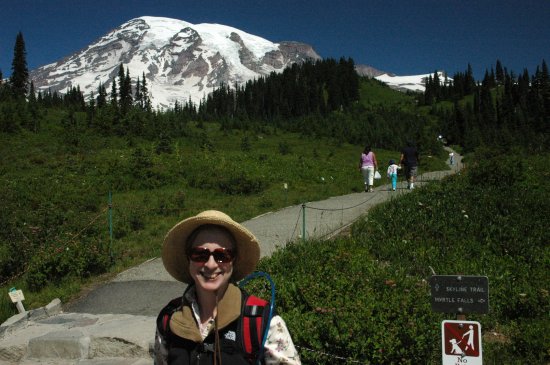
Diane and I spent today hiking the shorter trails near the visitor center at Mt. Rainier, in an area called Paradise. Below are two pictures to give you a feel. Tomorrow we start on some longer hikes, getting higher on the mountain. Later in the week we head to Mt. St. Helens.

Diane at the start of the trail

Alpine flowers

0 comments

Old Media, Old News

The New York Times today published an op-ed outlining the serious dangers we face should the Sun unleash a solar flare or coronal mass ejection of sufficient power to knock out our electrical grids. After describing the horrors of Hurricane Katrina, the author then says

We are similarly unready for another potential natural disaster: solar storms, bursts of gas on the sun’s surface that release tremendous energy pulses.

Now this might be interesting, had it been published in 1988. At that time, the electrical grids used in the U.S. and Canada were very much unprepared for a sudden solar storm. Moreover, the Sun at that time was ramping up towards a particularly active solar maximum. The result: On March 13, 1989, the power grid that supplied electricity to Quebec and 200 utility companies in the U.S. came crashing down, overloaded by a power surge caused by a burst of energy sent hurtling towards the Earth, by the Sun.

However, to report this threat today as if it was news is somewhat laughable. Since the 1990 solar maximum, the world’s electrical systems have been very much aware of the problem and have instituted numerous safeguards should the Sun burp at them again. It was for this reason that there were few problems during the next solar maximum in 2001, even though it was almost as powerful as the maximum in 1990.

The real news story concerning the Sun is how inactive it has been, for reasons scientists do not understand. Not only was the recently concluded solar minimum the longest and deepest in almost a hundred years, the subsequent solar activity leading to the next solar maximum has been far weaker than every prediction. At the moment, the Sun appears headed for the weakest solar maximum in two hundred years. And when that last happened, the Earth experienced a period of significantly cold weather, also for reasons that scientist do not yet understand.

It is this story that journalists should be covering.
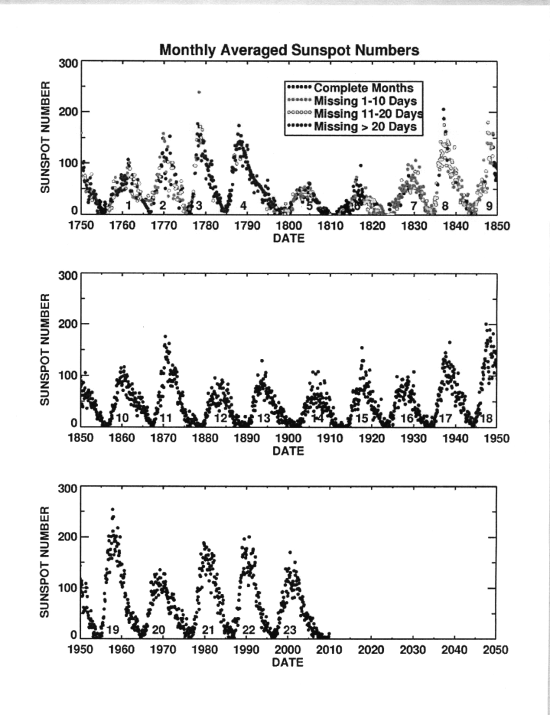
the solar cycle

2 comments

More questions raised about Mann’s hockey stick graph

A new research paper, written by statistical scientists and to be published next month in the Annals of Applied Statistics, has found that Michael Mann’s hockey stick graph, showing a steep increase in global temperature in the last two hundred years, is statistically invalid. Key quote:

Research on multi-proxy temperature reconstructions of the earth’s temperature is now entering its second decade. While the literature is large, there has been very little collaboration with university level, professional statisticians (Wegman et al., 2006; Wegman, 2006). Our paper is an effort to apply some modern statistical methods to these problems. While our results agree with the climate scientists findings in some respects, our methods of estimating model uncertainty and accuracy are in sharp disagreement.

[We] conclude unequivocally that the evidence for a ”long-handled” hockey stick (where the shaft of the hockey stick extends to the year 1000 AD) is lacking in the data. The fundamental problem is that there is a limited amount of proxy data which dates back to 1000 AD; what is available is weakly predictive of global annual temperature. Our backcasting methods, which track quite closely the methods applied most recently in Mann (2008) to the same data, are unable to catch the sharp run up in temperatures recorded in the 1990s, even in-sample. [emphasis mine]

In other words, the temperature data going back to 1000 AD is poor, and cannot be reliably used to prove a sudden increase in global temperature in the last two hundred years. More importantly, according to this paper, Michael Mann tried to use statistics to prove his point, without consulting any statisticians.

0 comments

Sloppy journalism from the BBC

Though solar scientists have discovered that certain recent solar behavior might help explain the long and deep solar minimum that just ended, this BBC article immediately tries to give that result credit for explaining everything. To quote:

Solar physicists may have discovered why the Sun recently experienced a prolonged period of weak activity.

NOT! The result only observed a change in solar behavior beneath the surface, whereby the meridional flow slowed down as well as lengthened significantly into the high latitudes, and that this change occurred at the same time as the weak solar minimum. The paper made no attempt to explain why this happened, nor did it provide a theoretical explanation for how these changes resulted in a weak solar minimum.

Finally, and far more important, scientists still have no good theory for explaining the solar cycle in the first place. “We think it’s the solar dynamo [that causes the solar cycle],” noted Dean Pesnell of the Goddard Space Flight Center when I interviewed him for my Sky & Telescope article, What’s Wrong with Our Sun? (August 2009). “But we don’t undertand how the dynamo works, as yet.”

The BBC should be more careful in how it reports a story like this.

2 comments

Astronomers announce their recommendations for the next decade

After two years of discussion among hundreds of astronomers, the committee for the 2010 Decadal Surveyn for Astronomy and Astrophysics announced its recommendations today. The two main recommendations were

The report also called for the federal government to become a partner in one of the two giant ground-based optical telescopes now in the planning stages. In addition, the report recommended that the government increase its participation in the Laser Interferometer Space Antenna (LISA), a space telescope designed to detect gravity waves, as well as commit monies to begin the design work for a new high resolution X-ray space telescope. Other recommendations including asking NASA to increase its support for medium-sized space telescopes.

The report did not recommend any replacement for the Hubble Space Telescope.

This report follows earlier decadal surveys, for the 1970s, 1980s, 1990s, and 2000s, all of which had enormous influence on what federal agencies and astronomers built over the following decade. For example, these decadal surveys recommended the construction of the VLA, the Chandra X-Ray Observatory, the Spitzer Space Telescope, and a host of other telescopes, all of which were built.

0 comments

Reporter arrested for discussing politics

Freedom of speech alert. In this post, I noted that though it seemed as if the arrest of four protesters on the University of Texas campus during a visit by President Obama seemed a violation of their rights, there wasn’t enough information in the reports to know for sure. We now have more information. Read this report also. And watch this video of the arrest of one protester, while wearing a press badge, and tell me if this isn’t an abuse of power.

0 comments

Rebuilding the American space program — the right way

In reading my post, Both for and against the Obama plan, reader Trent Waddington emailed me to say that this “is so fatalistic that it seems you don’t think it is worthwhile even spending a few minutes explaining why the policy is good. It’s easy to dismiss something a politician says as the stopped clock that is right twice a day. It’s harder to set aside your skepticism and explain why something is good policy.”

Trent is absolutely correct. What I wrote was very depressing and fatalistic. However, I think it very important to be coldly honest about things, no matter how bad they look. Once you’ve done that, you then have the right information necessary for fixing the situation.

My problem with most of the debate about the future space policy of the United States, — as well as innumerable other modern issues faced by our government — is that people don’t seem to want to face up to the reality of the problem. In the case of space and Obama, I doubt any advice, gentle or otherwise, is going to move him into putting forth a plan for NASA that has any realistic chance of getting passed by Congress. As I noted in a different post, he doesn’t play the game. He acts like the worst sort of autocrat, convinced that if he simply says what he wants to do, everyone must agree.

The reason the good part of his plan (commercial space) is not passing Congress is not because people think it is a bad idea. It is being rejected because » Read more

3 comments

Mapping daylight at the Moon’s South Pole

Using data from the Japanese lunar orbiter Kaguya, scientists have identified several locations near the Moon’s south pole that are in daylight from 86 to 94 percent of the time. Key quote from abstract:

The place receiving the most illumination (86% of the year) is located close to the rim of Shackleton crater at 88.74°S 124.5°E. However two other areas, less than 10 km apart from each other, are collectively lit for 94% of the year. We found that sites exist near the south pole that are continuously lit for several months during summer. We were also able to map the locations and durations of eclipse periods for these areas. Finally we analyzed the seasonal variations in lighting conditions, from summer to winter, for key areas near the south pole. We conclude that areas exist near the south pole that have illumination conditions that make them ideal candidates as future outpost sites. [emphasis mine]

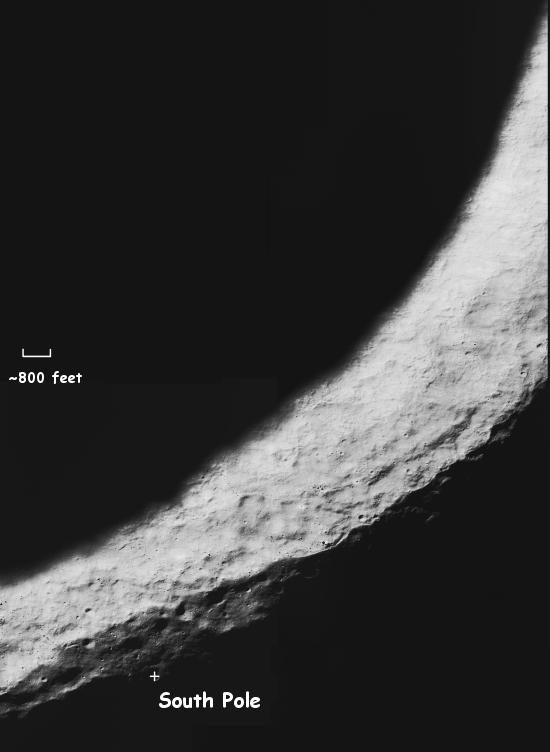
Below is a composite close-up image of the rim of Shackleten crator that I assembled using this Lunar Reconnaissance image. The key quote from the full caption :

The full [Narrow Angle Camera] mosaic reveals a shelf on the southeast flank of the crater that is more than two kilometers across and perfectly suitable for a future landing. The extreme Sun angle gives the surface an exaggerated rough appearance, but if you look closely at this scale any area that is between the small craters might make a good landing site.

Rim of Shackleton Crater

1 comment

Melting Ice on Mars?

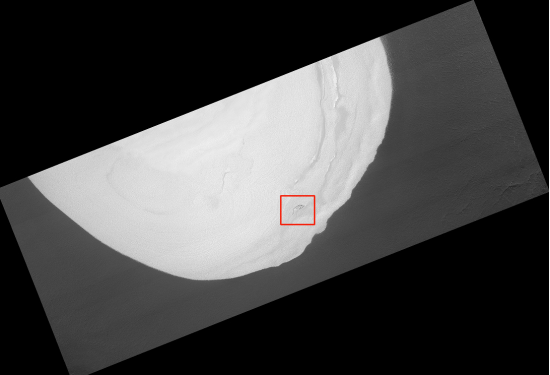
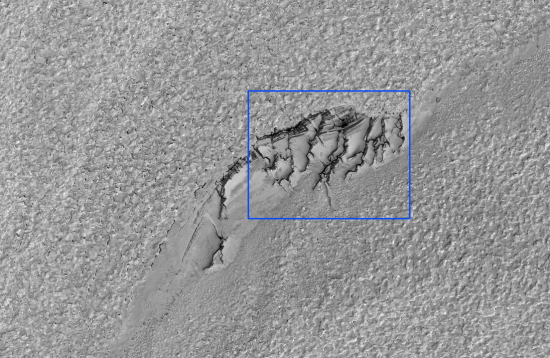
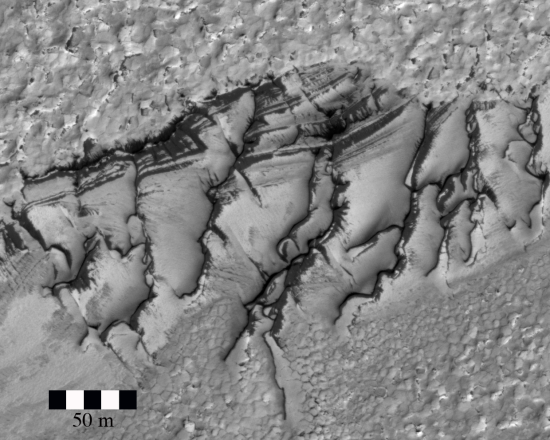
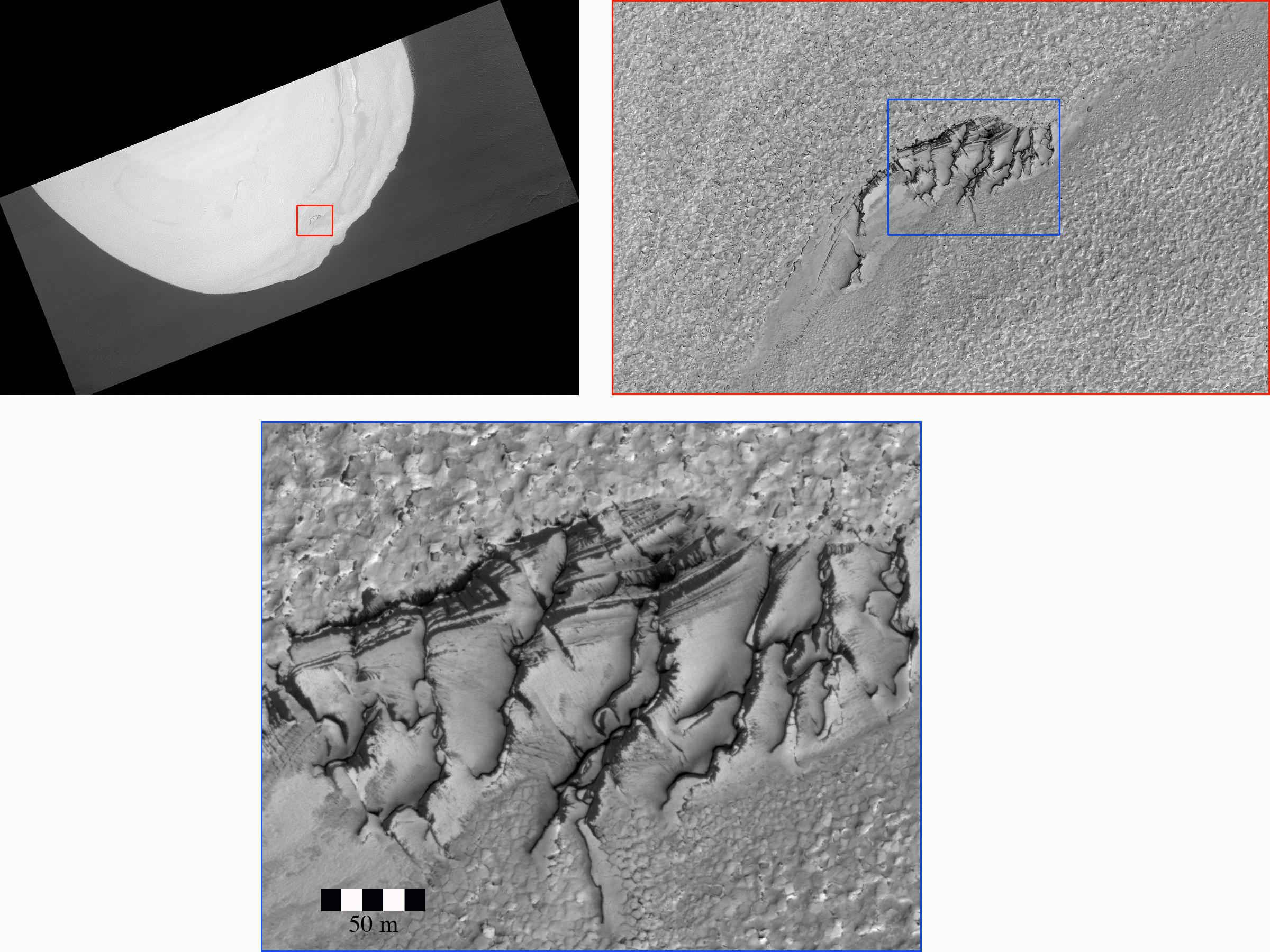
These Mars Reconnaissance Orbiter images show in increasing magnification a puzzling feature in the southeast part of a ice mound in Louth Crater on Mars. Located at 70 degrees north latitude, this is the farthest south that scientists have found permanent water ice. The close-up image suggests melting ice with the draining water running down hill to the south, though on Mars the low air pressure would cause any liquid water to evaporate instantly. Key quote:

These may be the crests of partially defrosted dark sand dunes or perhaps some other feature that we do not understand. This is the only area on Louth where these enigmatic ridges are found.

wide view of crator mound

Middle view of ice mound

Closeup of ice mound

0 comments

Saturn’s ring shadow widens

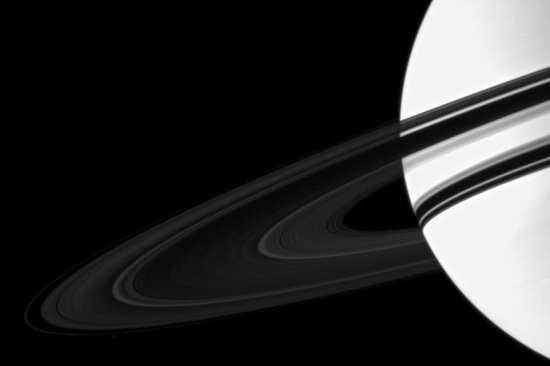
This stunning image of Saturn, taken by Cassini on June 24, 2010, shows the ring’s widening shadow across the planet. As the planet orbits the Sun the tilt of its rings relative to the Sun changes with time. In August 2009 the tilt was essentially zero, so that the shadow was very narrow. Since then the tilt has been increasing, as has the width of the shadow.

Saturn and its rings

0 comments

The great disconnect

The recent history of NASA illustrates a fundamental problem with how our political class thinks.

In 2004 George Bush announced that NASA would have a new goal, that of the exploration of the solar system. The shuttle would complete construction of the International Space Station and then be retired in 2010. NASA would meanwhile build a replacement for the shuttle, designed to return to the Moon and beyond, and have it flying by 2014.

Notice the gap? The shuttle retires in 2010, four years before its replacement is available. Notice also that the plan insisted that ISS would be finished, fully occupied, and in need of significant resupply and maintenance during this entire time, when neither the shuttle or its replacement would be on hand.

Yet, as obvious as this seems, no one at NASA, in the Bush administration, or in Congress, seemed to notice this gap. The Bush plan was implemented exactly as described, so that today we are about to be left with a space station in orbit and no way to reach it for at least four years. (That other countries can reach the station changes nothing: the United States has been left hanging, lacking a method for transporting its crews to its own space station.)

It was as if, among the political and elite class that runs the government, there was great disconnect between the fantasy of the intended plan and the reality of its implementation. » Read more

3 comments

A ground-based telescope matches the Hubble Space Telescope-NOT

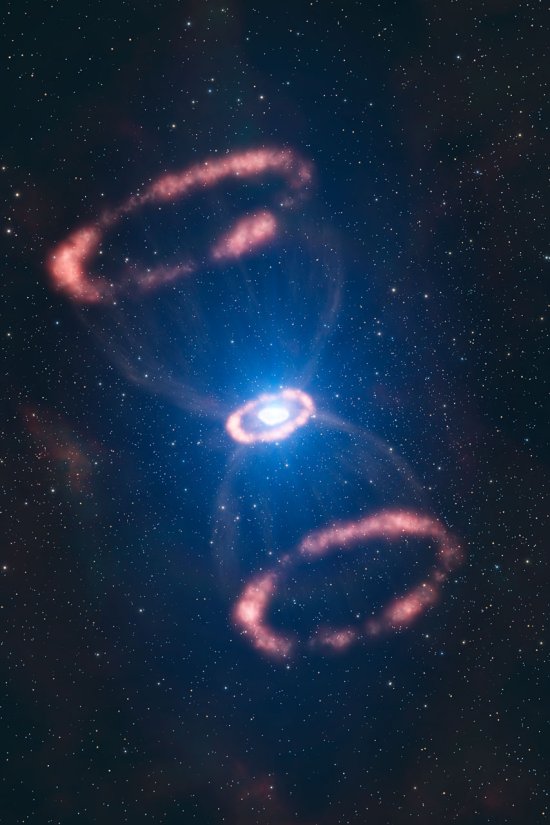
Correction.Regular reader James Fincannon emailed me to say that he thinks the image below is an artist’s impression. He is correct. I should have looked more closely at the press release. In reading the actual research paper [pdf] on the results it seems that the VLT did some very sophisticated spectroscopy, thereby measuring the uneven distribution of the velocity and density of the gas around the star. The image below was then created, based largely on Hubble images combined with the new data. In other words, this ground-based telescope did not match the abilities of a space-based telescope in any way. Had the Hubble images not existed the astronomers would have struggled to interpret their spectroscopic data.

Some important astronomy news: The European Southern Observatory’s Very Large Telescope (VLT) has released this spectacular image of supernova 1987a, the first and so far only supernova visible to the naked eye since the invention of the telescope.

SN1987a

This image is important for two reasons. First, The data shows that the supernova explosion was not symmetrical, with more material being thrown outward in some directions than in others. This fact confirms what astronomers in recent years have increasingly come to believe: Supernovae explosions are not simple spherical bursts, but chaotic events ripping stars apart in a lopsided manner.

Second, this image demonstrates that ground-based telescopes are becoming amazingly good at doing what the Hubble Space Telescope has done routinely for the past two decades. Five years ago, no telescope on the ground could have resolved the inner ring of supernova 1987a. Only Hubble in space had that capability. Now, VLT can do it, almost as well as Hubble. Though a space-based telescope can still beat any ground-based telescope, it is great news that the technology for ground-based telescopes has improved so much, especially since there presently are no plans to replace Hubble.

0 comments
1 133 134 135 136 137 139