Only one step short of tyranny

Obama is asking the court for the right to assassinate American citizens, without due process, and in total secret. Key quote:

Both the Bush and Obama administrations have repeatedly insisted that their secret conduct is legal but nonetheless urge courts not to even rule on its legality. But what’s most notable here is that one of the arguments the Obama DOJ raises to demand dismissal of this lawsuit is “state secrets”: in other words, not only does the President have the right to sentence Americans to death with no due process or charges of any kind, but his decisions as to who will be killed and why he wants them dead are “state secrets,” and thus no court may adjudicate their legality. [emphasis in original]

The Bush administration was wrong when it tried to imprison an American citizen without trial. The Obama administration is even more wrong now to claim it has the right to kill an American citizen without trial. Such behavior is unconscionable.

1 comment

A November wipe-out

This article suggests that the Republican victory in November is going to be far greater than any polls have indicated. Key quote:

Only about 160 of the Democrats’ 239 Congressional Districts are even remotely considered to be in play. But that playbook is badly out of date. The Republican message has raced far ahead of the GOP campaign and put a lot of new seats in play. We just have to work these districts to win them.

In fact, there are no polls to analyze in most of these 160 districts. Nobody considered them in play enough to poll them. We just don’t know how vulnerable these extra incumbents are. But, given the surprising vulnerability of the first eighty seats, we believe that a substantial number of these formerly invincible Congressmen can be ousted. [emphasis mine]

I strongly suspect that my home district, the 5th Congressional district of Maryland, is one of these 160 unknown districts. My congressman, House Majority Leader Steny Hoyer, is running against Republican Charles Lollar. For years this district has been considered safe for Steny. No more.

Lollar, a black conservative with Tea Party connections, has run an aggressive campaign, raised lots of money, and has been unafraid of taking the race into the hardcore Democratic areas near Washington. His signs are up everyone, only a week after clinching the nomination in the primary.

Come November 2, I think that the results from this district will be a stunning upset. I also think these results will only be one example among many others.

Full disclosure notice: In all my life, I had never given money to any political candidate. I considered such contributions a waste of my money. This year, however, I broke that string. Soon after the healthcare bill passed Congress (under Steny Hoyer’s leadership), I contributed $200 to Charles Lollar’s campaign. Not only do I believe this contribution will not be a waste of money, I think the fact that I did it is another indication that the results of this coming election will be very surprising.

1 comment

The crumbling cliffs of Mars

Among the new images posted last week by the HiRise camera on Mars Reconnaissance Orbiter is a picture showing the layered and looping ridgelines within Galle Crater. A close-up of these ridgelines revealed the precarious nature of those crumbling cliff tops.

Below is a low resolution version of the image, with a high resolution cropped inset below that, showing a close-up of the most interesting looking area. In the inset you can see that the top of the cliff has separated away. It almost looks as if several large pieces are about to break off. You can also see that the top of the cliff to the north is made up of hanging rocks that appear to almost float in the air. They too look as if they are about to break off.

What makes this even more intriguing is that there are no boulder piles at the bottom of any cliff. All we can see on the valley floor is a pattern of polygonal fractures, possibly “due to ground ice, or regional tectonic stresses.” If large pieces of these ridge lines are breaking off periodically, as they surely appear to be doing, where has the debris gone?

Martian cliffs

crumbling cliffs

0 comments

A scientist’s ten commandments

Published today on the astro-ph website, this preprint by Ignacio Ferrín of the Center for Fundamental Physics at the University of the Andes, Merida, Venezuala, is probably the shortest paper I have ever seen. I think that Dr. Ferrin will forgive me if I reprint it here in its entirety:

1. Go to your laboratory or your instrument without any pre-conceived ideas. Just register what you saw faithfully.

2. Report promptly and scientifically. Check your numbers twice before submitting.

3. Forget about predictions. They are maybe wrong.

4. Do not try to conform or find agreement with others. You may be the first to be observing a new phenomenon and you may risk missing credit for the discovery.

5. Criticism must be scientific, respectful, constructive, positive, and unbiased. Otherwise it must be done privately.

6. If you want to be respected, respect others first. Do not use insulting or humiliating words when referring to others. It is not in accord with scientific ethics.

7. Do not cheat. Cheating in science is silly. When others repeat your experiment or observation, they will find that you were wrong.

8. If you do not know or have made a mistake, admit it immediately. You may say, “I do not know but I will find out.” or “I will correct it immediately.” No scientist knows the answer to everything. By admitting it you are being honest about your knowledge and your abilities.

9. Do not appropriate or ignore other people’s work or results. Always give credit to others, however small their contribution may have been. Do not do unto others what you would not like to be done unto you.

10. Do not stray from scientific ethics.

It seems that some scientists in the climate field (Phil Jones of East Anglia University and Michael Mann of Pennsylvania State University are two that come to mind immediately) would benefit by reading and following these rules.

1 comment

Now it’s “global cooling”!

So now that the “global warming” narrative is beginning to fall flat (sorry John Holdren, but I refuse to play your game and call it “global climate disruption”), what do the elite apparachiks worldwide decide to do? They get together in a private meeting in Spain in June to discuss the future threat from global cooling.

What was that? Did I hear you right? Did you say “global cooling?”

Yup. Key quote from the meeting announcement:

The 58th Bilderberg Meeting will be held in Sitges, Spain 3 – 6 June 2010. The Conference will deal mainly with Financial Reform, Security, Cyber Technology, Energy, Pakistan, Afghanistan, World Food Problem, Global Cooling, Social Networking, Medical Science, EU-US relations. Approximately 130 participants will attend of whom about two-thirds come from Europe and the balance from North America. About one-third is from government and politics, and two-thirds are from finance, industry, labor, education, and communications. The meeting is private in order to encourage frank and open discussion. [emphasis mine]

If it’s not one thing, it’s another. The goal has never been to save the Earth, but to grab power. Now that the public is questioning the reality of the global warming meme, these blowhards have to come up with some other crisis they can use to maintain their positions of power and control. And if it isn’t getting hotter, maybe it’s getting cooler? Never mind the facts or the science, which remains confused and complex. All they want is some justification, no matter how unjustified, for telling everyone else how to live their lives.

One more thought: How much do you want to bet that a good majority of the participants (the full list) flew in on private jets?

James Delingpole of the Telegraph uncovered this little tidbit, and has some blunt but very true words to say about it.

1 comment

Birthplace of the Sun?

In a preprint [pdf] posted today on the astro-ph website, astronomers outline the discovery of a star more like a twin of the Sun than any previously discovered. The star is located in the galactic star cluster M67, 3000 light years away. The similarity is so close that the scientists even speculate that the Sun itself might have formed in this same cluster, 4.5 billion years ago. Key quote from paper:

The similarity of the age and overall composition of the Sun with the corresponding data of M67, and in particular the agreement of the detailed chemical composition of the Sun with that of M67-1194, could suggest that the Sun has formed in this very cluster. According to the numerical simulations by Hurley et al. (2005) the cluster has lost more than 80% of its stars by tidal interaction with the Galaxy, in particular when passing the Galactic plane, and the Sun might be one of those. We note that the orbit of the cluster encloses, within its apocentre and pericentre, the solar orbit. However, the cluster has an orbit extending to much higher Galactic latitudes, presently it is close to its vertical apex at z = 0.41 kpc (Davenport & Sandquist 2010), while the Sun does not reach beyond z = 80 pc (Innanen, Patrick & Duley 1978). Thus, in order for this hypothesis of an M67 origin of the Sun to be valid, it must have been dispersed from the cluster into an orbit precisely in the plane of the Galactic disk, which seems improbable.

The last sentences above refer to the different orbital inclinations of the galactic orbits of both the Sun and M67. M67’s orbital inclination is far steeper. While M67 is presently about 1350 light years (410 parsecs) above the galactic plane, the Sun’s orbit never takes it more than 261 light years above the plane.

One more point of interest: M67 is a well known object to amateur astronomers, located in the constellation Cancer.

0 comments

The moons of Saturn

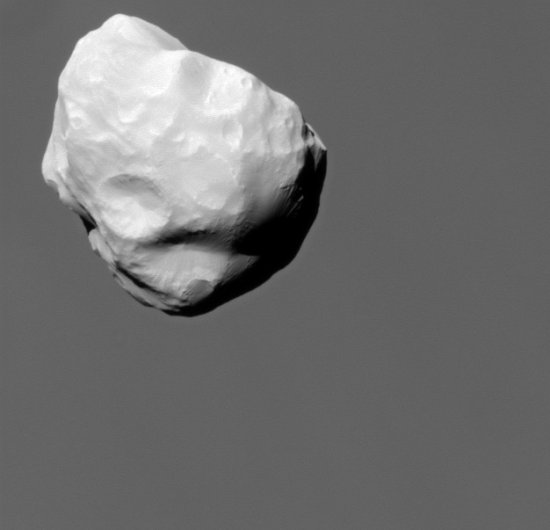
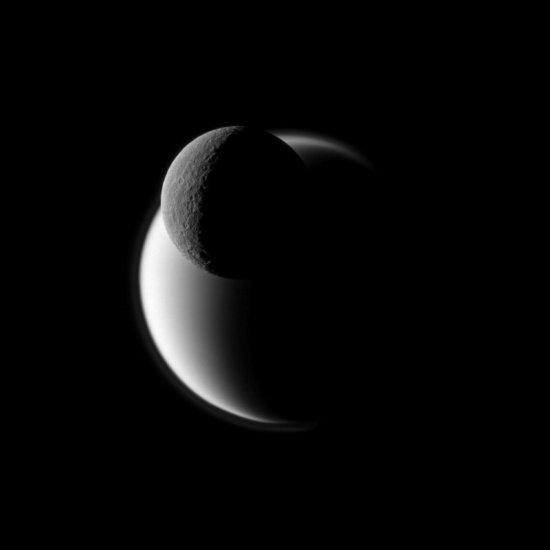
The Cassini spacecraft orbiting Saturn continues to send back a wealth of data, and some gob-smacking wonderful images. Below are two of the more recent examples. The first is not a computer-generated graphic: it shows the small moon Helene (21 miles across) during a fly-by on March 3, 2010, with Saturn’s atmosphere providing the background. The second captures Saturn’s two largest moons, with the smaller Rhea crossing in front of the larger Titan.

Saturn's moon Helene

Rhea eclipses Titan

0 comments

First tests of beer in zero gravity

Who says space exploration is dead? Sometime in November researchers will conduct the first zero gravity tests of the world’s first beer to be certified for drinking in space. The tests will take place during suborbital flights of what is commonly known as the Vomit Comet. Key quote:

Sampling the beer during weightless parabolas, the flight researcher will record both qualitative data on beverage taste and drinkability and biometric data on body temperature, heart rate, and blood alcohol content.

0 comments

Federal spending is out of control and NASA’s gonna get what it wants?

You think NASA’s going get money this year or next? Or ever? In one graph (see below), this article shows how completely out of control federal spending has become, beginning in 2007, with no end in sight. Key quote:

Until this skyrocketing spending growth is arrested and reversed, we suspect that government spending has become disconnected from the ability of any American household to support it.

out of control

0 comments

Something’s coming, something good

Three polls issued today make it very clear that the upcoming November elections are going to be a very different animal than any election anyone has seen in decades.

First, Public Policy Polling (PPP) finds that in the West Virginia race for the Senate seat formerly held by Robert Byrd, long shot Republican John Raese is leading shoe-in Democrat Joe Manchin by 3 points.

Second, Rasmussen finds that not only is Republican Joe Miller leading his opponents in the Alaska Senate race by 15%, the Democrat candidate, Scott McAdams, can only garner 25%. Meanwhile, Lisa Murkowski, who lost to Miller in a primary upset, is doing almost as bad as an independent write-in candidate, with 27%.

Third, a Quinnipiac poll shows Republican Tom Corbett destroying Democrat Dan Onorato by a 54-39 margin in the race for Pennsylvania governor.

Not only do these numbers show a willingness of the public to consider new and unknown candidates and reject incumbents, they also show a surprising hostility to Democrat candidates in regions that have always been considered Democrat strongholds. In West Virginia, the accepted wisdom was that the Democrat Manchin would be nominated and then annointed. Not so. In Alaska, not only did Miller upset the incumbent Murkowski in the Republican primary, voters apparently have little interest in seeing her return to office, or give her Democrat rival the job either. And in Pennsylvania, a swing state that has in recent years been swinging increasingly Democratic, the numbers show instead a complete reversal of that trend and a total rejection of the Democrat candidate.

Yes, November 2nd is going to be an interesting day indeed.

Update: Another poll released today from PPP and commissioned by the leftwing website, Daily Kos, continues these astonishing trends. In the Wisconsin Senate race, Democrat incumbent Russ Feingold now trails Republican Ron Johnson by 11% points. And in Wisconsin governor’s race, the same poll found the Republican leading by 9%.


1 comment

The United States, as seen from the Moon

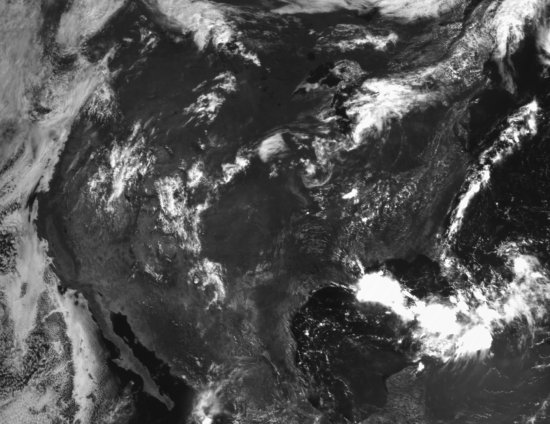
On August 9, 2010 the camera on Lunar Reconnaissance Orbiter took some routine calibration images and captured the Earth from lunar orbit, showing the western hemisphere with relatively little cloud cover. The picture below is a tiny piece from that global image, cropped to show the United States. The details are pretty remarkable, considering the distance. You can explore the full global image in detail here.

The U.S. from the Moon

1 comment

Something is recycling the methane on Mars

Research results posted today [pdf] at the European Planetary Science Congress show that the methane in Mars’s atmosphere is seasonally variable and far more short-lived than predicted, disappearing in less than a year. Some process, therefore, must be both using it and replenishing it. On Earth, that’s almost always done by some form of life process. Key quote by one of the scientists, from the press release:

“Only small amounts of methane are present in the martian atmosphere, coming from very localised sources. We’ve looked at changes in concentrations of the gas and found that there are seasonal and also annual variations. The source of the methane could be geological activity or it could be biological ­ we can’t tell at this point.”

The image below shows the three regions (in yellow) where the methane is concentrated.

Mars methane locations

0 comments
1 130 131 132 133 134 139