The August monthly sunspot graph

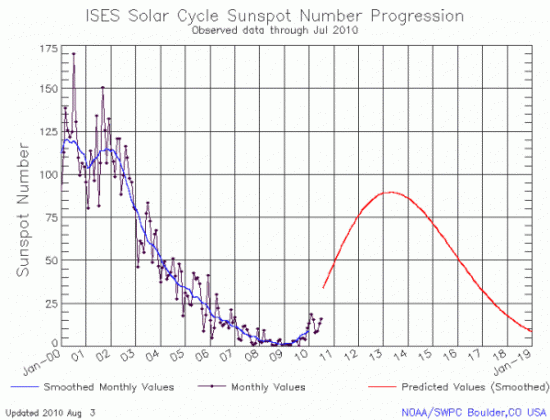
Waking up is hard to do. Today NOAA’s Space Weather Prediction Center once again published its monthly graph, showing the progress of the sun’s sunspot cycle in comparison with the consensis prediction made by the solar science community in May 2009.

August 3, 2010 Solar Cycle progression

As I noted when I posted the July graph, the data continues to show that the Sun’s ramp up to solar maximum is far slower and weaker than predicted, despite the stories this week about how Sunday’s coronal mass ejection demonstrates that the sun is “waking up.”

1 comment

Lost British ship found in Arctic after almost 150 years

Using sonar equipment Canadian archeologists have detected the underwater remains of the British ship Investigator, abandoned in the Canadian archipelago of islands by Captain Robert McClure and his crew in 1853. McClure had been sent out to both find the Northwest Passage as well as locate the missing Franklin expedition. As winter had set in in September 1851, however, McClure had anchored the ship for refuge in a bay he named Mercy Bay on the coast of Banks Island. As Pierre Berton noted in his wonderful history of the exploration of the Arctic in the 1800s, The Arctic Grail, Mercy Bay was not a refuge but “a cul-de-sac in which the crew would be confined for the next two years and from which the ship itself would never be freed.” Now, that ship has been rediscovered after almost 150 years.

0 comments

Picture of the day from Mars

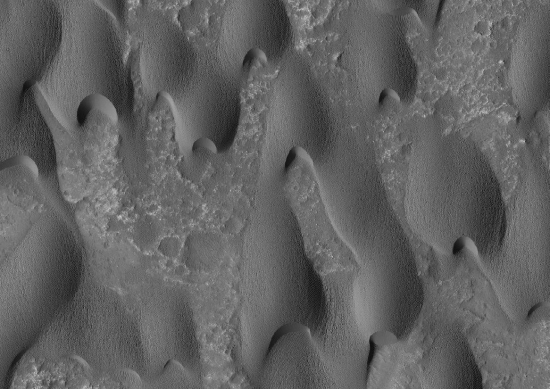
Sand dunes on Mars, from the HiRise camera on Mars Reconnaissance Orbiter:

Dunes on Mars

Fun quote:

These dunes are “barchan” dunes, which are also commonly found on Earth. Barchan dunes are generally crescent-shaped, with their “horns” oriented in the downwind direction. They have a steep slip face (the downwind side of the dune). Barchan dunes form by winds that blow mostly in one direction and thus are good indicators of the dominant wind direction. In this case, the strongest winds blow approximately north to south.

0 comments

The failure of the past and a hint of the future

The coolant system failure on the International Space Station this weekend and the upcoming spacewalks being planned to fix it is a dramatic and fascinating story, capturing the interest of the general public while causing some news pundits to express fear and dread about science fiction scenerios of disasters in space.

The situation is hardly that death-defying. The station’s cooling systems have a lot of redundancy, all of which are being used to good effect. Moreover, the spacewalk repair to install a replacement pump module, though challenging, is exactly the kind of thing the astronauts have been trained to do. I expect them to do it with few problems. I would be far more surprised if they have serious difficulties and fail to get it done.

What this failure foreshadows, however, is the future on ISS. As the years pass and systems age, » Read more

3 comments

Poor leadership by Obama on NASA

Glenn Reynolds of Instapundit today said the following (in recognizing Jeff Foust’s op-ed for Technology Review):

CONGRESS BLOWS IT: Commercial Spaceflight, We Have A Problem. Congress will always choose short-term pork over long-term development unless thereโ€™s strong Presidential leadership. But while the Obama space policy is good, the White House hasnโ€™t provided the kind of legislative push it takes to make it work. Without strong leadership, a good policy will always lose out to pork.

Didn’t someone say this already? In fact, didn’t that someone say this more than once?

0 comments

Single Rope Techinque — on the Moon

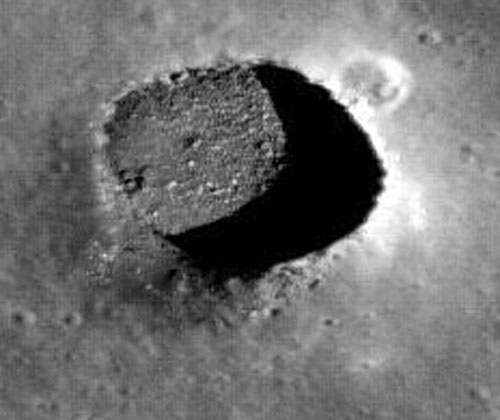
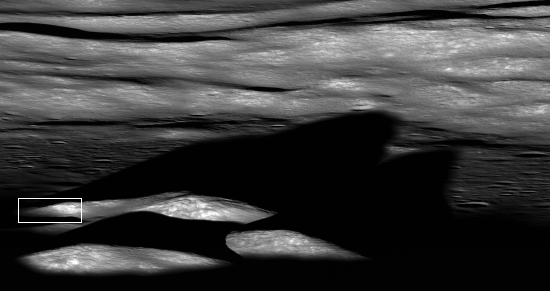
James Fincannon of NASA took the two images of the Marius Hills lunar pit taken at different times by Lunar Reconnaissance Orbiter (which I posted here) and did an overlay so that the shadow produced by pit’s rim could be easily compared with the rim itself (see below). He then did some calculations based on the sun’s angle of light shining into the cave and came up with the following calculations:

I estimate it is 60 meters from rim to bottom. The floor is flat below the surface. The rocks on the flat surface below ground are in stark relief (hard shadows) compared to above ground due to the sun coming only at one angle while above ground the albedo/reflections makes for soft shadows at this high sun angle (65 deg elevation). I cannot tell if the black portion of the combo image is a slope or more flat floor. Need a different high sun angle or azimuth to fill that in. Still I like the general pattern of the rim matching the shadow on the floor, although the image I found originally has that edge of the cave rim in shadow for a large extent.

overlay of Marius Hill cave

A 60 meter drop is about 200 feet deep. This result is reasonably close to the depth estimated by Japanese scientists, 88 meters or 288 feet, based on images of the same lunar pit taken by their Kaguya probe.

Knowing the approximate depth of the entrance pit raises the much more important question: How will future lunar explorers to get to the bottom of this pit? It is ironic » Read more

9 comments

Deniers of science

On Saturday (July 24) the American Geophysical Union published a paper in Geophysical Research Letters, entitled “Northern Hemisphere winter snow anomalies: ENSO, NAO and the winter of 2009/10.” This paper attempted to explain the unusually cold 2009-2010 winter, with its record snow falls.

The conclusions of the paper were reasonable, noting that this past winter experienced both an El Nino event in the Pacific as well as a very negative (cold) North Atlantic Oscillation (NAO). To quote the paper’s conclusions: “In winters when an El Nino event and a negative NAO combine, analysis reveal that there are positive snow anomalies across the southern U.S. and northern Europe.”

The authors of the paper made no attempt to explain why these two climate events “combined” this past winter, which in the field of climate change is actually the essential question. What caused it? Moreover, did the deep and extended negative (cold) phase of the Arctic Oscillation (AO) contribute as well, and if so, why did the AO also go negative this winter? And finally, were all these climate events somehow related to the Sun’s unusally long and deep solar minimum?

That they didn’t answer these fundamental questions is not surprising. Climotogists have been struggling with them for decades, and to expect this quickly written paper focused on this one climate event — the cold winter of 2009-2010 — to answer them would be unreasonable. In fact, considering the state of our knowledge, it probably is impossible for any paper to answer these questions at this time.

What makes this particular paper really noteworthy, however, is a quote in its introductory paragraphs:

The wintry winter has encouraged deniers of global warming » Read more

1 comment

Exploring virgin cave passage

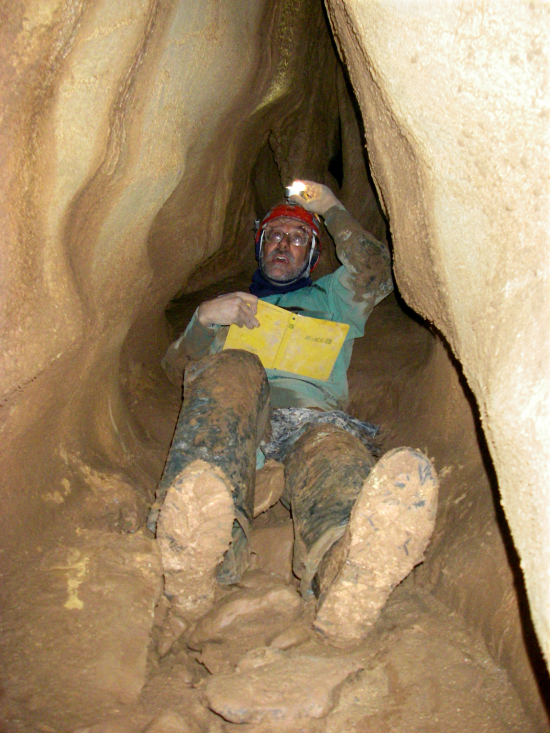
As I mentioned previously, last weekend I was in West Virginia exploring and surveying some newly discovered cave passages. These pictures, taken by Nikki Fox, will give you a flavor of what it is like to visit a place never before seen by human eyes.

Bob surveying

Here I am, trying to sketch the final section of a clean, generally dry flowstone and bedrock passage. Trust me, it isn’t easy drawing a place that your body almost fills.

The lead where this virgin passage began had been known for decades, but had never been entered because » Read more

1 comment

An ice-free Arctic in 10 years?

In today’s version of global warming fear-mongering, Senator John Kerry (D-Massachusetts) declared that the Arctic will be ice-free in “five or 10 years.” He apparently based this statement on a 2009 Geophysical Research Letters paper [pdf] that, using computer models, predicted an ice-free Arctic in September could occur as soon as the late 2020s but was more likely in the late 2030s.

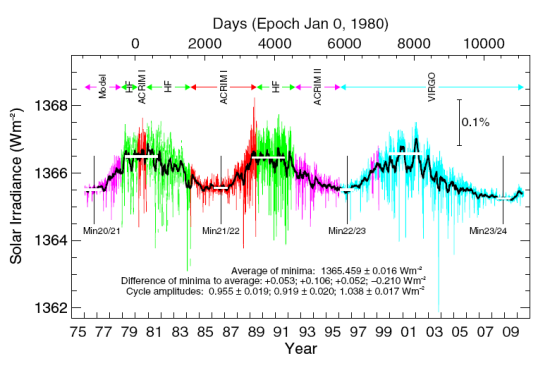
Wanna bet? Since that 2009 paper was published, Arctic ice has seen a rebound in ice extent. Moreover, the Arctic oscillation remains in the deepest freeze it has seen in years. And the sun remains quiet, less active than we have seen it since scientists began tracking its behavior from space. Such inactivity means a dimmer sun, which in turn brings with it cold temperatures. Here is the most recent graph (updated on July 20) from the Total Solar Irradiance Time Series produced by Physikalisch- Meteorologisches Observatorium Davos (PMOD) using satellite data since 1978:

PMOD graph, July 20, 2010

Even though the sun’s total irradiance has shown an up-tick recently as it slowly moves from solar minimum towards solar maximum, if you look closely you will see this up-tick still remains below the lowest points for the previous three solar minimums. And as I have noted here, we appear to be heading for the weakest solar maximum in two centuries.

Of course (as stock brokers say), the past performance of all of these trends is no guarantee of the future performance. Nonetheless, the data indicates clearly the simplistic nature of statements like Kerry’s.

1 comment

Sunset on the Moon

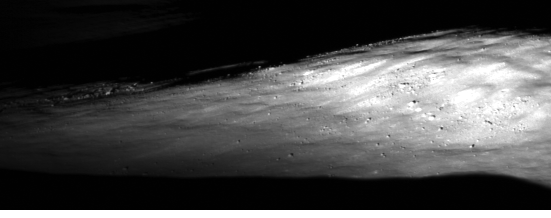
As the sun sets on Bhabha crater on the Moon’s farside, small boulders on the crater’s central peaks become visible in this Lunar Reconnaissance Orbiter image, with inset below. (It is very worthwhile to click on the link above and stroll through the full resolution image.) Scientists believe that the impact which created this crater excavated these boulders from deep within the Moon’s crust, thereby making them valuable tools for determining the geological history of the Moon. Of course, to use these tools requires the geologist to be there, something that might not happen for a while.

lunar sunset

inset

0 comments

Exploring Mars from Earth

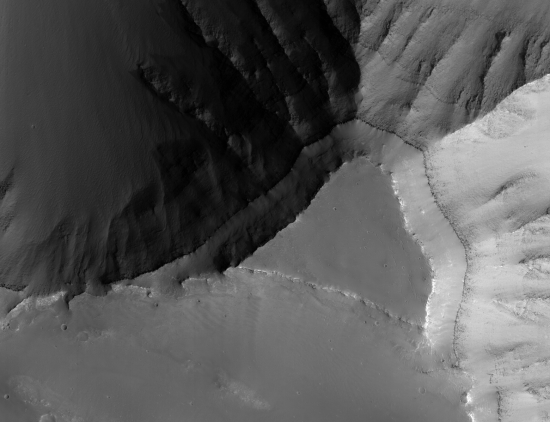
Want to poke around on Mars? Since it might be a while before you can actually go there, I suggest you instead make frequent visits to the images page for the HiRise camera on Mars Reconnaissance Orbiter. The pictures that appear here are routinely breath-taking. Below is a cropped image showing the flat top of a mesa in Coprates Chasma. The full image shows detailed layers down the side of the mesa as well as rippled dunes on the mesa top. Everything is remarkably reminescent of something you’d see if you visited the Grand Canyon. Only on Mars, this grand canyon is many times larger and deeper.

Mesa top on Mars

0 comments

An update on the Dept of Energy’s hold on monies to East Anglia

This story about the Department of Energy’s decision in May to suspend payments to the University of East Anglia because of the climategate scandal might very well be a Potemkin village. The story notes that they are placing a hold on $200k. However, Anthony Watts notes that DOE has probably provided East Anglia significantly more funds, in the millions. The suspension in funds then is only about one specific and not very large contract, with nothing said about the other funding. Note also that the hold was placed in May, pending the results of East Anglia’s own investigation. Since that investigation was a whitewash, I expect DOE to release these funds in near future.

0 comments
1 134 135 136 137 138 139