
2Cellos – Thunderstruck
An evening pause: Music by AC/DC.
Hat tip Don Carrera, who adds, “With a shout-out ranging from Vivaldi & his Primavera, up to Michael J. Fox & Johnny Be Good.”
An evening pause: Music by AC/DC.
Hat tip Don Carrera, who adds, “With a shout-out ranging from Vivaldi & his Primavera, up to Michael J. Fox & Johnny Be Good.”
Courtesy of BtB’s stringer Jay. This post is also an open thread. I welcome my readers to post any comments or additional links relating to any space issues, even if unrelated to the links below.

One of many sudden public collapses from jab-induced heart failure.
Click for full video.
On June 9, 2025 the head of the Health and Human Services at the federal government Robert Kennedy fired all seventeen members of the Centers for Disease Control and Prevention’s (CDC) Advisory Committee for Immunization Practices (ACIP).
According to Kennedy, each member was appointed by the Biden administration as part of a “concerted effort to lock in public health ideology” and to limit the Trump administration from taking “the proper actions to restore public trust in vaccines.” ACIP members usually serve four-year terms. Because 13 appointees took their seats in 2024, without the complete ouster, the committee would not have had a Kennedy-selected majority until 2028.
“A clean sweep is necessary to reestablish public confidence in vaccine science,” Kennedy said in the HHS release. He will be responsible for appointing the new committee members, which are scheduled to meet from June 25 to June 27 to discuss a slate of vaccines, including those for anthrax, chikungunya, COVID-19, cytomegalovirus, influenza and HPV.
All the usual suspects on the left, including members of Congress and in the propaganda press, immediately went into a hissy-fit, claiming Kennedy’s action was “politicizing the ACIP,” even though it is blatantly obvious that Biden had made his 2024 appointments, just before the election, for his own political reasons.
Politics aside, however, the real reason to dump these Biden-era appointees is that they were also part of the “intellectual” cabal that foisted jab mandates, mask mandates, six-foot social distancing, and lockdowns on everyone. None of these policies were based on any proven science research, and in fact they violated decades of infectious disease policy that recommended doing the exact opposite, across the board.
Worse, there is now clear evidence [pdf] that these same people demanded the imposition of jab mandates, even though they were well aware at the time that the jab caused serious side effects that killed. As noted in this June 11, 2025 report:
» Read more

The Starlab design in 2025. Click
for original image.
The space station startup Voyager Technologies has now raised $383 million during its first public stock offering this week, with the possibility of more investment capital to come.
The six-year-old provider of mission-critical space and defense technology solutions sold 12.35 million shares at $31 each, pricing above the $26–$29 range it marketed last week. The Denver-based company had initially planned to offer 11 million shares.
Underwriters also have a 30-day option to purchase up to 1.85 million additional shares of the company’s Class A common stock, up from 1.65 million, trading under the ticker symbol VOYG.
Of the four private commercial space stations under development, Voyager is the only one to have so far built nothing. Its station, dubbed Starlab, is conceived as a single large module launched on SpaceX’s Starship/Superheavy rocket. Though the company has obtained a $217.5 million development grant from NASA, and is partnering with Airbus, Northrop Grumman, and the European Space Agency, it has focused so far all of its work on design.
We must assume the company intends to use this additional public capital to begin some construction. It likely needs to if it is to have any chance of winning NASA’s major contract for building the station itself, since all of its other competitors are doing so. My present rankings for these four projects:

Click for original image.
Because its orbit has now dropped 17 degrees below the ecliptic plane of the solar system, the European Space Agency’s (ESA) Solar Orbiter probe has been able to snap the first images of the Sun’s south pole, as shown by the two pictures to the right.
The [two images show] the Sun’s south pole as recorded on 16–17 March 2025, when Solar Orbiter was viewing the Sun from an angle of 15° below the solar equator. This was the mission’s first high-angle observation campaign, a few days before reaching its current maximum viewing angle of 17°.
The instruments each observe the Sun in a different way. PHI images the Sun in visible light (left) and maps the Sun’s surface magnetic field (right).
The magnetic field data on the right has revealed that at present the field at the pole is “a mess,” because the Sun is presently at solar maximum.
While a normal magnet has a clear north and south pole, the PHI instrument’s magnetic field measurements show that both north and south polarity magnetic fields are present at the Sun’s south pole. This happens only for a short time during each solar cycle, at solar maximum, when the Sun’s magnetic field flips and is at its most active. After the field flip, a single polarity should slowly build up and take over at the Sun’s poles. In 5–6 years from now, the Sun will reach its next solar minimum, during which its magnetic field is at its most orderly and the Sun displays its lowest levels of activity.
Solar Orbiter is now well positioned to observe the expected changes in the Sun’s magnetic field as sunspot activity ramps down to solar minimum.
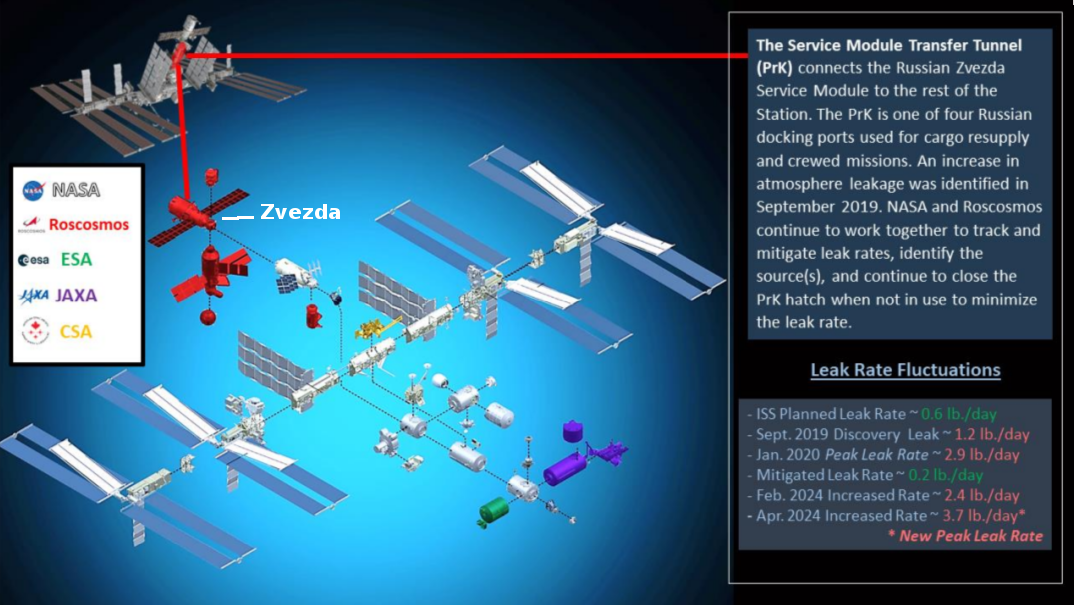
Figure 3 from September Inspector General report, showing Zvezda’s location on ISS.
According to a press update today by NASA, the launch of the commercial Ax-4 manned mission to ISS has been further delayed due to work by the Russians attempting to seal new leaks in the station’s Zvezda module.
NASA and Axiom Space are postponing the launch of Axiom Mission 4 to the International Space Station. As part of an ongoing investigation, NASA is working with Roscosmos to understand a new pressure signature, after the recent post-repair effort in the aft most segment of the International Space Station’s Zvezda service module.
Cosmonauts aboard the space station recently performed inspections of the pressurized module’s interior surfaces, sealed some additional areas of interest, and measured the current leak rate. Following this effort, the segment now is holding pressure.
In other words, the Russians had recently detected an increase in leakage in the module, identified several more cracks inside Zvezda, and have been working to seal them.
The graphic above comes from a 2024 NASA inspector general report, which at that time noted a significant increase in the leak rate in 2024 (see the data in the lower right). Since then it has been NASA policy to close the hatch that connects the American and Russian sections of the station whenever anything docks with Zvezda, due to risk that the docking could cause the module to fail entirely.
Zvezda is one of the oldest modules on ISS, built in the late 1980s and launched in 2000. It is believed the leaks are due to stress fractures in its hull due to the many dockings and undockings that have occurred at its aft docking port.
If the NASA press release can be believed, the situation is under control and the repairs have been successful. If so, expect the Axiom mission to be rescheduled shortly.
If not, we could be witnessing the beginning of the end of ISS, five years earlier than planned by bureaucrats in Washington and Moscow.
Embedded below the fold in two parts.
To listen to all of John Batchelor’s podcasts, go here.
» Read more
An evening pause: Performed live 2003.
Hat tip Judd Clark.
Courtesy of BtB’s stringer Jay. This post is also an open thread. I welcome my readers to post any comments or additional links relating to any space issues, even if unrelated to the links below.
Useless: In its first review of Trump’s proposed budget cuts for the Space Force, the House Appropriations Committee, under Republican leadership, immediately moved to not only eliminate those cuts, but to increase the Space Force budget another $300 million.
And these turkeys are adding this money even though they admit, due to Congress’s incompetent budget process, they really have no way to determine exactly how the money will be spent.
The House Appropriations committee took the first step in crafting a FY2026 bill to fund the Department of Defense today, albeit reluctantly. Appropriators from both parties lamented the paucity of data they have about what the money will be used for, but decided to move ahead and mark up their bill at subcommittee level this afternoon. Full committee markup is scheduled for Thursday. President Trump’s request would cut about $2.5 billion from the U.S. Space Force’s budget, but the committee would restore it and add a little more.
According to the new budget put forth by this committee, the Space Force will have a budget of $29 billion, more than even the highest budget figure proposed for NASA.
This is what we can expect now from the Republican leadership in Congress. They will cut nothing, but instead restore all the spending that Trump attempts to eliminate, even money that is expressly designed to help leftist causes. They are worse than useless.
What these idiots don’t realize that if the country goes bankrupt, it will become impossible to accomplish anything. A smart person would realize it is better to only get part of what you want now (so you can maybe get the rest later) than to try to get it all immediately and instead end up with nothing at all.
But then, these are Congressmen. The word “smart” is the last word I would use to describe them.
It now appears that one Chinese robotic servicing satellite, Shijian-25, is now approaching another Chinese servicing satellite, Shijian-21, and it is expected that the two will eventually dock in order to test refueling technology.
Shijian-25 was launched in January to test on-orbit refueling and mission extension technologies, while Shijian-21 was launched in October 2021.
Shijian-21 has already executed its primary mission, docking with the defunct Beidou-2 G2 navigation satellite and towing it into a graveyard orbit above GEO. It had been passively drifting westward in GEO for much of the last year, according to COMSPOC, suggesting it may have run out of fuel, but it recently initiated maneuvers taking it towards Shijian-25.
Shijian-21 has since parked at 127.5 degrees East. Now, Shijian-25 is drifting eastwards towards Shijian-21. The two satellites are in a phased orbit, meaning their key orbital elements—such as semi-major axis, eccentricity, inclination, right ascension of the ascending node and argument of perigee—are nearly identical, but remain separated by a distance along the same path. This minimizes fuel required for a future rendezvous. The pair are expected to meet June 11 at current rate of approach, though Shijian-25 will likely slow down as it closes in.
In other words, China used the older satellite to test docking and tug operations, and now plans to use the new satellite to refuel it for further operations.
Nor are these the only satellites that are maneuvering into the area. Two American military surveillance satellites have moved in, are flying in parallel, and are likely there to observe the Chinese operations.
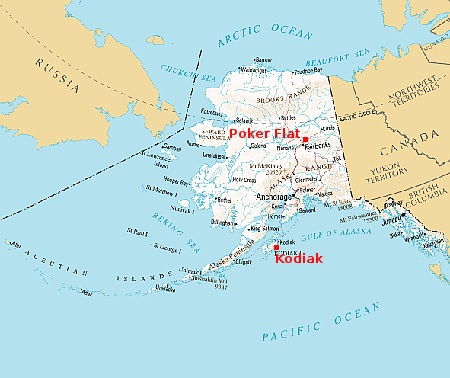
The Alaska Aerospace Corporation, which runs the Kodiak spaceport in Alaska, has now signed a five year partnership agreement with University of Alaska’s Geophysical Institute in Fairbanks, which runs the Poker Flat suborbital spaceport, to upgrade the latter for commercial orbital launches.
Though the terms of that agreement are highly technical, Gov. Mike Dunleavy’s draft budget for the corporation indicates that the university plans to seek a FAA spaceport license for the university’s Poker Flat Research Range, which has been flying sounding rockets — smaller rockets used for research — into the upper atmosphere since March 1969, including some earlier this spring.
An FAA license could allow Poker Flat to launch larger rockets, and for commercial purposes, not just scientific ones. Making Poker Flat a “licensed vertical orbital spaceport” could take up to two years, the budget documents state.
The map to the right shows the location of each spaceport. You can read the text of the agreement here [pdf].
Kodiak has been used recently by several orbital rocket startups, most often by Astra. Poker Flat in turn has only done suborbital launches (mostly for universities), and its interior location suggests it would have a very limited capability to do orbital launches. The lower stages of any orbital rocket would crash either in Alaska or Canada, something that neither the U.S. or Canada has previously allowed.
The deal however allows both spaceports to coordinate their effort, which might bring more business to both, for different purposes.
The European Commission has now approved the purchase of the long established satellite communications company Intelsat by the long established Luxembourg satellite communications company SES for about $4 billion.
This decision follows an approval by the government of the United Kingdom. It now appears the only remaining regulatory hurdle is approvals by the FCC and the Department of Justice in the U.S.
This buy-out follows similar mergers by other old established satellite companies, such as the merger of Viasat with Imarsat and OneWeb with Eutelsat. All are occurring because these older companies, which mostly launched large geosynchronous satellites, have been under heavy competitive pressure from the low orbit constellations like Starlink and OneWeb.
Whether these older companies can compete following these mergers however remains uncertain. To succeed they need to have a product customers want, and at the moment it isn’t clear they have one.
Rocket Lab this morning successfully launched a commercial imaging satellite for the Japanese company iQPS (the fourth launch for this company), its Electron rocket lifting off from one of its two launchpads in New Zealand.
The leaders in the 2025 launch race:
72 SpaceX
33 China
8 Rocket Lab
6 Russia
SpaceX still leads the rest of the world in successful launches, 72 to 54.
Axiom and SpaceX have scrubbed the launch tomorrow of Axiom’s fourth commercial manned mission to ISS due to an oxygen leak detected during the standard prelaunch static fire test.
NASA, Axiom Space, and SpaceX are standing down from the launch opportunity on Wednesday, June 11, of Axiom Mission 4 to the International Space Station to allow additional time for SpaceX teams to repair a liquid oxygen leak identified during post-static fire Falcon 9 rocket inspections. A new launch date for the fourth private astronaut mission will be provided once repair work is complete, pending range availability.
There a number of launches already scheduled for Florida in the next few days, so it could be that the launch of Ax-4 could be delayed by more than a few days.
An evening pause: Performed live 1967. One of their most beautiful songs, but rarely heard anymore.
Hat tip Wayne DeVette.
Courtesy of BtB’s stringer Jay. This post is also an open thread. I welcome my readers to post any comments or additional links relating to any space issues, even if unrelated to the links below.
I post this early because I have a hour-long taping with Robert Pratt of Pratt on Texas this afternoon, and want to get it up beforehand.
Mexican officials of the border state adjacent to Texas are now demanding an investigation into Starship/Superheavy debris that has been found recent on its coast, claiming SpaceX is “polluting Mexican beaches.”
Karina Lizeth Saldivar, the head of the Tamaulipas Secretariat for Urban Development and Environment, recently announced that they would be requesting that federal authorities in Mexico investigate the damages and potential damages that rocket fragments could cause.
According to Saldivar, the rocket pieces could pose a potential danger to locals and claimed that her agency would request a formal investigation by Mexican federal environmental agencies. It remains unclear if Mexico’s government could do anything about the issue.
Saldivar is a typical government apparachik. Rather than try to develop the beach area in Mexico that is close to Boca Chica and thus provides a great tourist spot for viewing launches, she instead can only whine and demand the government shut things down.
Meanwhile, the article notes that ordinary Mexicans aren’t complaining. Instead, they have been collecting the rocket pieces enthusiastically, with some making money by selling them as collector’s iten on social media.
In an executive order released on June 6, 2025, President Trump eliminated the half-century-old regulations that forbid supersonic airplanes to fly over the land mass of the United States.
The Administrator of the Federal Aviation Administration (FAA) shall take the necessary steps, including through rulemaking, to repeal the prohibition on overland supersonic flight in 14 CFR 91.817 within 180 days of the date of this order and establish an interim noise-based certification standard, making any modifications to 14 CFR 91.818 as necessary, as consistent with applicable law. The Administrator of the FAA shall also take immediate steps to repeal 14 CFR 91.819 and 91.821, which will remove additional regulatory barriers that hinder the advancement of supersonic aviation technology in the United States.
This order makes sense for several reasons. First, the restrictions were always absurd. The sonic boom concern was always over-rated. Second, the concern increasingly doesn’t exist due to improvements in technology. In a flight test in January, the commercial supersonic airplane startup Boom Aerospace confirmed that its test plane broke the sound barrier three times and each time with “no audible sonic boom.”
Though Boom isn’t the only supersonic startup, it is far ahead of the others. It already has orders from United and Japan airlines for its Overture 80-passenger supersonic jet. This new Trump order will certainly help it attract investment capital, as well as more airlines willing to buy its planes.
According to a statement from David Limp, the CEO of Blue Origin, on June 9, 2025, the company has once again delayed the second launch of its new New Glenn rocket, pushing back from May to August.
New Glenn’s second mission will take place NET August 15th. Following in the footsteps of our first booster, we’ve chosen the name “Never Tell Me The Odds” for Tail 2. One of our key mission objectives will be to land and recover the booster.
The rocket’s first launch had occurred in January, and successfully placed its test payload in orbit as intended, though it was unable to land the first stage on its barge in the Atlantic. Blue Origin later said it was targeting May for the second launch, carrying NASA’s two Escapade smallsat Mars orbiters. With this new delay it is unclear what the payload would be.
According to this report, anonymous sources claim an August launch is unlikely and will likely slip to September. The company has a large backlog of launch contracts, including 27 for Amazon’s Kuiper constellation as well as a number for the military. The hope had been that it could ramp up its launch cadence in 2025 to meet those contracts.
Instead, Amazon has begun shifting some of its launch work to SpaceX’s Falcon 9. Its FCC license requires it to get 1,600 satellites in orbit by July 2026, and at present it only has sixteen in space. It can no longer wait for Blue Origin to dilly-dally along.
Considering the actual success of the first launch, it seems very puzzling for there to be a nine-month delay until the second launch, even with the failure to land the first stage. Was there some technical problems with the rocket that have not been revealed? It seems foolish to delay further launches in order to fix the landing of the first stage, since that has no impact on getting the customer’s payload into orbit. Wouldn’t it be better to fly again, test the landing again during flight, than sit on the ground looking at computer simulations?
It is also possible the company is still having production problems producing enough BE-4 engines for both ULA’s Vulcan rocket and its own New Glenn. Vulcan uses two per launch, and according to ULA Blue Origin has delivered enough to begin launching Vulcan as many as fifteen times before the end of this year. New Glenn uses seven BE-4s on its first stage. Could it be that Blue Origin wasn’t able to produce enough of these engines for this year’s New Glenn launches?
All this is speculation. What we do know for certain is that both of these companies continue to disappoint. The result is that for larger payloads the United States remains reliant entirely on SpaceX, a situation that is not healthy for the commercial and government satellite industry.